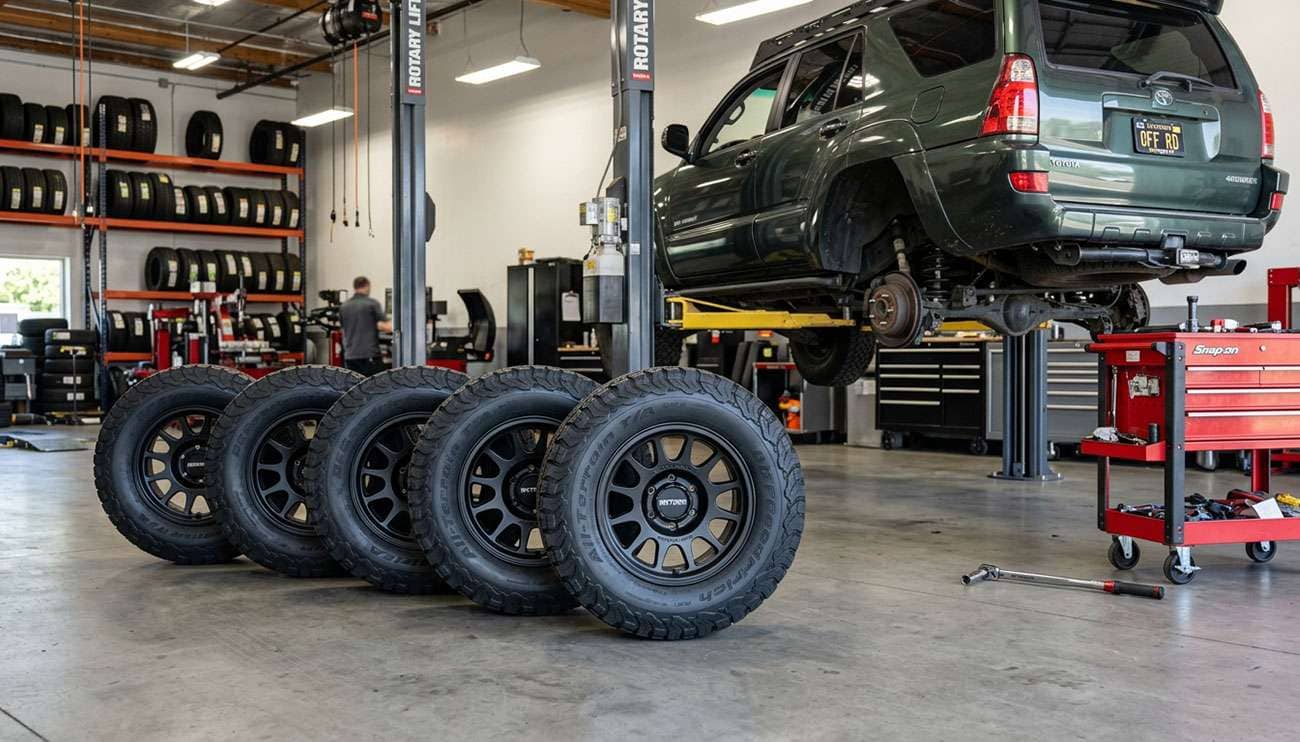
Put the spare on the right rear, and the tire that would have gone to the right rear becomes the new spare. On a rear-wheel drive or 4x4, that move rides inside a rearward cross. On front-wheel drive, it rides inside a forward cross. That's the easy part. The part most guides skip is whether your spare belongs in the rotation at all. It has to match the other four in tire, size and wheel. It has to be close to them in tread depth, especially on AWD. And it can't be years older than the rest, because a spare ages in the carrier whether it turns or not.
I've been mounting tires since 1971, and some of the scariest tires I've pulled off trucks were the ones that never touched the road: full tread, cracked sidewalls, ten years old. A five-tire rotation done right prevents exactly that. Done wrong, it can put an old or mismatched tire on a corner where it doesn't belong. Here's how to tell which spare you've got.
Should Your Spare Join the Rotation?
Your Spare |
Rotate It In? |
Why |
|---|---|---|
Same tire, size and wheel, in the rotation since new |
Yes, every rotation |
All five wear and age together |
Matching, never rotated, road tires still close in tread |
Yes, starting now |
Check its DOT date and pressure first |
Matching, never rotated, road tires well worn, on AWD or full-time 4WD |
No, hold it for emergencies |
Many AWD systems allow only 2/32 to 4/32 inch of tread difference |
Matching but six or more years old |
No, replace it |
Many automakers call for replacement at six years regardless of tread |
Full-size, but a different tire or a steel wheel |
No |
Different tread, construction or rolling diameter |
Compact or marked for temporary use |
Never |
Built for short distances at reduced speed |
Directional tires or different sizes front and rear |
Usually no |
The spare can only stand in for a tire of the same size turning the same way |
If your spare passed, here's where each tire goes. Both patterns put the spare on the right rear, which is what Tire Rack and Bridgestone both recommend when your owner's manual doesn't give its own procedure.
5-Tire Rotation Patterns by Drivetrain
Tire |
Rearward Cross (RWD, 4WD, AWD) |
Forward Cross (FWD) |
|---|---|---|
Left front goes to |
Spare |
Left rear |
Right front goes to |
Left rear |
Spare |
Left rear goes to |
Left front |
Right front |
Right rear goes to |
Right front |
Left front |
Spare goes to |
Right rear |
Right rear |
A matching spare is a fifth copy of what's on the ground: the same tire brand and model, the same size, the same load rating, on the same wheel. That's the only kind that belongs in a rotation. Tire Rack puts it plainly: the spare goes in only when it matches the other four's wheel and tire, it isn't directional, and it isn't marked for temporary use.
A lot of trucks carry what the window sticker calls a "full-size spare" that isn't a match. It's the right size, but it sits on a steel wheel, and the tire is often a different model from the ones on the road. That spare will get you home. It shouldn't join the rotation, because a different tread and construction behaves differently on the same axle as the others.
Matching spares show up most on off-road rigs. Jeep Wranglers and Ford Broncos carry a full-size spare on the tailgate, and Ford sells Bronco wheel packages in sets of five. Toyota's 2025 4Runner TRD Pro carries a full-size spare with its own pressure sensor. Plenty of other trucks only match the four on the ground at certain trims, so check yours: same wheel design, same tire model on the sidewall, same size and load index.
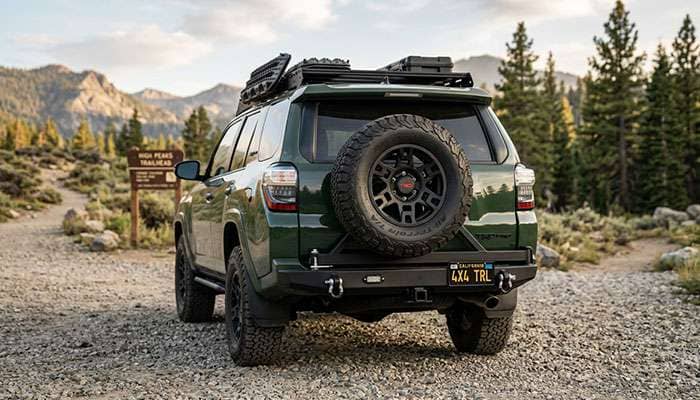
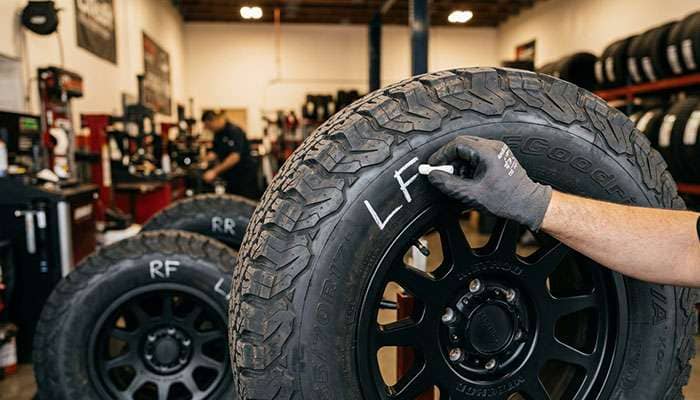
The five-tire patterns are the same cross patterns you'd use with four tires. The spare just takes one tire's place for a cycle.
Follow the pattern and every tire works its way through all five positions over five rotations, including a turn resting in the carrier. That's the whole point: five tires carrying four corners' worth of wear, evenly.
A directional tire is built to roll one way, so it has to stay on the same side of the truck: front to rear on the left, front to rear on the right, no crossing. That breaks the five-tire pattern, because a directional spare mounted for one side can only stand in for a tire on that side. Tire Rack's rule is simple: a directional spare stays out of the rotation. Keep it in the carrier for emergencies, and rotate the four on the ground front to rear.
Your owner's manual wins over any general chart. Some manuals show a different five-tire sequence, and some show only a four-tire pattern even on trucks that ship with a matching spare. For the four-tire patterns and the right way to lift, swap and torque, see our step-by-step tire rotation guide.
Yes, and it matters more there than anywhere else, but only if the spare has been in the rotation from the start. An AWD system reads any difference in rolling diameter as wheel slip. A tire with more tread is a bigger tire, so it turns fewer times per mile than its worn partners. The center differential or clutch pack works to make up the difference mile after mile, and that steady slip builds heat and wear.
That's why AWD makers set tight tread-depth limits. Subaru and Honda's SH-AWD allow about 2/32 inch of difference. Audi, BMW and Mercedes systems run 2/32 to 4/32 inch depending on the model. A never-used spare at 12/32 inch going onto a truck whose road tires sit at 6/32 inch is far outside any of those numbers. Our guide to AWD tire requirements lists the limits by system.
Tire Rack makes the same point from the other side: rotating the spare in from day one keeps all five at about the same tread depth, so you never end up mounting a brand-new spare next to partly worn tires on a 4WD or AWD drivetrain. A part-time 4WD truck running in 2WD is more forgiving, but the mismatch matters again every time you shift the transfer case into 4WD.
If your AWD vehicle came with a compact spare, it's an emergency-only part with its own rules. Our guide to driving an AWD car on a donut spare covers how far and how fast.
Check its age first. Rubber ages whether the tire rolls or sits in a carrier. NHTSA's tire aging research found that full-size spares stored on the vehicle showed similar degradation over time. Its report flagged spares as a particular concern, because they aren't replaced regularly, still look like they have plenty of tread, and often get rotated into use.
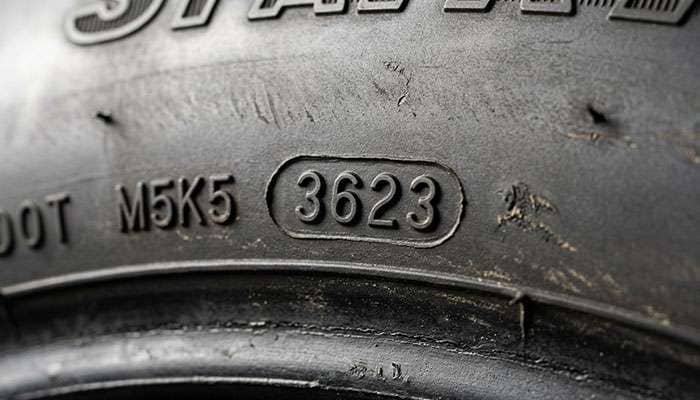
The replacement guidance splits two ways. Many automakers, including Ford, Nissan and Mercedes-Benz, tell owners to replace tires six years after they were made, regardless of tread. Tire makers such as Continental and Michelin say no later than 10 years. Your spare falls under the same rule as the tires on the ground. Read its DOT date code on the sidewall. The last four digits are the week and year it was built, and our guide to reading DOT tire date codes shows where to find them.
Inflation is the other trap. In an NHTSA field study, about 30 percent of spare tires were significantly underinflated when first checked. A tailgate spare also sits in the sun all day, which ages the rubber faster. Before an old spare goes on the ground, check its pressure and look over its sidewalls for cracking, bulges or cuts. Our guide to whether tire sidewall damage is safe to drive on shows what disqualifies a tire.
If the spare is going on the ground, yes. Once it's on a corner, the truck expects a sensor in that wheel, and a wheel without one will light up the dash. How the truck handles the fifth sensor varies by make:
Some trucks relearn positions on their own in a few miles. Others need a scan tool or a menu procedure. Check your manual before your first five-tire rotation, and if you're adding a fifth wheel, put a sensor in it that's compatible with your system.
On the same schedule as a four-tire rotation. Tire Rack advises every 3,000 to 5,000 miles, sooner for aggressive all-terrain and mud-terrain treads, and your owner's manual takes priority. Our guide to how often to rotate tires breaks the interval down by drivetrain.
Here's the wear math that makes it worth the effort. With five tires sharing four corners, each tire is on the road four miles out of every five. If a set of tires would last 50,000 miles of driving on four tires, five tires in rotation carry the truck about 62,500 miles before they're all worn out. You bought 25 percent more tire, and you get 25 percent more miles, so the cost per mile comes out even. What you gain is a spare that's always the same age and tread depth as the other four, and a matched fifth tire on hand the day one gets ruined.
Because a wheel and tire have to fit the hub, the brakes and the drivetrain, and those vary truck to truck. A spare has to match:
Even a spare from the same brand can miss on one of those across model years, and every one matters more once that spare is in the rotation full time.
If your truck came with a non-matching spare, the cleanest time to fix it is your next set of tires. Buy five, not four. Here's how I'd set it up:
When you're ready, shop tires by size and order five.
Skip the spare, or rotate the wrong one in, and the cost builds over time.
The cheapest rung on that ladder is the first one: buy five matching tires and put all five to work.
Rotating with a full-size spare is simple once the spare qualifies: it goes to the right rear, and the tire that would have gone there takes its place in the carrier. Use a rearward cross on RWD, 4WD and AWD, and a forward cross on FWD. What decides whether you should do it is the spare itself. It has to match the other four, sit close to them in tread depth and be no older than the rest. Start the five-tire pattern with a new set and all five wear and age together. Rotate an old or mismatched spare in late and you risk the drivetrain and the tire.
Only if it's a true match: the same tire, size and wheel as the other four, non-directional and not marked for temporary use. If it qualifies, rotating it from the start keeps all five at the same tread depth and age.
The right rear, unless your owner's manual says otherwise. The tire that would have gone to the right rear goes into the spare carrier until the next rotation.
Usually, on a truck or SUV with a matching spare. Five tires last about 25 percent more miles than four at the same cost per mile, and your spare stays the same age and tread depth as the others, which matters most on AWD and 4WD.
Not if the tire or wheel differs from the other four. Keep it for emergencies. To join the rotation, the spare needs the same tire model and size on a matching wheel.
If it has never been on the road or you don't know its history, have it checked on a balancer first. Once all five are in a regular rotation, they can be checked together at each service.
It follows the same age limits as the tires on the ground, even if it's never been used. Many automakers say replace at six years from the build date, and tire makers say no more than 10. Check the DOT date code on its sidewall.