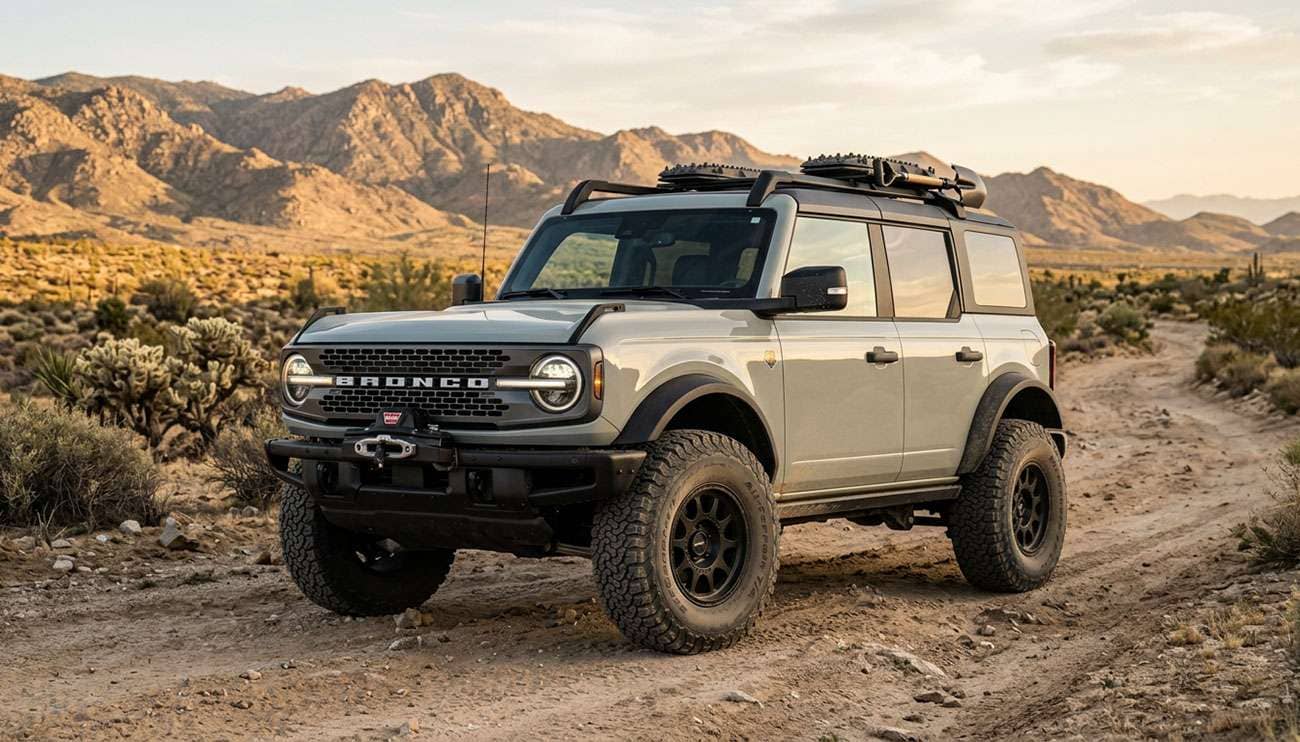
Every week somebody rolls a Bronco into our shop on Cherry Avenue, points at the wheel well, and asks me the same thing: will 37s go under there without a lift? I've been mounting big tires on Fords in Long Beach since 1971, and I can tell you the honest answer takes about ten seconds once I know one thing about the truck. Most guides skip that one thing.
The short answer: Yes, if your Bronco has the Sasquatch package. No, if it doesn't. A Sasquatch Bronco will run a 37x12.50R17 at factory ride height for street and light trail driving once you push the tire out with a 0 mm wheel or a spacer and trim the front body-mount area. A Bronco without Sasquatch runs out of flare, offset, and crash-bar clearance before the tire ever touches anything a lift would fix. Most answers stop at "it depends." It depends on the package, the wheel offset, and which 37 you buy. None of those three is the lift.
Your Bronco |
Factory wheel and tire |
37s at stock height? |
What it takes |
|---|---|---|---|
Any Bronco with the Sasquatch package (standard on Wildtrak, Everglades, Heritage, and Stroppe; optional on Base, Big Bend, Outer Banks, and Badlands) |
17x8.5 at +30 mm, LT315/70R17 (about 34.4 in.) |
Yes, for street and light trail |
0 to -12 mm wheels or 1.25 to 1.5 in. spacers, body-mount trim, liner block out, rock rails trimmed if equipped |
Badlands without Sasquatch |
17x8 at +55 mm, LT285/70R17 (about 32.7 in.) |
No |
Crash bars out, high-clearance flares, new wheels, 2 to 3 in. of lift, trimming, regear |
Base, Big Bend, Black Diamond, Outer Banks without Sasquatch |
16 to 18 in. wheels at +55 mm, 30 to 32 in. tires |
No |
Everything above, plus the most gear and steering work of any Bronco |
Bronco Raptor |
17-in. wheels, 37x12.50R17 from the factory |
Already on 37s |
Nothing; it was built wider and taller for them |
Not sure which one you have? Open the driver's door. If the placard lists LT315/70R17, you have the Sasquatch hardware. If it lists anything smaller, you don't, no matter what badge is on the fender.
Yes, and the reason is that a Sasquatch Bronco already has most of what a "37 kit" would give you. Ford built the package around 35s, and in doing that it handed you four things that matter for 37s.
Add the 4.70 final drive that comes with the package, and you have a truck that is about one tire size away from where a lot of lifted Broncos end up.
A 37 is about 1.3 inches taller in radius than the 34.4-inch factory tire. That extra radius shows up everywhere the tire moves, but it bites hardest in one place: the back of the front wheel opening at full steering lock. Turn the wheel all the way and the rear inside shoulder of the tire swings toward the front body mount and the bracket area where non-Sasquatch trucks bolt their crash bars. On trucks with factory rock rails, the front end of the rail is next in line.
Owners who run 37x12.50R17s on Sasquatch wheels at stock height report the same pattern over and over. Around town, nothing rubs. Driving straight down a dirt road, nothing rubs. At full lock in a parking lot, the tire kisses the body-mount area. Under full compression with the sway bar disconnected, the rear usually clears and the front needs a little trimming. The fixes are small: trim the front body-mount area, pull the plastic block behind the front fender liner, and take about an inch off the front of the rock rails.
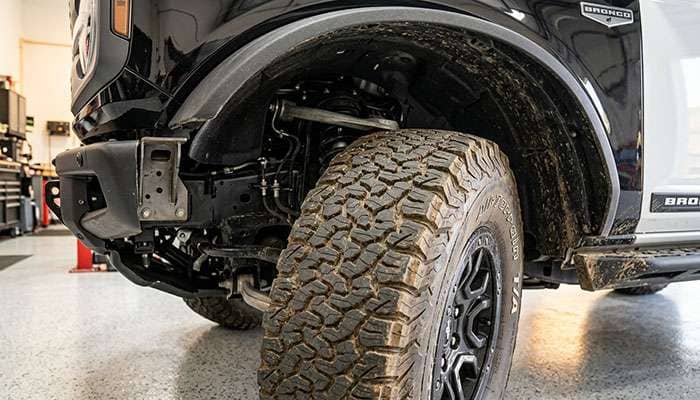
This is where the two answers you'll hear online both turn out to be true. If your Bronco lives on pavement, fire roads, and the occasional beach run, a Sasquatch truck on 37s with the right offset and a few cuts will run all day with no lift. If you wheel hard, with the sway bar off and one corner stuffed into the fender, you will find contact a lift can't fix by itself. That's where bump stops, upper control arms, and a clearance kit come in. Those are trail upgrades. They're not the price of admission for 37s.
Not without a lift, and the lift is the smallest part of the bill. A non-Sasquatch Bronco is missing every piece on that Sasquatch list, so you have to buy them back before 37s make sense.
Start with the crash bars. On a stock non-Sasquatch truck, even a 35 hits them. Pull them and you've got room for a 35, which is why that's the first move in our guide to putting 35s on a Bronco without Sasquatch. A 37 needs that and more.
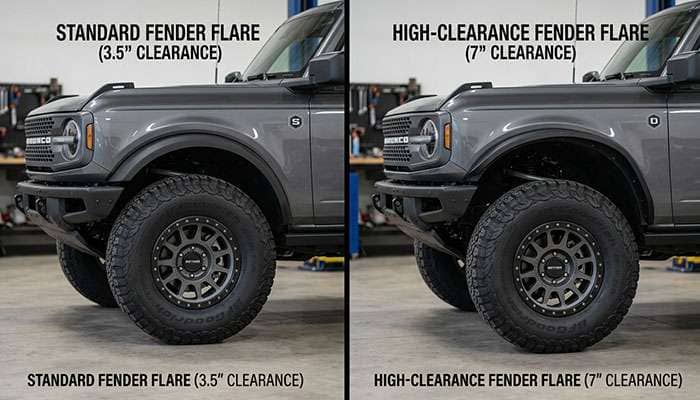
Next is the flare. The standard flare is lower and narrower than the Sasquatch flare, and a 37 on a properly offset wheel sticks out past it. Then comes the wheel. Your factory wheel is +55 mm, which parks a 37's inside sidewall about an inch closer to the upper control arm than the Sasquatch tire sits. Finally, you're starting from a ride height that's a little over an inch below a Sasquatch truck if you have a Base, Big Bend, or Outer Banks.
One widely shared test put 37s on a non-Sasquatch Badlands with the crash bars pulled. The tires cleared at full lock with the truck sitting still, but the front was so tight that almost any suspension travel would bring contact. That's not a setup you drive to work.
Here's the realistic non-Sasquatch recipe for 37s:
By the time you've bought all that, you've built a Sasquatch and then some. If you're shopping for a new Bronco and you know 37s are in its future, check the Sasquatch box. For 2026, Ford offers it on the Base, Big Bend, Outer Banks, and Badlands, and it's standard on the Heritage and Stroppe editions.
Because a lift changes where your tire sits when the truck is parked. It doesn't change where the tire ends up when the suspension is fully compressed, and it doesn't change how far the tire swings toward the frame at full lock.
Think about what most Bronco lifts are. A spacer lift or a leveling kit sets the body higher on the same springs and shocks, with the same bump stops. At ride height, the tire sits lower in the wheel well, so you get more room for daily driving. But when you hit a whoop and the suspension stuffs up to the bump stop, the tire travels right back to the same spot it would have reached without the lift. If it touched the flare there before, it touches the flare there now.
Full lock works the same way. The body mount and the rock rail are bolted to the frame. A lift raises the body and frame together relative to the tire at ride height, which helps a little in a parking lot, but the tire still arcs toward the same hardware. The parts that move the tire away from it are wheel offset and trimming.
So here's what each piece actually controls:
A Sasquatch truck already has the ride height, the flares, and a head start on offset. That's why it can skip the lift. We walked through the same mechanism on a Jeep in our breakdown of whether 37s fit a JL with a 2.5-inch lift, and the lesson carries straight over: the lift number on the box doesn't tell you what clears.
"37" covers a lot of different tires. Two numbers on the sidewall decide how a 37 behaves on a Bronco without a lift: the width and the load range. Load range matters because it changes construction, and construction changes both weight and how tall the tire actually stands once it's mounted and aired up.
Some of the lighter all-terrain 37s measure closer to 36 to 36.5 inches mounted. On a stock-height Sasquatch, that half inch to an inch is the difference between a light kiss at full lock and a clean turn.
37 option |
Section width |
Load index |
Fit at stock Sasquatch height |
|---|---|---|---|
37x12.50R17, load range C |
12.5 in. |
116 |
Best bet: lightest, and often measures under a true 37 |
37x12.50R17, load range D |
12.5 in. |
121 to 124 |
Fits with the standard trimming; the most common 37 |
37x12.50R17, load range E or F |
12.5 in. |
128 to 129 |
Fits, but more capacity than a Bronco uses and a stiffer ride |
37x11.50R17 |
11.5 in. |
121 to 128 |
More inside room, but very few tread designs |
37x13.50R17 |
13.5 in. |
121 to 131 |
Not at stock height; plan on lift and flare work |
Across the market, most 37x12.50R17s are load range D at a 124 load index. Load range E is the next most common. The C-range versions are the rare ones, built in only a handful of tread designs, so if you want the lightest 37 for a no-lift Bronco, shop that load range first and expect fewer choices.
Stay away from 37x13.50R17 on a stock-height truck. That extra inch of width goes half inside, toward the control arm, and half outside, past the flare. On a Bronco with no lift, both halves are already spoken for.
Plan on 0 to -12 mm on a 17x9, or the factory Sasquatch wheel with a 1.25 to 1.5 inch hub-centric spacer. Either one moves the tire about 1.2 to 1.7 inches farther out than the Sasquatch tire sits, which pulls the inside shoulder away from the body mount at full lock and away from the control arm over bumps.
Here's where a 37x12.50R17 lands on different wheels, measured against the factory Sasquatch tire on its +30 mm wheel.
Wheel setup |
Inside room vs. Sasquatch |
Outside poke vs. Sasquatch |
What it means |
|---|---|---|---|
Factory +55 mm wheel (non-Sasquatch) |
About 1.0 in. less |
About 0.9 in. farther in |
Tire crowds the upper control arm; not a 37 wheel |
Sasquatch +30 mm wheel, no spacer |
Same, within 0.05 in. |
Same, within 0.05 in. |
Clears straight ahead; rubs the body-mount area at full lock |
Sasquatch wheel with 1.25 in. spacer |
About 1.2 in. more |
About 1.3 in. farther out |
The budget route; keeps your factory wheels |
17x9 at 0 mm |
About 1.1 in. more |
About 1.2 in. farther out |
The cleanest no-lift setup; stays close to the flare |
17x9 at -12 mm |
About 1.6 in. more |
About 1.7 in. farther out |
Most inside room; tire sits past the Sasquatch flare |
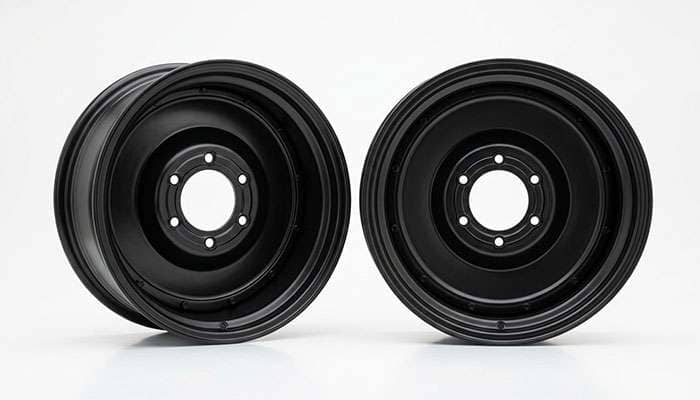
You'll find plenty of wheels in that range. Most 17x9 wheels in the 6x139.7 bolt pattern are built at zero or negative offset, with -12 mm the most common, and most 17x8.5s cluster right at 0 mm. The Bronco shares that bolt pattern with the Tacoma, the 4Runner, and the half-ton GM trucks, so it draws from a deep pool of off-road wheels built for exactly this kind of fitment.
If you go the spacer route, use hub-centric spacers built for the Bronco's hub and torque them to spec, then torque the wheel to spec and recheck both after the first 50 miles. Our guide on whether wheel spacers stop tire rubbing covers how to tell when a spacer is the fix and when it's just moving the problem.
One more thing about offset: pushing the tire out also lengthens the lever the tire has on your steering. That's fine on a daily driver. It matters if you wheel hard, and we'll get to why in the cost section.
On a Sasquatch Bronco with the right offset, the trimming is short and nobody at a car show will ever see it.
This is the big one. At full lock, the rear inside shoulder of a 37 reaches the front body mount and the bracket area behind the front wheel. Owners trim the mount area so the tire can swing past. Some go further and use a body-mount relocation or clearance kit, which is the cleaner long-term fix if you plan to go bigger later.
There's a plastic block behind the front fender liner, and the liner itself has molded ribs. Pulling the block and trimming the ribs buys you room at full lock and under compression for almost no work.
If your Bronco has factory rock rails, the front end of the rail is in the tire's path at full lock. Owners typically take about an inch off the front of the rail.
The rear usually clears at stock height, even under compression. If you flex the truck hard off road and the front tire finds the flare at full stuff, the fix is a longer bump stop, not more lift. The bump stop is what decides where the tire stops going up.
On a Sasquatch Bronco with 4.70 gears, most street drivers don't. On anything else, plan on it.
Ford sized the Sasquatch gearing for a 34.4-inch tire. A 37 effectively drops every ratio by the same percentage, which costs you leverage off the line, on grades, and in low range. Here's how each factory ratio works out on a 37, compared with a Sasquatch on its factory tires.
Factory axle ratio |
Effective ratio on a 37 |
Leverage vs. Sasquatch on 35s |
What most owners do |
|---|---|---|---|
4.70 (Sasquatch) |
About 4.37 |
About 7% less |
Leave it for street; 5.13 if the truck lives in low range |
4.46 |
About 4.15 |
About 12% less |
Regear to 5.13 |
4.27 |
About 3.97 |
About 16% less |
Regear to 5.13 |
3.73 |
About 3.47 |
About 26% less |
Regear to 5.13 or deeper |
Why 5.13? Because 4.70 times 37 divided by 34.4 comes out right around 5.06. A 5.13 puts a 37 back where Ford put the Sasquatch on its own tires, with a hair to spare. The 10-speed automatic hides a 7% loss well on the highway. It can't hide 16% or 26%, and you'll feel it in shift hunting on grades and in how hard the engine works in town. Our guide to when to regear after bigger tires walks through the math for any setup. Remember a Bronco has two axles to regear, front and rear, and both have to match.
Your speedometer moves too. Going from the 34.4-inch Sasquatch tire to a 37 makes the speedometer read about 7.5% slow, so an indicated 65 is really about 70. From a 32.7-inch Badlands tire, it's more like 13%, and an indicated 65 is closer to 73. Have the tire size reprogrammed after the swap; our article on how bigger tires throw off your speedometer explains what changes and what doesn't.
Here's the part most 37 conversations skip, and it's the part that saves you the most weight. Ford's own Sasquatch tire, the LT315/70R17 the truck rolls out of the factory on, carries a 113 load index. That's 2,535 pounds per tire at its maximum rated pressure, and it's a load range C tire.
Now look at what's available in 37x12.50R17:
Every one of them out-carries the factory Sasquatch tire. That matters because FMVSS 110 is the federal standard that requires a vehicle's original tires to carry its rated axle loads, and the Tire Industry Association's guidance for replacements is to match or beat that original load capacity. Any 37x12.50R17 clears that bar on a Bronco. You don't need a load range E for capacity.
What you do get with an E is more plies, more weight, and a tire built to support its load at higher pressure. Run it at the pressure a Bronco actually needs and it rides stiffer and can wear unevenly, because it doesn't need that little air to carry the truck. A C or D-range 37 is built for the weight a Bronco actually puts on it. Most 37x12.50R17s land somewhere between the mid-60s and mid-80s in pounds, against the low 50s for the factory Sasquatch tire, so picking the lighter end of that range takes real weight off every corner.
The load index and the load range aren't the same thing, and the pressure you run changes the capacity you actually get. Our explainer on load range vs. load index shows how to read both and how to use the tire maker's load table to set pressure, instead of the door placard, which was written for the factory tire.
A 37 that rubs isn't a cosmetic problem. It starts cheap and gets expensive, and it climbs this ladder in about this order.
1. Fender liner and flare scuffing. The first sign is a chirp at full lock or a thump over driveway aprons. It's annoying, it's fixable, and if you trim when you first hear it, it never goes past this step.
2. Shoulder and sidewall damage. Ignore the chirp and the tire keeps finding the body-mount bracket and the end of the rock rail. Those are steel edges. A shoulder that rubs steel every time you park wears through the rubber, and a sidewall that catches an edge can cut or bruise. Sidewall damage can't be patched or plugged, so that's a new 37. If you've already got a mark there, read our guide on whether sidewall damage is safe to drive on before your next trip.
3. Steering parts. A heavier, taller tire on a lower-offset wheel puts more leverage on your tie rods every time it hits a rock or a curb. That's why Ford equips its HOSS 3.0 package with a Ford Performance severe-duty steering rack and tie-rod ends, and why the Raptor gets its own heavy-duty steering. Standard Bronco tie rods on 37s are the part owners bend most. A bent tie rod throws off toe, and bad toe chews through tread fast.
4. Bearings and ball joints. More weight and a wider scrub radius load your hub bearings and ball joints harder on every turn. On a daily driver, that shows up as earlier wear. On a hard-wheeled truck, it shows up sooner.
5. Drivetrain heat and fuel. Skip the regear on a non-Sasquatch truck and the transmission and engine work harder everywhere, with more downshifts on grades and more heat in traffic.
Every step on that ladder traces back to the same two choices: which 37 you bought and what wheel it's on. Get those right up front and you stop at step one.
Step 1: Confirm your package. Check the door placard for LT315/70R17 and look for the high-clearance flares. If you don't have both, stop here. Either go to 35s or plan the full non-Sasquatch build with flares, wheels, and 2 to 3 inches of lift.
Step 2: Pick the 37. Go with a 37x12.50R17. On a no-lift truck, start your search with load range C, then D, and look for the lightest tire in the tread style you want. Skip 37x13.50R17 at stock height. You can compare the 37x12.50R17 lineup by load range and tread type to narrow it down.
Step 3: Set the offset. Choose a 17x9 at 0 to -12 mm, or keep your Sasquatch wheels and add 1.25 to 1.5 inch hub-centric spacers. Make sure the wheel width falls inside the tire's approved rim range; most 37x12.50R17s want 8.5 inches or wider.
Step 4: Mount and check at ride height. With the truck on the ground, turn slowly lock to lock and mark every contact point.
Step 5: Trim. Work on the front body-mount area, pull the plastic block behind the front fender liner, and trim the front of the rock rails if your truck has them. Recheck after each cut.
Step 6: Flex it if you wheel. Disconnect the sway bar, stuff each front corner on a ramp or with a jack under the lower control arm, and look for flare and liner contact. Add bump-stop length where you find it.
Step 7: Finish the job. Get an alignment, have the tire size reprogrammed for the speedometer, set pressure from the tire maker's load table, and recheck lug torque after 50 miles. If you wheel hard, budget for heavier tie rods.
The question everybody asks is "how much lift do I need for 37s?" On a Bronco, the better question is "do I have Sasquatch?" If you do, Ford already gave you the flares, the ride height, the missing crash bars, and the gears. Add the right offset, a lighter 37, and an afternoon of trimming, and you're done without a lift. If you don't, the lift is the least of what you need, and the smart money either goes to 35s or builds the truck properly. Either way, you'll make the decision once, with the right numbers, instead of finding out in a parking lot.
Yes. The factory Sasquatch wheel is a 17x8.5 at +30 mm, and a 37x12.50R17 mounts on it. On that offset, the tire sits almost exactly where the factory tire does, so it clears driving straight but rubs the front body-mount area at full lock. Adding 1.25 to 1.5 inch hub-centric spacers and trimming the body-mount area makes it work.
Not driving straight, but yes at full lock until you trim. The contact points are the front body-mount area, the plastic block behind the front fender liner, and the front of the factory rock rails. Off road at full compression, the front can also touch the liner, which is a bump-stop fix rather than a lift fix.
Not without a lift. A non-Sasquatch Badlands has front crash bars, standard flares, +55 mm wheels, and a lower ride height. To run 37s, you need to pull the crash bars, add high-clearance flares and 0 to -12 mm wheels, lift it 2 to 3 inches, trim the body-mount area, and regear.
None on a Sasquatch Bronco used mostly on the street, as long as the offset and trimming are right. Non-Sasquatch Broncos need 2 to 3 inches along with flares and new wheels. Hard off-road use on any Bronco usually calls for longer bump stops and a clearance kit, which matter more than the lift height.
Run 0 to -12 mm on a 17x9 wheel, or the factory +30 mm Sasquatch wheel with a 1.25 to 1.5 inch spacer. Either moves the tire about 1.2 to 1.7 inches outboard of the factory Sasquatch tire, which clears the body-mount area at full lock. The standard +55 mm Bronco wheel puts a 37 too close to the upper control arm.
A Sasquatch Bronco with 4.70 gears loses about 7% of its leverage on 37s, which most street drivers can live with. Broncos with 4.46, 4.27, or 3.73 gears lose 12% to 26% and should regear, usually to 5.13. That ratio puts a 37 back where Ford set the Sasquatch on its factory tires.