
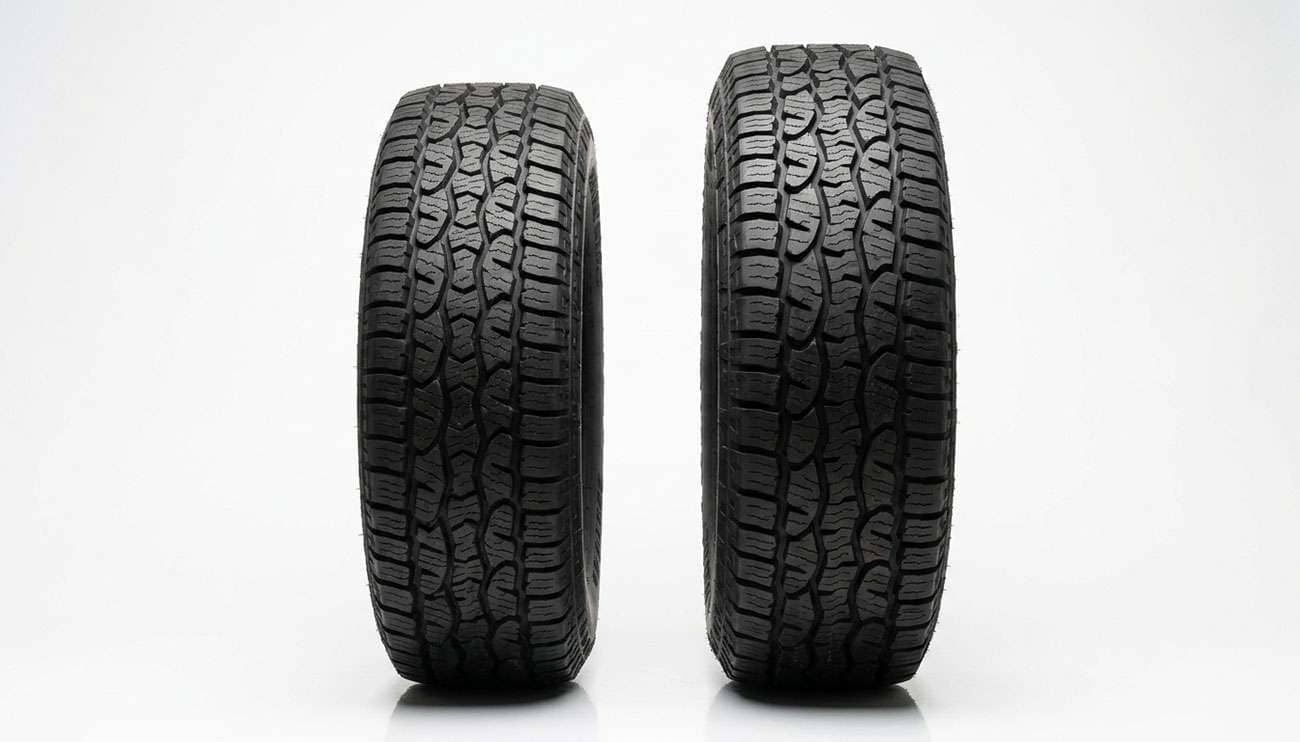
Yes, you can run 275/65R18 instead of 265/65R18 on most half-ton trucks and full-size SUVs. The tire is about half an inch taller and four-tenths of an inch wider, and it fits the same 18-inch wheel. Most size guides stop there and say "it depends." Here is what it actually depends on: the construction of the 275 you buy. A P-metric or standard-load 275/65R18 is a near drop-in. An E-range LT275/65R18 is a different tire entirely, with different weight, different ride, and a different air pressure requirement than anything printed on your door.
The size change is small. The load-range change can be enormous. That is the variable to decide first, and it is the one I want you to walk away understanding.
The 275/65R18 size comes in four distinct constructions. They share the same sidewall numbers and the same 32-inch height. They do not share the same capacity, weight, or inflation pressure. Find the row that matches the tire you are shopping, and compare it to the P265/65R18 112T that most GM half-tons wore from the factory.
Feature |
Max Load per Tire |
Vs. P265/65R18 112T (2,469 lb) |
What Changes on Your Truck |
|---|---|---|---|
P275/65R18 114T (P-metric, SL) |
2,601 lb at 35 psi |
+132 lb |
Same ride, same placard pressure. The easiest swap. |
275/65R18 116 (Euro-metric, SL) |
2,756 lb at 36 psi |
+287 lb |
Same ride, slightly more capacity at the same pressure. |
LT275/65R18 113/110 (Load Range C) |
2,535 lb at 50 psi |
+66 lb, but only at higher pressure |
Firmer sidewall, more cut resistance. The factory Trail Boss construction. |
LT275/65R18 123/120 (Load Range E) |
3,415 lb at 80 psi |
+946 lb at max pressure, less than stock at placard pressure |
Heaviest, stiffest ride. Built for towing and payload, not commuting. |
Look at the gap between the top row and the bottom row. Moving from 265 to 275 at the same construction buys you two load index points. Moving from SL to Load Range E inside the same 275 size moves you nine points and adds more than 800 pounds of rated capacity, along with roughly 13 pounds of rubber per corner. The width is a rounding error next to the construction.
The second table routes you by truck and use. These are the platforms where 265/65R18 was factory equipment and where the 275 swap is most common.
Feature |
Factory 18-Inch Size |
Best 275/65R18 Construction |
|---|---|---|
2007-2014 Silverado / Sierra 1500, Tahoe, Yukon, Suburban, Avalanche, Escalade |
P265/65R18 |
P-metric 114 or Euro-metric 116 SL for daily driving |
2014-2018 Silverado / Sierra 1500, 2015-2020 Tahoe / Yukon |
P265/65R18 |
Euro-metric 116 SL, or LT Load Range C for gravel and trail use |
2019 and newer Silverado / Sierra 1500 LTZ and RST on 18s |
P265/65R18 |
LT Load Range C matches what GM put on the Trail Boss; SL for the smoothest ride |
Any of the above, towing near the trailer rating or carrying a camper |
P265/65R18 |
LT Load Range E, inflated from the tire maker's load table, not the door |
Both sizes share a 65 aspect ratio and an 18-inch wheel, so the only input that changes is section width. Because the sidewall is calculated as 65 percent of that width, every extra millimeter of width also adds height. Ten millimeters of width turns into 6.5 millimeters of sidewall on each side of the wheel, which is where the half inch of extra diameter comes from.
Feature |
265/65R18 |
275/65R18 |
Difference |
|---|---|---|---|
Overall Diameter |
31.56 in |
32.07 in |
+0.51 in (+1.6%) |
Section Width |
10.43 in |
10.83 in |
+0.39 in |
Sidewall Height |
6.78 in |
7.04 in |
+0.26 in |
Circumference |
99.2 in |
100.8 in |
+1.6 in |
Revolutions per Mile |
639 |
629 |
-10 |
Ground Clearance Gain |
Baseline |
+0.26 in |
About a quarter inch at the axle |
Those are calculated, free-standing dimensions. Real tires vary by model. Aggressive all-terrain and mud-terrain tread adds depth, so an LT275/65R18 with a deep lug often measures closer to 32.2 inches out of the box, while a highway SL tire may come in slightly under its calculated number. Under load, both sizes squat about the same amount, so the half-inch gap holds when the truck sits on the ground. For the stock size broken down by itself, see our 265/65R18 in inches guide.
The 275/65R18 lands at 32.07 inches, which is why you will hear owners call it a "32-inch tire" even though it is a metric size. That label matters when you compare it to the next step up, 275/70R18 at roughly 33.2 inches, which is where real clearance work begins. The full 275 measurements live in our 275/65R18 size guide.
Width is the dimension people notice least and should notice most. Four-tenths of an inch does not sound like much, but it splits into about two-tenths per side when the tire is centered on the same wheel. On the inner side, that brings the sidewall closer to the frame, control arms, and sway bar end link. On the outer side, it moves the shoulder closer to the fender liner and the front valance at full steering lock. If you want the width question on its own, our 265 vs 275 tire comparison covers the handling and footprint side in detail.
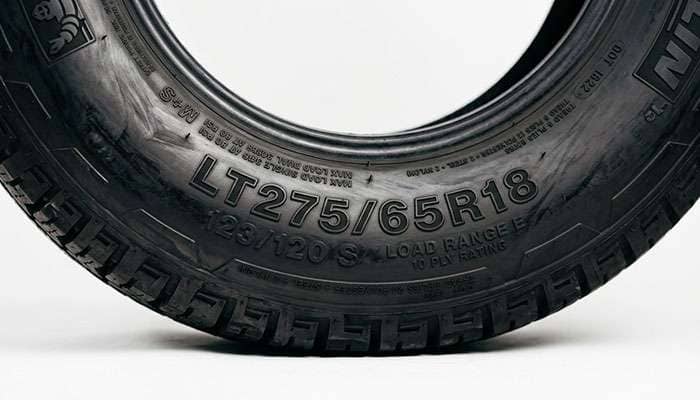
The rule from the Tire Industry Association and every tire shop that follows its service standards is simple: a replacement tire must carry at least the load the vehicle maker specified. Your floor is printed on the tire and loading information placard on the driver's door jamb, the label NHTSA requires under FMVSS No. 110. On a GM half-ton with 18-inch wheels, that placard usually reads P265/65R18 112T at 35 psi front and rear.
Load index 112 means 2,469 pounds per tire at the P-metric reference pressure of 35 psi. Every 275/65R18 in the table above clears that number at its own reference pressure. That is why the swap is legal and safe in principle. The catch is the phrase "at its own reference pressure," and that is where the construction difference does its damage.
A P275/65R18 114T and a 275/65R18 116T look like near twins, and on the road they behave like twins. The difference is the standard each one is rated under. P-metric tires reach their maximum load at 35 psi. Euro-metric standard load tires reach theirs at 36 psi and are rated a few index points higher for the same physical size. Either one carries more than your original P265 at the placard pressure, so either one works without changing how you air up.
The Tire and Rim Association applies a 10% load reduction when passenger-construction tires go on light trucks and SUVs. Divide 2,469 by 1.10 and the P265/65R18 112T is really doing about 2,245 pounds of work per corner on your Silverado. The vehicle maker already built that margin into the placard. Your replacement only has to match or beat the original tire's rating in the same construction class, and a 275 SL does that with room to spare.
LT tires carry two load indexes, such as 123/120. The first number is the single-tire rating and the second is the dual-wheel rating. They are also rated at much higher pressures: 50 psi for Load Range C and 80 psi for Load Range E. The capacity figure on the sidewall is what the tire carries at that maximum pressure, not at the 35 psi on your door. If the difference between a load index and a load range is fuzzy, our load range vs. load index explainer lays out how the two systems interact.
GM itself answered the construction question on the 2019 and newer Silverado. LTZ and RST trucks on 18-inch wheels came on P265/65R18. The Trail Boss, built on the same platform, came on LT275/65R18 in Load Range C. That is the clearest signal you will get that the 275 size works on the chassis, and that a C-range LT tire, not an E, is what the engineers picked for a half-ton that sees dirt. The Goodyear Wrangler DuraTrac in LT275/65R18 113Q is a well-known example of that C-range construction.
It depends entirely on construction, and this is the section most size calculators skip.
If you buy a P-metric or Euro-metric standard load 275/65R18, run the placard pressure. The tire is larger, so at the same 35 psi it carries more than the 265 did. No adjustment needed.
If you buy an LT275/65R18, the placard pressure is no longer the right starting point. LT tires are built with a stiffer carcass designed to carry load at higher pressure. At low pressure, the Tire and Rim Association load-inflation tables give an LT tire less capacity than a passenger tire of the same size. An E-range LT275/65R18 inflated to 35 psi typically carries less than the P265/65R18 it replaced at that same 35 psi. The sidewall reads 3,415 pounds, but that number only exists at 80 psi.
Here is the mechanism. Air pressure carries most of the load in any radial tire. A passenger tire's flexible sidewall is designed around a low reference pressure, so its load curve tops out early. An LT tire's stiffer construction needs more pressure before the casing reaches its working shape, so its load curve starts lower and climbs higher. Run an LT tire at passenger pressure and the casing flexes more than designed, the shoulders run hot, and the tread wears on the outer edges.
The fix is not complicated. Pull the load-inflation table for the exact LT tire from its manufacturer, find the pressure where the LT275/65R18 carries at least the original P265 rating, and add a few psi for highway margin. On a half-ton running empty, that usually lands in the low to mid 40s. Towing or hauling, you will go higher. The full construction comparison is in our P-metric vs. LT tires guide.
Your TPMS will not complain about the higher pressure. It warns on low pressure against the placard value, so running 45 psi in an LT tire will not trigger anything. The sensors carry over to the new tires without a relearn for the size change itself, though a relearn is good practice any time wheels move positions.
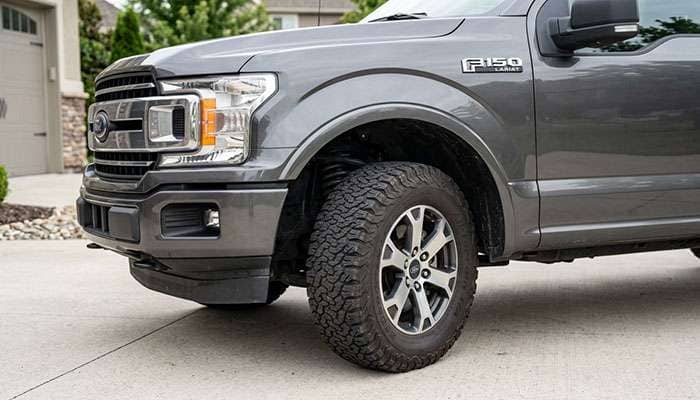
On a stock-height GM half-ton or full-size SUV with factory wheels, a 275/65R18 usually clears. The quarter inch of added radius is small, and these trucks have room in the wheel wells. When rubbing does show up, it shows up in specific places and under specific conditions, and you can predict it before you mount anything.
The Silverado, Sierra, Tahoe, Yukon, Suburban, Avalanche, and Escalade of this era all ran P265/65R18 on 18-inch trims. The 275/65R18 swap is common on these and generally clean on factory wheels. The contact points to watch at full lock are the front edge of the plastic fender liner and the lower front valance, especially if a leveling kit has raised the front and changed the angle the tire sweeps through.
The 2014-2018 Silverado and Sierra 1500 and the 2015-2020 Tahoe and Yukon carry the same factory 18-inch size. Owners on these platforms commonly run a 275/65R18 at stock height. Tahoe and Yukon owners often pick taller-not-wider sizes because the factory wheels sit at a high positive offset, which pushes the tire inboard. On those SUVs, the inner sidewall at full lock is the first thing to check.
This is the easiest platform of the three. The 275/65R18 is a factory size on the Trail Boss, and while that truck carries a factory lift, the size is engineered into the suspension geometry, steering stops, and ABS calibration of the chassis family. LTZ and RST owners swapping up from P265/65R18 are running a tire GM already validated on the same frame.
The size alone rarely causes rubbing. It is the combination. A leveling kit plus an aftermarket wheel with lower or negative offset pushes the tire outward and forward, and that is when the 275 starts touching the valance and the fender liner on turns. If you are planning wheels, a lift, and tires together, measure with the wheel you will actually run. When you do get contact, our guide on why tires rub walks through diagnosing whether it is offset, height, or steering stops.
Yes. Both sizes are designed around an 8-inch measuring rim and share an approved rim width range of roughly 7.5 to 9 inches, depending on the tire maker's spec sheet. Factory 18-inch wheels on GM half-tons are 8.5 inches wide, which sits in the middle of both ranges.
That shared range is the reason this swap is so popular. You keep your wheels, your TPMS sensors, your lug nuts, and your center caps. The only hardware that changes is the rubber.
Where the rim width does matter is on aftermarket wheels. Mount a 275/65R18 on a 9.5-inch or 10-inch wheel and you have pushed past the range most makers approve. The sidewall gets pulled straight, the bead seats under more tension than designed, and the tire loses the sidewall bulge that protects the wheel lip on trails. Stay at 9 inches or under unless the specific tire's spec sheet allows wider.
One more detail: LT tires in this size often list a narrower starting point than SL tires. Some LT265 and LT275 spec sheets start at 8 inches rather than 7.5. If you have older 7.5-inch steel wheels from a work-truck trim, check the exact LT tire you plan to buy before you order.
Slightly. The 275/65R18 turns 10 fewer revolutions per mile than the 265/65R18, a 1.6% difference. Your speedometer still reads based on the factory tire, so it will read low.
Feature |
Actual Speed on 275/65R18 |
|---|---|
Speedometer reads 30 mph |
30.5 mph |
Speedometer reads 45 mph |
45.7 mph |
Speedometer reads 60 mph |
61.0 mph |
Speedometer reads 70 mph |
71.1 mph |
About one mile per hour at highway speed. That is inside the normal spread you get from tread wear alone, since a new tire and a worn-out tire of the same size differ by close to half an inch in diameter. Your odometer will log about 1.6% fewer miles than you actually drive, which adds up to roughly 1,600 miles over 100,000.
Most owners leave it alone. If you want it exact, a dealer or a handheld programmer can update the tire size or revolutions-per-mile value in the truck's computer. That also keeps the transmission's shift timing and the stability control system working from accurate wheel speed. For a deeper look at when correction becomes necessary, our article on bigger tires and your speedometer covers larger jumps.
Gearing is a non-issue at this size. A 1.6% change in effective ratio is far below the point where you would feel lost acceleration or need a regear. You will notice the weight of an LT tire long before you notice the height of any 275.
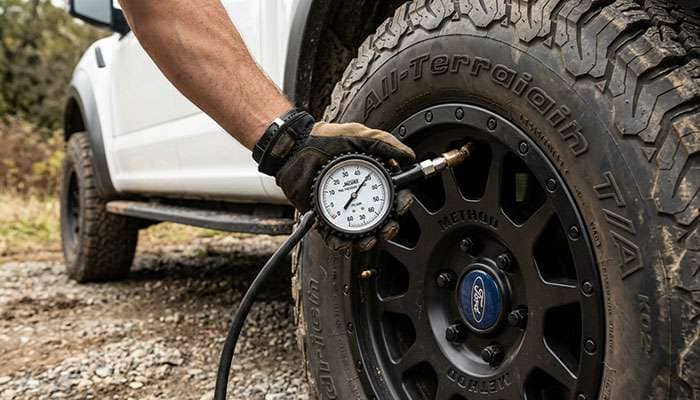
Picking the wrong construction does not announce itself on day one. It shows up gradually, and each stage costs more than the one before it.
An E-range LT275/65R18 typically weighs 55 to 60 pounds. A standard-load 275/65R18 in the same tread family usually weighs mid 40s. That is roughly 13 to 15 pounds more per corner, all of it unsprung and rotating. The stiffer sidewall transmits more road texture to the cab. Drivers who wanted a slightly bigger tire for looks often regret the E-range within the first week of commuting.
More rotating mass, a taller tire, and usually a more aggressive tread pattern all cost mileage. On a half-ton that averaged high teens on highway SL tires, an E-range all-terrain swap commonly costs one to two miles per gallon. Across 15,000 miles a year, that is real money every month you run them.
Run that LT tire at the 35 psi on the door, and the casing flexes more than designed. Both outer shoulders wear faster than the center. The tire also runs hotter on long highway stretches, which accelerates tread wear and ages the rubber.
Load up the bed or hook a trailer while that LT tire is still at passenger pressure, and you are asking it to carry more than it is rated for at that pressure. That is the scenario that leads to sidewall fatigue, heat damage, and casing failure. The sidewall stamp says 3,415 pounds. At 35 psi, it is nowhere close.
Uneven shoulder wear, heat-aged rubber, or a damaged sidewall all end the same way: a new set well before the first set's mileage warranty would have kicked in. Picking the right construction the first time is the cheapest decision in this entire swap.
Follow these steps in order and the swap goes smoothly.
Note the factory size, load index, and pressure. On most GM half-tons with 18s, that is P265/65R18 112T at 35 psi. Your replacement must meet or exceed that load rating.
Daily driving and light hauling point to P-metric or Euro-metric standard load. Gravel roads, trails, and occasional towing point to LT Load Range C. Regular heavy towing, a slide-in camper, or a loaded work truck point to LT Load Range E.
Factory 8.5-inch wheels work for every construction. On older 7.5-inch steel wheels, check that the specific LT tire you choose approves that width.
Stock trucks rarely need this. Leveled trucks, or trucks on aftermarket wheels with lower offset, should get a test fit: mount one tire, turn lock to lock, and cycle the suspension if you can.
Standard load tires go to the placard. LT tires go to the pressure the maker's load-inflation table gives for the load you carry, then a few psi higher for highway margin.
About one mile per hour low at highway speed. Correct it with a dealer or a programmer if you want exact readings, or leave it.
Running 275/65R18 instead of 265/65R18 is one of the safest size upgrades available for a GM half-ton or full-size SUV. Half an inch of height, four-tenths of an inch of width, the same wheels, the same sensors, and roughly one mile per hour of speedometer error. GM even put the size on the Trail Boss. On the size itself, there is very little to worry about.
The decision that actually changes the truck is construction. A standard-load 275 rides and behaves like the factory tire with a little more capacity. A Load Range C LT tire adds durability with a modest ride penalty. A Load Range E LT tire is a towing tire that needs its own inflation pressure and adds real weight. Pick the construction for how the truck is used, set the pressure to match, and the swap pays off for the life of the tread.
When you are ready to compare 275/65R18 options across highway, all-terrain, and LT constructions, browse our modern tire selection and filter by size and load range.
Here is what to remember before you order.
Yes, on most half-ton trucks and full-size SUVs that came with 265/65R18. The 275 is about half an inch taller and fits the same wheels. Choose a load index that meets or beats your door placard, and if you buy an LT tire, inflate it to the maker's load table rather than the placard.
Usually not. Stock GM half-tons and full-size SUVs that came with 265/65R18 typically clear a 275/65R18 on factory wheels. Rubbing shows up mainly when a leveling kit is combined with aftermarket wheels that have lower offset, pushing the tire into the fender liner or front valance at full lock.
About 0.51 inches. A 275/65R18 measures roughly 32.07 inches tall and a 265/65R18 measures roughly 31.56 inches. That raises ground clearance about a quarter inch at the axle.
It is optional. The speedometer reads about 1.6% low, so 70 mph on the dash is about 71.1 mph on the road. A dealer or a handheld programmer can correct it if you want exact readings.
Yes. Both sizes use an 8-inch measuring rim and an approved width range of roughly 7.5 to 9 inches. Factory 18x8.5 GM wheels sit inside both ranges, so your wheels and TPMS sensors carry over.
Only if you need it. LT construction adds cut resistance and towing capacity but also weight and a firmer ride. For daily driving, a P-metric or standard load tire is the better match. For trails, Load Range C is a good middle ground, and Load Range E makes sense for heavy towing or campers.



