
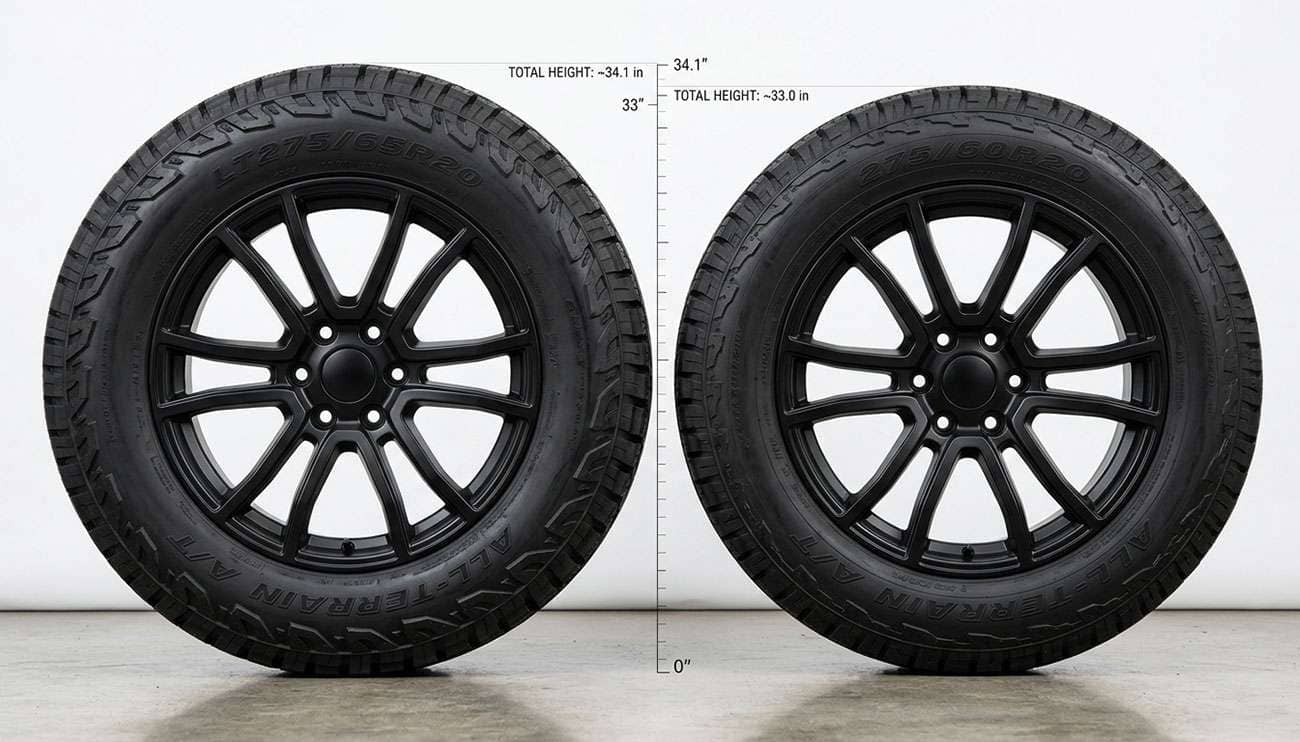
Yes. On most leveled half-ton pickups, and on many stock ones, a 275/65R20 fits in place of 275/60R20. It's about 1.1 inches taller and exactly the same width. The variable nobody mentions is construction: nearly every 275/65R20 on the market is an LT tire, most of them Load Range E. So you aren't just going up a size. You're moving from a passenger-style tire to a 10-ply truck tire that weighs 15 to 25 pounds more per corner, needs a different pressure than your door placard, and usually carries a lower speed rating.
I'm Dennis Feldman, and I handle fitment at Performance Plus Tire. Most answers to this question are about clearance, and clearance is the easy part. Use the table below to find your truck and how you use it, then read the sections that apply.
Your Truck |
How You Use It |
275/65R20 Verdict |
What to Watch |
|---|---|---|---|
Stock half-ton |
Daily driver, light loads |
Usually fits; ride gets firmer |
Full-lock contact at the front liner; set pressure from the LT chart |
Half-ton with 2-inch level |
Daily driver or trail |
Clean fit on most |
Pressure, speed rating, speedometer |
Half-ton, stock or leveled |
Regular towing or heavy payload |
Strong choice |
Load Range E adds real capacity; raise pressure when loaded |
Half-ton, any setup |
Smooth ride is the priority |
Think twice |
Look for the few P-metric or XL options, or stay at 275/60R20 |
4WD with automatic 4WD mode |
Any |
Yes, as a full set |
Your spare is now 1.1 inches shorter than the road tires |
Only the aspect ratio changes. Width stays at 275 millimeters and the wheel stays at 20 inches. Moving from 60 to 65 percent adds about 0.54 inches to each sidewall, so the tire grows about 1.1 inches in diameter. That is the cleanest kind of size change: all of the growth is vertical.
Measurement |
275/60R20 |
275/65R20 |
Difference |
|---|---|---|---|
Overall diameter |
33.0 in |
34.1 in |
+1.1 in (+3.3%) |
Section width |
10.8 in |
10.8 in |
None |
Sidewall height |
6.5 in |
7.0 in |
+0.54 in |
Circumference |
103.6 in |
107.1 in |
+3.4 in |
Revolutions per mile |
611 |
592 |
19 fewer |
Ground clearance gain |
Baseline |
+0.54 in |
Half the diameter gain |
Typical approved rim range |
7.5 to 9.5 in |
7.5 to 9.5 in |
Identical |
Two things make this swap simpler than most. First, the approved rim width range is identical, so any factory 20x8 to 20x9 wheel that runs 275/60R20 is in spec for 275/65R20. Second, because the width doesn't change, the inner sidewall sits exactly where it sits today. The tire gets no closer to the control arms, the tie rod, or the frame. Every bit of the clearance question is about the extra half inch at the top, front, and back of the tread.
In plain terms, you're going from a 33-inch tire to a 34-inch tire. For a full measurement breakdown of the bigger size, see what a 275/65R20 is in inches. If you've been weighing the other direction, a lower-profile 275/55R20, we covered that tradeoff in 275/55R20 instead of 275/60R20.
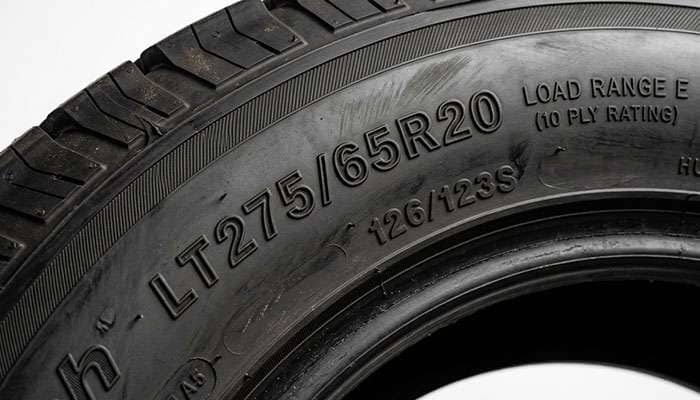
Because 275/65R20 grew up as a heavy-duty truck size. It's the factory fitment on many three-quarter-ton and one-ton pickups, and those trucks need LT Load Range E. Tire makers built the size around that market. When I look across the 275/65R20 tires available today, all but a handful carry the LT prefix, and the large majority are Load Range E. In 275/60R20, the picture is reversed: most are P-metric or Euro-metric passenger-style construction built for half-tons.
That means the real swap isn't "a slightly taller tire." It's this:
Spec |
Typical 275/60R20 |
Typical LT275/65R20 |
What It Means |
|---|---|---|---|
Construction |
P-metric, Standard Load |
LT, Load Range E (10-ply rated) |
Stiffer sidewall, more plies, more steel |
Load index |
114 to 115 (2,601 to 2,679 lb) |
126/123 (3,748 lb single) |
About 1,100 lb more capacity per tire |
Capacity on a truck |
2,365 to 2,435 lb (P-metric derate) |
3,748 lb (no derate) |
Gap widens once the 1.10 rule applies |
Max pressure |
44 to 51 psi molded max |
80 psi |
Pressure must come from the LT chart |
Weight |
Around 43 to 45 lb |
Around 60 to 67 lb |
Roughly 80 lb more across four corners |
Common speed rating |
T (118 mph) or H (130 mph) |
S (112 mph), R (106), or Q (99) |
A step down from most factory tires |
The capacity jump is the good news, and it's real. Under the Tire and Rim Association rule, a P-metric tire on a light truck gets its rating divided by 1.10, so a P275/60R20 rated 2,601 pounds is really a 2,365-pound tire on your pickup. An LT275/65R20 Load Range E carries 3,748 pounds with no derate. If you tow regularly or keep a camper or toolbox in the bed, that margin is worth having. If you want the construction story in depth, read our breakdown of P-metric vs. LT tires, and for reading the numbers on the sidewall, see load range vs. load index.
The weight is the cost. LT construction adds plies, heavier bead bundles, and deeper tread, and in this size that typically adds 15 to 25 pounds per tire over a passenger-construction 275/60R20. Within the same tire model and the same LT construction, the 65 series is only a few pounds heavier than the 60 series. The jump comes from the construction change, not the size change.
Here's how the capacity gap plays out on a real truck. Say you pull a 7,000-pound travel trailer. Tongue weight typically runs 10 to 15 percent of trailer weight, so 700 to 1,050 pounds lands on the hitch. Add a weight-distributing hitch, passengers, and gear, and the rear axle of a half-ton can easily climb past 4,000 pounds, which is 2,000-plus pounds per rear tire.
A P275/60R20 rated 2,601 pounds, derated to 2,365 on a truck, has only a few hundred pounds of margin in that situation, and only at its maximum pressure. An LT275/65R20 Load Range E rated 3,748 pounds carries the same load with well over a thousand pounds of margin per tire. That margin is what keeps sidewall flex and heat down on a long, hot grade. It's also why so many half-ton owners who tow make this exact swap, and why the stiffer ride is a fair trade for them.
The flip side is just as important. If your truck never sees more than a couple of passengers and some groceries, you're paying for that margin in weight, ride, and fuel every day without ever using it. That's not a reason to avoid the swap, but it is a reason to choose it on purpose.
A few exist, usually rated 116 Extra Load. They ride closer to your factory tire, weigh less, and keep a passenger-style speed rating more often. They're also a small fraction of the market, so tread design choices are limited. If ride quality matters more to you than capacity, they're worth hunting for. Owners who've switched from an LT 275/65R20 to a non-LT version commonly report a noticeably softer ride on broken pavement.
Not the number on your door, and not the 80 psi molded on the sidewall. This is the single most important step in the swap, and the one almost nobody covers.
Your half-ton's placard pressure, often around 35 psi, was set for a P-metric tire. LT and P-metric tires use different load and inflation tables. At the same pressure, an LT tire doesn't carry the same load as a P-metric tire, and at low pressures the LT tire often carries less. So an LT275/65R20 aired to your placard pressure can actually be supporting less weight per corner than the P275/60R20 it replaced, even though its maximum rating is far higher.
Your TPMS will still trigger at the threshold set for the original placard pressure, which means it won't warn you until the LT tire is already well below where it should be. Treat the TPMS light as a backstop, not a gauge, and check pressure by hand once a month.
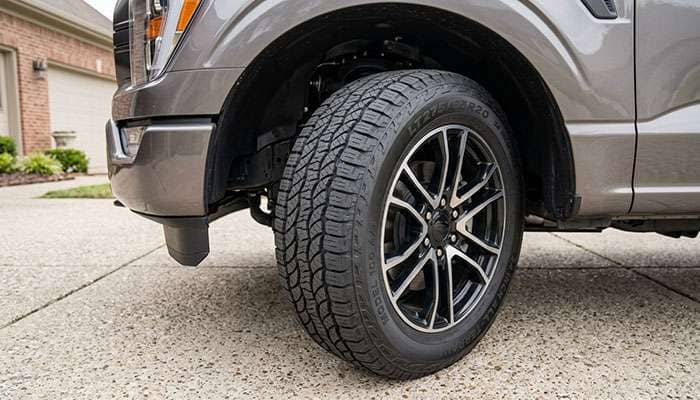
On many half-tons, yes at ride height, with some contact possible at full lock. With a 2-inch leveling kit, most owners report a clean fit with no rubbing in either direction.
Since the width is unchanged, the tire grows only outward from the hub, about 0.54 inches in radius. At ride height, that closes the gap to the top of the fender opening by about half an inch. Turn the wheel to full lock and the front edge of the tread swings toward the bumper valance and the forward section of the fender liner, while the rear edge swings toward the cab mount area and the back of the liner. Those are the contact points, in that order of likelihood.
A leveling kit raises the front of the truck, which moves the fender opening and liner up and away from the tire. It doesn't create new room at the valance on every truck, but it usually solves the full-lock contact. Many half-tons sit nose-low from the factory, so a level also makes the 34-inch tire look proportionate front to back.
Light brushing at full lock on the plastic liner is the most common complaint. Trimming or heat-forming the liner, or adjusting the front mud flaps, usually fixes it. Contact with metal or with the sidewall under compression is a different problem, and you should not ignore it. Our guide on why tires rub walks through how to locate the contact point.
Parking-lot checks only show you the steering arc at ride height. On a truck that sees trails, the tire also moves up into the wheel well as the suspension compresses. Watch the rear of the front wheel opening and the leading edge of the rear wheel opening when one corner is stuffed on a curb or a ramp. With the width unchanged, rear-axle contact on a stock half-ton is uncommon, but a bed-mounted spare carrier, aftermarket mud flaps, or running boards with low-hanging brackets can change that. Ten minutes of looking now saves a sidewall later.
In most cases, yes. Factory 275/60R20 tires on half-tons are commonly T-rated (118 mph) and sometimes H-rated (130 mph). The large majority of LT275/65R20 tires are S-rated (112 mph), and a good share are R (106 mph) or even Q (99 mph), especially in aggressive all-terrain and mud-terrain designs.
For most driving, an S rating is plenty. But a speed rating also tells you how much heat a tire tolerates at sustained highway speed, and heat is exactly what an underinflated or overloaded tire produces. A Q-rated tire at 80 mph in desert summer heat, towing, at the wrong pressure, has the least margin of any combination in this article. If you drive long highway stretches loaded, favor an S-rated design over Q or R. Also note that some trucks base their top-speed limiter on the factory tire. If yours does, ask your dealer whether it can be set to match the new tire's rating.
The diameter change is 3.3 percent, just past the 3 percent line most of the industry treats as the no-recalibration limit. Your speedometer will read low.
Speedometer Shows |
Actual Speed on 275/65R20 |
Error |
|---|---|---|
30 mph |
31.0 mph |
+1.0 mph |
45 mph |
46.5 mph |
+1.5 mph |
55 mph |
56.8 mph |
+1.8 mph |
65 mph |
67.1 mph |
+2.1 mph |
75 mph |
77.5 mph |
+2.5 mph |
Most modern half-tons can be recalibrated for tire size with a dealer scan tool or an aftermarket programmer. I'd do it, because it also corrects the odometer, which otherwise under-counts about 330 miles every 10,000. Our article on bigger tires and your speedometer covers the options.
A taller tire behaves like a numerically lower axle ratio. Multiply by 0.968: 3.23 acts like 3.13, 3.55 like 3.44, 3.73 like 3.61, 3.92 like 3.80. Modern 8- and 10-speed transmissions mask most of that. You'll feel it more from the added rotating weight, roughly 80 pounds across the set, than from the diameter itself. Launches get a little softer and the transmission may hold a lower gear longer on grades.
Expect a real drop, and expect it to come from three places: the added weight, the stiffer LT carcass (which usually means higher rolling resistance), and, most of all, tread design if you move from a highway tire to an all-terrain at the same time. Many owners see somewhere around one mile per gallon, sometimes more with aggressive tread. Before you measure, correct for the odometer: an uncalibrated truck understates miles by 3.3 percent, so hand-calculated MPG looks worse than reality. Multiply displayed miles by 1.033 or recalibrate first.
Done right, this is a durable upgrade, especially for trucks that work. Done wrong, the problems arrive in a predictable order.
Aired to 80 psi, an LT tire on an empty half-ton crowns the tread, rides harshly, and wears the center ribs. It also shrinks the contact patch, which costs wet braking grip. Aired to a P-metric placard number, it sags at the shoulders and wears the outer edges. Both waste thousands of miles of tread.
Repeated full-lock contact with the liner or valance polishes and then scuffs the shoulder and upper sidewall. Once cords show, the tire is finished. If you've already found scuffing or a bulge, read whether sidewall damage is safe to drive on.
An LT tire run at placard pressure while towing is the dangerous combination. It may be carrying less than it's rated for at that pressure, and every revolution flexes the sidewall more than it should. Flex makes heat, heat breaks down the bond between rubber and steel, and a lower speed rating leaves less heat margin to begin with. NHTSA lists underinflation and overloading among the leading causes of tire failure. A tread separation at highway speed with a trailer behind you is the worst-case end of this stage.
Eighty extra pounds of rotating mass and a taller tire put more work on the brakes every stop. Pads and rotors wear sooner, and stopping distance grows slightly when towing. On trucks with an automatic 4WD mode that engages the front axle on its own, running the factory spare, now 1.1 inches shorter than the road tires, forces the transfer case to absorb a 3.3 percent rolling difference. Keep it to short, slow trips in 2WD, or buy a fifth tire and confirm it fits the under-bed carrier.
Most 275/65R20 tires are built as all-terrains, which matches the way most half-ton owners use this size: daily driving with a trailer, a trail, or a job site mixed in. Compare load ranges, speed ratings, and weights across our selection of all-terrain tires.
The 275/65R20 is one of the most popular ways to get a 34-inch tire onto a half-ton without changing wheels, and on most trucks it fits with little or no trimming, especially with a level. The fit was never the hard part. Because nearly every 275/65R20 is an LT Load Range E tire, this swap quietly changes your construction, your weight, your speed rating, and, most importantly, the pressure you need to run. Pick the construction that matches how you use the truck, set pressure from the LT table instead of the door, and recalibrate the speedometer. Do that and you get the capacity and stance of a heavy-duty tire without the harsh ride, uneven wear, or heat problems that come from treating it like the tire it replaced.
Yes, on most half-ton pickups. It's 1.1 inches taller and the same width, and it uses the same wheels. Most 275/65R20 tires are LT Load Range E, so set pressure from the LT load table, expect a firmer ride, and check full-lock clearance.
On many half-tons it fits at ride height, with possible light contact at the front fender liner or valance at full lock. A 2-inch leveling kit usually eliminates the contact.
About 1.1 inches taller in overall diameter, 34.1 inches versus 33.0 inches. That's a 3.3 percent increase and adds roughly half an inch of ground clearance.
Use the tire maker's LT load and inflation table to find the pressure that carries at least what your original P-metric tire carried at placard pressure. On an unloaded half-ton that often lands in the low-to-mid 40s psi. Confirm with a chalk test and add pressure when towing.
Usually, because most are LT Load Range E with a stiffer, heavier carcass. Running the correct pressure instead of the sidewall maximum makes the biggest difference. A few non-LT 275/65R20 options ride closer to the factory tire.
Yes, close to it. A 275/65R20 measures about 34.1 inches tall and 10.8 inches wide, which is why it's commonly called a 34-inch tire for 20-inch wheels.



