
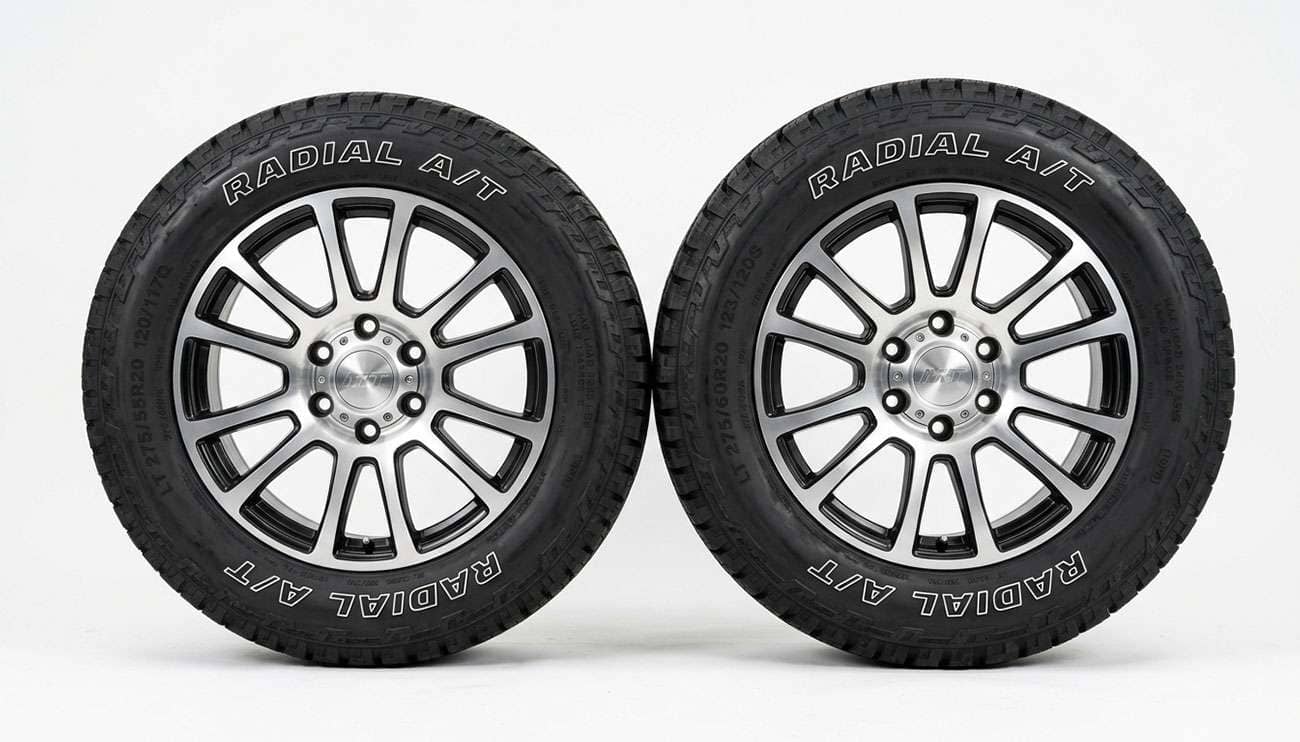
Yes, you can run 275/55R20 instead of 275/60R20 on most trucks and SUVs, but only if the replacement carries a load index of 117 XL or higher and you raise the pressure to match. The two sizes share the same wheel and the same 275 mm width. What they do not share is load capacity. A standard-load 275/55R20 is rated for 144 to 276 pounds less per tire than the 115-rated 275/60R20 most half-tons wear from the factory. Most answers stop at "it depends." It depends on the load index, and on the pressure you run.
I'm Dennis Feldman, and fitment questions like this one land on my desk every week. The swap itself is mechanically simple. The part nobody puts in front of you is the capacity math, and that's where this decision is actually made. Start with the table below, find the load index printed on the 275/55R20 you're looking at, and you'll know in ten seconds whether it belongs on your truck.
275/55R20 Load Index |
Max Load per Tire |
vs. 275/60R20 115 SL (2,679 lb) |
Verdict |
|---|---|---|---|
111 SL |
2,403 lb |
-276 lb per tire (-1,104 lb per set) |
No. Below factory capacity at any legal pressure. |
113 SL |
2,535 lb |
-144 lb per tire (-576 lb per set) |
No for trucks. Short of OE capacity. |
117 XL |
2,833 lb |
+154 lb per tire at XL reference pressure |
Yes, if inflated above placard pressure. |
118 XL |
2,910 lb |
+231 lb per tire at XL reference pressure |
Yes, with the same pressure caveat. |
LT275/55R20 Load Range E |
Roughly 3,000+ lb (dual-rated, see sidewall) |
Exceeds OE capacity by a wide margin |
Yes for towing and payload. Firmer ride. |
If your truck came with a 114 SL or 116 XL 275/60R20 instead of 115 SL, the same logic holds: match or beat the factory number on your door placard. Load index values come from the standardized tables published by the Tire and Rim Association, so a 117 means 2,833 pounds on every brand.
The second axis is how you use the truck. That decides which 275/55R20 construction you should be shopping for.
How You Use the Truck |
275/55R20 Spec to Shop |
Pressure Note |
|---|---|---|
Daily driving, empty bed most days |
117 XL highway or all-season |
Run about 3 psi over placard, confirm with load table |
Weekend hauling, occasional light trailer |
117 or 118 XL all-terrain or highway |
Run toward XL reference pressure when loaded |
Regular towing near rated capacity |
LT275/55R20 Load Range E |
Use the LT load/inflation table, not the placard |
Lowered or street-focused SUV |
117 XL performance all-season |
Never drop below the pressure that matches OE load |
The only number that changes between these two sizes is the aspect ratio, and that one number changes everything downstream. Aspect ratio is sidewall height expressed as a percentage of section width. Five points of aspect ratio on a 275 mm tire works out to about 14 mm of sidewall. Here's what it means for these two sizes specifically.
Measurement |
275/60R20 |
275/55R20 |
Difference |
|---|---|---|---|
Section width |
275 mm (10.83 in) |
275 mm (10.83 in) |
None |
Sidewall height |
165 mm (6.50 in) |
151 mm (5.95 in) |
-0.54 in |
Overall diameter |
32.99 in |
31.91 in |
-1.08 in (-3.3%) |
Circumference |
103.6 in |
100.3 in |
-3.4 in |
Revolutions per mile |
611 |
632 |
+21 |
Ground clearance at the axle |
Baseline |
-0.54 in |
Half the diameter change |
Those figures are calculated, not marketing numbers. Actual measured diameter varies by brand and tread depth, usually within a few tenths of an inch. For the full inch conversion of each size, see what size 275/55R20 is in inches and our breakdown of what a 275/60R20 tire is equivalent to.
Both sizes show up as factory fitments on full-size half-ton pickups and three-row SUVs. That overlap is why the question comes up so often. A shop or a sale price puts 275/55R20 in front of you, it's the size your neighbor's truck wears, and the tire looks like it will bolt right on. It will. The question is whether it will carry what your truck was engineered to carry.
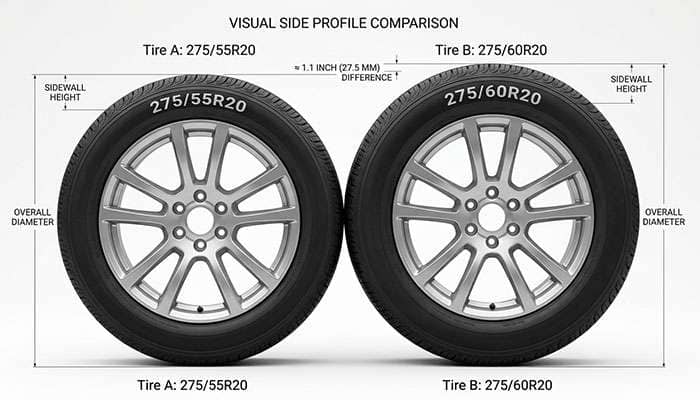
Yes. Rim diameter is 20 inches on both, and because the section width is identical, both sizes share the same approved rim width range, typically 7.5 to 9.5 inches. Factory 20-inch half-ton and SUV wheels sit squarely in that window. You do not need new wheels, new lug hardware, or spacers.
Clearance only improves. The 275/55R20 is about half an inch shorter in radius, so it sits farther from the fender liner, the upper control arm, and the frame. If your current 275/60R20 rubs at full lock with a leveling kit, the 55-series will rub less, not more.
The fit question is the easy one. It's also the one every forum thread answers, which is why most drivers stop there. Fitment tells you the tire mounts. It tells you nothing about whether the tire can do the job the old one did.
Not automatically, and this is the variable that decides the whole swap. A tire carries load with air volume, not rubber. Take half an inch of sidewall away and you take air volume away with it. At the same pressure, a shorter sidewall means less carrying capacity. That's physics, and the load index tables reflect it.
Look at where the market sits. The 275/60R20 size is dominated by 115 SL tires (2,679 lb), with 114 SL and 116 XL also common. The 275/55R20 size is split: the largest group is 117 XL (2,833 lb), but there's a large block of 113 SL (2,535 lb) and a smaller set of 111 SL (2,403 lb). Those standard-load 275/55R20s are perfectly good tires for the vehicles they were designed for. They're not built for a truck that left the factory on 115s.
If you're fuzzy on how load index differs from load range, read load range vs. load index before you shop. The short version: load index is the weight number, and load range or XL tells you how much pressure the tire needs to reach it.
Federal Motor Vehicle Safety Standard 120, administered by NHTSA, governs tire selection on trucks, SUVs, and other vehicles that aren't passenger cars. It requires that the combined load rating of the tires on an axle meet or exceed that axle's Gross Axle Weight Rating (GAWR), which is printed on the certification label in your driver's door jamb.
There's a detail in that standard most people never see. When a P-metric tire goes on a truck or multipurpose vehicle, FMVSS 120 requires its load rating to be divided by 1.10 before you do that math. Run the numbers on a hypothetical half-ton with a 4,500 lb rear GAWR:
Tire |
Rated Load |
Truck-Use Load (divided by 1.10) |
Pair on Rear Axle |
Clears 4,500 lb GAWR? |
|---|---|---|---|---|
275/60R20 115 SL |
2,679 lb |
2,435 lb |
4,871 lb |
Yes |
275/55R20 113 SL |
2,535 lb |
2,305 lb |
4,609 lb |
Barely, with no reserve |
275/55R20 111 SL |
2,403 lb |
2,185 lb |
4,369 lb |
No |
275/55R20 117 XL |
2,833 lb |
2,575 lb |
5,151 lb |
Yes, at XL reference pressure |
Your truck's actual GAWR will differ, so pull the number off your own door label and redo the math. The pattern won't change: standard-load 275/55R20s eat into the reserve your truck's manufacturer built in, and the 111 can fall below the line entirely.
The Tire Industry Association's guidance for replacement tires lines up with this. Replacement tires should match or exceed the original equipment load capacity and speed rating. Going down a size is fine. Going down in capacity is the mistake.
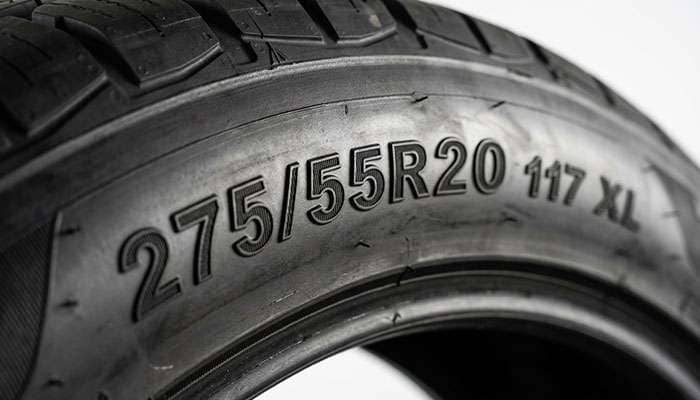
This is where most swaps go quietly wrong, even when the buyer picked the right tire. An XL (Extra Load) tire is built with a stronger carcass so it can safely hold more air. The extra capacity comes from that extra air. It doesn't exist at standard pressure.
Here's the mechanism. Load tables for standard-load and XL P-metric tires are identical up to 35 psi. A 275/55R20 117 XL at 35 psi carries about the same weight as a 275/55R20 113 SL at 35 psi: roughly 2,535 pounds. The XL keeps gaining capacity as you add air, up to its reference pressure of 41 psi (P-metric) or 42 psi (Euro-metric), where it reaches the full 2,833 pounds stamped on the sidewall. For a deeper look at how XL construction works, our guide to XL load range covers the construction side.
Now apply that to your truck. Your door placard specifies a pressure for the 275/60R20 that came on it, often 35 psi. If you mount 117 XL 275/55R20s and air them to the placard number, you've installed tires that carry about 144 pounds less per corner than the originals. The tire is capable. The pressure isn't.
To match the 2,679 lb capacity of a 115 SL 275/60R20, a 117 XL 275/55R20 needs somewhere around 38 psi, based on interpolating the standard XL load/inflation curve. That's an estimate, not a prescription. Every tire manufacturer publishes a load/inflation table for each size, and that table is the authority. Find the pressure where the 275/55R20's capacity equals or exceeds your original tire's rated load, and make that your new cold pressure.
Two rules keep this simple:
Your TPMS will still work. Most systems warn at roughly 25% below the programmed placard pressure, so running a few psi over placard won't trigger anything. It also means the TPMS won't warn you if you drift back down to placard pressure, which is now too low for your new tires. Check with a gauge, cold, once a month.
A smaller tire turns more times per mile, so your speedometer reads high and your odometer piles up miles faster than you're actually driving them. With a 3.3% diameter drop, here's what that looks like on the road:
Speedometer Shows |
Actual Speed on 275/55R20 |
Error |
|---|---|---|
30 mph |
29.0 mph |
-1.0 mph |
45 mph |
43.5 mph |
-1.5 mph |
60 mph |
58.0 mph |
-2.0 mph |
70 mph |
67.7 mph |
-2.3 mph |
80 mph |
77.4 mph |
-2.6 mph |
You won't get a ticket from this error. You'll be driving slower than you think. The odometer side matters more if you lease or track maintenance by mileage: for every 10,000 actual miles, the odometer records about 10,340. On a lease with a mileage cap, that's real money.
The speed error is the mirror image of the one you get going up a size. Our article on bigger tires and your speedometer covers the recalibration options, and they apply in reverse here. Most dealers and many aftermarket programmers can update the tire size in the computer, which also corrects the transmission shift points.
A 3.3% smaller tire acts like a 3.3% numerically higher axle ratio. A 3.73 rear behaves like a 3.86. You'll feel slightly quicker launches and the engine will run a few dozen RPM higher at highway speed. Indicated fuel economy usually looks a touch worse because the odometer over-counts, even when real-world consumption barely moves. The ABS and stability control systems tolerate this change on nearly every modern truck, since all four tires change together.
No. Not on a 4WD or AWD vehicle, and not as a long-term setup on a 2WD truck either. The 275/55R20 makes 21 more revolutions every mile than the 275/60R20. On a part-time 4WD truck, that difference fights the locked transfer case every time you engage it. On a full-time AWD system, the center differential or clutch pack slips constantly to absorb it, generating heat and wear it was never designed to handle continuously.
On a 2WD truck, mixing sizes front to rear won't wreck a driveline, but it changes the handling balance and confuses the stability control's wheel-speed comparison. Mixing sizes side to side on the same axle is a hard no on any vehicle.
If you're replacing one damaged 275/60R20, replace it with a 275/60R20. If you're switching sizes, switch all four at once. The same principle applies to width swaps, which we cover in replacing a 235 with a 225 tire.
It depends on which 275/55R20, and on how much you tow. This is where the decision splits three ways.
A small utility trailer, a jet ski, or a pop-up camper adds modest tongue weight, typically 10 to 15% of trailer weight. A 117 or 118 XL 275/55R20 inflated toward its reference pressure handles that with more capacity than your original 115 SL had. Air up before you hook up, and check the rear tires cold before the trip.
If you pull a travel trailer or a loaded car hauler near your truck's tow rating, step up to an LT275/55R20 in Load Range E. LT construction uses a heavier carcass and runs at much higher pressures, up to 80 psi, giving you a large margin over any P-metric tire. The trade-off is ride quality. An LT tire at its towing pressure rides noticeably firmer than the passenger tire your truck came with. Use the manufacturer's LT load/inflation table to set pressure for the actual weight on each axle. Don't just copy the max sidewall number.
Tongue weight compresses the rear tires. A shorter sidewall has less room to deflect before the tire's footprint distorts and the shoulders start carrying the load. That's why the pressure discipline matters more on a 55-series than it did on the 60s. The upside: a shorter sidewall also flexes less laterally, so a properly inflated 275/55R20 can actually reduce trailer sway compared to a soft 275/60R20 at the same pressure.
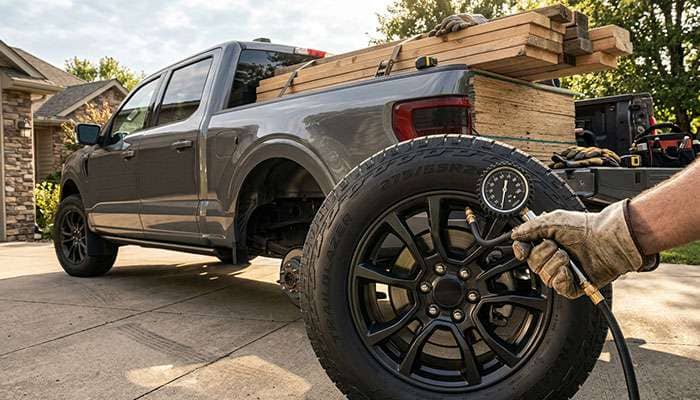
An underrated tire doesn't fail on day one. It fails on the hot day, with the bed loaded, after months of quiet damage. Here's how that damage builds, in order.
An overloaded tire flattens its footprint. The shoulders carry weight the center tread should be sharing. You'll see both outer edges wearing faster than the middle, the same pattern underinflation produces. Your tread life drops, often by thousands of miles.
Every revolution flexes the sidewall. More load means more flex, and more flex means more heat. At highway speed on a summer day, an overloaded tire runs significantly hotter than one inside its rating. Heat is what breaks down the bond between the rubber and the internal steel belts and body plies.
Repeated over-flexing fatigues the sidewall cords. A lower-profile tire also has less cushion between a pothole and the wheel lip, so impacts that a 275/60R20 absorbed can now pinch the sidewall. The result shows up as bulges, cracks near the bead, or cord damage you can't see from outside. If you spot any of that, read our guide on whether tire sidewall damage is safe to drive on before your next trip.
Once heat and flex have weakened the belt bond, the tread can begin to separate from the casing. Early signs include vibration that appears at highway speed and a lumpy feel through the steering wheel. By this point, the tire is done.
The last stage is a sudden air loss or a tread throw at speed, usually with the truck at its heaviest. On a rear tire while towing, that's the worst-case scenario: a sway event and a possible loss of control. Even when it ends safely on the shoulder, the bill typically includes a fender liner, a bumper cover or a damaged wheel, plus the set of four correctly rated tires you should have bought in the first place.
That last line is the point. The correctly rated 275/55R20 costs about the same as the underrated one. The difference is one number on the sidewall that takes ten seconds to check.
Follow these steps in order and the swap will be safe, legal, and predictable.
When you're ready to shop, our truck tires section lets you filter 275/55R20 by load index, so you can skip straight past the standard-load options and compare only the XL and LT tires that actually fit your truck's numbers.
The 275/55R20 is a perfectly valid replacement for 275/60R20. It mounts on the same wheel, clears everything the original cleared, and the 3.3% speedometer change is minor and fixable. Those are the parts everybody checks.
The part that actually decides the swap is load capacity. Standard-load 275/55R20 tires carry less than the 115-rated 275/60R20s most trucks wear from the factory, and FMVSS 120's P-metric derating makes that gap matter even more on a truck. An XL 275/55R20 closes the gap, but only when you run it above the old placard pressure. Get the load index right, set the pressure from the load table, change all four, and you'll have a truck that steers a little sharper, sits a half-inch lower, and still carries every pound it was built to carry.
Yes, as long as the 275/55R20 has a load index equal to or higher than your original tire, typically 117 XL or higher to replace a 115 SL 275/60R20, and you inflate it to the pressure that matches the original tire's load capacity. It fits the same 20-inch wheel and is 1.08 inches shorter in overall diameter.
Yes. A 275/55R20 measures about 31.91 inches tall versus 32.99 inches for a 275/60R20, a difference of 1.08 inches or 3.3%. Both are the same 275 mm width. The difference is entirely in sidewall height, which is 5.95 inches on the 275/55R20 and 6.50 inches on the 275/60R20.
Yes. Because the 275/55R20 is 3.3% smaller, your speedometer will read high. When it shows 60 mph, you're actually going about 58 mph, and at an indicated 70 mph you're doing about 67.7 mph. Your odometer will also record about 3.4% more miles than you actually drive. A dealer or aftermarket programmer can correct it.
Match or exceed the load index of your original tire, listed on the door placard. If your truck came with a 115 SL 275/60R20 rated at 2,679 pounds, choose a 275/55R20 rated 117 XL (2,833 pounds) or higher, or an LT Load Range E for regular towing. Standard-load 111 and 113 275/55R20 tires carry less than the original.
Run the pressure at which the 275/55R20 carries at least as much weight as your original 275/60R20, found in the tire manufacturer's load/inflation table. To match a 115 SL original, a 117 XL typically needs around 38 psi, a few psi above a 35 psi placard. Never exceed the maximum pressure molded on the sidewall.
A 275/55R20 usually rides slightly firmer because it has about half an inch less sidewall to absorb bumps, and XL tires run at higher pressure. In exchange, steering response is a little sharper and the tire flexes less in corners and under trailer sway. The difference is noticeable but modest on most half-ton trucks and SUVs.



