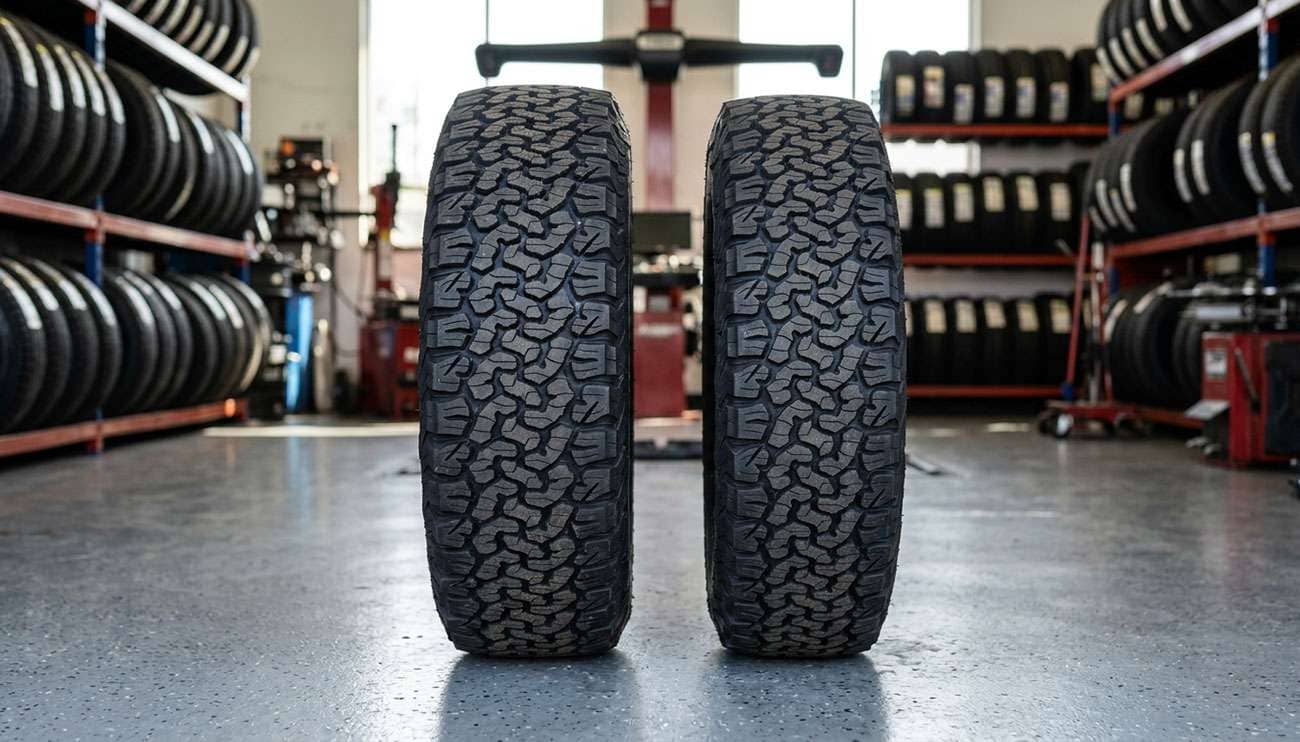
Short answer: yes. A 265/70R17 is only 0.14 inch taller than a 245/75R17, about 31.6 inches against 31.5, and about 0.8 inch wider. Ford and GM both list the two sizes for the same 3/4-ton trims. What decides whether it's the right tire is which 245/75R17 is printed on your door placard. On a Wrangler or Gladiator, it's a passenger tire, and a passenger 265/70R17 carries more than it did. On a Super Duty or 2500HD, it's a Load Range E, and only a Load Range E 265/70R17 will do the job. Most answers stop at "they're practically the same size." The size is the easy part.
I'm Hank Feldman. I've been fitting tires out of our Long Beach shop since 1971, and this question walks in from two completely different directions. One guy has a Jeep and wants a little more meat on it. The other has a work truck and the tire he wants is out of stock. Same two sizes, opposite answers on what to buy. Here's how to tell which one you are.
Find your truck, then read across. The "rated" number is what's molded into the sidewall. The "counted" number applies to passenger tires on a truck or SUV, where the tire industry knocks the rating down by about 9 percent.
Your Factory Tire |
Found On |
Factory Load |
The 265/70R17 to Buy |
Pressure |
|---|---|---|---|---|
245/75R17 112, passenger |
Wrangler JL Sport and Sport S; Gladiator Sport, Sport S, Altitude |
2,469 lb rated; 2,245 lb counted |
Passenger 265/70R17 115: 2,679 lb rated, 2,435 counted |
Your door placard (36 psi) |
245/75R17 112, passenger |
Same Jeeps, shopping for an LT all-terrain |
2,245 lb counted |
LT265/70R17 Load Range E: about 1,925 lb at 36 psi |
About 45 psi to match the factory tire |
LT245/75R17 Load Range E 121/118 |
F-250 Super Duty XL; Silverado and Sierra 2500HD WT |
3,195 lb at 80 psi |
LT265/70R17 Load Range E 121/118: 3,195 lb at 80 psi |
The LT265/70R17 line on your placard |
LT245/75R17 Load Range E 121/118 |
Same 3/4-tons, offered a passenger 265/70R17 |
3,195 lb at 80 psi |
None. A passenger 115 counts for 2,435 lb |
No pressure fixes it |
Read that bottom row twice. It's the swap that gets made at the counter when the shop is out of LT245/75R17 and has a pile of passenger 265/70R17s left over from half-ton jobs. Same height, wider, looks like an upgrade. It's about 760 pounds per tire short.
The 265/70R17 market splits roughly in half: about half LT construction, nearly all of it Load Range E, and about half passenger, most of it rated 115. The 245/75R17 market is the opposite: nearly 9 in 10 tires are LT, almost all of them Load Range E. So the tire you're replacing and the tire you're shopping often aren't built the same way.
265/70R17 Construction |
Load Index |
Pounds at 36 psi |
Pounds at 80 psi |
Right For |
|---|---|---|---|---|
Passenger, standard load |
113 or 115 |
2,305 to 2,435 counted on a truck |
Not rated for it |
Jeeps and half-tons that came on passenger tires |
LT Load Range C |
112/109 |
About 1,925 |
Not rated for it (50 psi max) |
Rarely the right answer on either truck |
LT Load Range E |
121/118 |
About 1,925 |
3,195 |
3/4-tons on LT245/75R17; Jeeps if you raise the pressure |
Barely taller, noticeably wider. The first number is section width in millimeters, so the 265 is 20 mm wider: about 10.4 inches across against 9.6. The second number is the sidewall height as a percentage of that width. Seventy percent of 265 mm and seventy-five percent of 245 mm come out almost identical, about 7.3 inches of sidewall against 7.2. That's why these two sizes are so often treated as twins.
Stack two sidewalls on a 17-inch wheel and you get about 31.61 inches overall for the 265/70R17 and 31.47 for the 245/75R17. That's 0.14 inch, or 0.44 percent. The axle comes up about 1/16 of an inch. The tire turns about 638 times per mile instead of 641. You will not see the difference, and your truck won't care.
The same pairing one wheel size down works the same way, and we covered it in 265/75R16 instead of 245/75R16. If you're thinking about going taller than this, not just wider, that's a different conversation: 285/70R17 instead of 265/70R17 is the next step up.
On the same wheel, the extra 20 mm splits about evenly, roughly 10 mm toward the suspension and 10 mm toward the fender. On the trucks that come on 245/75R17, there's room for that. Jeep puts LT285/70R17s on the Rubicon, a much wider tire on the same body, and Ford and GM list 265/70R17 for the very trims that wear 245/75R17. Where the extra width does show up is on the wheel, and I'll get to that.
Yes, with room to spare. The Wrangler JL Sport and Sport S, and the Gladiator Sport, Sport S, and Altitude, came on 245/75R17 at 36 psi. Jeep's own Willys and Rubicon trims run taller tires on the same bodies, LT255/75R17 and LT285/70R17, so a 31.6-inch 265/70R17 is well inside what these Jeeps were built to clear.
The factory tire is a passenger design. On the 2018 Wrangler, it was the Bridgestone Dueler H/T 685 at 245/75R17 112T. Load index 112 means 2,469 pounds at full rated pressure. Because a Wrangler is a multipurpose vehicle, the tire industry counts a passenger tire at the rating divided by 1.10 there, about 2,245 pounds.
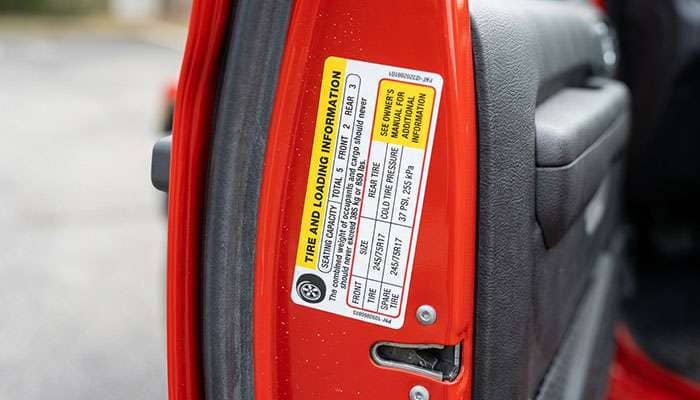
A passenger 265/70R17 is almost always rated 113 or 115. A 115 is 2,679 pounds, about 2,435 counted on the Jeep. That's 190 pounds more per tire than the factory tire, at the same 36 psi on your door placard. Nothing to recalculate. This is the cleanest version of the swap there is.
A lot of Jeep owners want an LT all-terrain for the tougher sidewall, and about half of all 265/70R17s are LT anyway. Here's the part people miss. An LT tire is built to carry its rated load at high pressure, up to 80 psi for Load Range E. At low pressure it carries less than a passenger tire of the same size, because the tire industry's light truck load tables are calculated differently.
At 36 psi, an LT265/70R17 carries about 1,925 pounds. The factory passenger tire counted for 2,245. To match it, the tire industry's light truck table puts you at about 45 psi, where the LT265/70R17 carries about 2,255. Toyo's own fitment guidance walks through the same math for a passenger-to-LT swap: match the factory tire's load at the new pressure, and accept that the ride gets firmer. The full trade-off is in P-metric vs LT tires.
One more thing. Your TPMS warning is keyed to the placard pressure. Under NHTSA's FMVSS 138, the light comes on at 25 percent below placard, so on a 36 psi Jeep it waits until about 27 psi. If your LT tires need 45 to carry the load, the light won't say a word at 35. Check them with a gauge.
Yes, and the manufacturers prove it. Ford lists both LT245/75R17 and LT265/70R17 for the F-250 Super Duty XL. GM lists LT245/75R17 as the standard tire on the Silverado 2500HD WT, with LT265/70R17 Load Range E as an alternate on the same trim. Both are 121/118 Load Range E, which means 3,195 pounds single at 80 psi.
The placards tell the story. On a 2020 F-250 XL, Ford calls for 65 psi front and 80 rear with LT245/75R17, and 60 front and 80 rear with LT265/70R17. On a 2017 Silverado 2500HD WT, GM calls for 60 and 80 with either size. Look at that Ford front number. The 265 has more air inside it, so it carries the same front axle weight at 5 psi less. That's not a guess. That's the engineers telling you the bigger tire has more capacity at the same pressure.
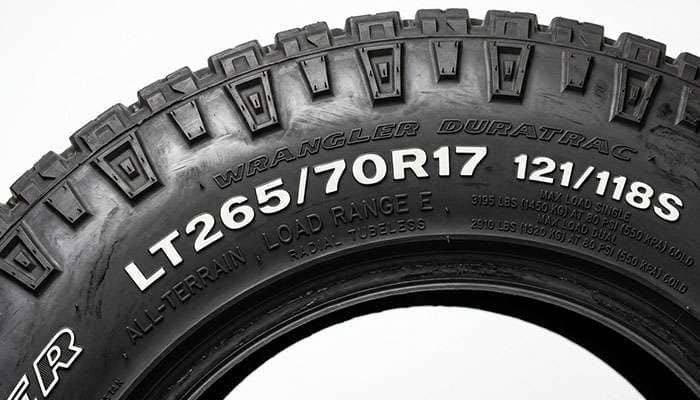
A passenger 265/70R17 rated 115 is 2,679 pounds, and on a truck it counts for about 2,435. Your LT245/75R17 was 3,195. That's roughly 760 pounds short at each corner, and there's no pressure that closes the gap, because a standard-load passenger tire reaches its full rating at 35 psi and goes no higher. On a 3/4-ton's rear axle, with a camper, a gooseneck, or a bed full of gravel, that's the tire that heats up and quits. If you're not sure what a lower load index actually costs you, read is a lower load index tire safe before anybody mounts anything.
Load Range C has the same problem from a different angle. An LT265/70R17 Load Range C tops out at 50 psi and 2,470 pounds. Better than a passenger tire, still more than 700 pounds short of what the truck came with. If the old tire said LT and Load Range E, the new one says LT and Load Range E. The LT245/75R17 vs 245/75R17 breakdown covers how much those letters change inside the same size.
Yes. Tire makers list an approved rim width range for every size. For 245/75R17 it's about 6.5 to 8.0 inches, measured on a 7.0. For 265/70R17 it's about 7.0 to 9.0 inches, measured on an 8.0. The factory steel wheels on the Jeeps and the 3/4-tons above are 17x7.5, which sits inside both ranges.
What changes is the shape. On a 7.5-inch wheel, the 265 is mounted half an inch narrower than the wheel it was measured on, so the sidewall bows out a little more past the rim flange. It's normal, it's approved, and it actually gives the rim edge a little more protection from curbs and rocks. The tire's real width on that wheel will come in a hair under the 10.4-inch catalog number. How rim width reshapes a tire is covered in what putting the same size tire on different rim widths does.
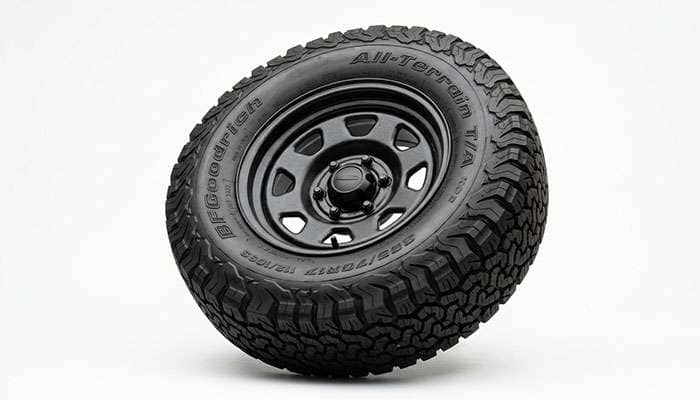
Where it goes the other way: anything narrower than 7.0 inches is below the 265's range, so check before mounting on an old 17x6.5. And if you've put the 245 on an aftermarket 17x8.5 or 17x9, you were already past the top of its range. The 265 is the size that actually belongs on those wheels.
Not enough to notice. The 265/70R17 is 0.44 percent taller, so when your speedometer says 60, you're doing about 60.3. Over 10,000 miles, the odometer will log about 44 fewer miles than you actually drove. No recalibration needed, no transmission or ABS concerns, and the gearing change is too small to feel. For comparison, a jump to 285/70R17 is about 3.5 percent, eight times as much.
A little, and it's the one honest trade-off in this swap. In deep snow and slush, a narrower tire cuts down through to firmer footing, and a given weight pressing on a narrower footprint bites harder. That's why plow guys and snowbelt fleets lean toward the skinnier size, and why a lot of folks run narrower tires on winter sets. Twenty millimeters isn't a dramatic difference, but in heavy snow, the 245 has the edge.
The wider 265 wins on the other side of the ledger: more float on sand and soft dirt, a slightly bigger footprint on dry pavement, and more choices if you want a passenger all-terrain for a Jeep. Expect the 265 to weigh about 2 pounds more per tire than the same construction in 245/75R17, which is a rounding error on fuel economy.
On the same axle, no. Left and right should match in size and construction, every time.
Across axles, the size difference itself is tiny. A 0.14-inch difference in diameter is less than the gap between a new tire and a half-worn one of the same size, so a 245 spare will get you home on a 4x4 running 265s. But mixing sizes front to rear means mixing grip, wear, and often construction, and that's not a setup I'd run on purpose. If your Jeep has a full-size spare in the rotation, buy five tires, not four. On a 3/4-ton, make sure the spare under the bed is Load Range E too, because a spare that can't carry the load is a spare in name only.
An under-rated tire doesn't fail in the parking lot. It fails a little at a time, usually when you're loaded heaviest and furthest from home.
Every rung costs more than getting the construction right the first time. When you're ready to shop, our 265/70R17 tires list the load index and speed rating on every tire, so you can match it to your placard before you buy.
Size-wise, 265/70R17 and 245/75R17 are about as close as two different tire sizes get: 0.14 inch apart in height, 20 mm apart in width, and approved on the same 17x7.5 wheels. Ford and GM list both on the same 3/4-ton trims, and Jeep runs bigger tires than either one on its own Wranglers and Gladiators.
What you have to get right is construction. If your placard says 245/75R17 with no LT, a passenger 265/70R17 is a straight upgrade at the same pressure, and an LT version needs more air. If it says LT245/75R17 Load Range E, the replacement has to say LT265/70R17 Load Range E, every time. Match that, and the swap is as easy as it looks. You can compare load ratings side by side in our 265/70R17 tires.
Almost the same height, not the same width. A 265/70R17 is about 31.6 inches tall and 10.4 inches wide; a 245/75R17 is about 31.5 inches tall and 9.6 inches wide. The height difference is 0.44 percent.
Yes. Wrangler JL Sport and Sport S models came on 245/75R17, and Jeep runs taller tires on the Willys and Rubicon. A 265/70R17 fits the factory 17x7.5 wheels without a lift.
Yes, if it's an LT265/70R17 Load Range E. Ford lists that size for the F-250 Super Duty XL alongside LT245/75R17. A passenger 265/70R17 does not carry enough load for a 3/4-ton truck.
It depends on construction. A passenger 265/70R17 on a Jeep runs at your placard pressure. An LT265/70R17 on a Jeep needs about 45 psi to match the factory tire. On a 3/4-ton, use the LT265/70R17 pressures on your placard.
Barely. The 265/70R17 is 0.44 percent taller, so at an indicated 60 mph you're doing about 60.3. No recalibration is needed.
About 7.0 to 9.0 inches, with 8.0 as the measuring rim. Factory 17x7.5 steel wheels on Jeeps and 3/4-ton trucks are inside that range.