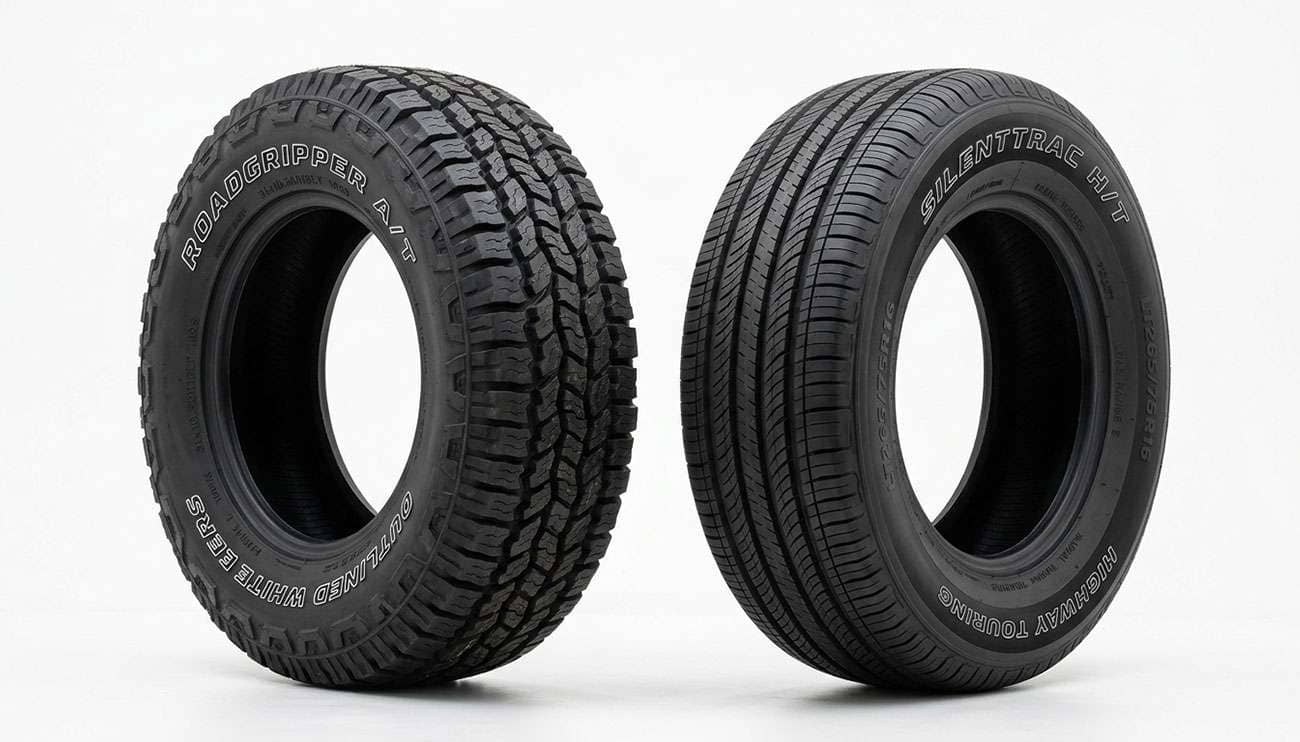
Both tires measure about 31.5 inches tall and 9.65 inches wide, and both bolt onto the same 17 inch wheel. The LT version carries roughly 3,195 pounds per tire. The P-metric version carries about 2,469 pounds, and on a truck you have to knock another ten percent off that. That is a spread of more than 900 pounds a corner hiding behind two letters. If you tow, haul, or run a work bed, the letters are the whole answer.
I have been selling tires out of this shop for a long time, and there is one phone call I get more than almost any other. Fella reads his sidewall, writes down 245/75R17, goes shopping online, finds a set two hundred bucks cheaper than what the shop quoted him, and buys them. Tires show up. They fit. They air up. They look right.
Then he loads the bed with a pallet of pavers, or hooks up the equipment trailer, and about forty miles down the road he notices the truck feels loose in a way it never did before. Or he does not notice anything at all, right up until a sidewall lets go on I-5 in August.
What happened is that he bought a P-metric tire to replace an LT tire. Same size string, same inches, same rim. Completely different piece of equipment.
Let me lay this out the way I would across the counter.
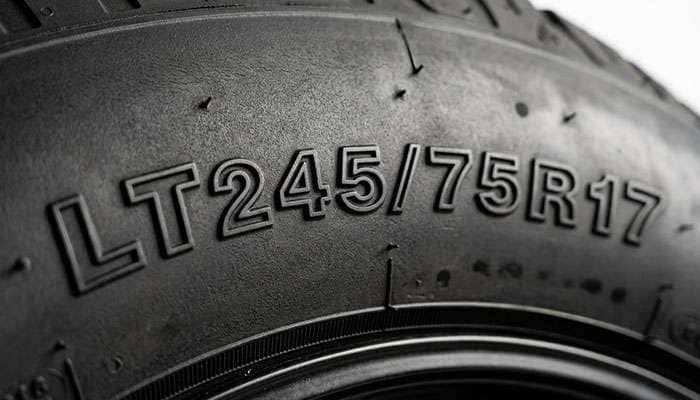
Walk down the sidewall of your tire and find the size. You are going to see one of three things at the front of it.
LT245/75R17. LT stands for light truck. This is a tire built with more plies, a heavier casing, stiffer sidewalls, and a bead package designed to take high inflation pressure. In this size it almost always carries load range E, which is a ten ply rating, and a load index of 121.
P245/75R17. P stands for P-metric, which is the passenger car standard. Lighter casing, softer sidewall, lower maximum pressure. In this size you are usually looking at a load index of 110 to 116.
245/75R17 with nothing in front of it. This is a Euro-metric tire. For practical purposes on an American truck it behaves like the P-metric, and in this particular size most of the no-prefix tires land at load index 112, right alongside the P-metrics. If the sidewall adds XL after the size, that is a reinforced passenger tire rather than a light truck tire, and our guide to XL load range explains what that marking does and does not buy you.
Here is the thing that trips people up. The number 245/75R17 is a description of shape. It tells you the tire is 245 millimeters across the section, that the sidewall is 75 percent of that width, and that it wraps a 17 inch rim. Shape is all it tells you. It says nothing about how much the thing can hold up, and holding weight up is the entire job of a truck tire.
Two tires can be the same shape and be built for completely different lives. A 55 gallon drum and a 55 gallon plastic trash can are the same shape too. You would not put transmission fluid in the trash can.
Let me get this out of the way first, because it is the part everybody looks up and it is the same for both versions.
Overall diameter is about 31.5 inches. The math: 245 millimeters times 0.75 gives you a sidewall of 183.75 millimeters. Two sidewalls, one top and one bottom, is 367.5 millimeters, which is 14.47 inches. Add the 17 inch rim and you land at 31.47 inches.
Section width is about 9.65 inches. That is 245 millimeters divided by 25.4.
Sidewall height is about 7.23 inches from the rim edge out to the tread.
That is the answer, and it does not change whether the tire says LT on it or not. Which is precisely the problem. Everything you can measure with a tape is identical. Everything that matters for whether the tire survives a loaded run over the Grapevine is stamped somewhere else on the sidewall in smaller print.
If you want the same breakdown for the neighboring size, we ran the numbers on 245/70R17 in inches as well, which comes out about an inch shorter.
This is the number that should decide your purchase, so let us put it in plain arithmetic.
Spec |
LT245/75R17 |
P245/75R17 or 245/75R17 |
|---|---|---|
Typical load index |
121 |
110 to 116, most commonly 112 |
Max load per tire |
About 3,195 lb |
About 2,469 lb at index 112 |
On a truck, after de-rating |
About 3,195 lb, no de-rate |
About 2,244 lb |
Typical load range |
E, a ten ply rating |
Standard load or XL |
Max inflation |
Commonly 80 psi |
Commonly 44 to 51 psi |
Overall diameter |
About 31.5 in |
About 31.5 in |
Section width |
About 9.65 in |
About 9.65 in |
Read the top three rows and the bottom two rows together. The tires are dimensionally the same and structurally nothing alike.
Across four corners, an LT set gives you roughly 12,780 pounds of tire capacity. A P-metric set on a truck gives you roughly 8,976 pounds. That is a difference of about 3,800 pounds of margin, which is a whole second truck bed worth of capacity you either have or do not have.
The load index scale itself is worth understanding, because it is not intuitive and the numbers are not linear. Our guide on load range versus load index walks through how the two systems relate and why light truck tires use letters where passenger tires use XL.
This is the part that gets left out of every online listing, and it is the single most useful thing in this article.
When you install a P-metric or Euro-metric tire on a truck, an SUV, or any multipurpose passenger vehicle, you divide the tire's rated load capacity by 1.10 before you use it. Ten percent comes right off the top.
That is not my rule and it is not a shop superstition. It is the industry standard practice published by the Tire and Rim Association, and it exists because passenger tires are engineered around the duty cycle of a car. Cars carry people and groceries. They do not sit loaded at gross weight for eight hours on a hot interstate with a trailer pushing on the hitch. Trucks do. The ten percent is the engineering margin that accounts for the difference in how the vehicle actually gets used.
So a P245/75R17 at load index 112, which is rated 2,469 pounds on paper, is worth about 2,244 pounds once it is under your truck. An LT tire takes no such haircut, because it was built for the truck duty cycle in the first place.
Now do the comparison honestly. 3,195 against 2,244. That is 951 pounds per corner. Nearly half a ton of capacity per tire, and the two tires look identical sitting side by side on the rack.
If you want the deeper background on how these two construction standards diverged, we covered it in our breakdown of P-metric versus LT tires.
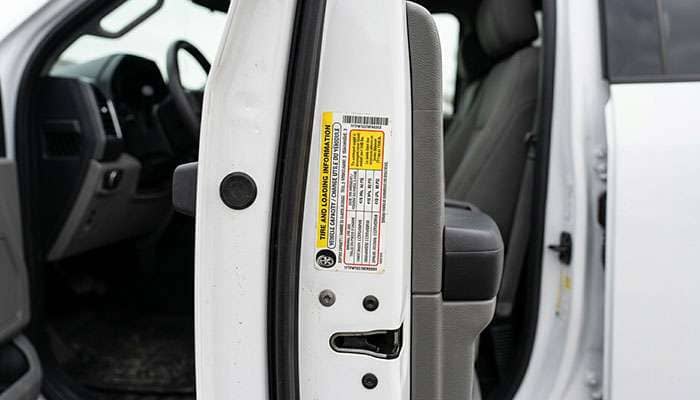
You do not have to guess and you should not. Open the driver's door and look at the placard on the jamb. That sticker was put there by the people who engineered the truck, and it lists the exact size the vehicle was certified with, including the prefix.
Here is roughly how it shakes out with the trucks that run this size.
If your placard says LT245/75R17, you replace it with LT245/75R17. Full stop. There is no version of this where dropping to a P-metric is the right call. The truck's gross axle weight rating was certified against that tire's capacity. Federal Motor Vehicle Safety Standards require the manufacturer to fit tires adequate to the axle rating, and the placard is the document that records it. Going below it is a deviation from vehicle specification, and if that tire is ever part of an incident, that fact ends up in the file.
If your placard says P245/75R17 or plain 245/75R17, you have a real choice. Lighter half-ton trucks and body-on-frame SUVs frequently come this way from the factory, and for a truck that hauls kids and a couple of mountain bikes, the P-metric it came with is genuinely the better daily tire. But if your use has changed since the truck was new, and now there is a camper on it or a trailer behind it most weekends, upgrading to LT is a legitimate and common move.
If the placard is gone, faded, or painted over, pull the owner's manual or call the dealer with the VIN. Do not take the word of whatever is currently mounted, because the tire on the truck is evidence of what the last owner bought, not evidence of what the truck requires.
One more piece of housekeeping while you are down there. Look at the sidewalls of what is on the truck right now for bulges, cuts, or gouges. Any of those means the tire is done regardless of what the numbers say, and our guide on tire sidewall damage and whether it is safe to drive explains why sidewall injuries are never repairable.
I am not going to sit here and tell you LT is free. It is not, and anybody who pretends otherwise has not driven an empty three quarter ton truck on eighty pound tires across town.
Weight. An LT tire in this size runs meaningfully heavier than its P-metric counterpart. That is unsprung, rotating weight, and you feel it in acceleration, in braking, and in the steering.
Ride. Stiffer sidewalls and more plies mean the tire does less of the work absorbing pavement joints and the suspension does more. On an empty truck, an E-range tire rides firm. On a loaded truck, that same firmness is exactly what you want, because the sidewall stops squirming under the load.
Fuel economy. More mass to spin up and more rubber flexing per revolution both cost you. It is not dramatic, but over the life of a set it is real money.
Purchase price. LT tires generally cost more than the equivalent P-metric in the same tread pattern, because there is more material and more construction in them.
Here is my honest take after decades of this. If your truck is a truck, take the ride penalty and buy the LT. If your truck is really a family vehicle with a bed on the back, and the heaviest thing it carries is a load of mulch twice a year, a good P-metric is the smarter tire and you will enjoy driving it more. The mistake is not choosing one or the other. The mistake is choosing without knowing which one you chose.
People want to know what actually goes wrong, not just that something goes wrong. Fair question. Here is the sequence, and it is a ladder, not a light switch.
First, the sidewall starts flexing more than it was designed to. A tire running close to its capacity deflects further on every single revolution. At sixty miles an hour that tire is turning something like eight hundred times a minute, and every one of those revolutions is a flex cycle.
Second, that flexing turns into heat. Rubber is not a spring, it is a damper. When you bend it and let it go, some of that energy comes back out as heat instead of motion. Engineers call it hysteresis. You and I can call it the reason a tire is hot to the touch after a highway run when it should just be warm.
Third, the heat goes after the belt package. The steel belts inside your tire are held to the surrounding rubber by a chemical bond. That bond has a temperature it does not like, and sustained operation above it degrades the bond a little at a time. Nothing announces itself. The tire looks fine.
Fourth, the handling goes soft under load. Long before anything fails you will notice the truck feels vague when it is loaded. Trailer sway that was not there before. A wandering feeling in a crosswind. That is the sidewall doing the moving instead of the suspension.
Fifth, you get a separation. Belt separation shows up as a vibration you cannot balance out, or a visible bulge, or a piece of tread departing the tire at speed. By the time it shows, the damage has been accumulating for thousands of miles.
That whole ladder is why the ten percent de-rate exists. It is a margin against exactly this progression, and the reason it feels invisible is that steps one through three do not produce any symptom at all.
If you want to get comfortable reading the load range and ply markings yourself, our walkthrough on how to read tire load range and ply ratings covers what the letters mean and where to find them.
If you do change from P-metric to LT, understand that you are changing the pressure conversation completely, and this is where a lot of people get it wrong in the other direction.
An LT tire in load range E typically shows 80 psi as its maximum on the sidewall. That number is the pressure at which the tire achieves its maximum rated load. It is a ceiling, not a target, and I have seen more than a few trucks come in here running 80 all the way around on an empty bed, chewing the center out of a brand new set of tires and riding like a buckboard.
What you actually want is the pressure that matches the load you are carrying, which is what the manufacturer's load and inflation tables are for. For most half ton and light three quarter ton trucks running LT245/75R17 unloaded, that lands considerably below the maximum, and then you air up when you load up.
Two practical rules from the shop floor.
Set pressures cold. Cold means the truck has been parked at least three hours, or has driven less than a mile. A tire that has been running highway speeds reads several psi high and you will end up underinflated when it cools.
Adjust for the season. You lose roughly one psi for every ten degree drop in ambient temperature. A truck set correctly on a warm afternoon is meaningfully low on a cold morning, and on a heavy tire that shortfall goes straight into sidewall flex. Our guide on how to find your recommended tire pressure shows where to find the right starting number.
One more thing. If you switch from P-metric to LT, do not assume the placard pressure carries over. It does not. The placard number was calculated for the tire the truck was certified with, and an E-range tire achieves the same load at a different pressure than a standard load tire does. Ask whoever mounts them to look it up properly.
One. Read the door jamb placard. Write down the full size including any prefix, plus the cold inflation pressure. That is your baseline and everything else is measured against it.
Two. Find your gross vehicle weight rating and your payload. Same sticker, usually. If your payload number is over about 1,700 pounds, or if the truck is rated to tow more than about 7,000, you belong on LT.
Three. Be honest about what you actually do with the truck. Not what you did once in 2019. What you do most months. Weekend dump runs and a bike rack is P-metric territory. A slide-in camper, a welder, a fifth wheel, or a bed full of tools every day is LT territory.
Four. Never go down in load index. Going up is always allowed. Going down is never allowed. If the placard says LT245/75R17 at index 121, index 121 is your floor.
Five. Buy four. Do not mix LT on one axle and P-metric on the other. The two constructions have different spring rates and different slip characteristics, and mixing them gives you a truck that does one thing at the front and something else at the back exactly when you need it to be predictable.
The inches are the easy part, and they are the same either way. 31.5 tall, 9.65 wide, 17 inch rim, no matter which one you buy.
The hard part is the two letters in front, and that is the part your tape measure cannot help you with. LT245/75R17 carries about 3,195 pounds a corner. The P-metric version carries about 2,244 pounds a corner once you apply the truck de-rate. Same shape, nearly half a ton apart.
Go look at your door jamb. It takes thirty seconds and it will tell you which tire your truck was built around. If it says LT, buy LT and do not let a cheaper listing talk you out of it. If it says P-metric, you get to choose, and you should choose based on what is actually going in that bed this year.
Ready to shop? Take a look at our full range of LT245/75R17 tires and check the load index on every one before you add it to the cart.
A 245/75R17 is about 31.5 inches in overall diameter and about 9.65 inches in section width, with roughly 7.23 inches of sidewall height, mounted on a 17 inch wheel. Those figures are identical whether the tire is an LT, a P-metric, or a Euro-metric version, which is why the inches alone are not enough to tell you which tire your truck needs.
No. The truck's gross axle weight rating was certified against the LT tire's load capacity, and a P-metric tire in this size gives up roughly 951 pounds per corner once the required ten percent truck de-rate is applied. That is a deviation from the vehicle's specification, and it shows up as excess sidewall flex, elevated operating temperature, and accelerated degradation of the belt bond under load.
Yes. Going up in load capacity is always permitted, and it is a common upgrade for owners who have started towing or hauling more than the truck was originally bought for. Expect a firmer ride, a bit more weight, and a small fuel economy penalty. Do not carry the old placard pressure across, because an E-range tire reaches the same load at a different inflation pressure than a standard load tire.
Load range E corresponds to a ten ply rating and is the most common load range for LT245/75R17. It does not mean the tire literally contains ten plies of material, since modern construction achieves the same strength with fewer, stronger layers. It means the casing is built and certified to the strength standard historically associated with ten plies, and it typically comes with an 80 psi maximum inflation.
For purposes of fitting it to a truck, treat it that way. A size with no prefix is a Euro-metric tire, and in this size most of them carry a load index around 112, right in line with the P-metric versions. The ten percent truck de-rate applies to Euro-metric tires the same way it applies to P-metrics. Always read the load index on the sidewall rather than assuming from the prefix alone.
Match the pressure to the load you are actually carrying using the tire manufacturer's load and inflation table, starting from the figure on your door jamb placard. The 80 psi molded into an E-range sidewall is the pressure required to reach the tire's maximum rated load, not a daily target. Running maximum pressure on an unloaded truck wears out the center of the tread and rides badly. Set pressures cold and add air seasonally as temperatures drop.
Somewhat. LT tires are heavier and their stiffer casings flex more material per revolution, and both of those cost energy. The penalty is modest rather than dramatic, but over the life of a set it adds up. Whether that is worth it comes down to how you use the truck. On a vehicle that regularly carries or tows near its rating, the capacity and stability are worth far more than the fuel.