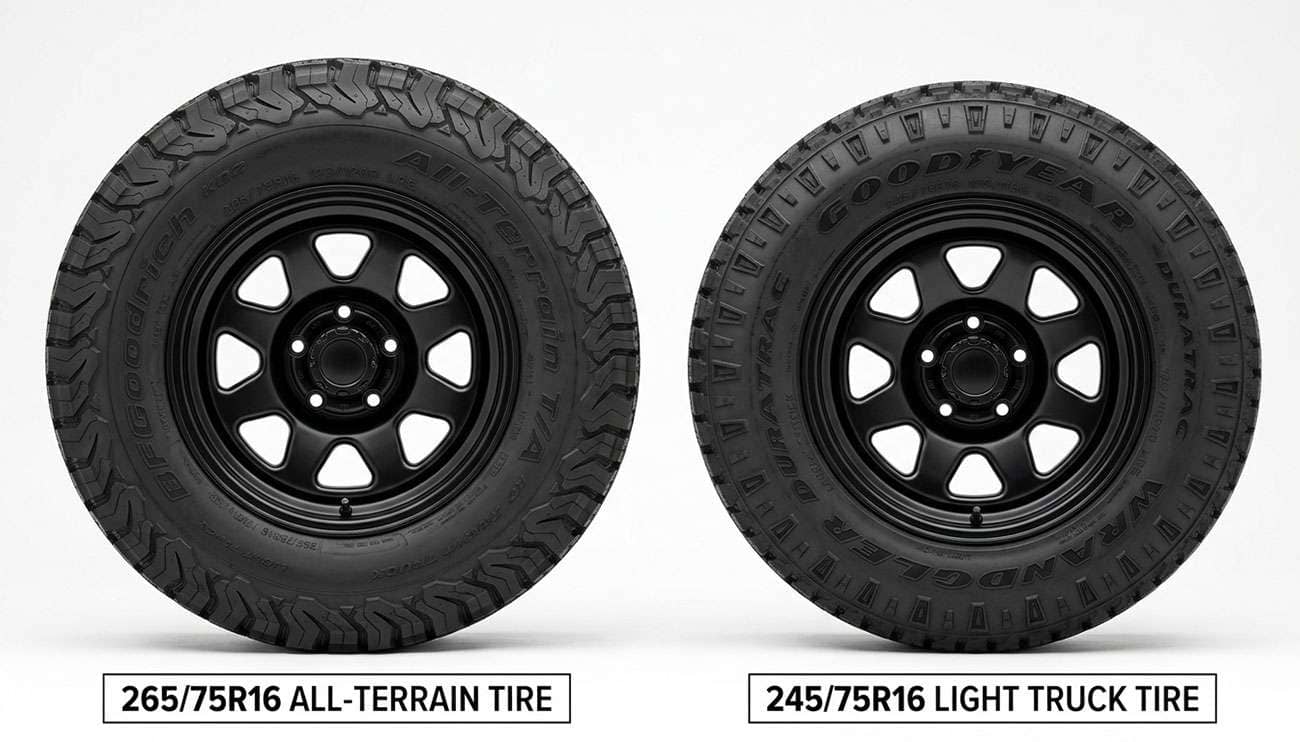
Yes. On most pickups, vans, and SUVs that came with 245/75R16, a 265/75R16 fits and works. Two variables decide whether yours is one of them: the width of the wheel the tire is going on, and the load range you are replacing. Most 265/75R16 tires list 7.0 inches as their minimum approved rim width, and plenty of trucks and vans rolled out of the factory on 6.5-inch steel wheels. And a bigger size does not mean more capacity. A P-metric 265 carries roughly 700 pounds less per tire than the LT245 Load Range E it replaces.
I'm Dennis Feldman, and I handle fitment questions at Performance Plus Tire every day. Most answers to this question stop at "it depends on your truck" and never say what it depends on. Here it is. Find your wheel width and your current load range in the table below, and you have your answer before you scroll any further.
Your Setup |
Current Tire |
Can You Run 265/75R16? |
What to Buy |
|---|---|---|---|
7.0- to 8.0-inch wheel |
P245/75R16 (SL or XL) |
Yes, a clean fit on most trucks |
P265 or LT265; either matches or beats your capacity |
7.0- to 8.0-inch wheel |
LT245/75R16 Load Range E |
Yes, if you stay at Load Range E |
LT265/75R16 Load Range E only |
6.5-inch wheel |
Any 245/75R16 |
Only if that exact tire lists 6.5 inches as approved |
Check the spec sheet, or move to a 7.0- to 8.0-inch wheel |
6.0-inch wheel |
Any 245/75R16 |
No |
New wheels first, then tires |
Full-time 4WD or AWD |
Any 245/75R16 |
Yes, as a full set of four (plus the spare) |
Never mix 245 and 265 on the same vehicle |
Both sizes share the same 75 aspect ratio and the same 16-inch wheel, so the only number that changes is section width: 245 millimeters versus 265 millimeters. Because the aspect ratio is a percentage of width, that 20-millimeter jump makes the sidewall taller too. The 245 has a 183.75-millimeter sidewall. The 265 has a 198.75-millimeter sidewall. Two sidewalls stack into overall diameter, so the tire grows in both directions at once.
Measurement |
245/75R16 |
265/75R16 |
Difference |
|---|---|---|---|
Overall diameter |
30.5 in |
31.6 in |
+1.2 in (+3.9%) |
Section width |
9.6 in |
10.4 in |
+0.8 in |
Sidewall height |
7.2 in |
7.8 in |
+0.6 in |
Circumference |
95.7 in |
99.4 in |
+3.7 in |
Revolutions per mile |
662 |
637 |
25 fewer |
Ground clearance gain |
Baseline |
+0.6 in |
Half the diameter gain |
Measuring rim width |
7.0 in |
7.5 in |
+0.5 in |
Typical approved rim range |
6.5 to 8.0 in |
7.0 to 9.0 in |
Minimum moves up 0.5 in |
Those calculated figures are nominal. Real tires vary by brand and tread design, and an aggressive all-terrain often measures a few tenths taller than a highway tread in the same size. In plain terms, the 265/75R16 is a 31-inch tire, which is why so many people treat it as the metric cousin of the old flotation size. If you have wondered how close that comparison really is, I broke it down in whether 265/75R16 is the same as 31x10.5R15.
The 3.9 percent diameter change is the number to remember. It drives your speedometer error, your effective gearing, and your clearance at full steering lock. Industry convention puts a 3 percent diameter change as the comfortable limit for a no-modification swap. At 3.9 percent, the 265 sits just past that line. That doesn't make it a bad swap. It makes it a swap where the details below actually matter.
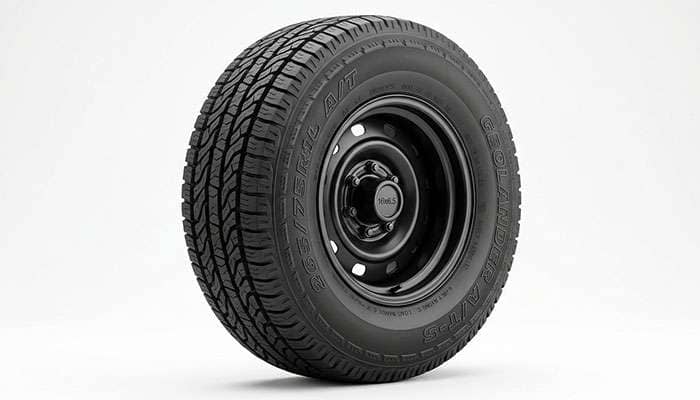
This is the variable almost nobody puts in front of you, and it is the one that decides the swap on a lot of work trucks and vans. A great many heavy-duty pickups and full-size vans shipped on 16x6.5 steel wheels. Most 245/75R16 tires list 6.5 inches as an approved width. Most 265/75R16 tires list 7.0 inches as their minimum.
Every tire maker publishes an approved rim width range for each size, based on Tire and Rim Association guidelines. The range is not a suggestion. The tire's bead, sidewall angle, and tread footprint are engineered around a specific "measuring rim," which is 7.0 inches for 245/75R16 and 7.5 inches for 265/75R16. Move inside that window and the tire behaves as designed. Move below it and the geometry changes.
When you mount a 265 on a 6.5-inch wheel, the beads sit closer together than the tire was built for. The sidewalls pinch inward at the bead and bow outward above it. The tread face crowns, so the center of the tread carries more of the load than the shoulders. Three things follow.
Plenty of owners run 265s on 6.5-inch steelies without drama, but "it seems fine" is not the same as "it's inside spec." Tire Industry Association training teaches installers to mount tires only on rim widths the manufacturer approves, and many shops will refuse the job when the wheel falls outside that range.
Look on the back side of a spoke or the inside of the wheel center for a stamp such as "16x6.5" or "16x6.5JJ." The second number is the width, measured bead seat to bead seat, not lip to lip. If you measure the outside lips with a tape, you will read about an inch wider than the true size. Then pull the spec sheet for the exact 265/75R16 you want and look at the approved rim range. A handful of models do list 6.5 or even 6.0 inches as approved. If yours does, you are in spec. If it doesn't, the answer is a 16x7 or 16x7.5 wheel first. Our guide to matching tire size to wheel width walks through the full range logic.
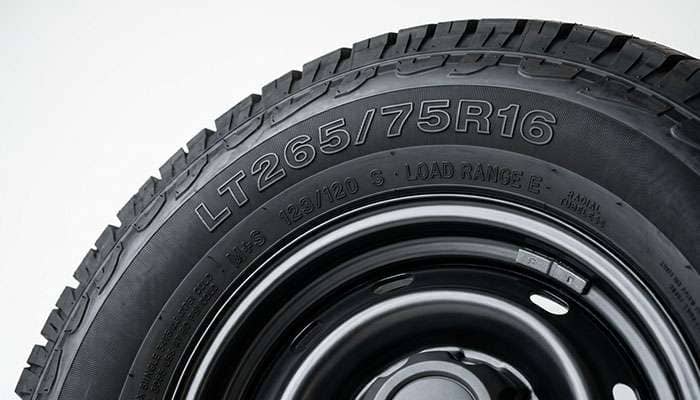
Only when you compare the same construction and the same load range. Size by itself tells you almost nothing about capacity. This is where a "bigger tire" swap quietly turns into a downgrade.
A bigger tire holds more air, and air is what carries the load. So in an apples-to-apples comparison, the 265 wins: LT265/75R16 Load Range E carries 3,417 pounds per tire at maximum pressure, versus 3,086 pounds for LT245/75R16 Load Range E. That is 331 more pounds per corner. But the moment you change construction, that advantage can vanish and reverse.
Construction |
245/75R16 Max Load |
265/75R16 Max Load |
Load on a Truck (P-metric derated) |
Max Pressure |
|---|---|---|---|---|
P-metric Standard Load |
109 / 2,271 lb |
114 / 2,601 lb |
2,065 lb vs 2,365 lb |
35 psi load basis |
P-metric Extra Load |
112 / 2,469 lb |
116 / 2,756 lb |
2,245 lb vs 2,505 lb |
41 psi load basis |
LT Load Range C |
108 / 2,205 lb |
112 / 2,469 lb |
No derate (LT) |
50 psi |
LT Load Range D |
Rarely offered |
119 / 2,998 lb |
No derate (LT) |
65 psi |
LT Load Range E |
120 / 3,086 lb |
123 / 3,417 lb |
No derate (LT) |
80 psi |
Look at the fourth column. The Tire and Rim Association rule is that when a P-metric tire goes on a light truck, SUV, or van, you divide its rated capacity by 1.10. That margin accounts for the harder duty cycle trucks see. So a P265/75R16 Standard Load rated at 2,601 pounds is really a 2,365-pound tire on your pickup.
Now compare that number to the LT245/75R16 Load Range E that a lot of three-quarter-ton trucks and cargo vans wear from the factory: 3,086 pounds. Swap to a P-metric 265 because it's "bigger," and you just lost about 720 pounds of capacity per tire, close to 2,900 pounds across the set. Even an LT265 in Load Range C falls more than 600 pounds short of the LT245 E it replaces. If you want the full construction story, see our breakdown of P-metric vs. LT tires.
Under FMVSS 110, the vehicle's tire placard lists the original size and the inflation pressure that supports the vehicle's maximum loaded weight. NHTSA's position is simple: any replacement tire must carry at least the load the original tire was rated to carry at that placard pressure. In practice that means one thing. Match or exceed your original load range letter, and check the load index number on the sidewall, not the size. Our guide to load range vs. load index explains how to read both marks.
Going the other direction works fine. If your truck came on P245/75R16 Standard Load, nearly any 265/75R16, P-metric or LT, matches or beats the original capacity. That is the easy version of this swap.
Because the 265 holds more air, it carries a given load at a slightly lower pressure than the 245 in the same load range. That does not mean you should copy the door-placard number blindly, and it does not mean you should drop pressure until the ride feels soft. Use the tire maker's load and inflation table to find the pressure that carries your actual axle weight, then confirm with a chalk test on dry pavement: a chalk stripe across the tread should wear evenly across the full width after a short drive. With LT tires on a lightly loaded half-ton, that number often lands well below the 80 psi max molded on the sidewall. With a loaded van or a truck pulling a trailer, it will land much closer to it.
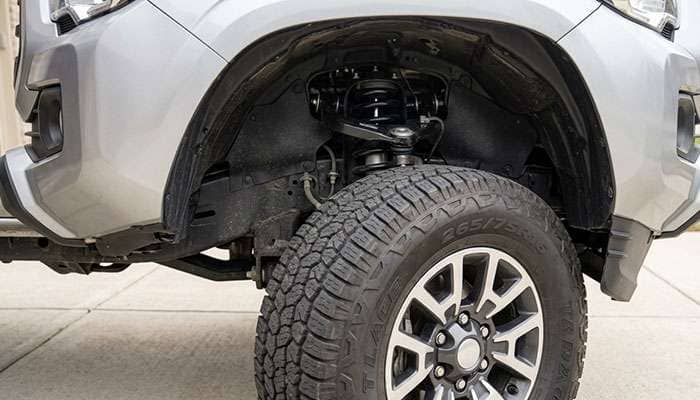
On most full-size pickups and many midsize trucks, no. The 265/75R16 has been a popular no-lift upgrade for decades because the numbers are modest. But "most" is not "all," and where it rubs is predictable.
Think of the change in terms of space. The tire grows about 0.6 inches in radius, which closes the gap to the fender lip and inner liner by that much at ride height and more under compression. It also grows about 0.8 inches in width. On the same wheel, that width splits roughly in half: about 0.4 inches closer to the suspension on the inside and 0.4 inches closer to the fender on the outside. Those are small numbers until you turn the steering wheel all the way and hit a bump at the same time.
If you are keeping your factory wheel, the 0.4-inch split above holds. If you are buying new 7-inch or 7.5-inch wheels to get inside the 265's rim range, pay attention to backspacing. A wider wheel with the same backspacing pushes all of the extra width outward, toward the fender. A wider wheel with more backspacing pulls the tire toward the control arm. The safe play is a replacement wheel whose backspacing keeps the tire's centerline close to stock. If your truck already rubs, or you aren't sure whether a noise is rubbing at all, our guide on why tires rub covers how to find the contact point.
Aggressive tread also matters. A mud-terrain with tall shoulder lugs often measures wider at the shoulder than its section width implies, and those lugs find plastic faster than a highway tread. The 265/75R16 size has far more mud-terrain choices than the 245, which is part of its appeal, so this is a real consideration.
About 3.9 percent, and it always reads low. Your speedometer counts wheel revolutions and assumes each one covers the distance of a 245/75R16. The 265 covers more ground per turn, so the truck is moving faster than the dash says.
Speedometer Shows |
Actual Speed on 265/75R16 |
Error |
|---|---|---|
30 mph |
31.2 mph |
+1.2 mph |
45 mph |
46.7 mph |
+1.7 mph |
55 mph |
57.1 mph |
+2.1 mph |
65 mph |
67.5 mph |
+2.5 mph |
75 mph |
77.9 mph |
+2.9 mph |
Two and a half miles per hour at highway speed won't change your life, but it will change your odometer. Every 10,000 miles the truck shows, it actually traveled about 10,390. That matters for maintenance intervals and warranty mileage, and it matters for the gas mileage math in the next section. Most modern trucks can be recalibrated with a dealer scan tool or an aftermarket programmer that lets you enter the new tire size. Older trucks with a mechanical drive use a replaceable speedometer gear in the transmission. Our article on bigger tires and your speedometer covers the recalibration options in detail.
A taller tire acts like a numerically lower axle ratio. Multiply your ratio by 0.963 and you have the effective ratio on 265s: 3.42 behaves like 3.29, 3.73 like 3.59, 4.10 like 3.95. On a V8 truck with 3.73 or deeper gears, most drivers barely notice. On a smaller engine with highway gears, or on a truck that tows near its limit, you will feel it in acceleration and in how often the transmission hunts between gears on grades. A 3.9 percent change does not justify a regear on its own, but it is worth knowing if you plan to go bigger later.
A little, and less than your hand calculation will tell you. Three factors are in play.
Weight. When I compared the same tire model in both sizes and the same Load Range E construction across the market, the 265 typically weighed about 4 to 6 pounds more per tire. The Yokohama Geolandar A/T4, for example, gains a little over 5 pounds per tire going from 245 to 265. Commercial-duty tread runs heavier: the Toyo M-55 adds about 12 pounds per tire. That is rotating, unsprung mass, so it costs more in acceleration and braking than the same weight in the bed.
Rolling resistance and frontal area. A wider footprint and a taller profile add a small amount of drag. Tread design matters more here than size. Moving from a highway rib to an aggressive all-terrain often costs more fuel than the size change itself.
The odometer trap. This is the one that fools people. Because your odometer under-reads by 3.9 percent, a truck that actually holds steady at 18 mpg will calculate out to about 17.3 mpg if you divide displayed miles by gallons. Recalibrate the speedometer first, or correct the miles by 1.039, before you decide the swap cost you anything. Once that correction is in, most drivers see a real-world drop somewhere around half a mile per gallon to one mile per gallon, more if they changed tread type at the same time.
A properly specified 265/75R16 swap is one of the most reliable small upgrades you can make to a truck. A poorly specified one fails slowly, and it fails in a predictable order.
On a wheel narrower than the tire's approved range, the crowned tread wears the center ribs first. On an underinflated LT tire, or an overloaded P-metric tire, the shoulders wear first. Either way you lose usable tread thousands of miles early and the truck starts to wander on grooved pavement.
A tire that kisses the control arm or liner at full lock leaves a polished band on the sidewall. Repeated contact scuffs through the rubber and exposes the cords underneath. Once cords show, the tire is done. If you have found scuffing or a bulge already, read our guide on whether sidewall damage is safe to drive on before your next trip.
This is the stage that matters most. A P-metric 265 replacing an LT245 Load Range E on a loaded van or three-quarter-ton truck is running past its derated capacity every time the bed is full. An overloaded tire flexes more with every revolution, and flex turns into heat. Heat breaks down the bond between rubber and steel belts. NHTSA lists overloading and underinflation among the leading causes of tire failure for exactly this reason. The tire looks fine right up until a tread separation at highway speed.
On a full-time 4WD or AWD vehicle, running a 245 spare alongside three 265s forces the center differential or coupling to make up a 3.9 percent difference in rolling distance. Over enough miles, that wears clutch packs and overheats viscous couplings. Part-time 4WD trucks in 2WD are safe on a mismatched spare for a short trip, but not in 4WD on pavement. The fix is cheap compared with a transfer case: buy five tires, and confirm the 265 actually fits your spare carrier, since some under-bed winches and tailgate mounts are tight on height.
Run through these steps in order. Each one takes a few minutes and each one eliminates one of the failure modes above.
For most drivers making this swap, an all-terrain tread is the sweet spot: it suits the size's work-truck and weekend-trail use, and the 265/75R16 is one of the most widely offered all-terrain sizes on the market. You can compare tread patterns, load ranges, and approved rim widths across our full selection of all-terrain tires.
The 265/75R16 is a proven upgrade from 245/75R16, and on most trucks it fits without a lift, rides at least as well, and gives you a slightly taller, more planted footprint. But the swap is not decided by the size on the sidewall. It is decided by the wheel underneath it and the load range molded into it. Get the tire onto a wheel inside its approved range, keep the load range at or above what you started with, set pressure from the load table, and recalibrate the speedometer. Do those four things and you get every benefit of the bigger tire with none of the slow-motion failures that come from guessing.
Yes, on most pickups, vans, and SUVs. The swap works when your wheel is at least 7.0 inches wide (or the specific tire approves your narrower wheel) and the new tire matches or exceeds the load range of the original. Check full-lock clearance after mounting.
It will mount, but most 265/75R16 tires list 7.0 inches as the minimum approved rim width, which puts a 6.5-inch wheel outside spec. A few models approve 6.5 inches. Check the exact tire's spec sheet; if it does not list your width, move to a 16x7 or 16x7.5 wheel.
About 1.2 inches taller in overall diameter, 31.6 inches versus 30.5 inches. That is a 3.9 percent increase and adds roughly 0.6 inches of ground clearance at the axle.
Most full-size and many midsize trucks run 265/75R16 without a lift. Where contact happens, it is usually the upper control arm or fender liner at full steering lock. Aggressive mud-terrain treads and wheels with less backspacing make rubbing more likely.
Yes. The speedometer reads about 3.9 percent low, so an indicated 65 mph is about 67.5 mph actual. Most modern trucks can be recalibrated with a scan tool or programmer.
In the same load range, yes. LT265/75R16 Load Range E carries 3,417 pounds per tire versus 3,086 pounds for LT245/75R16 Load Range E. A P-metric or Load Range C 265 carries less than an LT245 Load Range E, so match the load range, not just the size.