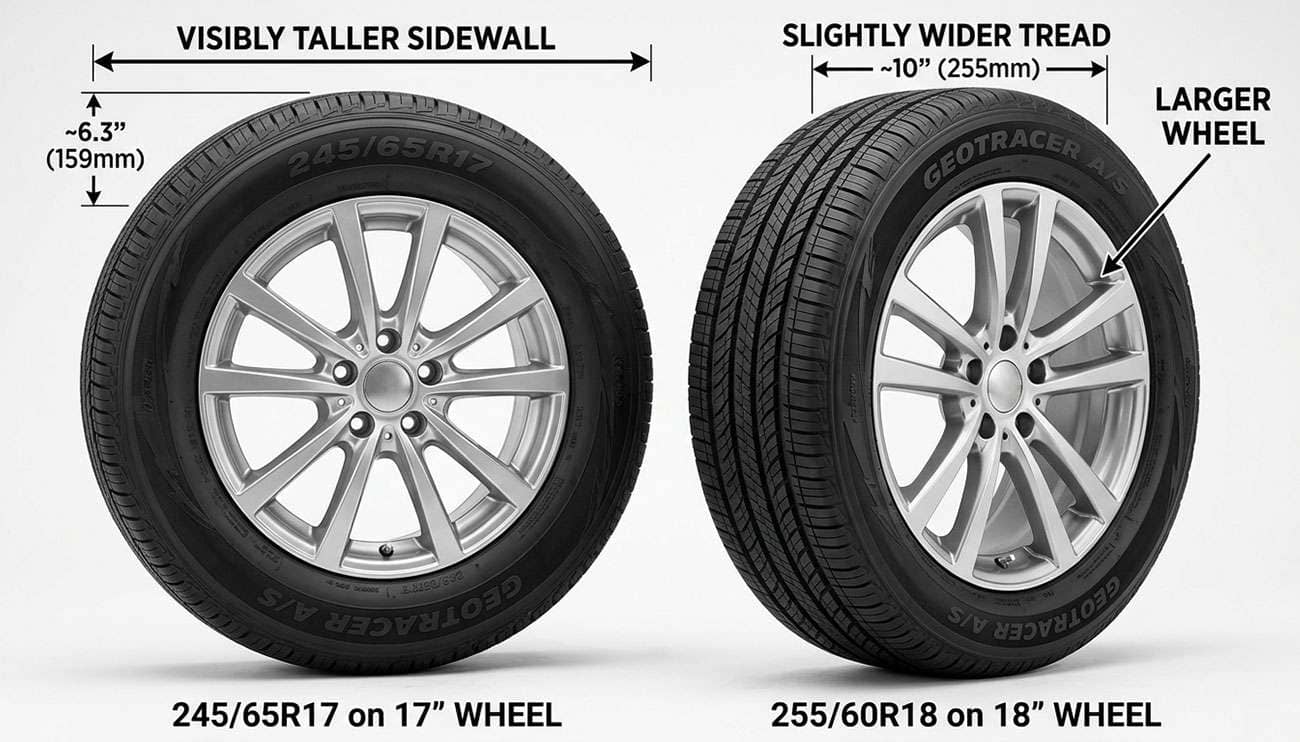
The short answer: the 245/65R17 is the better tire for ride comfort, rough roads, gravel, all-terrain use, and cost. The 255/60R18 is the better tire for steering response and dry-pavement grip. But the number that actually decides it for your vehicle is the one most comparisons never print: the load index stamped right after the size. Depending on which version you buy, these two sizes range from about 1,850 lb to about 2,470 lb per tire. That spread matters far more than the half inch of diameter everybody talks about.
I've been selling tires out of Long Beach since 1971, and I've had this exact conversation across the counter more times than I can count. Somebody walks in with a mid-size SUV or a pickup, they've read that the 18 is "1.7% bigger and 4.1% wider," and they want to know which one wins. Every one of those numbers is right. None of them answers the question. Most guides tell you "it depends" and stop there. Here's what it depends on.
Your Situation |
Better Choice |
Why |
|---|---|---|
Your wheels are 17-inch and you are keeping them |
245/65R17 |
A 255/60R18 physically cannot mount on a 17-inch wheel |
Your wheels are 18-inch and you are keeping them |
255/60R18 |
Same logic in reverse; the size has to match the bead seat |
You tow, haul, or run loaded most of the time |
Either, but only in XL or LT construction |
Load index matters more than size; a P-metric 245/65R17 is the weakest option on the board |
Potholes, broken pavement, dirt roads |
245/65R17 |
Taller sidewall, deeper all-terrain and LT selection |
Mostly smooth highway and freeway miles |
255/60R18 |
Sharper steering, more H and V speed-rated options |
Lowest cost per mile |
245/65R17 |
Typically 30 to 45 percent less per tire and far more models to shop |
No. Let me get this out of the way first, because I still see people order the wrong one. The last number in the size, the R17 or R18, is the bead seat diameter of the wheel. A 255/60R18 tire has an 18-inch bead. It will not seat on a 17-inch wheel, and no amount of pressure or soap will change that. Trying to force it is how bead wires get broken and people get hurt.
So the real question underneath "which is better" is usually one of two things:
If your vehicle offered both sizes from the factory, check the Tire and Loading Information placard on the driver door jamb. Under FMVSS 110, that placard lists the original tire size and the cold inflation pressure the manufacturer set for it. If the 18 was an option on your model, the 18-inch wheels on the upper trim were already cleared for brakes, suspension, and fender travel. If it wasn't, you need to verify clearance yourself. We walk through the wheel side of that decision in our 17-inch to 18-inch wheels guide.
One more fitment detail: approved rim width. Tire makers commonly list the 245/65R17 for wheels from about 6.5 to 8.5 inches wide, depending on the manufacturer, and the 255/60R18 for about 7 to 9 inches. If you are going to 18s, a 7.5- or 8-inch wheel sits in the sweet spot for the 255. The full explanation of how width changes tire shape is in our tire size for wheel width breakdown.
Here's the geometry, worked out from the size codes. These are calculated, unloaded dimensions; actual measured diameter varies a little by brand and tread design.
Feature |
245/65R17 |
255/60R18 |
Difference |
|---|---|---|---|
Overall diameter |
29.54 in (750 mm) |
30.05 in (763 mm) |
+0.51 in (+1.7%) |
Section width |
9.65 in (245 mm) |
10.04 in (255 mm) |
+0.39 in (+4.1%) |
Sidewall height |
6.27 in (159 mm) |
6.02 in (153 mm) |
-0.25 in (-3.9%) |
Revolutions per mile |
683 |
671 |
-1.7% |
Approximate air volume |
About 4,420 cu in |
About 4,560 cu in |
About +3% |
Look at that last row, because it's the one nobody prints and it explains everything that follows. A tire doesn't hold your vehicle up. The air inside it does. The rubber and cords are the container. When the Tire and Rim Association assigns a load capacity to a size, the starting point is how much air the casing holds at a given pressure.
The 18 gives up a quarter inch of sidewall, but it gains width and a bigger overall diameter, so its air chamber comes out roughly 3 percent larger. That's why, in standard construction, the 255/60R18 carries a 108 load index (2,205 lb) and the 245/65R17 carries a 107 (2,149 lb). The difference between the two sizes is about 2.6 percent. Air volume and load capacity track each other almost exactly.
That half inch of height also raises the vehicle about a quarter inch. Nobody will notice the stance change, but you may notice the gearing change slightly, which I'll get to in the speedometer section.
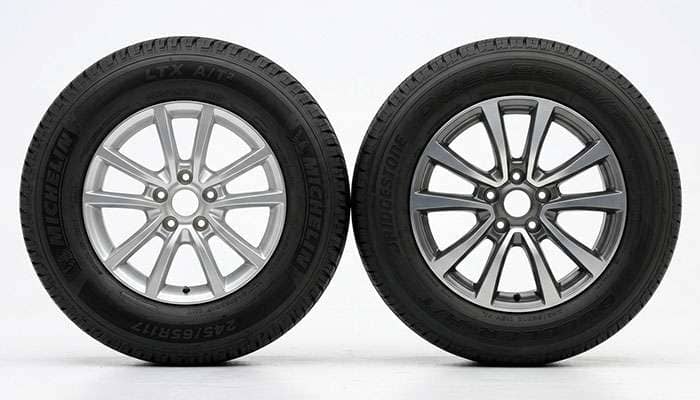
This is the section that should decide your purchase, and it's the part nobody puts in front of you. Both of these sizes are sold in several different constructions, and the construction changes the load rating far more than the size does.
Feature |
245/65R17 |
255/60R18 |
|---|---|---|
P-metric (marked P245/65R17 or P255/60R18) |
105 = 2,039 lb; about 1,854 lb once derated on an SUV or truck |
107 = 2,149 lb; about 1,954 lb once derated on an SUV or truck |
Standard Load (SL) Euro-metric |
107 = 2,149 lb |
108 = 2,205 lb |
Extra Load (XL) |
111 = 2,403 lb |
112 = 2,469 lb |
Light Truck (LT) |
Commonly 111, with heavier-duty versions available |
Rare; only a few specialty LT fitments exist |
Most common speed rating on the market |
T (118 mph) |
H (130 mph) or V (149 mph) |
Read that table from the bottom-left corner to the top-right. A P-metric 245/65R17 on an SUV is good for about 1,854 lb per tire. An XL 255/60R18 is good for 2,469 lb. That's a spread of more than 600 lb per corner, and close to 2,500 lb across four tires, between two sizes that most comparisons treat as nearly identical.
A P-metric tire is a passenger-car design. When one is installed on a light truck, SUV, or multipurpose vehicle, Tire and Rim Association practice is to divide its rated load by 1.10. That 10 percent reduction is built in because those vehicles see heavier loads, higher centers of gravity, and harder use than a sedan. Your vehicle manufacturer already accounted for it when they set the door placard pressure. You need to account for it when you shop.
Euro-metric tires (the ones with no P in front of the size) are rated differently, which is why a plain 245/65R17 107 out-carries a P245/65R17 105 in the same dimensions. If you want the full picture of how the two systems differ, read our breakdown of P-metric vs LT tires.
Here's the mechanism most people miss. A load index is the maximum load at a specific reference pressure. A standard-load tire reaches its rated load at about 35 psi. An XL tire reaches its higher rating only at about 41 psi. Run an XL tire at the 35 psi your door placard may call for and it carries roughly what a standard-load tire carries. The extra plies only pay off when you add the air to use them.
So "buy XL" isn't the whole answer. "Buy XL and run the pressure the load requires" is. We go deeper on that in SL vs XL tires: which should you really choose.
Federal Motor Vehicle Safety Standard 110 requires that the tires a vehicle leaves the factory on can carry the vehicle's maximum loaded weight at the placard pressure. NHTSA's guidance for replacements follows the same logic: never install a tire with a lower load capacity than what came on the vehicle. If your SUV came with an SL 255/60R18 108 and you move down to a P-metric 245/65R17 105, you have just bought tires that carry less than the factory spec, even though the size change looks small on paper.
It can be, if you buy the right version. An XL 255/60R18 112 has the highest load capacity of any common version of either size. For a mid-size SUV pulling a small camper or a boat, that's plenty, provided you inflate it for the load.
The catch is sidewall. Trailer tongue weight pushes down on the rear axle and makes the rear tires work harder in every crosswind and lane change. A shorter sidewall flexes less, which some people like because it feels more planted. But it also has less room to absorb a hit, and towing adds weight to every pothole you find.
If you tow regularly and you are on 17s, the 245/65R17 gives you something the 18 doesn't: real LT options. An LT tire uses a heavier casing designed for sustained load. A tire like the BFGoodrich All-Terrain T/A KO2 in LT245/65R17 carries a 111 load index on a casing built for trucks rather than crossovers. In 255/60R18, you will have a hard time finding anything comparable.
My shop advice is simple. For occasional towing on pavement, either size in XL works. For frequent towing, heavy tongue weight, or towing on dirt, the 245/65R17 in LT construction is the stronger setup.
The 245/65R17, and it isn't close. But let me explain why, because a quarter inch of sidewall doesn't sound like much.
When you hit a pothole, the tire's sidewall compresses until either the impact is absorbed or the tire bottoms out against the wheel flange. A taller sidewall has more distance to work with before it runs out of travel. Both tires here are already fairly tall, so neither one is a low-profile tire. But the 245/65R17 has about 4 percent more sidewall height, and it usually sits on a narrower wheel, which gives the sidewall a softer, rounder profile.
That shows up in three ways you will feel:
If you already have a bulge or cut in the sidewall from a hit, stop and read tire sidewall damage: is it safe to drive before you put another mile on it.
The 255/60R18's trade is steering. The shorter, stiffer sidewall twists less when you turn the wheel, so the vehicle responds faster and feels more connected on a freeway on-ramp. It's a real difference, and for a lot of drivers on smooth Southern California pavement it's worth it. Just know what you are paying for.
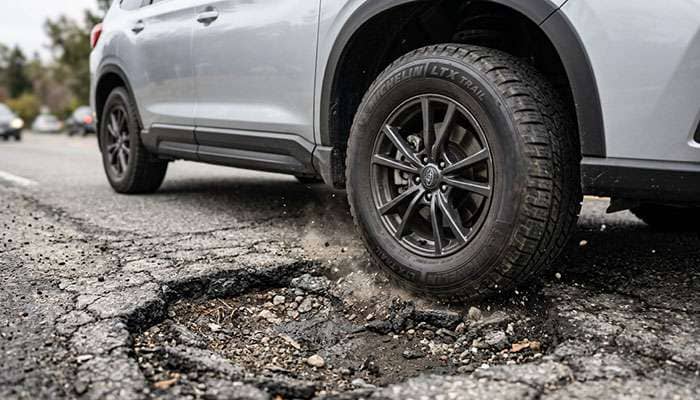
The 245/65R17, for two reasons.
The first is the same sidewall advantage. Off pavement, you air down for traction. A taller sidewall gives you more footprint growth when you drop pressure, and more protection between a rock and your rim. On washboard roads, the extra flex keeps the tread in contact instead of skipping across the ridges.
The second reason is selection, and this is the one people find out the hard way. Across the market, the 245/65R17 has a deep bench of all-terrain tires, plus several LT all-terrains with heavier casings. The 255/60R18 is overwhelmingly a highway and touring size. You can find a few all-terrains in it, but your choices narrow fast, and real LT construction is almost nonexistent.
That matters because tread design and casing do more for you off-road than any dimension in this comparison. If you spend weekends on fire roads or the desert, a good A/T in 245/65R17 will outperform almost anything you can get in 255/60R18. Our roundup of the best tires in 245/65R17 breaks down which ones I'd put on a truck that actually leaves the pavement.
A little, and which direction depends on what your vehicle was calibrated for.
If your speedometer was set up for the 245/65R17 and you switch to 255/60R18, the bigger tire covers more ground per revolution. At an indicated 60 mph, you are actually doing about 61. At an indicated 70, about 71.2. Your odometer will undercount by the same 1.7 percent.
If your vehicle came on 18s and you are dropping to 17s, it goes the other way. Your speedometer reads high. At an indicated 60, you are doing about 59. That's the safer direction for tickets, but your odometer will now overcount miles, which affects warranty and lease tracking.
Either way, 1.7 percent is inside the roughly 3 percent range most tire and vehicle engineers consider acceptable for a diameter change. Your ABS and stability control will handle it without complaint as long as all four tires match. Mixing sizes front to rear on an all-wheel-drive vehicle is a different story, and it can damage a transfer case or center differential. If you want the full math, our guide to bigger tires and your speedometer walks through it.
The gearing effect is real but small. A 1.7 percent taller tire is like a 1.7 percent taller final drive. On a V6 SUV, you'd have trouble feeling it. On a four-cylinder crossover that already works hard at highway speed with a load, you may notice slightly more downshifting on grades.
The 255/60R18, by a meaningful margin.
Across the market, a comparable 255/60R18 commonly runs 30 to 45 percent more per tire than a 245/65R17 of similar quality. Part of that is the bigger wheel diameter. Part of it is that the 18 skews toward higher speed ratings, and H- and V-rated tires use compounds and construction that cost more to build. And part of it is simple volume: the 17 is a higher-production size, with far more models competing for your money.
Then add the costs people forget:
None of that means the 18 is a bad choice. It means you are paying for steering feel and appearance, and you should decide whether that's what you want to pay for.
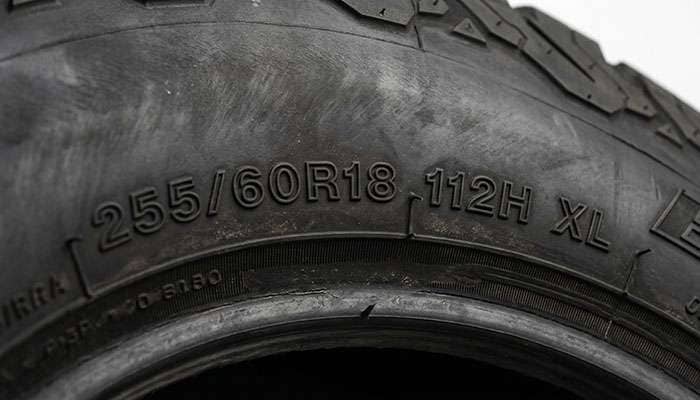
Size alone almost never causes a problem between these two. The wrong load version does. Here's how that plays out, from the least to the most expensive.
Every step on that ladder is avoided by one thing: reading the load index on the tire you are about to buy and comparing it to what came on your vehicle.
When you have those answers, browse our modern tires and filter by your size and load index. If you're stuck between two choices, call the shop. We have been answering this exact question since 1971.
Neither size wins in the abstract. The 245/65R17 is the more practical tire: it rides softer, survives potholes better, costs less, and gives you a real choice of all-terrain and LT tires. The 255/60R18 is the more precise tire: it steers more sharply, looks fuller in the wheel well, and in XL form carries the most weight of any common version of either size.
What decides it for your vehicle is the wheel you are running and the load index on the tire you buy. Get those two right and you'll be happy with either one. Get the load index wrong and the size you picked won't matter.
Only if you also change to 18-inch wheels. The 255/60R18 has an 18-inch bead and will not mount on a 17-inch wheel. If you convert, the 1.7 percent diameter increase is within normal tolerances, but you need to confirm brake and fender clearance and choose a tire with a load index equal to or higher than the original.
The 255/60R18 is about 30.05 inches tall versus 29.54 inches for the 245/65R17, about 10 mm wider, and has a sidewall about a quarter inch shorter. It mounts on an 18-inch wheel instead of a 17. In standard construction it carries a 108 load index (2,205 lb) versus 107 (2,149 lb) for the 245/65R17.
Generally yes, when the overall diameter stays about the same. Moving to an 18-inch wheel shortens the sidewall, which leaves less room to absorb impacts. Between 245/65R17 and 255/60R18 the difference is modest, but the 17 is noticeably softer over potholes and expansion joints.
Slightly. If your vehicle was calibrated for 245/65R17, a 255/60R18 makes the speedometer read about 1.7 percent low, so an indicated 60 mph is about 61 mph. That falls within the roughly 3 percent range generally considered acceptable.
Yes. It is a common mid-size SUV and light pickup size with a tall sidewall for ride comfort, wide model selection, and real all-terrain and LT options. Choose an XL or LT version if you tow or carry heavy loads.
The load version matters more than the size. An XL 255/60R18 has the highest common rating at 2,469 lb per tire, but the 245/65R17 offers LT construction with heavier casings, which is the better choice for frequent or heavy towing. Avoid P-metric tires for towing on SUVs and trucks because they are derated by 10 percent.