
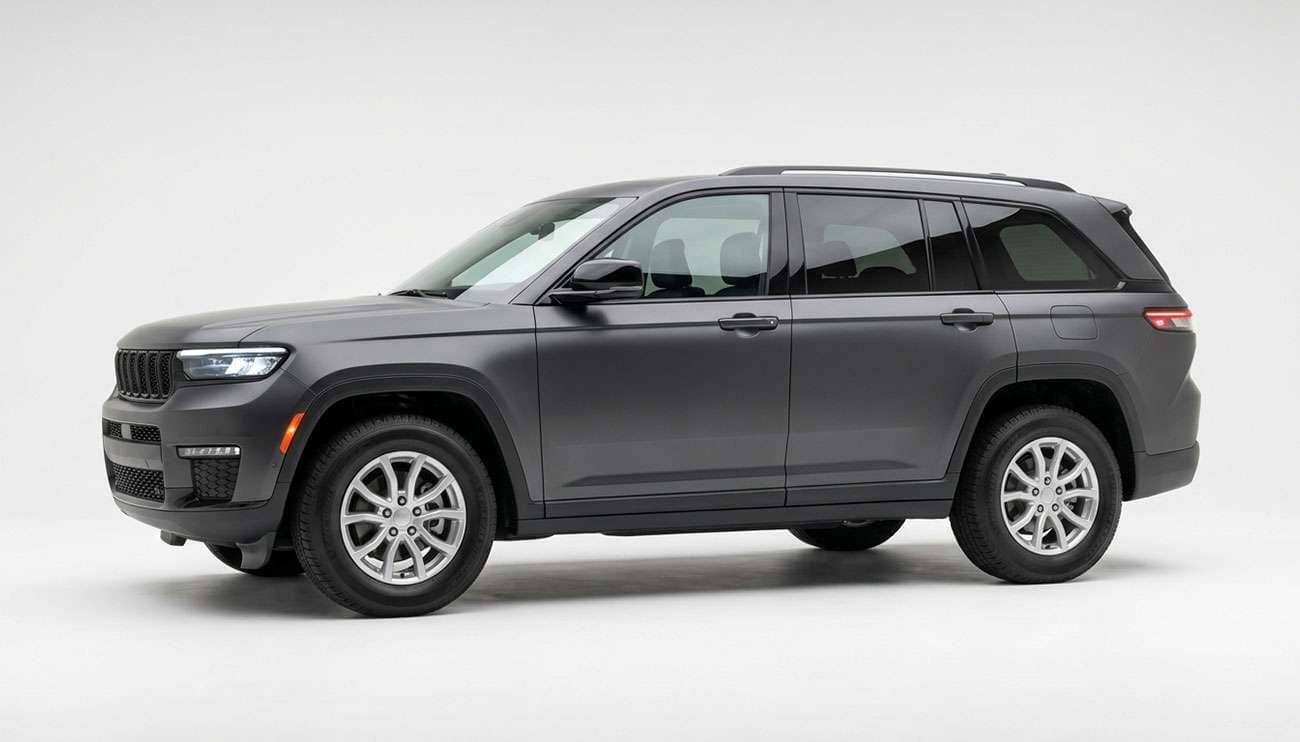
There is no single best 245/65R17 tire, because 245/65R17 is not one tire. It is sold in at least five different load builds, from a light SL 105 rated at 2,039 pounds per corner up to an LT 117 rated at 2,833 pounds. That is a 794-pound swing per tire, or nearly 3,200 pounds across the axle set. Pick the right tread pattern on the wrong load index and you have downgraded your vehicle. Match the load index first, then argue about brands.
Almost every "best 245/65R17" list you will find names a tread pattern and stops there. Some of those picks are genuinely good tires. What none of them tell you is that the same model name can arrive at your door in a load index your vehicle was never engineered around, and that the number stamped after the size is the one spec that is not a matter of preference.
Here is the part nobody puts in front of you. Across the roughly one hundred vehicle models that came from the factory on 245/65R17, the load index assignments cluster into three main groups, with load index 111 the single most common, then 107, then 105. Those three numbers describe three different vehicles wearing the same size marking. A 2008 Ford Explorer and a loaded three-row crossover with a hitch on it are not asking the same thing of a tire, and the industry answered that by building the size three ways.
The load index is assigned from the Tire and Rim Association load tables, and your vehicle's required minimum appears on the placard inside the driver's door jamb, not in any tire review. Federal Motor Vehicle Safety Standard 139 governs how these tires are tested and marked, and NHTSA's guidance is consistent on the point: replacement tires must carry a load rating at least equal to the original equipment specification. Going under it is not a compromise. It is a fitment error.
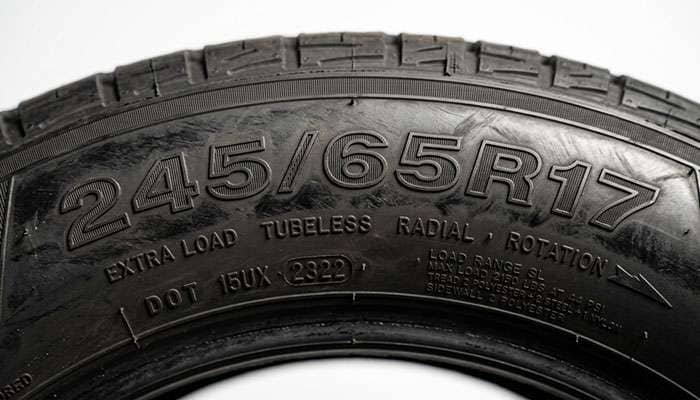
Find the marking on your door placard or on the tires currently on the vehicle, then read across. This is the table to settle before you look at a single tread pattern.
Sidewall Marking |
Load Index |
Max Load Per Tire |
Who It Is Built For |
What Happens If You Go Lower |
|---|---|---|---|---|
SL 105 |
105 |
2,039 lbs |
Older midsize SUVs and body-on-frame wagons, lightly loaded |
Nothing below this exists in the size; this is the floor |
SL 107 |
107 |
2,149 lbs |
Most three-row crossovers and midsize SUVs in normal family use |
Dropping to 105 costs 440 lbs of axle capacity |
XL 111 |
111 |
2,403 lbs |
Loaded three-row SUVs, roof cargo, light towing, heavier trims |
Dropping to 107 costs 1,016 lbs across the vehicle |
LT 111/108, Load Range C |
111 single / 108 dual |
2,403 lbs single |
Body-on-frame trucks and SUVs, trail use, sidewall protection |
P-metric equivalents must be derated by roughly 10 percent on a truck |
LT 117, Load Range E |
117 |
2,833 lbs |
Heavy hauling, slide-in campers, commercial duty |
Sidewall flex and heat build under sustained load |
One point that trips people up: an LT tire's stamped capacity is not directly comparable to a P-metric tire's. When a light truck runs P-metric or Euro-metric tires, the industry standard is to divide the tire's rated load by about 1.10 before comparing it to the vehicle's requirement. That derating is why an LT 245/65R17 rated at the same number as an XL passenger tire is doing considerably more work. If the difference between the two rating systems is new to you, our breakdown of load range vs load index lays out exactly how the two scales interact.
Speed rating matters less here, but it is worth thirty seconds. The 245/65R17 size is offered in S, T, H and V ratings. An S-rated tire is good to 112 mph, T to 118, H to 130 and V to 149. Most factory placards in this size call for T or H. Going up a rating generally firms the ride slightly and shortens tread life a little; going down below the placard is not something to do casually, because speed rating is tied to the tire's heat tolerance, not just its top speed.
This size spans two families of vehicle that have almost nothing in common mechanically, which is exactly why the load index spread exists.
Body-on-frame midsize SUVs. The Chevrolet TrailBlazer and TrailBlazer EXT, GMC Envoy, Buick Rainier and Acura SLX all rode on 245/65R17. These are truck-based vehicles with solid or independent front ends bolted to a ladder frame, and they reward a tire with a stiffer casing.
Unibody crossovers and midsize SUVs. The Ford Explorer through the 2011 to 2018 generation, the Explorer Sport Trac, the GMC Acadia in later model years and various Toyota Highlander trims use the same size on a fundamentally different chassis, where ride quality and rolling resistance matter more than casing stiffness.
Global pickups and light commercial. Outside North America the size shows up on the Ford Everest and Endeavour and on several midsize pickup platforms, which is where the LT builds find their audience.
The practical takeaway is that "what vehicles use 245 65 17 tires" is the wrong question to lead with. The better question is which family yours belongs to, because that determines whether you want a stiff-shouldered highway terrain tire or a compliant touring tire. If you are shopping for a specific platform, our guides to Ford Explorer aftermarket tires and Toyota Highlander aftermarket tires go deeper on those two chassis in particular.
A 245/65R17 measures 245 mm across the section, has a sidewall 65 percent of that width at roughly 159 mm or 6.3 inches, and mounts on a 17-inch wheel. Overall diameter works out to about 750 mm, or 29.5 inches. Approved rim widths run from 6.5 to 8.5 inches, with 7.0 to 7.5 inches as the target. If your factory wheel is a 17x7 or 17x7.5, you are squarely in the middle of the range.
This is where most 245/65R17 buyers land, and it is the right default if your vehicle spends its life on pavement. What you are buying here is quiet running, wet braking and a tread compound that survives a long service life. Highway terrain and touring designs in this size typically carry 60,000 to 80,000 mile treadwear warranties.
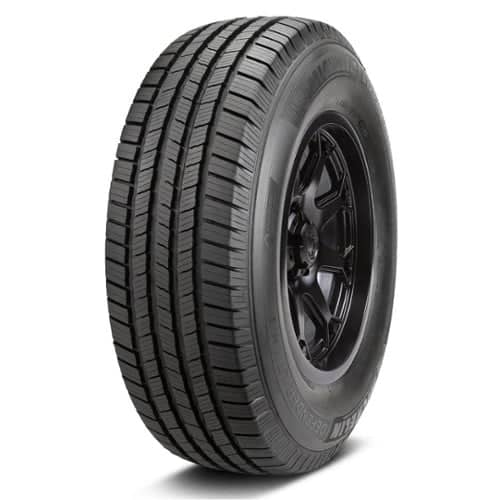
Michelin Defender LTX M/S is the reference point in this category and has been for years. The Evertread compound is built around wear resistance in severe service rather than peak grip, and MaxTouch construction spreads acceleration, braking and cornering loads across the footprint to keep wear even. In 245/65R17 it comes as an SL 107T. It is not the cheapest thing on this page and it is not trying to be.
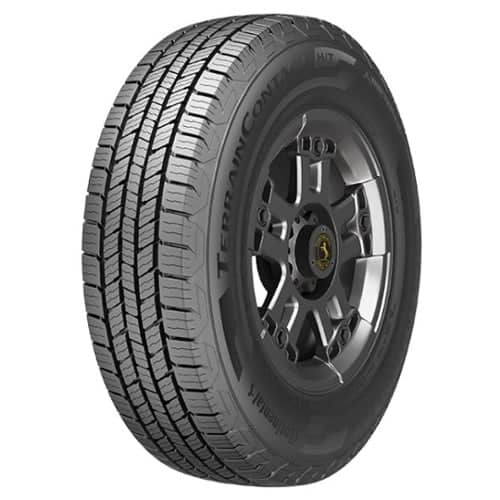
Continental TerrainContact H/T is the pick if wet braking is your priority. Continental's traction grooves and the compound's silica loading give it short stopping distances on standing water, and the ride is noticeably softer than a truck-oriented highway tire. SL 107T in this size.
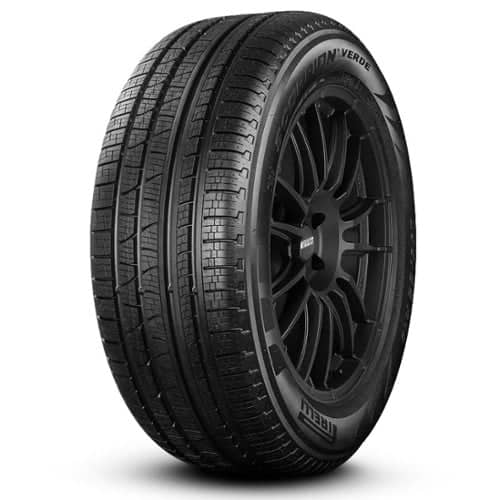
Pirelli Scorpion All Season Plus 3 shows up in a lot of automated summaries for this size, and the recommendation holds up. It is a genuinely comfortable long-distance tire with a 70,000-mile warranty and light snow capability. The thing those summaries leave out is that it arrives as an SL 107H here, so if your placard asks for XL 111, it is the wrong tire regardless of how good it is.
Tire |
Load Index |
Speed Rating |
Best For |
Approx. Price Each |
|---|---|---|---|---|
Michelin Defender LTX M/S |
SL 107 |
T |
Maximum tread life |
USD 257 |
Pirelli Scorpion All Season Plus 3 |
SL 107 |
H |
Long-distance comfort |
USD 240 |
Continental TerrainContact H/T |
SL 107 |
T |
Wet braking |
USD 225 |
Bridgestone Dueler H/L Alenza Plus |
SL 105 |
H |
Quiet ride on lighter SUVs |
USD 195 |
Cooper Endeavor Plus |
SL 107 |
T |
Value with a long warranty |
USD 182 |
Nexen Roadian HTX 2 |
SL 107 |
H |
Budget-conscious highway use |
USD 179 |
Notice that every tire in that table is a 105 or a 107. That is not an accident of selection. The highway and touring category in 245/65R17 is built almost entirely around the lighter placards, which is precisely why owners of heavier three-row vehicles keep ending up on the wrong tire when they shop by tread pattern.
All-terrain is where the XL 111 builds live in this size, which makes this category the answer for a lot of people who thought they needed a highway tire. If your placard reads XL 111 and you want a passenger-rated tire rather than an LT, the all-terrain shelf is where most of your options are.
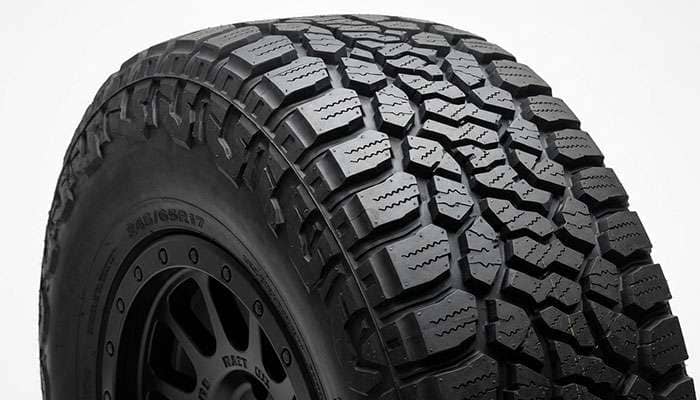
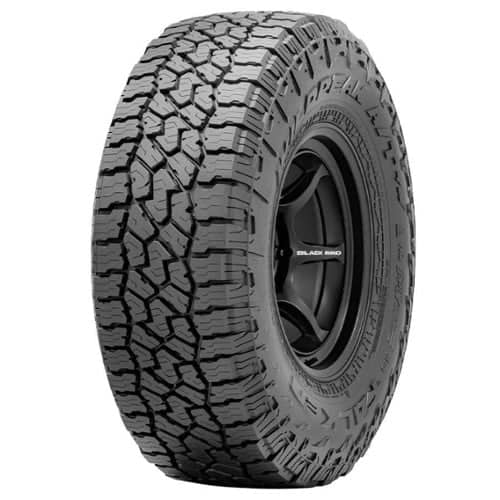
Falken Wildpeak A/T4W replaced the long-running A/T3W and carries the improvements where they count. Falken rates it to 65,000 miles for non-LT sizes, up from 55,000 on the tire it replaced, and it retains the three-peak mountain snowflake severe snow certification. Staggered shoulder blocks and full-depth sipes mean the snow traction does not fall off a cliff at half tread. In 245/65R17 it is an XL 111T. If you have seen the A/T3W offered cheaper, that is old stock being cleared.
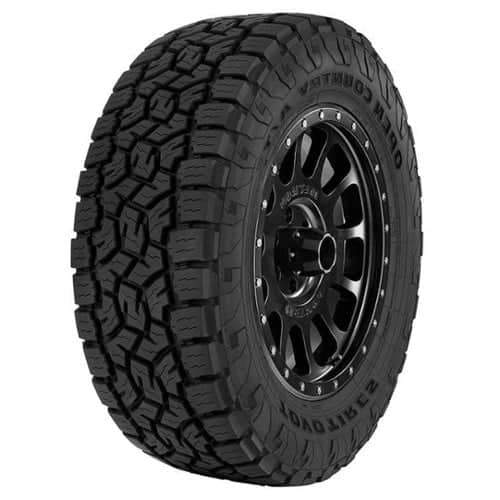
Toyo Open Country A/T III is the most rounded all-terrain in the size. Stone ejectors, 3D multi-wave sipes and a compound tuned for cut and chip resistance make it the one to pick if the vehicle sees genuine gravel and forest road duty but still commutes. Available as XL 111T in passenger construction and as an LT 111/108T in 8-ply.
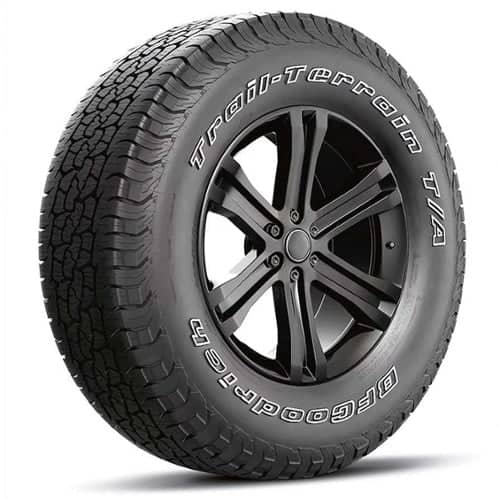
BFGoodrich Trail-Terrain T/A is the crossover-friendly end of the category. It looks like an all-terrain, runs closer to a highway tire on noise, and carries the snowflake. XL 111T here. For an Explorer or an Acadia owner who wants the look and the winter certification without the road roar, this is usually the right call.
Tire |
Load Index |
3PMSF Rated |
Best For |
Approx. Price Each |
|---|---|---|---|---|
Falken Wildpeak A/T4W |
XL 111 |
Yes |
All-around all-terrain with long warranty |
USD 231 |
Toyo Open Country A/T III |
XL 111 |
Yes |
Mixed gravel and highway duty |
USD 242 |
Yokohama Geolandar A/T4 (G018) |
XL 111 |
Yes |
Wet traction and tread life |
USD 227 |
Nitto Terra Grappler G3 |
XL 111 |
Yes |
Aggressive look, on-road manners |
USD 221 |
BFGoodrich Trail-Terrain T/A |
XL 111 |
Yes |
Quiet all-terrain for crossovers |
USD 220 |
Cooper Discoverer AT3 4S |
XL 111 |
Yes |
Best value in the category |
USD 177 |
Every one of those carries the severe snow certification, which is the practical argument for an all-terrain over a highway tire in this size even if you never leave pavement. The tradeoff is real though: expect one to three decibels more road noise and a small fuel economy penalty. Our comparison of all-terrain vs all-season tires covers where that line actually falls.
There are two separate answers here and conflating them is the most common mistake in this size.
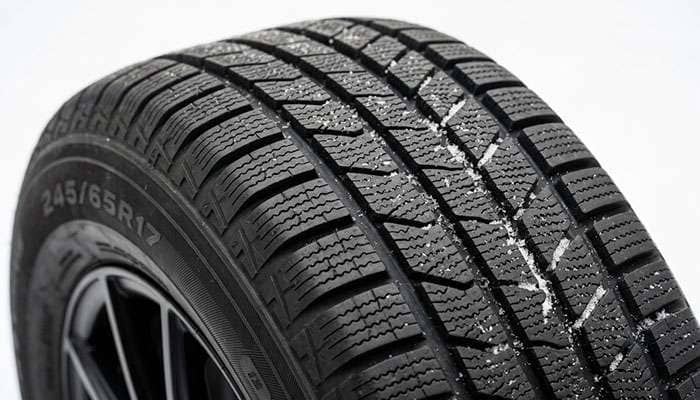
All-weather tires carry the three-peak mountain snowflake symbol earned under the ASTM F1805 snow traction test, but run a compound that survives summer heat. They are the right answer if you see real winter a handful of times a year and do not want a second set of wheels.
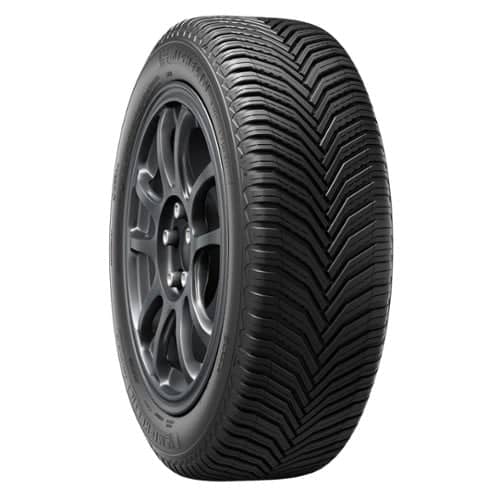
Michelin CrossClimate2 CUV is the category benchmark. The V-shaped directional tread and Thermal Adaptive compound deliver winter certification without giving up wet braking in July. SL 107H in this size, and priced accordingly.
Bridgestone WeatherPeak gets you most of the way there for meaningfully less. SL 107H, snowflake certified, 70,000-mile warranty. Toyo Celsius II is the XL 111H option in this group, which matters if your placard demands it. Nokian Outpost APT splits the difference between all-weather and all-terrain at SL 107H.
If you are unclear on what the snowflake actually certifies and what it does not, our guide to the snowflake tire symbol spells out the test and its limits.
No all-weather tire matches a purpose-built winter tire below about 20 degrees Fahrenheit or on ice. If you live where that is normal, run a second set.
Tire |
Category |
Load Index |
Approx. Price Each |
|---|---|---|---|
Michelin CrossClimate2 CUV |
All-weather |
SL 107 |
USD 279 |
Toyo Celsius II |
All-weather |
XL 111 |
USD 182 |
Bridgestone WeatherPeak |
All-weather |
SL 107 |
USD 141 |
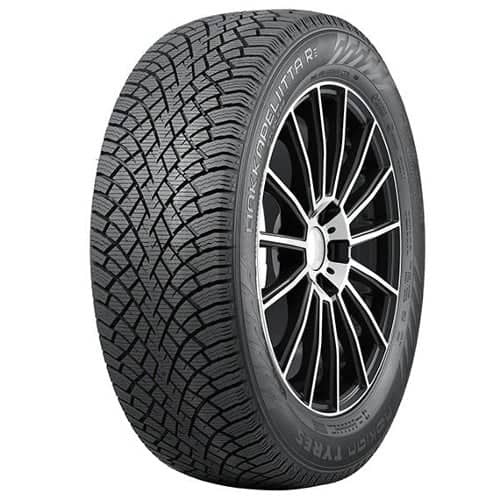
Nokian Hakkapeliitta R5 SUV |
Studless winter |
XL 111 |
USD 268 |
Michelin X-Ice Snow SUV |
Studless winter |
XL 111 |
USD 247 |
Continental VikingContact 7 |
Studless winter |
XL 111 |
USD 191 |
Roughly a third of the 245/65R17 market sits under 150 dollars per tire, which is more choice at that price than most sizes offer. The honest framing is this: at this price you are trading tread life and wet braking, not safety. Every tire sold in the United States meets the same FMVSS 139 minimums.
Where budget tires genuinely differ is in the tail. A premium touring tire holds its wet stopping distance reasonably well as it wears; a value tire tends to fall off faster in the last third of its life. If you plan to replace at 5/32 rather than run to the wear bars, that difference shrinks a lot.
Tire |
Type |
Load Index |
Approx. Price Each |
|---|---|---|---|
Milestar Patagonia H/T |
Highway terrain |
SL 105 |
USD 121 |
Nexen Roadian HTX RH5 |
Highway terrain |
SL 107 |
USD 124 |
Ironman All Country HT |
Highway terrain |
SL 107 |
USD 126 |
Sumitomo HTR Enhance C/X |
Touring |
SL 107 |
USD 105 |
Milestar Patagonia A/T R |
All-terrain |
SL 107 |
USD 141 |
GT Radial Adventuro HT |
Highway terrain |
SL 105 |
USD 152 |
Watch the load index column carefully in this bracket. Several of the cheapest options in 245/65R17 are 105s, and if your vehicle needs a 107 or a 111, the price advantage evaporates because the tire is not a candidate.
An LT-metric 245/65R17 is a different animal. Heavier casing, more plies, higher inflation pressures and a stiffer sidewall. It also weighs more, rides firmer and costs you a little fuel economy. You want one if any of the following is true.
The important number: when a light truck runs P-metric or Euro-metric tires, the tire's rated load is divided by roughly 1.10 before it counts toward the vehicle's requirement. That is the single most misunderstood figure in truck tire fitment, and it is why a 111 XL passenger tire and a 111 LT tire are not interchangeable on a loaded truck.
Tire |
Load Range |
Load Index |
Approx. Price Each |
|---|---|---|---|
Toyo Open Country A/T III LT |
C, 8-ply rated |
111/108T |
USD 253 |
Hankook Dynapro AT2 Xtreme RF12 LT |
C, 8-ply rated |
111/108S |
USD 259 |
Yokohama Geolandar A/T G015 LT |
E, 10-ply rated |
117S |
USD 202 |
Hankook Dynapro AT2 RF11 LT |
C, 8-ply rated |
111/108S |
USD 167 |
If none of the four bullets above apply to you, an LT tire is a downgrade in ride quality that buys you capacity you will never use. Most 245/65R17 owners are better served by an XL passenger tire.
The middle of the 245/65R17 market sits right around 170 dollars per tire. Around a third of the size is priced under 150 dollars, about half falls between 150 and 225, and fewer than one in seven crosses 225 dollars. Specialty whitewall and redline builds for classic and restoration work sit above that again, near 360 dollars.
Price Bracket |
Per Tire |
Set of Four |
What You Get |
|---|---|---|---|
Value |
USD 65 to 140 |
USD 260 to 560 |
Meets all federal standards; shorter tread life, weaker wet grip late in life |
Mid-tier |
USD 140 to 200 |
USD 560 to 800 |
Best value bracket; strong warranties, real snowflake options |
Premium |
USD 200 to 280 |
USD 800 to 1,120 |
Longest tread life, quietest ride, best wet braking retention |
Specialty |
USD 280 to 360 |
USD 1,120 to 1,440 |
Flagship touring, dedicated winter, whitewall and redline builds |
Budget separately for installation. Mounting, balancing, a road-force check and valve service are typical line items, and if your vehicle has direct tire pressure monitoring, sensors run around 40 dollars each when they need replacing. Lug nuts, if yours are corroded or swollen, land in the 40 to 49 dollar range for a set. None of that is optional work, so factor it in when you compare a 140 dollar tire against a 200 dollar one.
Usually yes, and here are the actual numbers rather than a shrug.
Specification |
235/65R17 |
245/65R17 |
Difference |
|---|---|---|---|
Section width |
235 mm |
245 mm |
10 mm wider, about 0.4 in |
Sidewall height |
152.8 mm |
159.3 mm |
6.5 mm taller |
Overall diameter |
737 mm, 29.0 in |
750 mm, 29.5 in |
1.7 percent larger |
Speedometer at indicated 60 |
60.0 mph |
61.0 mph |
Reads about 1 mph slow |
Approved rim widths |
6.5 to 8.0 in |
6.5 to 8.5 in |
Overlap covers 17x7 and 17x7.5 |
The 1.7 percent diameter change is comfortably inside the 3 percent tolerance the industry treats as acceptable, and your existing wheel almost certainly fits both. Three things to verify before you commit. First, the extra 10 mm of width needs clearance at full lock and full suspension compression, particularly on lowered vehicles or anything with aftermarket wheels running a different offset. Second, replace all four rather than mixing sizes across an axle or across an all-wheel-drive system, where a persistent circumference difference loads the center differential. Third, check that the 245 you are buying carries a load index at least equal to the 235 it replaces, which is exactly the trap this article opened with.
For a fuller look at how the two widths behave differently once they are on the car, our piece on 235 vs 245 tires works through the handling and fuel economy side.
Reliability is not a brand-level property, it is a model-level one, and the honest answer is that "most reliable" depends on what you are measuring. Tread life, wet grip retention, sidewall durability and ride comfort do not rank the same brands in the same order.
That said, three names have earned their reputation in 245/65R17 specifically. Michelin leads on tread life and on how well wet braking holds up as the tire wears down, which is the metric that actually matters for a family vehicle. Bridgestone and Continental are consistently strong on wet performance and noise. Among value brands, Cooper, Yokohama and Falken punch well above their price in this size.
What is more useful than a brand ranking is a habit: read the DOT date code on the sidewall before the tires go on. The last four digits give the week and year of manufacture. A tire that has sat in a warehouse for three years has already spent part of its service life, and no brand reputation compensates for that. If you want the full picture on how manufacturers stack up, we ranked them in our guide to the 15 best tire brands by safety and performance.
The reason "what are the best tires for a 245/65R17" is a hard question to answer well is that the size covers a twenty-year span of vehicles across two completely different chassis philosophies, sold in five load builds that differ by nearly 800 pounds per corner. Any list that hands you a tread pattern without asking what your placard says is answering a question you did not ask.
Start with the load index. Then pick the category that matches how the vehicle actually gets used, not how you would like to imagine using it. Within a bucket, at a given load index, the field narrows to a handful of genuinely good tires and the decision gets easy. Get those two steps right and you will not regret the third.
When you are ready to compare what is available in your load index, browse the full 245/65R17 tire selection and filter from there.
It depends on your load index first and your use case second. For highway and touring use at SL 107, the Michelin Defender LTX M/S and Continental TerrainContact H/T lead. For XL 111 placards, the Falken Wildpeak A/T4W and Toyo Open Country A/T III are the strongest all-terrain choices. For one set year-round, the Michelin CrossClimate2 CUV and Bridgestone WeatherPeak carry severe snow certification. Check your door placard before choosing any of them.
The middle of the market sits around 170 dollars per tire. Value options start near 65 to 140 dollars, mid-tier runs 140 to 200, and premium touring, all-terrain and winter tires run 200 to 280. Specialty whitewall and redline builds reach about 360 dollars. Add mounting, balancing and valve service on top, plus roughly 40 dollars per sensor if TPMS units need replacing.
Expect roughly 65 to 360 dollars per tire depending on category and load index. A set of four typically lands between 560 and 800 dollars in the mid-tier bracket, which is where most buyers get the best balance of warranty and performance. LT and dedicated winter builds sit at the upper end because of the heavier construction and specialized compounds.
In most cases yes. The 245 is 10 mm wider and 1.7 percent larger in overall diameter, which is inside the 3 percent tolerance the industry accepts. Your speedometer will read about 1 mph slow at an indicated 60. Both sizes fit a 17x7 or 17x7.5 wheel. Confirm clearance at full steering lock, replace all four rather than mixing, and make sure the 245 carries a load index at least equal to the 235 it replaces.
Reliability is a model-level question rather than a brand-level one, but in 245/65R17 specifically, Michelin leads on tread life and on how well wet braking holds up as the tire wears. Bridgestone and Continental are consistently strong on wet grip and noise. Cooper, Yokohama and Falken deliver the best performance per dollar. Whichever you pick, check the DOT date code before the tires are mounted.
Roughly one hundred models across nearly forty manufacturers. The common North American fitments include the Ford Explorer and Explorer Sport Trac, Chevrolet TrailBlazer and TrailBlazer EXT, GMC Envoy and Acadia, Buick Rainier, Toyota Highlander trims and the Acura SLX. Globally the size also appears on the Ford Everest and Endeavour and several midsize pickup platforms, which is where the LT builds are used.



