
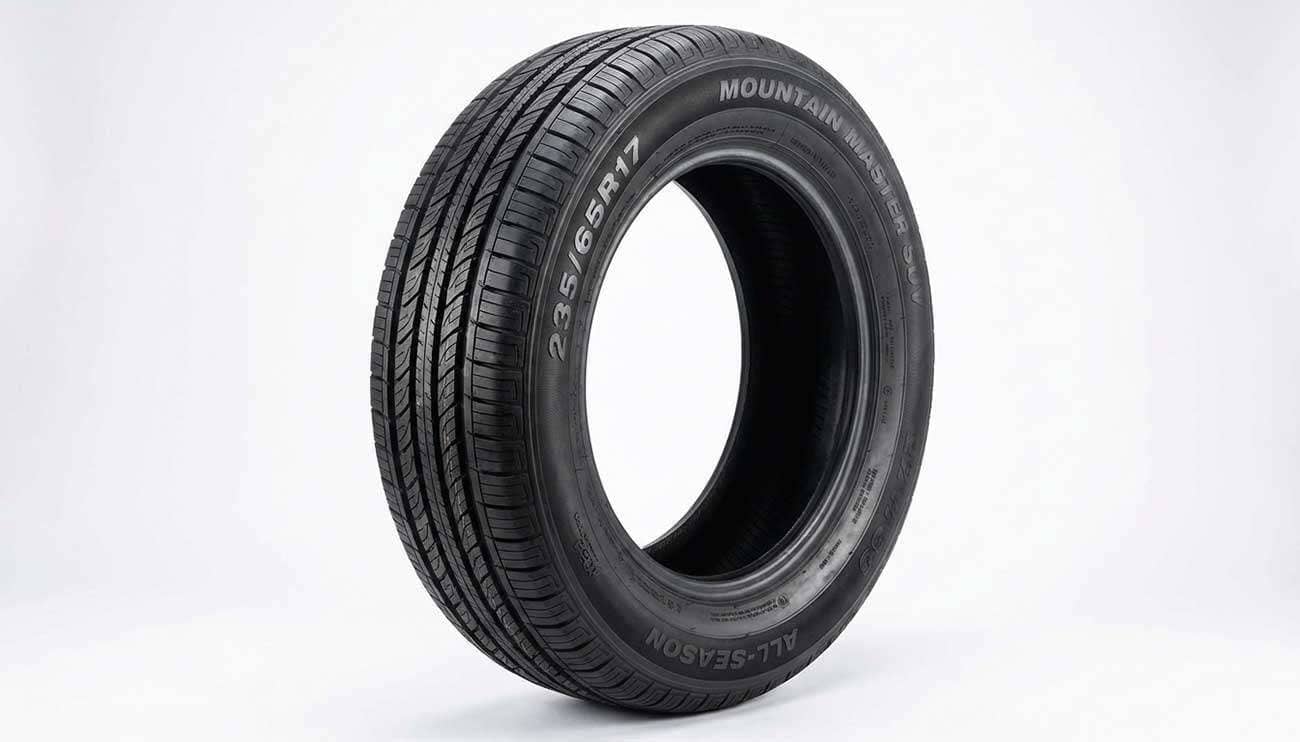
What tire size is 235 65R17? This popular tire size measures 29.03 inches (737.3 mm) in diameter and represents one of the most common choices for SUVs and crossovers. These tires deliver a practical width of 9.25 inches (235 mm) with a circumference of 91.19 inches (2316.3 mm).
When selecting tires for your vehicle, these exact measurements matter more than you might think. The 235/65R17 tire completes approximately 695 revolutions per mile, which directly impacts your speedometer accuracy and fuel economy calculations. The sidewall height of 6.01 inches provides the sweet spot between ride comfort and steering responsiveness that makes this size so popular.
We'll walk you through what each number in the 235/65R17 code actually means and why it matters for your vehicle's performance. You'll discover the precise measurements in both inches and millimeters, plus learn about compatible alternatives that might work for your specific needs. Whether you're shopping for replacement tires or want to understand what's currently on your vehicle, this guide covers everything you need to make the right choice.
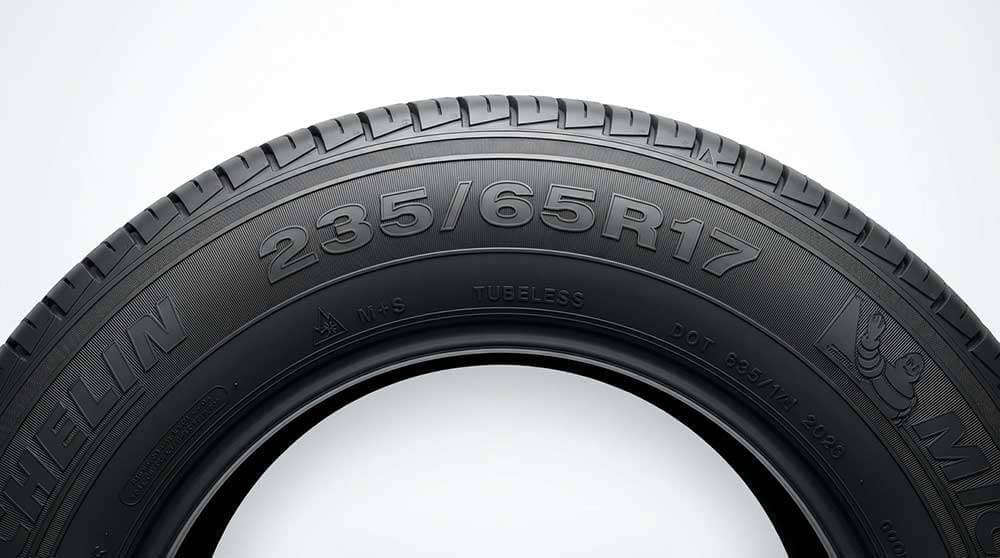
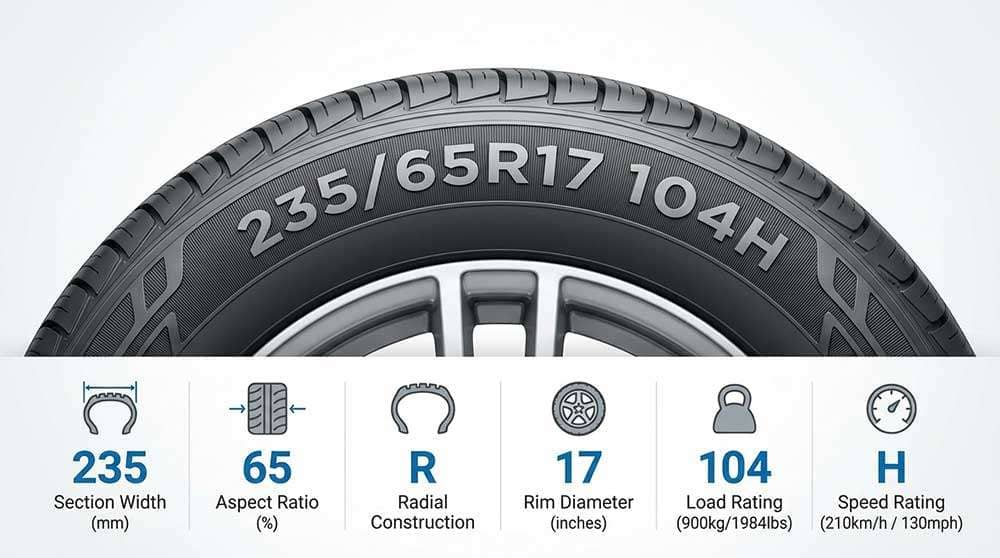
Tire codes contain four essential specifications that determine fitment and performance. Each element in the 235/65R17 designation provides specific dimensional and construction information that affects how the tire functions on your vehicle.
The number 235 indicates the tire's section width measured in millimeters from sidewall to sidewall. This 235/65R17 tire measures exactly 235 mm wide, converting to approximately 9.25 inches. Section width determines the tire's contact patch with the road surface.
Wider tires typically deliver improved grip and stability during cornering and braking. However, increased width can reduce fuel economy due to higher rolling resistance. The 235 mm measurement represents an optimal balance for SUVs and crossovers, providing adequate traction without sacrificing efficiency.
The aspect ratio of 65 represents the sidewall height as a percentage of the tire's width. This critical dimension affects ride quality, handling characteristics, and overall tire performance. For a 235/65R17 tire, the sidewall height equals 65% of the 235 mm width.
Calculate the sidewall height using this formula: 235 mm × 0.65 = 152.75 mm (approximately 6.01 inches)
Higher aspect ratios create taller sidewalls that absorb road impacts more effectively, resulting in a smoother ride. Lower aspect ratios produce shorter sidewalls that enhance handling precision and steering response, particularly during aggressive driving.
The letter "R" designates radial construction, the standard for modern passenger vehicle tires. Radial tires have dominated the industry for over 25 years due to their superior performance characteristics. Radial construction features internal plies that run perpendicular to the tire's centerline.
Earlier bias-ply tires (marked with "D" for diagonal construction) used cruder manufacturing methods that compromised handling and durability. Radial construction provides better road contact, reduced rolling resistance for improved fuel economy, enhanced ride comfort, and extended tire life.
The final number, 17, specifies the wheel diameter in inches that the tire fits. This measurement indicates the rim size required for proper tire mounting. The tire industry uses metric measurements for width but maintains imperial measurements for wheel diameter.
Matching this diameter exactly is crucial for safe tire replacement. Installing a tire with an incorrect diameter creates safety hazards and physical fitment problems. When upgrading to larger wheels, you must purchase tires with the corresponding diameter specification.
These four components work together to define the complete tire specifications needed for proper vehicle fitment and optimal performance.
Precise measurements define how your 235/65R17 tire performs, affects fuel economy, and influences vehicle handling characteristics. These specifications matter when replacing tires or comparing alternatives.
The overall diameter measures 29.03 inches (737.3 mm), creating a tire approximately 29 inches tall from bottom to top. Circumference—the distance around the complete tire—spans 91.19 inches (2316.3 mm). Manufacturing variations can produce slight differences, with diameters ranging from 29.0 to 29.1 inches depending on the specific tire model and brand.
Diameter directly affects ground clearance, wheel well fitment, and speedometer accuracy. Maintaining the correct diameter when replacing tires preserves your vehicle's intended performance characteristics and prevents potential clearance issues.
Sidewall height (aspect height) spans 6.01 inches (152.75 mm). This distance from wheel rim to tread edge absorbs road impacts and contributes significantly to ride comfort.
Section width measures 9.25 inches (235 mm), representing the tire's width from sidewall to sidewall. These tires mount on wheels with rim widths from 6.5 to 8.5 inches, providing flexibility when selecting wheels for your vehicle.
Converting between metric and imperial measurements reveals tire dimensions across different measurement systems:
Dimension |
Metric (mm) |
Imperial (inches) |
|---|---|---|
Overall Diameter |
737.3 mm |
29.03" |
Section Width |
235 mm |
9.25" |
Sidewall Height |
152.75 mm |
6.01" |
Wheel Diameter |
431.8 mm |
17" |
Circumference |
2316.3 mm |
91.19" |
Most tire dimensions use millimeters except rim diameter, which traditionally uses inches. This mixed measurement system remains standard throughout the tire industry worldwide.
A 235/65R17 tire completes approximately 695 revolutions per mile (432 revolutions per kilometer)[112]. This measurement determines speedometer accuracy and indicates how many complete rotations occur over a given distance.
Revolutions per mile figures vary slightly among sources—ranging from 693 to 718—due to minor manufacturing differences between tire models with identical size designations. These variations can affect speedometer readings and actual speed calculations.
When you replace tires with a different size having fewer revolutions per mile, your actual speed exceeds speedometer readings. A tire with 3% larger diameter causes speedometer under-reading by approximately 3%. At a speedometer reading of 60 mph, your actual speed might be 58 mph with a smaller tire, or 62 mph with a larger replacement.
These precise measurements—diameter, circumference, sidewall height, section width, and revolutions per mile—determine how the 235/65R17 tire performs on your vehicle. Understanding these specifications helps when comparing alternative tire sizes or determining compatibility with your current wheels.
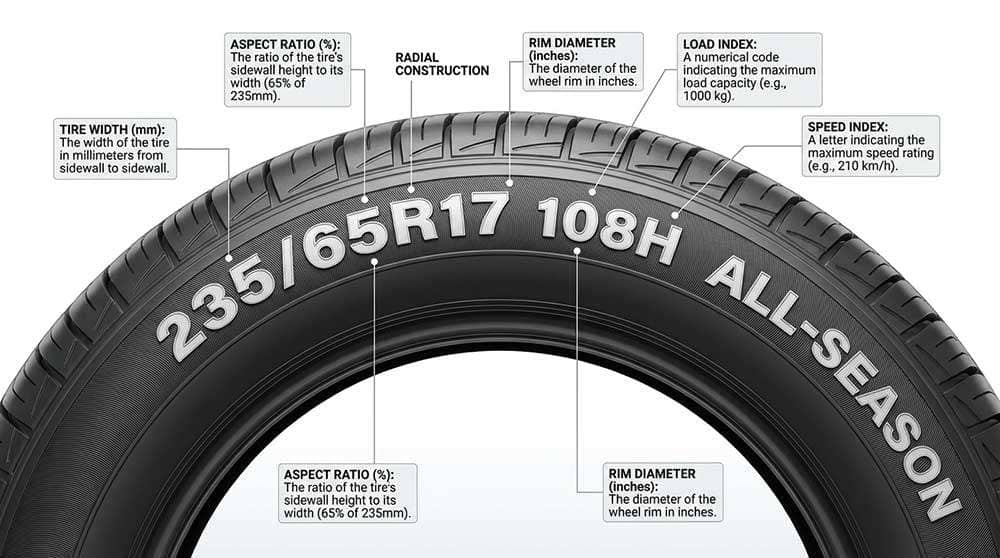
Converting metric tire measurements to inches makes it easier to visualize actual tire dimensions and compare different sizes. The 235/65R17 conversion follows straightforward mathematical steps that anyone can master with basic calculator work.
Converting a 235/65R17 tire to inches requires three essential calculations. Here's the basic conversion approach for each component:
Convert section width: Divide the width in millimeters by 25.4 (the number of millimeters in one inch)
Calculate sidewall height: Multiply the width in inches by the aspect ratio (expressed as a decimal)
Determine overall diameter: Add twice the sidewall height to the rim diameter
These calculations give you precise measurements that show exactly how the tire will fit your vehicle and impact its performance.
The first number, 235, represents the section width in millimeters. Converting this measurement:
Section width (in) = 235 ÷ 25.4 = 9.25 inches
This tells you the tire measures 9.25 inches wide from sidewall to sidewall. Some tire shops might round this to 9.3 inches for simplicity. This width measurement becomes critical when checking if a tire will clear your vehicle's wheel wells and suspension components.
The aspect ratio (65) shows the sidewall height as a percentage of the width. Here's how to calculate the actual sidewall height:
Sidewall height (in) = Section width (in) × Aspect ratio Sidewall height (in) = 9.25 × 0.65 = 6.01 inches
With the sidewall height, you can determine the overall diameter:
Overall diameter (in) = (2 × Sidewall height) + Rim diameter Overall diameter (in) = (2 × 6.01) + 17 = 29.0 inches
This diameter calculation directly affects your speedometer accuracy and ground clearance. The tire's circumference equals the diameter multiplied by π (3.14), which gives you 91.2 inches.
These simple conversions provide complete dimensional understanding: 9.25 inches wide with a 6.01-inch sidewall height, mounted on a 17-inch wheel, creating a 29-inch total diameter and approximately 91.2-inch circumference.
When selecting replacement tires, knowing which compatible alternatives work with your vehicle prevents costly mistakes and maintains proper performance. Here's how different tire sizes compare to the 235/65R17 and which substitutions make sense for your specific needs.
The 225/65R17 tire runs 10mm (0.39 inch) narrower than the 235/65R17, creating these specific changes:
Smaller overall diameter: 28.52 inches vs 29.03 inches (-1.8% difference)
Narrower width: 8.86 inches vs 9.25 inches (-4.3% difference)
Reduced sidewall height: 5.76 inches vs 6.01 inches (-4.3% variance)
The good news is that 225/65R17 stays within the recommended 3% diameter variance, making it a safe swap that fits the same rims. You might notice slightly better fuel economy with the narrower profile, though you'll give up a small amount of road contact.
The 245/65R17 tire offers more width and these dimensional changes:
Increased diameter: 29.54 inches vs 29.03 inches (+1.8% difference)
Wider profile: 9.65 inches vs 9.25 inches (+4.3% difference)
Taller sidewall: 6.27 inches vs 6.01 inches (+4.3% increase)
These tires mount on the same wheels without issues. The speedometer variance remains minimal—at 60 mph, your actual speed would be 61.06 mph (+1.8%). The wider footprint can improve traction, particularly in dry conditions.
Comparing width alone, 265 tires measure 30mm (1.18 inches) wider than 235 tires. This substantial width increase typically delivers:
Notably larger overall diameter
Wider contact patch for potentially improved traction
Higher sidewall height when comparing same-aspect-ratio tires
The size difference becomes even more dramatic with complete size comparisons like 235/75R15 vs 265/75R16, where the diameter difference reaches 9.6%.
We recommend staying within 3% of your original tire's diameter to avoid potential brake issues or vehicle damage. Safe alternatives for 235/65R17 include:
225/65R17 (-1.8% diameter variance)
245/65R17 (+1.8% diameter variance)
235/60R17 (-3.2% diameter variance)
235/70R17 (+3.0% diameter variance)
Always check your vehicle's manual or consult a tire professional before making any substitutions to ensure proper fitment and maintain your vehicle's designed performance characteristics.
The 235/65R17 tire size serves as original equipment on an impressive range of vehicles, with manufacturers choosing this dimension for its versatility across crossovers and SUVs.
This tire size appears on most popular SUVs and crossovers in today's market. Honda CR-V, Hyundai Santa Fe, and Kia Sorento represent some of the most common applications for this size. Ford's Edge and Bronco Sport use this dimension as standard equipment, along with Nissan's Rogue and X-Trail models. Mazda CX-7 vehicles also come equipped with these tires from the factory.
Original equipment manufacturer specifications show 235/65R17 tires across diverse vehicle lineups:
Honda: CR-V, Pilot, Odyssey
Hyundai/Kia: Santa Fe, Tucson, Sorento, Sportage
Ford: Edge, Bronco Sport, Maverick
Luxury brands: Audi Q5, BMW X5, Volvo XC60, Land Rover Evoque
Ford Maverick owners often upgrade from the stock 225 size to 235/65R17 tires for enhanced appearance and performance.
The 235/65R17 size delivers the ideal balance that light trucks and SUVs require. Market data shows 17-inch tire sizes dominate the passenger and light truck segments. This widespread adoption comes from the size's ability to provide adequate load capacity while maintaining reasonable fuel economy. Manufacturers select this dimension because it offers the right combination of comfort, performance, and utility that modern crossovers and light trucks demand.
The 235/65R17 tire size represents one of the most practical choices in today's automotive market. We've covered the essential components that make this size so popular among SUV and crossover owners, from the precise width and aspect ratio calculations to the compatibility factors you need to consider.
These tires work because they deliver the right combination of performance characteristics. The 29-inch diameter provides adequate ground clearance without affecting fuel economy significantly. The 9.25-inch width offers sufficient road contact for stability while maintaining reasonable rolling resistance.
When replacement time arrives, you have several compatible options within the recommended diameter variance. The 225/65R17 offers a slightly narrower profile, while the 245/65R17 provides additional width for those wanting a more aggressive stance. Both alternatives maintain the performance balance that makes this tire family so versatile.
The widespread adoption across Honda CR-V, Ford Edge, and Hyundai Santa Fe models demonstrates why manufacturers choose this specification. It delivers the optimal blend of ride comfort, handling capability, and durability that modern drivers expect from their vehicles.
Armed with this knowledge, you can make confident decisions about your next tire purchase. Whether you stick with the original 235/65R17 size or explore compatible alternatives, you now understand how each dimension affects your vehicle's performance and safety. The right choice ensures proper speedometer accuracy, optimal handling characteristics, and reliable performance for thousands of miles ahead.
Understanding tire size codes empowers you to make informed decisions about replacements and ensure optimal vehicle performance.
• 235/65R17 measures 29.03 inches in diameter with 9.25-inch width, making 695 revolutions per mile for accurate speedometer readings.
• Each number has specific meaning: 235 = width in mm, 65 = sidewall height percentage, R = radial construction, 17 = wheel diameter in inches.
• Stay within 3% diameter variance when choosing alternatives like 225/65R17 or 245/65R17 to maintain safety and performance.
• Popular on SUVs and crossovers including Honda CR-V, Ford Edge, and Hyundai Santa Fe due to optimal comfort-performance balance.
• Convert to inches easily: Divide width by 25.4, multiply by aspect ratio for sidewall height, then add twice sidewall height to rim diameter.
This tire size represents the sweet spot for modern crossovers, delivering the right combination of ride comfort, handling capability, and fuel efficiency that today's drivers demand.
A 235/65R17 tire has a width of approximately 9.25 inches. This measurement is obtained by converting 235 millimeters to inches.
This tire size impacts various aspects of vehicle performance. It has a diameter of about 29 inches, which influences ground clearance and speedometer accuracy. The tire makes roughly 695 revolutions per mile, affecting speed readings and overall handling.
Yes, a 245/65R17 tire is generally compatible with vehicles that use 235/65R17 tires. It's slightly wider and has a 1.8% larger diameter, which is within the recommended 3% variance for safe substitution.
This tire size is popular among SUVs and crossovers. Models like the Honda CR-V, Ford Edge, Hyundai Santa Fe, and Kia Sorento often come equipped with 235/65R17 tires as standard.
To convert this tire size to inches, divide the width (235) by 25.4 to get 9.25 inches. The sidewall height is 65% of this width, which is about 6.01 inches. Add twice the sidewall height to the 17-inch rim diameter for a total diameter of approximately 29 inches.



