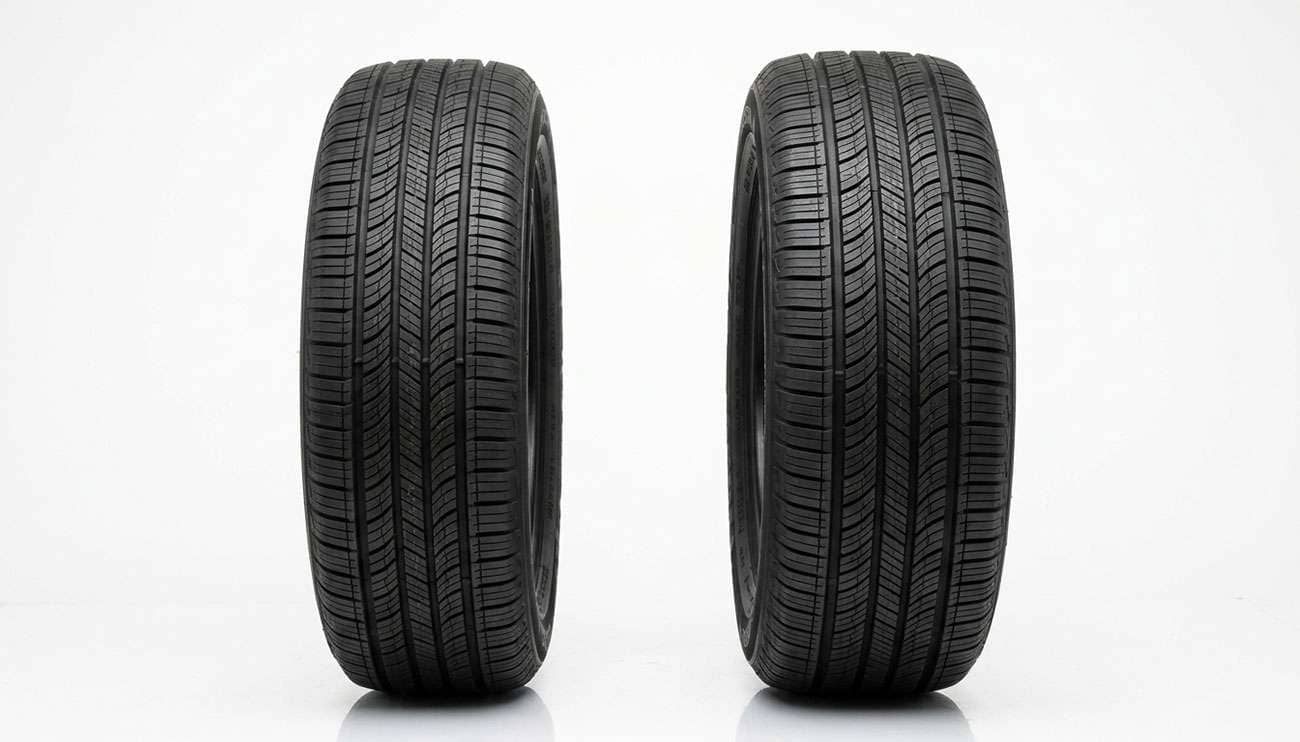
Yes. On most crossovers that came with 225/60R18, a 235/60R18 mounts on the same factory wheels, stands less than half an inch taller, and carries more weight. Lexus made this exact move when the NX went from 225/60R18 to 235/60R18 for 2022. The variable that decides your case is how many tires you're changing. On an all-wheel-drive vehicle, the 235 goes on all four corners or none, because a 235 axle against a 225 axle is about six times the circumference mismatch AWD service guidance allows.
Most of what you'll find on this question stops at "check your clearance" and never says what else it depends on. I've been answering it across the counter at our Long Beach shop since 1971, and clearance is usually the easy part.
The customer is usually a RAV4, Outback, or Cherokee owner whose favorite tire shows up in 235/60R18 before 225/60R18. That's no coincidence. The 235 is the more widely produced of the two sizes, with more models and more load options. Whether the swap makes sense on your vehicle comes down to this table.
Can you run 235/60R18 instead of 225/60R18? The quick answer by situation:
Your Situation |
Verdict |
Why |
|---|---|---|
Front-wheel drive, replacing all four |
Yes |
Fits factory 18-inch wheels. Diameter grows 1.65 percent, inside the 3 percent window most shops work to. |
All-wheel drive, replacing all four |
Yes |
All four corners roll the same distance per turn, so the AWD system never sees a difference. |
All-wheel drive, replacing only two (or one) |
No |
A 1.48-inch circumference gap front to rear, about six times the quarter-inch tolerance AWD service guidance works to. |
Front-wheel drive, replacing only the front pair |
Not recommended |
Won't hurt the drivetrain, but it puts the grip on the wrong end of the car and your placard lists one size for all four. |
Door placard calls for 100 SL (1,764 lb) |
Yes |
A 235/60R18 103 SL or 107 XL carries more per tire. |
Door placard calls for 104 XL (1,984 lb) |
Only in XL |
Buy a 107 XL. A 102 or 103 standard-load 235 comes in under spec. |
Less than 1/2 inch between tire and strut or liner today |
Test-fit first |
The 235 moves the inner sidewall about 5 mm closer to the strut and the top of the tire about 6 mm higher. |
The first number is section width in millimeters. The 60 is the aspect ratio, meaning the sidewall is 60 percent as tall as the tire is wide. The 18 is the wheel diameter. Change only the first number and you'd think only the width moves. It doesn't.
Because the sidewall is a percentage of the width, a wider tire with the same aspect ratio also gets a taller sidewall. Sixty percent of 225 mm is 135 mm. Sixty percent of 235 mm is 141 mm. That extra 6 mm shows up twice in the overall diameter, once above the wheel and once below it, so the 235 stands about 12 mm, or 0.47 inch, taller. Here's the full comparison:
Spec |
225/60R18 |
235/60R18 |
Difference |
|---|---|---|---|
Section width |
225 mm (8.9 in) |
235 mm (9.3 in) |
+10 mm (0.39 in) |
Sidewall height |
135 mm (5.31 in) |
141 mm (5.55 in) |
+6 mm (0.24 in) |
Overall diameter |
28.63 in |
29.10 in |
+0.47 in (+1.65%) |
Circumference |
89.94 in |
91.43 in |
+1.48 in |
Revolutions per mile |
704 |
693 |
-11 |
Approved rim width |
6.0 to 8.0 in |
6.5 to 8.5 in |
Overlap: 6.5 to 8.0 in |
Measuring rim width |
6.5 in |
7.0 in |
+0.5 in |
Most common load indexes |
100 SL / 104 XL |
103 SL / 107 XL |
+3 index points (+165 lb) |
Half an inch of height and four-tenths of an inch of width isn't much on its own. Ride height goes up about a quarter inch, the footprint gets a little wider, and the sidewall gets a little more cushion. For the full breakdown of the size you're starting from, see the 225/60R18 tire size guide.
Those small numbers stop being small in three places: the gap to the strut, the way an AWD system reads a 1.48-inch circumference difference, and the load index you end up with.
Yes, and this is the easiest box to check. Every tire size has an approved range of rim widths set by the Tire and Rim Association, and tire makers publish that range on their spec sheets. A 225/60R18 is approved on wheels 6.0 to 8.0 inches wide. A 235/60R18 is approved on 6.5 to 8.5 inches.
The factory 18-inch wheels on most compact crossovers run around 7 to 7.5 inches wide. That's not just inside the 235's range. A 7-inch wheel is the 235/60R18's measuring rim, the exact width the tire maker uses to measure and publish its dimensions. So on a typical factory wheel, the 235 actually sits closer to its design width than the 225 did.
The only wheel I'd think twice about is an aftermarket 18x6.5. It's still approved, but it's the bottom of the range, so the sidewalls pinch in and the steering feels a touch softer. Safe, just not where the tire works best.
Your TPMS sensors stay in the wheels and keep working. FMVSS 138 sets the low-pressure warning at 25 percent below placard pressure, and you'll keep running placard pressure on the 235s, so nothing changes. Same lug nuts, same torque spec.
On most crossovers that came with 225/60R18, no. But this is the one part you have to check yourself, because no chart knows how much room your wheel wells have.
Here's the geometry. Mount the 235 on the same wheel and the extra 10 mm of width splits evenly, about 5 mm toward the outside and 5 mm toward the inside. Five millimeters is just under a quarter inch. At the same time, the top of the tire rises about 6 mm toward the fender liner. The tire grows in two directions at once, toward places you can't see when you walk around the car.
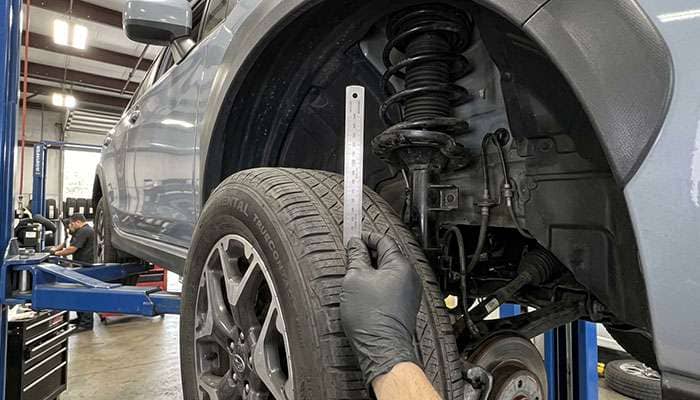
Where a 235/60R18 rubs first:
On some of these vehicles, the Outback included, owners describe the wheel wells as snug, which is exactly why you check instead of guessing. My shop rule is simple. If you have more than half an inch between the tire and the strut right now, a 235/60R18 fits with room left over. If you have less than half an inch, mount one 235 on a wheel and try it before you buy four. Turn lock to lock, bounce the corner, and look.
And if a tire does rub, don't reach for wheel spacers to push it away from the strut. That trades a rubbing problem for a bearing-load and fender-clearance problem. I walk through the right fixes in why your tires are rubbing, but on this swap, the right fix is usually to stay with 225/60R18.
Yes, as long as all four tires are 235/60R18. This is the variable that matters most for this swap, because almost every vehicle that comes with 225/60R18 is a crossover sold with all-wheel drive. Every Subaru Outback is AWD. Most RAV4s with 18-inch wheels are AWD. The Cherokee runs 225/60R18 on its 4x4 trims. And this is the part almost nobody puts in front of you with actual numbers.
Here's the mechanism. An AWD system connects the front and rear axles through a coupling, usually a clutch pack, sometimes a center differential. That coupling expects both axles to turn at nearly the same speed when you're driving straight. When one axle turns faster than the other, the system reads it as wheel slip and the coupling works to make up the difference.
A 225/60R18 turns about 704 times per mile. A 235/60R18 turns about 693 times. Put 235s on one axle and 225s on the other and the 225 axle has to turn 11 extra times every mile. That's not slip you'll ever feel. It's 11 turns per mile, every mile, forever. Over 1,000 miles, the coupling has quietly absorbed more than 11,000 revolutions of difference.
How big is that gap compared to what AWD can handle? Subaru dealers commonly work to a quarter-inch limit on circumference difference between tires on the same vehicle. The difference between a 225/60R18 and a 235/60R18 is 1.48 inches. That's about six times the limit.
Look at it another way. The 235's radius is 0.236 inch bigger, which works out to about 7.6/32 of an inch. A new all-season tire starts around 10/32 of tread. So mixing these two sizes on an AWD vehicle is roughly like putting brand-new tires on one axle and tires worn all the way down to the 2/32 wear bars on the other. No tire shop would sign off on that, and an AWD system doesn't like it any better just because the tires are new.
So the rule on AWD is four or none. If you'd only planned to replace two tires this time, either stay with 225/60R18 for those two or wait and do all four as 235s. If you damage one 235 later in its life, the same rule applies that applies to any AWD vehicle: match the replacement closely to the other three, which sometimes means having a new tire shaved down to their tread depth. I lay out the full set of rules in our AWD tire requirements guide.
Not on an AWD vehicle. On a front-wheel-drive vehicle it won't hurt the drivetrain, because the rear wheels just roll. I still don't recommend it.
The Tire Industry Association's long-standing guidance is that when you only buy two tires, the newer, grippier pair goes on the rear. The reason is wet-road stability. If the fronts grip better than the rears, the back of the car lets go first in a hard swerve on wet pavement, and a spin is much harder to catch than a slide. New, wider 235s up front over worn 225s in back builds that exact imbalance on purpose.
Your door placard, required under FMVSS 110, also lists one tire size for the vehicle. Two sizes means your stability control compares front and rear wheel speeds that never quite match. Do all four or stay with what you have.
Usually, yes, and the reason is air. A tire carries your car with compressed air; the rubber just holds the air in. A 235/60R18 holds more air, and at the same pressure, more air volume carries more weight.
In numbers, the most common standard-load 225/60R18 carries a 100 load index, which is 1,764 pounds per tire. The most common standard-load 235/60R18 carries a 103, which is 1,929 pounds. That's 165 pounds more per tire, about 9 percent, at the same pressure. Extra-load versions move the same way: a 104 XL 225 is rated for 1,984 pounds, and a 107 XL 235 is rated for 2,149.
You can see it inside a single tire line. The Pirelli Scorpion All Season Plus 3, for example, is a 100H in 225/60R18. In 235/60R18 it's built as a 103H standard load or a 107V extra load. Same tread, same compound, more capacity.
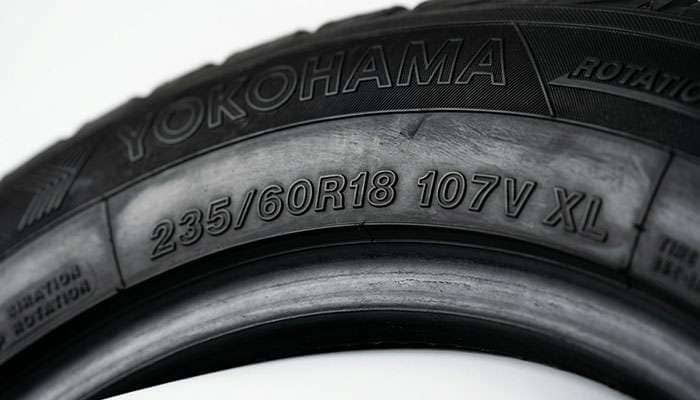
Here's where people get turned around. Not every 235/60R18 is a 103 or a 107. A smaller slice of the market, including several older original-equipment replacement lines, is built as a 102 standard load, rated for 1,874 pounds. That still beats a 100. But if your door placard calls for a 104 XL 225/60R18, a 102 or a 103 standard-load 235 comes in under spec, even though it's the bigger tire.
The fix is easy once you know how XL works. An extra-load tire and a standard-load tire of the same size carry the same weight at the same pressure. The XL's extra capacity only shows up when it's inflated past where a standard-load tire tops out, which is about 35 to 36 psi, up to around 41 psi. A standard-load tire can't be aired up to get there. So if your placard calls for XL, the vehicle was specced around that higher pressure range, and you need XL in the 235, too. I explain the difference in more depth in SL vs XL tires.
Tire Industry Association training, which most shops follow, says a replacement tire should match or exceed the original equipment's load capacity. Here's what that means for a 235:
Which 235/60R18 to buy, based on your door placard:
Placard Spec on Your 225/60R18 |
Minimum 235/60R18 to Buy |
What to Watch |
|---|---|---|
100 SL (1,764 lb) |
102 SL (1,874 lb) or higher |
A 103 SL or 107 XL is the common choice. All of them clear the factory spec. |
99 SL (1,709 lb) |
102 SL (1,874 lb) or higher |
Less common. Any 235/60R18 on the market clears it. |
104 XL (1,984 lb) |
107 XL (2,149 lb) |
Skip 102 and 103 standard-load 235s. Look for "XL" after the size. |
H speed rating (130 mph) |
H, V, or W |
About one in ten 235/60R18s is T-rated, mostly winter tires plus some all-terrain and highway-terrain designs. |
V speed rating (149 mph) |
V or W |
V is the single most common rating in 235/60R18, so this is easy to match. |
Speed rating barely moves on this swap. Both sizes are built mostly in H and V. The one place to slow down is all-terrain and highway-terrain tires, where T ratings show up about twice as often as they do in touring tires. If you're shopping an A/T for a RAV4 TRD Off-Road, read the speed letter before you read the price.
Your speedometer counts wheel revolutions and assumes each one covers the distance of the original tire. The 235 covers 1.65 percent more ground per turn, so the speedometer reads a little low.
Most factory speedometers read a hair fast from the start, so a 1.65 percent taller tire often brings the needle closer to true. No recalibration needed.
The gas mileage part nobody tells you about. Your odometer works off the same wheel revolutions, so it under-records distance by the same 1.65 percent. Drive 10,165 real miles and the odometer shows 10,000. Your trip computer's mpg reading divides that short distance by the fuel you actually burned, so it reads low by the same 1.65 percent. A vehicle that's really getting 30 mpg will show about 29.5 on the dash.
So a good chunk of the mileage drop people report after this swap is the odometer, not the tire. In the same tire line, a 235/60R18 typically weighs a pound to a few pounds more than the 225, and the wider footprint adds a little rolling resistance. Hybrid owners may notice. Most drivers won't.
These two sizes live on the same class of vehicle, and the automakers themselves move between them.
Vehicles that came with 225/60R18 include:
Vehicles that came with 235/60R18 include:
Two of those details deserve a closer look. Lexus moved the NX from 225/60R18 to 235/60R18 when it redesigned the vehicle for 2022. That's an automaker making this exact jump. Just don't read it as proof your 2019 NX has the same room. The 2022 is a new body with new wheel wells, and Lexus engineered it around the 235.
The RAV4 is even more telling. Look at the 2024 lineup and the hybrid trims ride on 225/60R18, while the Limited, Adventure, and gas XLE Premium ride on 235/55R19. That 19-inch tire is the same 235 mm wide and stands 29.2 inches tall, within a tenth of an inch of a 235/60R18. Toyota already wraps the RAV4's body around a tire that size. Offset can differ between the 18- and 19-inch wheels, so it's not a guarantee, but it's a strong sign the room is there.
A full set of four 235/60R18s with the right load index costs you nothing but a slightly lazy speedometer. A half-done swap is a different story, and it gets more expensive the longer you drive on it.
Every one of those ends at the same place: buying tires again. The cheapest way through this swap is to buy four of the right 235s once, or stay with 225/60R18.
Can you use 235/60R18 instead of 225/60R18? On most crossovers, yes, and done right it's a small upgrade: more load capacity, more tire choices, and a speedometer that's probably closer to true. It only goes wrong three ways: mixing sizes on an AWD vehicle, buying a standard-load 235 when your placard calls for XL, and skipping the clearance check. Avoid those and forget about it.
If you're weighing the same 10 mm step on 17-inch wheels, I ran those numbers in 235/65R17 instead of 225/65R17. And if you'd like a second set of eyes before you order, give us your year, make, and model. Checking this kind of swap is what we do every day.
On most crossovers, yes. A 235/60R18 is approved on wheels 6.5 to 8.5 inches wide, which covers typical factory 18-inch wheels, and it is only 0.47 inch taller. Check the gap between the tire and the front strut and the fender liner at full lock. If either gap is under half an inch, test-fit one tire before buying four.
Not on an all-wheel-drive vehicle. The two sizes differ by 1.48 inches in circumference, which forces the AWD coupling to slip about 11 revolutions every mile. On a front-wheel-drive vehicle it will not harm the drivetrain, but putting wider new tires on the front and narrower ones on the rear hurts wet-road stability. Run one size on all four.
About 0.47 inch, or 1.65 percent. A 225/60R18 measures about 28.63 inches tall and a 235/60R18 about 29.10 inches. Because the sidewall is 60 percent of the width, the 10 mm of extra width also adds 6 mm of sidewall height above and below the wheel.
Slightly. The speedometer reads about 1.65 percent low, so an indicated 60 mph is about 61 mph actual and an indicated 70 mph is about 71.2 mph. Most factory speedometers read a little fast to begin with, so the change often brings the reading closer to true. No recalibration is needed.
No. Both sizes mount on 18-inch wheels, and the 235/60R18 is approved on rims 6.5 to 8.5 inches wide. Most factory 18-inch crossover wheels are about 7 to 7.5 inches wide, and 7 inches is the 235/60R18's measuring rim. Your TPMS sensors, lug nuts, and wheels all stay the same.
It can be. Toyota already fits other RAV4 trims with 235/55R19 tires that are the same 235 mm wide and almost the same height, which is a good sign the body has room. Replace all four tires since most 18-inch RAV4s are AWD, choose a load index of 103 or higher, and check strut and liner clearance before committing.