
I get this question from two kinds of drivers. One just did their first autocross and wants to keep the sticky tires on for the commute. The other bought a car that came with them and wants to know if that was a mistake. Both usually get the same answer online: "they're fine if you don't mind replacing them." That's true, and it leaves out the three numbers that actually decide it.
The short answer: A 200-treadwear tire can be a perfectly good daily driver, but only inside three limits. Your morning temperatures need to stay above 40F. You need to replace it early for rain, because it starts with about 7/32 inch of tread and hits the 4/32 inch point where wet braking falls off after losing only 3/32. And you need to budget for short life, because 200-treadwear tires don't come with a mileage warranty. Most answers stop at "it depends." It depends on your climate, your rain, and your miles, in that order.
Your daily driving |
200-treadwear verdict |
The limit that decides it |
|---|---|---|
Mornings above 40F year-round, mostly dry roads, under 10,000 miles a year |
Yes, a good fit |
Cost per mile is the only real penalty |
Regular rain or highway commuting in the wet |
Yes, if you replace at 4/32 |
Only about 3/32 of usable tread above the wet-braking cliff |
Mornings below 40F for part of the year |
Only with a second set for the cold months |
Compound loses grip below 40F |
Freezing nights, snow, or a car parked outside below 20F |
No |
Flexing the tire below 20F can crack the tread |
15,000 or more miles a year |
Probably not |
You'll likely buy a set every year or less |
The treadwear number is one-third of the Uniform Tire Quality Grading (UTQG) system NHTSA requires on passenger tires. The tire runs in a convoy on a 400-mile loop of public roads near San Angelo, Texas, for 7,200 miles, alongside a government course monitoring tire. The manufacturer measures the wear, projects it to full life, and assigns a grade relative to that reference. A 200 means the tire projected to last twice as long as the reference on that course. A 500 would project to last two and a half times as long as the 200.
Three things make the number less useful than it looks:
So when you see 200 on a sidewall, read it as "built to the edge of the competition rule," not "lasts 200 of anything." Our guide to reading tire treadwear ratings covers the grade in more depth.
The market backs this up. Nearly every 200-treadwear tire sold is a summer tire, most carry an AA or A traction grade, and none carry a mileage warranty. The manufacturers are telling you what the tire is for.
The industry guidance for extreme performance summer tires sets two lines, and both are lower than the temperatures where problems start:
Here's the part daily drivers miss. The number that matters is your morning low, not the afternoon high. A day that hits 62F can start at 36F, and your commute happens at 36F. A tire that's perfect at 3 p.m. is out of its range at 7 a.m.
Do the calendar math for where you live. In coastal Southern California, morning lows rarely drop below 40F, so a 200-treadwear tire can stay on all year. Across much of the northern half of the country, morning lows sit below 40F for months, which turns a daily-driver 200 into a seasonal tire that needs a second set on a second set of wheels. And if the car lives outside where nights drop below 20F, the tire can be damaged before you ever start the engine. Our guide on whether summer tires crack in the cold covers storage and the warm-up rule in detail.
Above 40F, you're inside the guidance, but you're not inside the compound's best range. These tires are built to work warm, and on a 45F morning the first few miles happen on rubber that hasn't come up to temperature yet. Dry, that shows up as less grip than you're used to in the afternoon. Wet, it stacks on top of the shallow tread. Treat cool mornings like a slick road: give the tires a few miles of gentle driving before you lean on them, and leave more room in the rain.
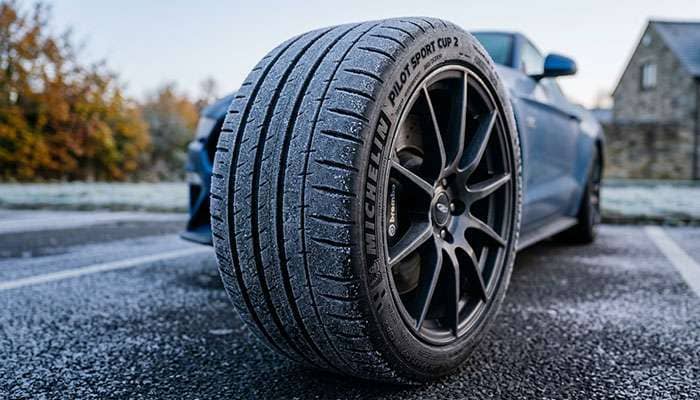
When they're new, most are good in the wet, and the traction grade says so. But that grade measures less than most people think, and the tread runs out fast.
The UTQG traction test drags a tire with its brakes locked behind a skid trailer at 40 mph on wet asphalt and wet concrete. It grades straight-line braking on a new tire. It does not test wet cornering, and it does not test hydroplaning resistance at highway speed. An AA on a 200-treadwear tire tells you the compound grips wet pavement. It tells you nothing about what happens when the grooves can't clear standing water.
Hydroplaning resistance comes from groove volume, and that's where a 200-treadwear tire gives up the most. SCCA's Time Trials tire rules set a minimum molded tread depth of 7/32 inch, and the category's benchmark tires are built right around it; the Bridgestone Potenza RE-71RS, for example, starts at 7/32. A typical all-season tire starts at 10/32 to 11/32.
Now put that against AAA's research. AAA found that all-season tires worn to 4/32 inch took an average of 87 feet longer to stop from 60 mph on wet pavement than new tires, a 43% increase, and recommends replacing at 4/32 instead of the legal 2/32. Here's what that leaves you:
Tire |
Starting depth |
Usable to 4/32 |
Usable to 2/32 (legal minimum) |
|---|---|---|---|
Typical 200-treadwear tire |
7/32 in. |
3/32 in. |
5/32 in. |
Typical all-season tire |
10/32 to 11/32 in. |
6/32 to 7/32 in. |
8/32 to 9/32 in. |
A 200-treadwear tire reaches the 4/32 point after losing less than half its starting tread. An all-season gets roughly twice as much tread before it gets there, and it wears that tread more slowly. If you commute in the rain, the useful life of a 200-treadwear tire isn't the miles to the wear bars. It's the miles to 4/32. Our guide on what tread depth to replace tires at covers how to measure it, and our explainer on why hydroplaning happens covers the speed and water depth side.
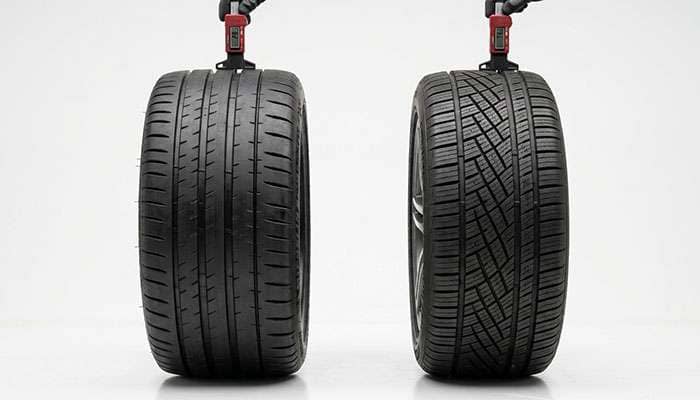
On the street, owner data mostly lands somewhere between about 8,000 and 16,000 miles, and the spread is wider than that number suggests. Weight, camber, driving style, and climate all move it, and so does the tire itself. Grassroots Motorsports' 2026 long-term test of four 200-treadwear tires in competition use found the longest-wearing one delivered about 50% more tread life than the shortest-wearing one. Same grade, very different life.
There's no warranty to fall back on, either. Here's how mileage warranties line up across treadwear grades in the current market:
Treadwear grade |
Typical tire type |
Share with a mileage warranty |
Typical warranty when offered |
|---|---|---|---|
Under 200 |
Track and competition |
About 1% |
Rare |
200 |
Extreme performance summer |
None |
Not offered |
201 to 299 |
Max performance summer |
About 22% |
25,000 miles |
300 to 399 |
Max and ultra high performance |
About 43% |
30,000 miles |
400 to 499 |
Performance all-season |
About 65% |
50,000 miles |
500 to 599 |
Touring and all-season |
About 90% |
50,000 miles |
600 and up |
Long-life touring |
About 90% |
60,000 to 70,000 miles |
Run the numbers on a commute. At 12,000 miles a year and 12,000 miles per set, a 200-treadwear daily driver needs a new set every year. Against a 50,000-mile touring tire, that's roughly four sets for every one. Whether that's worth it depends on how much you value the grip. Just make the decision with that ratio in front of you.
Highway miles are the gentlest miles a 200-treadwear tire will see. Stop-and-go traffic, tight parking garages, and twisty commutes scrub the shoulders on every turn and every launch. Two drivers with the same tire and the same annual mileage can see very different life depending on how much of it is straight-line cruising. Alignment matters just as much: aggressive negative camber, common on cars set up for autocross, wears the inside shoulder fast on the street, and that wear is easy to miss until a cord shows.
If you drive very little, the opposite problem shows up. A soft compound keeps hardening with age, cold cycles, and sun, so a 200-treadwear tire on a weekend car can lose grip long before it reaches the wear bars. Check the date code and the feel, not just the tread.
For most daily drivers, no. A max performance summer tire, usually graded somewhere above 200 and into the 300s, gives up a little ultimate dry grip in exchange for deeper starting tread, better wet margin as it wears, a quieter ride, and in many cases a mileage warranty. On public roads, you rarely use the last few percent of grip a 200 offers. You use the wet margin and the tread life every single day.
Here's how I'd sort it:
None of this shows up on day one. It builds in about this order.
Stiff sidewalls and a grippy compound mean more road noise and a firmer ride. That's the price of admission, and most owners know it going in.
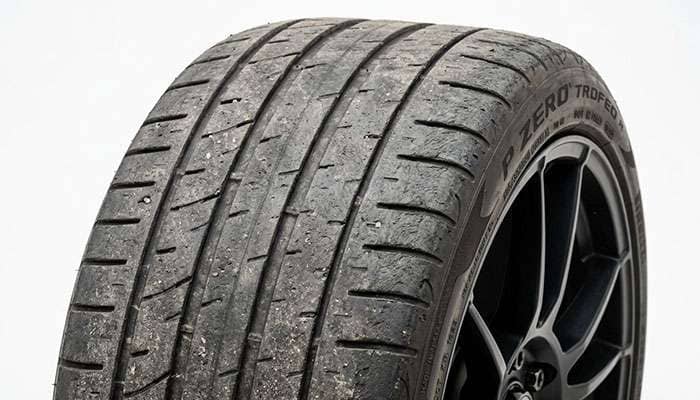
With about 5/32 of usable tread and a soft compound, the wear is visible within the first few thousand miles, especially on the driven axle and on cars with aggressive camber.
Long before the wear bars show, the tire passes 4/32, and the stopping distance in rain grows. The dry grip still feels great, which is exactly what makes this step easy to miss.
One frosty morning on the street costs you grip. One night parked outside below 20F, followed by a drive before the tires warm up, can crack the tread. Cracked tread means a new set, regardless of how much depth is left.
Every step ends in the same place: a new set sooner than you planned. The way to stop at step one is to buy the right category for how you actually drive, and to replace a 200-treadwear tire on your schedule instead of the weather's.
Step 1: Check your morning lows, not your highs. If your commute temperature drops below 40F for part of the year, plan for a second set for those months.
Step 2: Store them right. Keep the car or the spare set somewhere that stays above 20F. If they get colder, let them warm to 40F for 24 hours before you drive, mount, or inflate.
Step 3: Measure tread monthly. Start a log at 7/32. When any tire hits 4/32, start shopping, especially if you drive in the rain.
Step 4: Set pressure from the placard, then check it cold. Soft compounds are sensitive to pressure. Under-inflation chews the shoulders; over-inflation wears the center and shrinks the contact patch in the wet.
Step 5: Rotate if your car allows it. Staggered setups can't rotate front to rear, so expect the driven axle to wear out first and budget for it.
Step 6: Buy for the miles you actually drive. If you're going to run 200-treadwear tires on the street, compare extreme performance summer tires in your size and look at starting tread depth alongside price. An extra 1/32 of starting depth is a third more usable tread above 4/32.
A 200-treadwear tire isn't a bad daily driver. It's a daily driver with three hard limits. It needs mornings above 40F and storage above 20F. It needs replacing at 4/32 if you drive in the rain, which comes after only about 3/32 of wear. And it needs a budget for short, unwarrantied life, often a set a year at typical commuting miles. If all three fit how you drive, enjoy the grip. If any of them doesn't, a max performance summer or a UHP all-season will serve you better on the street, and you'll keep the 200s for the days you actually need them.
Yes, if your morning temperatures stay above 40F, you replace them at 4/32 inch if you drive in the rain, and you're prepared to replace them often. They're a poor fit for cold climates, high-mileage commutes, and cars parked outside where nights drop below 20F.
On the street, owners mostly report about 8,000 to 16,000 miles, depending on the tire, the car's weight and alignment, driving style, and climate. 200-treadwear tires don't carry mileage warranties, and two tires with the same grade can differ by 50% or more in real tread life.
Most are good in the rain when new and carry an AA or A traction grade. But they start with about 7/32 inch of tread, so they reach the 4/32 inch point where AAA found wet stopping distances grow sharply after losing only 3/32. Replace them at 4/32 if you drive in the wet.
Don't drive on them below about 40F, and some manufacturers set the line at 45F. Below 20F, the compound can crack if the tire is flexed. If the tires have been exposed to 20F or colder, let them warm to at least 40F for 24 hours before driving, mounting, or adjusting pressure.
A higher grade usually means longer tread life and a harder compound with less ultimate grip. Because manufacturers assign the grade from their own testing, compare grades within one brand rather than across brands, and treat the number as a relative wear projection, not a mileage figure.
SCCA's Street and Street Touring autocross classes and most of its Time Trials categories require a minimum treadwear grade of 200. Manufacturers build their stickiest street-legal tires to sit right at that floor so they stay eligible for competition.