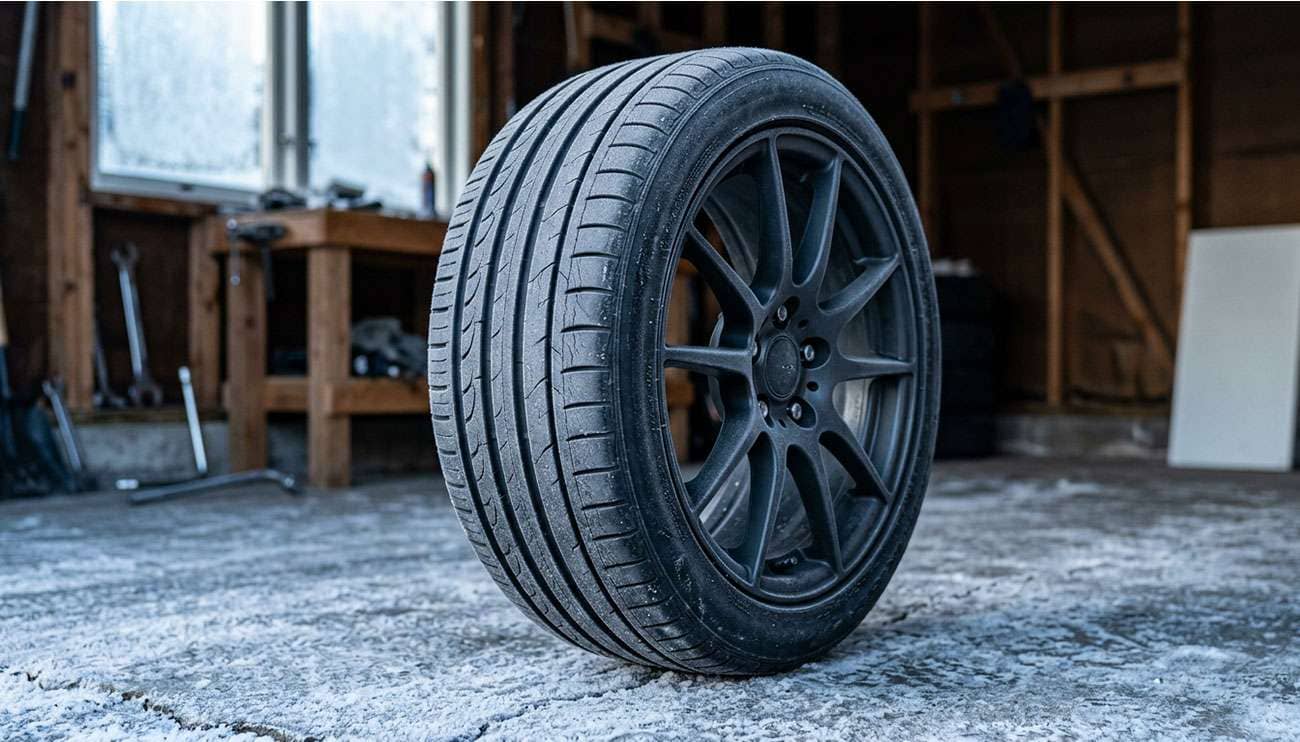
Yes, summer tires can crack in the cold, but cold alone is rarely what cracks them. Flexing does. Michelin and GM both draw the damage line at 20°F (-7°C), and the cracking happens when the tread is bent at or below that temperature: driven, rolled, mounted, inflated, or dropped. A summer tire sitting still in a 15°F garage is at far lower risk than the same tire rolling out of it. Most guides stop at "it depends." What it depends on is what the tire is doing while it is cold.
This question lands on our Fitment Team every November, usually from someone looking at a forecast low of 18°F. The honest answer is not one temperature. It is a set of lines, and each applies to a different situation:
What the Tire Is Doing |
Above 45°F |
20°F to 45°F |
Below 20°F (-7°C) |
|---|---|---|---|
Driving on it |
Full grip, no concern |
No damage line crossed, but grip falls hard below 40°F and some warranties stop covering cracking below 45°F |
Cracking risk. GM and Michelin say do not drive or move it |
Parked on the car, not moving |
No concern |
No concern |
Low risk while still. The first roll is the danger, so leave it parked until it warms |
Stored off the car |
No concern |
No concern |
Outside the GM and Michelin storage guidance (above 20°F). Porsche's hard floor is 5°F |
Mounting, inflating, or seating beads |
Normal service |
Acceptable if the tire never dropped below 20°F; cold rubber seats harder |
Stop. Warm it at 40°F or higher for 24 hours first |
Rolling, dropping, or loading the car on a trailer |
Normal handling |
Normal care |
Don't. Michelin says do not roll or drop its sport summer tires below 20°F |
Read that table by row, not by column. The temperature tells you how cold the rubber is. The row tells you whether anything is about to bend it. Cracking needs both.
The damage line tire makers and automakers publish is 20°F (-7°C). You will see other numbers too, and the confusion comes from treating them as if they meant the same thing. Here is what each one governs.
45°F (7°C): the warranty line. Porsche tells owners to switch to winter tires below 7°C. Pirelli's warranty language on its max performance summer tires excludes compound cracking from use below 45°F. Nothing breaks at 45°F. It is where the maker stops standing behind the tire if something does.
40°F (5°C): the traction line. GM service bulletin 13-03-10-001, on file with NHTSA and revised as recently as October 2024, warns of reduced traction below approximately 40°F and recommends winter tires below that point. Michelin uses the same number for its UHP sport summer tires, measured as tire temperature. Below 40°F you lose grip, but you are not yet breaking anything.
20°F (-7°C): the damage line. The same GM bulletin tells owners to avoid driving, moving, or test-driving these cars below 20°F because it can damage the tires. Michelin says its UHP sport summer tires may develop surface cracks in the upper sidewall and tread if flexed below 20°F, and tells owners not to use, roll, or drop them in that range.
5°F (-15°C): the storage floor. Porsche's approved-tire documentation says never to store summer tires where the ambient temperature drops below 5°F, and the 911 owner's manual warns that cold that extreme can permanently damage them. GM and Michelin set the storage line at 20°F. For a garage, use 20°F.
Competition tires sit on their own, higher floor. GM's technician publication says not to drive them below approximately 50°F (10°C). The 20°F storage and handling rules still apply.
Michelin writes its guidance around tire temperature, GM around ambient temperature. For a car parked outside or in an unheated garage, they are the same number at the moment that matters. A tire that sat all night at 15°F is 15°F when you start the car, and the only way to warm it on the road is to flex it while it is coldest. That is why the overnight low decides this question, not the afternoon high.
Between 32°F and 20°F, you are below freezing but above the published damage line. Careful driving in that band is unlikely to crack the tires, but they will perform badly. Grip on cold, dry pavement is a fraction of what the same tire delivers in July, and on snow, ice, or slush, GM warns that summer tires may cause loss of control. If yours are Pirellis, remember the 45°F warranty line.
Below 20°F, the answer is no. GM's language for the Camaro ZL1, Z/28, and SS 1LE is the most direct in the industry: at or below 20°F, "DO NOT MOVE THIS VEHICLE." It does not say do not drive fast or far. It says do not move it.
Yes, and a short drive is the riskiest kind. The damage is not cumulative mileage. It is strain on rubber that cannot stretch, and the first few hundred yards out of a cold garage, before any heat builds in the tread, is when the compound is least able to absorb it.
Above the cracking line, cold summer rubber still punishes hard driving. Stiff tread blocks don't deform smoothly under hard braking or cornering, and their edges can chip. If you have to drive summer tires on a 38°F morning, drive them like the grip is gone, because most of it is.
It depends on two things: how cold the garage gets, and whether the tires are on the car.
Tires off the car. GM and Michelin recommend storing summer tires indoors above 20°F. Porsche's floor is 5°F. An attached garage usually stays above 20°F. A detached, uninsulated garage or storage unit in the upper Midwest, the Northeast, or the mountain West often does not. If you don't know, a cheap min/max thermometer on the shelf for a January week will tell you. Our step-by-step guide to storing wheels and tires between seasons covers cleaning, bagging, and stacking. The temperature rule here is the one extra step summer tires need.
Tires on a parked car. This is the case most guides skip, and the one most collector-car and sports-car owners actually have. A tire that is not moving is not being flexed. The risk shows up the day you move it. When Corvette owners reported cracked tires on new cars in early 2015, Michelin's public statement put it simply: summer tires should never be driven or moved below 20°F, and owners whose garages regularly drop below 20°F should consider removing the tires and storing them inside.

That gives you two clean options for a car stored on summer tires in a garage that gets colder than 20°F:
What you should not do is what almost everyone does: let the car sit at 8°F for six weeks, then back it out on the first sunny Saturday because the afternoon hit 45°F. The air warmed up. The tires, on a cold concrete floor, did not.
Not if they have been at or below 20°F. This is the row of the table that catches shops and do-it-yourselfers alike. Mounting bends the bead and lower sidewall in ways driving never does: the changer stretches the bead over the wheel flange, and seating it pushes the whole carcass outward. Inflation alone is a flex event, because the tire changes shape as it fills. GM's bulletin says to inflate summer tires only after they have warmed above 40°F.
Any summer tire exposed to 20°F or colder needs at least 24 hours in a space at 40°F or warmer before you flex it in any way: adjusting pressure, mounting, rolling it across the shop, or putting a car's weight on it. The warm-up has to be gradual. GM says not to place the tires near heaters or blow heated air on them.
Why a full day? A tire is a thick laminate of rubber, steel belts, and fabric plies, often bolted to an aluminum wheel that started just as cold. The surface warms first and the inside lags for hours, so a tire that feels room temperature to your hand can still be much colder underneath. A heat gun aimed at one spot warms the surface fast and leaves the core cold, the opposite of what you want.
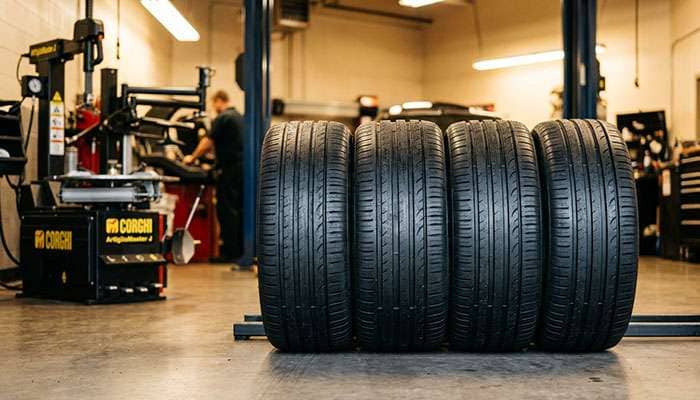
New tires cross the country in unheated trailers. A set delivered on a January morning in Denver or Detroit can arrive at the overnight low. If your summer tires show up in cold weather, bring the boxes inside, leave them for a full day, then hand them to the installer. That day costs nothing and keeps a new set from cracking before it turns a mile.
GM's bulletin lists test-driving right alongside driving and moving. A performance car on a February dealer lot, test-driven on a 15°F morning, can reach you with cracks it did not have a week earlier. Michelin's 2015 statement advised inspecting tires at the dealership before taking delivery. Do that, and do the same for a car driven off a transport truck on a frozen morning.
The mechanism is what tire engineers call the glass transition. Every rubber compound has a temperature range where it stops behaving like a stretchy elastic and starts behaving like a stiff plastic. Above it, the polymer chains move freely and the rubber deforms around the road texture and springs back. Inside it, the chains lock up and the rubber turns leathery, then glassy.
Summer tires put that transition relatively high on purpose. A compound near the edge of its stiff zone on a cool day is, on a hot day, at its peak for absorbing energy as it deforms, and that energy absorption is grip. Our breakdown of what summer tires are actually good for covers the warm-weather side of that trade. Winter compounds push the transition far below zero, so they stay pliable where a summer tread has gone hard. All-season compounds sit in between.
Cracking happens when you ask rubber in its stiff zone to stretch anyway. Every time a rolling tire passes through the contact patch, the tread blocks squeeze, the groove bottoms open and close, and the shoulder and upper sidewall bend. Rubber near its glass transition cannot stretch far enough, so the outer surface, under the most tension, tears in fine cracks. That matches where GM and Michelin say the damage appears: the tread, shoulder, and upper sidewall.
Those cracks do not close when the tire warms. They are physical tears. Warmth restores the compound's flexibility, but the cracks stay.
Cold cracking shows up as fine, shallow surface cracks in the tread compound, usually across the face of the tread blocks, at the bottoms of the grooves, and around the shoulder where the tread turns down into the sidewall. Michelin also names the upper sidewall. The cracks are often short and numerous rather than long and deep, and they tend to appear on more than one tire at once, because all four went through the same cold event.
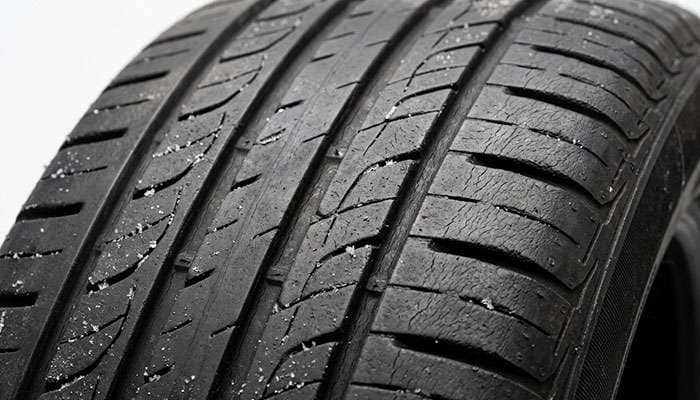
The thing it gets confused with most is dry rot, the age-related cracking caused by ozone and UV exposure. The two look similar in a photo. In person, location, age, and timing tell them apart.
Clue |
Cold Cracking |
Dry Rot (Ozone Cracking) |
|---|---|---|
Where it shows up |
Tread face, groove bottoms, shoulder, upper sidewall |
Mostly the sidewall, often near the rim and in the lettering |
Age of the tire |
Any age, including brand new |
Usually older tires, typically several years past the date code |
When it appears |
Suddenly, right after a cold drive, move, or mount |
Gradually, over months and years |
Tire type |
Summer and competition compounds |
Any tire type |
Warranty treatment |
Treated as improper use or storage, not covered |
Depends on the maker's terms and the tire's age |
If the tire is old and the cracks are in the sidewall, start with our guide to tire dry rot and when it means replacement. If the tire is a year old, the cracks are on the tread, and the car was moved on a frigid morning, you are looking at cold cracking.
One inspection note: do not try to open up suspected cracks by bending the tire while it is still cold. That is flexing it. Let it warm first, then look closely in good light at the tread face, the groove bottoms, and the shoulder all the way around.
The official answer is that it has to be replaced. GM's bulletin calls the surface cracks cosmetic in the sense that they will not cause air loss, then says in the next breath that the cracking damages the tire and that summer tires used in cold climates that show tread cracks should be discarded. Industry warranty language says the same thing from the other direction: compound cracking is not covered because it results from improper use or storage, and tires showing it must be replaced.
Here is how I read the word cosmetic. It describes air retention today. It does not describe how a cracked tread compound behaves after a summer of heat cycles at highway speed. A crack is a stress concentration, and every flex works at it. That is why GM's instruction is discard, not monitor.
Cold cracking is one type of crack in a larger family of tire damage, and the rules for the others are similar. Our guide to tire sidewall damage and whether it is safe to drive walks through bubbles, cuts, punctures, and surface cracks by type. For cold-cracked summer tires specifically, the decision is already made for you by the people who built the tire.
The more aggressive the compound, the higher the risk and the higher the temperature floor. Roughly, from most sensitive to least:
Mainstream all-season, all-weather, and winter tires generally do not carry a compound-cracking warning at all. Their compounds are built to stay flexible far colder. All-seasons have their own cold limit, but it is a traction limit, not a cracking limit. Our guide to what temperature is too cold for all-season tires covers where that line falls.
This matters more than it used to. In 19-inch and larger sizes, roughly three tires in ten on the market are summer-only, about triple the share in 15- to 18-inch sizes. Plenty of performance sedans, EVs, and hot hatches leave the factory on summer rubber, and their owners don't always know it. If the sidewall has no M+S marking and no three-peak mountain snowflake symbol, and the maker lists it as a summer tire, follow the rules in this article.
The cost escalates, and each step down the ladder is more expensive than the last.
Step one: grip, below 40°F to 45°F. Nothing breaks. You pay in stopping distance and margin. On snow or ice, the bill can be the car.
Step two: chipped tread blocks. Drive cold summer tires hard and the block edges chip. The tread wears faster and unevenly, and the tire gets noisier for the rest of its life.
Step three: compound cracking, below 20°F. One cold move is enough. By the maker's own standard the tires are due for replacement, and the warranty won't help.
Step four: replacing the set, not the tire. Cold cracking hits every tire that went through the same cold event. Staggered fitments and AWD tread-depth matching turn even partial damage into a full set, bought mid-winter for a car you still can't drive on summer tires until spring.
Step five: doing it again next year. None of that fixed the actual problem: warm-weather rubber in a cold-weather climate. The purchase that ends the cycle is a second set built for the cold. Where you land depends on your winter:
What Your Winter Looks Like |
Risk to Summer Tires |
What to Do |
What to Buy |
|---|---|---|---|
Overnight lows stay above 40°F |
None |
Keep driving them; give them a few gentle miles on cool mornings |
Nothing |
Lows in the 20s and 30s, dry roads |
Grip loss and chipping; warranty exclusions below 45°F on some brands |
Swap for the cold months |
All-season or all-weather tires on a second set of wheels |
Lows below 20°F, car driven daily |
Cracking on the first cold drive |
Swap before the first hard freeze |
Winter tires on dedicated wheels |
Car stored all winter in a garage that drops below 20°F |
Cracking the day it moves |
Don't move it until warm, or pull the wheels and store tires indoors |
Jack stands and indoor space, not tires |
Competition tires, any climate with cold mornings |
Grip and damage risk below about 50°F |
Store indoors and keep them for warm track days |
A street summer or all-season set for daily use |
A cold-weather set on its own wheels is the cleanest fix, because your summer tires come off before the first freeze and go into storage without ever being flexed cold. It also lets you drop a wheel size for winter, which usually means a taller sidewall, cheaper tires, and better pothole protection. Our guide to downsizing your wheels and tires for a winter package shows how to do that without fitment problems. When you are ready to set up the cold-weather half, start with our winter and snow tires.
Summer tires can crack in the cold, and the published line is 20°F (-7°C). What turns cold into cracks is flex. A summer tire that sits still below 20°F is at low risk. The same tire driven, rolled, mounted, inflated, or dropped below 20°F can come out of it with permanent surface cracks that the maker won't cover and GM says to discard. Above that line, the cost is grip, not rubber, and some warranties stop covering cracking below 45°F anyway. Get the summer set off the car before the first hard freeze, keep it indoors above 20°F, and give any tire that got colder than that a full day at 40°F before it bends. Do that, and your summer tires come back in April exactly the way they went into storage in November.
You can, but you shouldn't plan on it. At 30°F you are above the 20°F line where GM and Michelin say cracking risk begins, so careful driving on dry roads is unlikely to crack the tires. Grip, though, is far below normal because summer compounds lose traction below about 40°F, and some brands exclude compound cracking from warranty coverage below 45°F.
Yes, as long as the garage stays above 20°F, which is the storage line GM and Michelin publish. Porsche sets an absolute floor of 5°F. If your garage regularly drops below 20°F, store the tires indoors in a heated space. If the car is parked on summer tires in that garage, don't move it until the space has held above 40°F for a full day.
They can, especially if anything flexes them while they are cold. Tires sitting still are at lower risk than tires being driven, but outdoor storage puts them below the 20°F storage line in much of the country and adds the ozone and UV exposure that causes dry rot. If they were left out, warm them at 40°F or above for 24 hours before mounting or inflating them.
The published damage line is 20°F (-7°C). Below that temperature, Michelin says its sport summer tires may develop surface cracks in the tread and upper sidewall if flexed, and GM tells owners to avoid driving, moving, or test-driving cars on summer tires. Competition tires are more sensitive, and GM says not to drive them below about 50°F.
Cold weather compound cracking is generally not covered, because tire makers classify it as the result of improper use or storage rather than a defect. Pirelli's warranty language on its max performance summer tires excludes compound cracking from use in ambient temperatures below 45°F. Tires that show compound cracking still need to be replaced.
If they have been at 20°F or colder, at least 24 hours in a space at 40°F or warmer before you drive, roll, inflate, or mount them. Let them warm gradually and keep heaters and heat guns off them. If the tires never dropped below 20°F, no waiting period is required, but drive gently for the first few miles because cold summer rubber has far less grip.
Reviewed by Dennis Feldman, Vice President, Performance Plus Tire