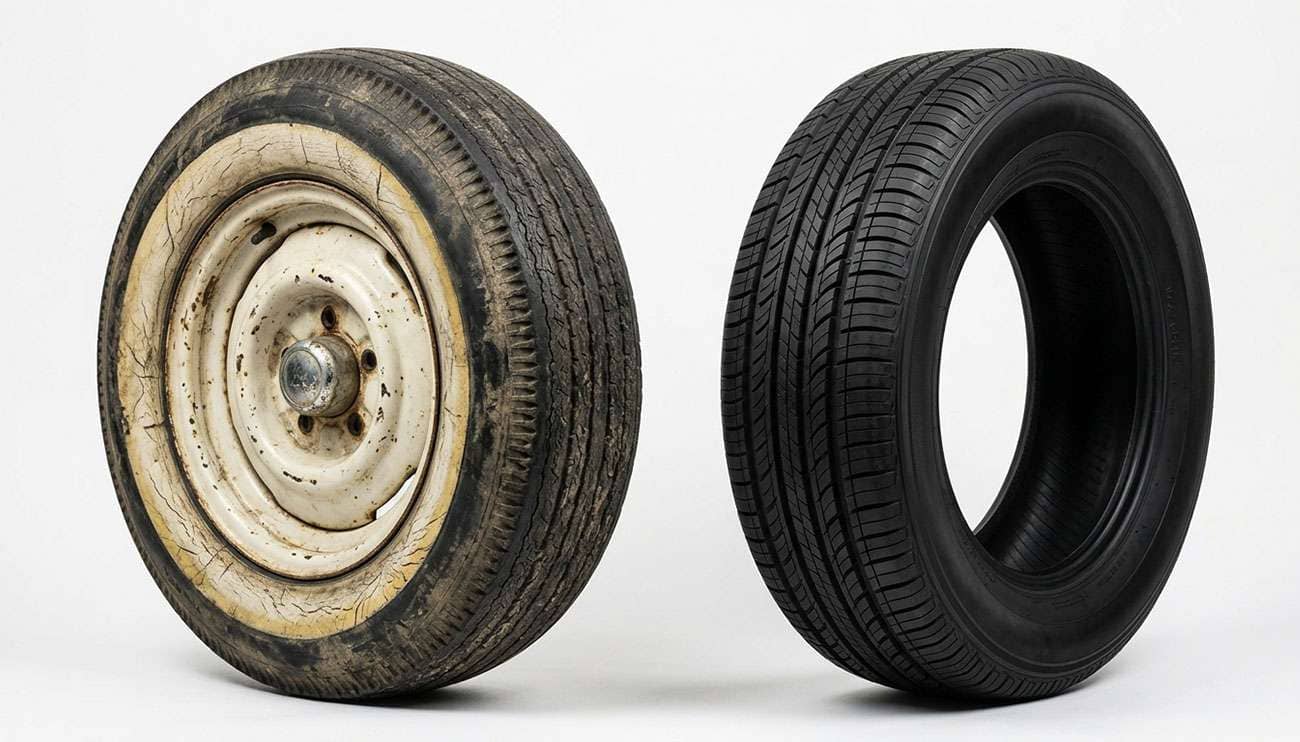
Short answer: yes, but only for jobs that never build heat. A 20-year-old tire can still be good for a static display, a shop floor, or a slow roll onto a trailer. It isn't good for the road, no matter how much tread it has. The variable most guides skip is the job you're asking the tire to do. Age sets up the failure, and speed, load, and heat set it off. NHTSA's research ties tire aging failures to hot states, summer days, and highway speeds.
I'm Hank Feldman, and I've been selling tires in Long Beach since 1971. Ask most people this question and you'll get a flat no. For any car on a public road, that's the right answer, and I'd give it myself. But a flat no doesn't help the fellow with a trailer-only show car, or the guy who just bought a barn find and needs to get it up a ramp. Good for what? That's the question that gets you a real answer, so let's go through the jobs one at a time.
Find the job you have in mind. The further down this chart you go, the more heat the tire has to live through, and heat is what finishes an old tire. A tire that's 20 years old today has a date code ending in 06, like 2306 for the 23rd week of 2006.
The Job |
Speed |
Heat and Load |
Verdict at 20 Years |
|---|---|---|---|
Static display |
0 mph |
None |
Good, as long as it holds air. |
Pushing around the shop |
Walking pace |
None |
Good, if it holds air and the sidewalls are sound. |
Rolling onto a trailer |
Under 5 mph |
Low |
Good after an inspection. Winch it if you can. |
Short move on private property |
Under 10 mph |
Low |
Acceptable after an inspection, with nobody nearby. |
Parade or trip to a local show |
10 to 35 mph |
Moderate |
No. Mount new tires first. |
Weekend cruise |
35 to 55 mph |
High on a warm day |
No. |
Highway driving |
55 mph and up |
High and sustained |
Never. |
Towing or hauling |
Any road speed |
Highest |
Never. |
Those speed bands are my judgment after a lot of years in this business. No regulator publishes a chart like this one, and a tire doesn't read charts. Treat the top of the table as the only safe side of it.
Because that's where heat and flex meet rubber that's already gone hard. NHTSA's summary of its tire aging work says aging failures tend to happen in high-heat states, in the summer months, during the day, and at highway speeds. Every one of those conditions adds heat.
Here's what's going on inside. Oxygen works its way through the rubber and slowly hardens it. That includes the thin layer of rubber between the two steel belts, and you can't see that layer from anywhere. A retired tire engineer who writes as Barry's Tire Tech says that's where failures usually start. When that rubber is young, it flexes and holds the belts together. When it's hard, it can't take the strain, and the belts start to come apart.
Heat speeds the whole thing up. Tire engineers use the Arrhenius rule, which says the chemical reaction roughly doubles for every 18 degrees F. Street tires typically run 140 to 170 degrees in normal driving, and that's a long way from the garage. Take a tire sitting at 68 degrees and the same tire running at 158. That's 90 degrees of difference, or five doublings, so by that rule the chemistry runs about 32 times faster. It's a rule of thumb, not a lab result, but it tells you why a garage is one world and the 405 in July is another.
NHTSA saw the same thing in the lab. It found that five weeks in a 149-degree oven approximates four years of service in Phoenix. Five weeks. That's what heat does to rubber.
Speed adds its share. Every time a section of tire rolls through the contact patch, it flexes, and every flex makes heat. Go faster and you flex more times a minute. Add load or run low on air and you make more heat still. Continental says heavy loads and long stretches at high speed push operating temperature up further, and tires reach that temperature within a few miles. So a tire can roll up a ramp at 3 mph and never know it happened. Put that same tire on the freeway and it's working at the one thing it can't do anymore.
Probably not, and I don't see many folks mention this one. FMVSS 139 is the federal performance standard for passenger and light truck radials, and it didn't take full effect until September 1, 2007. A tire built in 2006 came before that date.
That rule updated the tests a new tire has to pass. The high-speed test runs 30 minutes each at 87, 93, and 99 mph. The endurance test runs 34 hours at 75 mph, and the last 24 of those are at full load. The low-pressure test runs 90 minutes at 75 mph. Those are tests for a brand-new tire.
Then NHTSA looked at what happens with age. Its research found that oven-aged FMVSS 139 tires resisted degradation better than oven-aged tires built before the standard, and their failures were less severe. So a 20-year-old tire can have two strikes on it. It's old, and it may well come from the older rules. NHTSA also deferred a separate aging test when it wrote the rule, so even the newer standard doesn't tell you what a tire can do at 20.
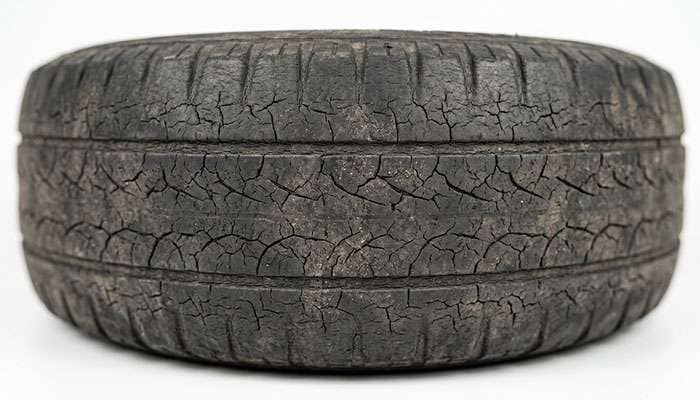
No, and that's the trap. A garage-kept tire can look better than the set on your daily driver. Deep tread, clean sidewalls, shiny whitewall. None of that tells you about the rubber between the belts.
Michelin's service life statement says it's "impossible to predict when tires should be replaced based on their calendar age alone," and in the same statement it calls for replacing any tire at 10 years "even if such tires appear serviceable." Read those together and you've got the whole problem. Nobody can say exactly when a given tire will let go, and a good-looking tire proves nothing. Barry's Tire Tech puts it best: "cracks = bad, but no cracks does not equal good." Some sidewall compounds simply resist cracking, so a clean sidewall only tells you about the sidewall.
Cracks still count against a tire. Fine surface crazing is early weathering, but anything 1/16 of an inch deep, or anything showing cord, means the tire is done for any job at all. Dennis lays out the crack-by-crack test in his guide to tire dry rot.
Hagerty once told a story that makes the point. A client bought tires in 2003 for a 1973 Chevrolet Caprice. The DOT code showed they were made in 1989, so they were about 14 years old when they went on. After about 7,500 miles, the client had a tread separation, and under-inflation helped it along. Those tires had plenty of life left by any tread measure, and they weren't even as old as the tires we're talking about here.
Not for the road. Storage slows the clock, but it doesn't stop it. Most of the industry treats an unused, well-stored tire as new for about five to six years. Continental's line for its motorcycle tires is up to five. After that, the word "new" starts to slip away, even with the molding whiskers still on.
Good storage helps. Keep tires cool, dark, and dry, keep them away from motors and other ozone sources, and don't stack them high. Hagerty ran a piece in 2021 saying old tires might not be as dangerous as you think if you store them right, and it's a good one. But notice the numbers in it. The real-world test was a 7-year-old set of motorcycle tires, and the tire makers it quoted put the ceiling at 10 years for a properly maintained set. That's a long way from 20.
Sitting still has its own cost, too. Flexing moves protective waxes and antioxidants through the rubber, so tires that rarely roll can crack sooner. A tire that's never been mounted isn't saved by that. It's just old in a different way. I went through the storage side in detail in are 10-year-old tires safe if stored in the garage, and the answer there was no at 10. Doubling the age doesn't improve it.
Not in any way that changes the road answer. Tire makers put the ceiling at 10 years, so an 11-year-old tire and a 31-year-old tire are both past it. A 15-year-old tire has had less time to harden, and one built after September 2007 at least came through the newer federal tests. That might make me a little more comfortable with it on a shop floor or a trailer ramp. It wouldn't get it on the freeway. Past 10 years, the question stops being how old and starts being what job.
Some, but nowhere near 20 years. Barry's Tire Tech suggests about six years in hot states and about 10 in cold ones. NHTSA did its field collection for aging tires in the Phoenix area because states with high average temperatures show higher tire failure rates. A tire that spent its life in a cool Minnesota garage has had an easier time than one that sat through 20 summers in Bakersfield.
Cold slows the clock without stopping it, because oxygen doesn't take the winter off. And a cool-climate tire doesn't stay cool once it's rolling at 70. Here in Southern California, I'd count us as a hot state and plan accordingly.
Most won't, and I don't blame them. I don't know of a law against it. It comes down to liability. If a shop mounts a tire that age and it fails later, the shop's name is on the invoice, even if the mounting had nothing to do with it. Many shops draw the line well before 20 years, some as early as six or seven. A few will do it with a signed waiver for a display car.
If a shop mounts a 20-year-old tire for road use and never asks a question, that tells you something about the shop.
You'd be surprised how many are still out there. Low miles keep the tread looking fresh, so nobody thinks about the date. Here's where I'd look first, and what to do about each one.
Where You'll Find Them |
Why They're Still There |
What Could Go Wrong |
What to Do |
|---|---|---|---|
Weekend classic |
Few miles a year, plenty of tread |
Tread separation on a warm freeway run |
Replace all four, plus the spare. |
Trailered show car |
Original or correct-looking tires |
Fine until someone drives it |
Keep them as a display set and buy a road set. |
Barn find or estate car |
The car stopped, so the clock looked stopped |
Flat spots, bad beads, unknown history |
Trailer it. New tires before the first drive. |
Spare on a 2006 truck or SUV |
Never been down off the carrier |
Fails on the day you need it |
Replace it and check the date on every spare you own. |
Low-mile motorhome |
Parked most of the year |
Heavy load plus long hot hours |
Replace before the next trip. |
Boat or utility trailer |
Sits outside, runs a few times a year |
Blowout with a load behind you |
Replace them. Trailer tires age out first. |
Yes, on the show floor. If the car goes everywhere on a trailer and only rolls on and off, those tires aren't building heat, and the job is about the safest one a tire can have. For a date-correct restoration, the original tires may even matter to the car.
The danger is the day the plan changes. Somebody offers to drive it around the block at the show, or the owner decides it's a nice afternoon. That's how a static tire turns into a road tire with nobody really deciding it. Here's what I tell collectors: keep the originals as a display set, label them, store them right, and buy a second set for driving. You keep the correct look for judging and you get a tire you can trust on the road. Swap them when the car moves under its own power.

Don't. I know it's only 40 miles and you've waited your whole life for this car. Bring a trailer. A car that's been sitting has tires with flat spots, hard rubber, and beads that may not seal. You also don't know what else sat with them, including the brakes.
If you only need the tires to get the car on the trailer, air them up carefully and stay out of line with the sidewall while you do it, because a very old tire can let go during inflation. Inspect all four, then winch the car up slowly. If a tire won't hold air, use wheel dollies. Once it's home, put new tires on before the first real drive. You've got a lot of work ahead on that car, and tires are the one thing you shouldn't save for later.
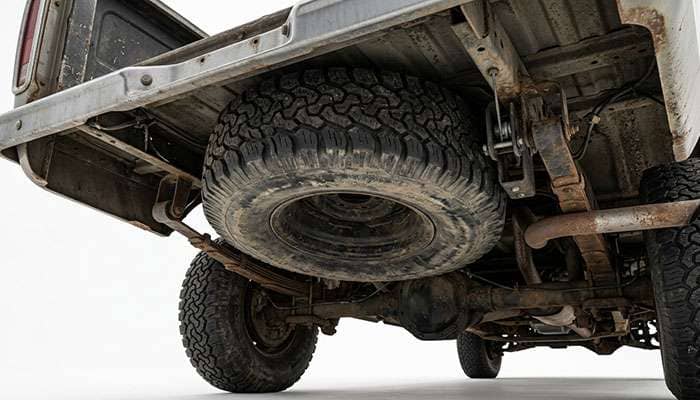
No, and this is the one that catches regular folks. A 2006 pickup that's still on the road may well have its factory spare hanging under the bed. It has perfect tread and it's never touched the pavement, so nobody thinks about it. That tire is the 20-year-old tire you're most likely to own.
People figure a spare doesn't count because it's only for emergencies. Look at that emergency, though. It happens on the side of the highway, probably in the heat, maybe with your family in the car, and then you put that tire on and drive it at road speed. A spare isn't a low-speed job. Michelin's 10-year statement includes spares by name. Temporary T-type spares aren't covered by FMVSS 139 at all. Dennis calls this the spare tire trap in his breakdown of the 5-year tire rule, and that's what it is. Check the date on yours this weekend.
No. This is about the worst match there is. A trailer or motorhome asks an old tire for heavy load, long hours, and hot pavement, all at once. Continental says asphalt can reach about 140 degrees F on a day that's only 86 degrees out. Now hang several tons over that tire and run it for four hours.
Trailer tires have less margin to start with. ST tires aren't covered by FMVSS 139, and they usually sit outside in the sun between trips. I told trailer owners to plan on replacing tires around five years old in how old is too old for trailer tires. At 20 years, you're at four times that number.
A little, maybe, but not enough to change anything. Hagerty has noted that bias-ply tires are often beefier and last longer, and they have no steel belts to separate. That's the good news. They're still made of rubber, oxygen still gets into them, and FMVSS 139 doesn't cover them, so that standard tells you nothing about them.
Bias-plies also have their limits when they're new. Dennis uses 85 mph as the rule of thumb for period-correct bias tires, and he'd tell you to stay well under that. An old one has less to give. I've sold bias-ply tires my whole career and I love the way they look on the right car. But a 20-year-old set belongs on the same chart as everything else. Dennis has more on the bias side in are vintage tires safe to use.
Folks keep old tires to save money. Here's how that bill runs once the car is moving:
Put a value on a fender for a car they stopped making 50 years ago. Then put a value on the people in the car. A new set is the cheapest thing on that list.
So can a 20-year-old tire still be good? Sure, the way an old pair of work boots is good for standing in the garage. It can hold air and hold a car up. It can look right under the lights. What it can't do is take heat, load, and speed, and those are the jobs a tire exists for.
Ask what job the tire has to do. If the answer is sitting still or rolling up a ramp, you can relax. If the answer includes a public road, the tread doesn't matter and neither do the looks. Change them. We've been doing this since 1971, and I've never met anyone who regretted buying new tires too soon.
No, not on a public road. Tire makers put the ceiling at 10 years, and a 20-year-old tire was built before the current federal standard took full effect. Tread depth doesn't change that, because the danger is hardened rubber between the belts. Use them only for jobs that build no heat, such as display or loading onto a trailer.
Yes. Oxygen keeps working through the rubber whether the tire rolls or not. Cool, dark, dry storage slows it down, but nothing stops it. Most of the industry treats an unused tire as new for about five to six years. A 20-year-old tire with the stickers still on isn't a new tire.
Only for slow jobs off the road. Tread depth tells you how much rubber is left, not what condition it's in. Michelin calls for replacing tires at 10 years even if they appear serviceable, which covers plenty of tires with deep tread.
Most won't. The issue is liability, because a shop is on the hook if an old tire fails after it has touched it. Many draw the line at six to 10 years. A few will mount old tires for a display car if you sign a waiver.
Yes. A spare has one job, and it happens at the side of the road followed by a drive at road speed. Michelin's 10-year statement includes spare tires. Check the date code on your spare even if it has never touched the pavement.
Yes, if the car is trailered and only rolls on and off. Keep them inflated and inspect them before each move. If the car will be driven at all, mount a separate road set and keep the originals for display.