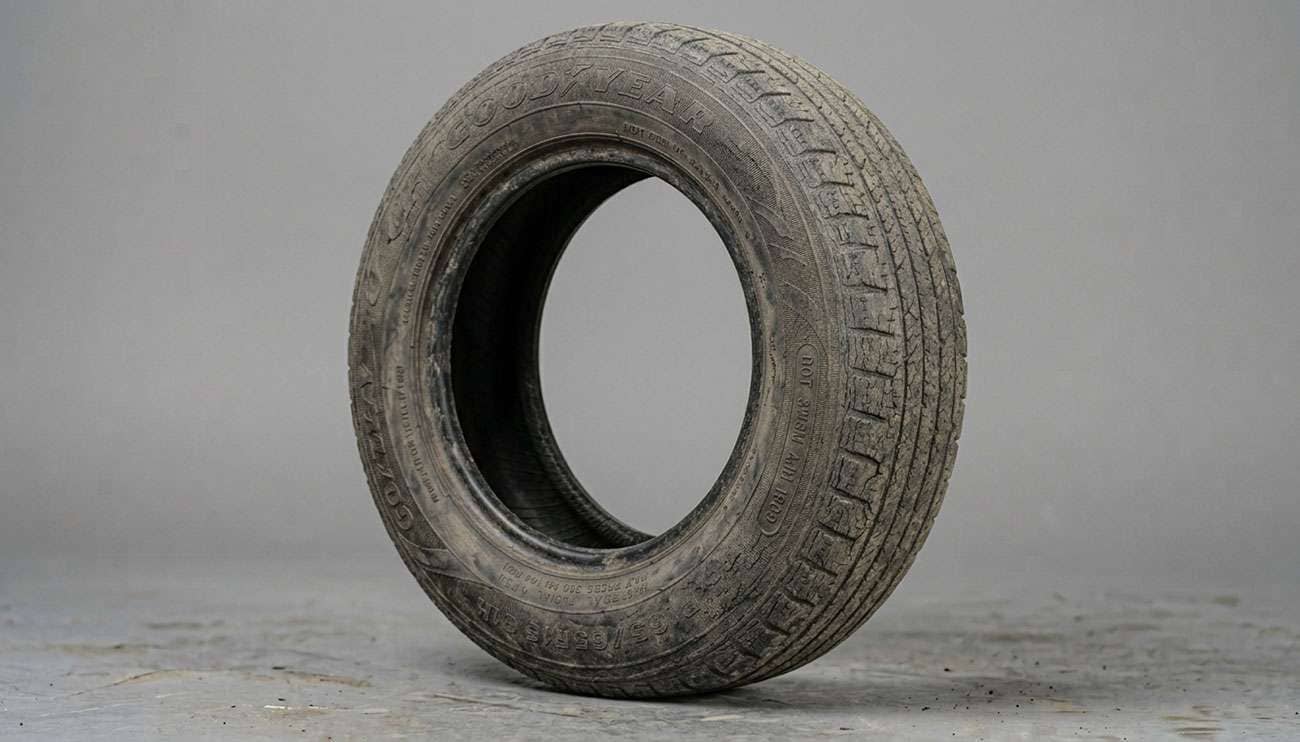
The 5-year tire rule is straightforward: once a tire passes its fifth birthday, it should be professionally inspected at least once a year — regardless of tread depth, mileage, or how good it looks from the outside. It's an inspection trigger, not a replacement deadline. The rubber compound starts oxidizing the day a tire leaves the factory, and by year five, internal aging can outpace what you can see from the curb. Ten years is the hard ceiling every major manufacturer agrees on, but the calendar starts working against you at year five.
Most drivers wear tires out before age becomes the deciding factor. If you cover 12,000 to 15,000 miles a year on typical all-season tires, you'll be shopping for new rubber on mileage alone long before age catches up. The 5-year rule matters most for low-mileage drivers, weekend cars, classic vehicles, RVs, trailers, and any tire with plenty of tread left after five or more years on the vehicle.
Tire rubber isn't a permanent material. It's a cured compound that begins breaking down from the moment it's manufactured — a process called thermo-oxidative degradation. Oxygen reacts with the polymer chains inside the rubber, the oils and plasticizers that keep the compound flexible gradually evaporate, and the internal structure slowly stiffens. This happens whether the tire is on the road, in your garage, or sitting on a dealer's shelf.
For the first five years, a properly stored and properly inflated tire holds up well against this process. The outer rubber and internal construction stay within their designed performance envelope. After year five, the rate of degradation picks up noticeably. Michelin recommends annual inspections once a tire hits five years of service, and Bridgestone uses the same threshold — not because every five-year-old tire is compromised, but because the probability of hidden damage starts climbing fast enough that you can't rely on visual checks alone.
The danger isn't always visible. Internal belt separation, microscopic cracking between the rubber and steel belts, and compound hardening can all occur without any obvious sidewall signs. That's why a trained inspector with a mounted tire on a machine can catch problems that a curbside glance never will. For a deeper look at what actually fails inside an aging tire, our guide on tire dry rot walks through the chemistry in detail.
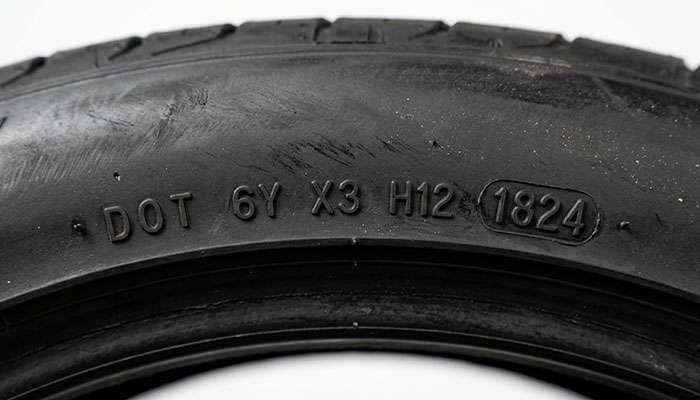
You can't apply the 5-year rule without knowing how old your tires actually are. The information is stamped on the sidewall — you just have to know where to look.
Find the DOT code on the sidewall. It starts with the letters "DOT" and ends with a four-digit number. Those last four digits are what matters:
A tire stamped DOT ... 3521 was built in the 35th week of 2021 — which puts it right at the 5-year inspection threshold in 2026. One side of the tire usually has the full code; the other side may only show a partial code, so check both. For a step-by-step walkthrough with photos, see our guide on how to read DOT tire date codes.
A few things to keep in mind when you find the date:
Not every year matters the same. Here's what each stage of a tire's life actually calls for — from a technical inspection and replacement standpoint — assuming normal passenger vehicle service.
Tire Age |
Risk Level |
What To Do |
|---|---|---|
0-5 years |
Normal service life |
Monthly pressure checks. Visual inspection at every rotation (every 5,000-7,500 miles). No special aging concerns for properly maintained tires. |
5-6 years |
Inspection threshold reached |
Start annual professional inspections. Tech checks sidewall, crown, shoulder, bead, and inner liner for cracking, dry rot, or belt separation. |
6-8 years |
Elevated risk zone |
Several automakers (Ford, Nissan, Mercedes-Benz, Volkswagen) recommend replacement at 6 years. Twice-yearly inspections if continuing service. Replace on any visible cracking. |
8-10 years |
Critical zone |
Replacement strongly advised regardless of tread. Internal aging can outpace external signs. Many tire shops decline to repair tires this old due to liability. |
10+ years |
Hard replacement deadline |
Michelin, Bridgestone, Continental, Dunlop, and most major brands require replacement regardless of appearance or tread depth. No exceptions — including the spare. |
The 5-year rule fits into a broader framework for knowing when to replace your tires. Age is one of four major signals — alongside tread wear, damage, and performance changes.
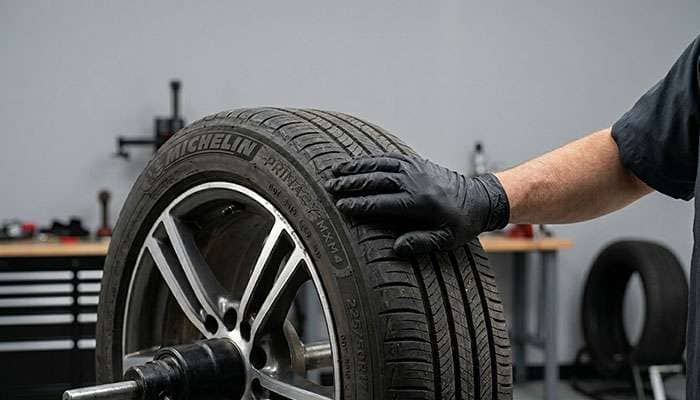
A proper 5-year inspection isn't the same as the 30-second look you get during a tire rotation. A qualified tech pulls the wheel, takes the tire off the rim if needed, and checks five specific areas:
Expect to pay between USD 10 and USD 25 per tire for a proper aging inspection if it's not bundled with other service. Many shops include it free with a rotation or seasonal changeover. If your shop quotes a rotation for USD 20 but won't look closely at the sidewall of a 6-year-old tire, find a different shop.
The 5-year rule assumes average service conditions. Certain environments can push the effective aging clock two or three years forward — meaning a tire that's chronologically four years old can show the internal condition of a 6- or 7-year-old tire.
If your vehicle lives in Phoenix, Miami, or coastal California, treat the 5-year rule as a 4-year rule. If it lives in a climate-controlled garage in Minnesota, the 5-year rule applies exactly as written.
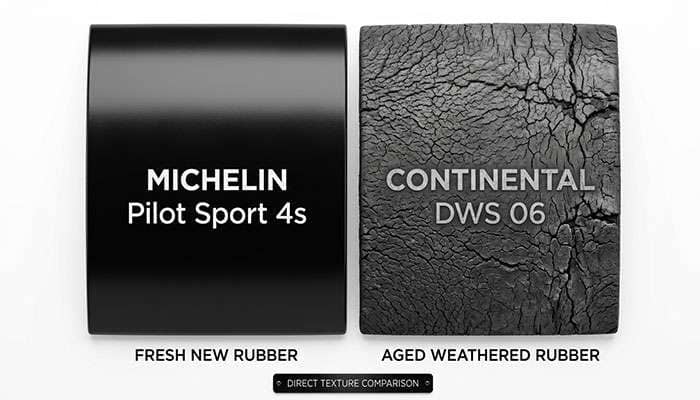
An inspection isn't a pass/fail exam with two possible outcomes. It's more of a spectrum, and certain findings bump a tire from "keep monitoring" straight to "replace now." Any of the following means the tire is done — no matter how much tread remains:
A borderline inspection — minor weather checking, no bulges, good tread, tire is 7 years old — is a judgment call that depends on how the vehicle is used. Daily driver that sees highway speeds? Replace. Garage-kept weekend cruiser that never sees over 45 mph? Monitor closely and plan to replace within 6 to 12 months.
The 5-year rule applies to every tire on the vehicle — including the one you haven't looked at in years. Full-size spares and compact "donut" spares are the most commonly forgotten tires on the road, and they're often the oldest.
A spare that's been sitting under the car since 2014 has been silently aging for 12 years. When you finally pull it out after a flat on the interstate, that tire has been through a decade of heat cycles, humidity, and compound breakdown — and you're about to drive on it at 55 mph before you can get to help. Bridgestone explicitly states that 10-year-old spares should be taken out of service even if they appear new.
Check your spare's DOT date code the next time you pop the trunk or look under the vehicle. If you can't easily reach it, the next time your vehicle goes in for service, have the shop verify the spare's age as part of the inspection. For a fuller discussion of how long tires actually last, see our article on the lifespan of a tire from purchase to replacement.
The tire industry and automakers haven't fully agreed on a single replacement rule, which creates confusion. Here's how the three most commonly cited timelines actually fit together:
Rule |
Source |
What It Actually Means |
|---|---|---|
5-Year Rule |
Michelin, Bridgestone, most major tire manufacturers |
Inspection trigger. Professional annual inspections begin at year 5. Not a replacement deadline. |
6-Year Rule |
Ford, Nissan, Mercedes-Benz, Volkswagen, other automakers |
Automaker-recommended replacement ceiling. More conservative than tire industry position. Tied to vehicle warranty and liability policy. |
10-Year Rule |
Michelin, Bridgestone, Continental, Dunlop, most tire manufacturers |
Hard replacement deadline. No tire — including the spare — should remain in service past 10 years from manufacture date. |
There's also the 7-7 rule for tires, which applies a different framework combining age and tread wear indicators. Different rules, complementary purpose — they all exist to stop drivers from running tires past the point of reasonable safety.
If you want to cross-check the math by looking at your specific tires, how to tell how old your car tires are walks through locating the DOT code and calculating age exactly.
No. The 5-year rule is an inspection trigger, not a replacement deadline. After five years from the manufacture date, your tires should be professionally inspected at least once a year. If the inspection shows no cracking, no bulges, no belt separation, and the tread is in good shape, the tires can stay in service. The hard replacement deadline is 10 years.
Find the DOT code on the tire sidewall. The last four digits show the manufacture date: the first two digits are the week of the year, and the last two digits are the year. A DOT code ending in "3521" means the tire was made in the 35th week of 2021.
Often yes, but they need professional inspection. Tire manufacturers like Michelin and Bridgestone consider tires up to 10 years old as serviceable if they pass inspection. However, several automakers — including Ford, Nissan, and Mercedes-Benz — recommend replacement at 6 years regardless of condition. Follow the more conservative recommendation if you're driving a vehicle covered by that automaker's guidance.
Yes. Spare tires age on the same clock as the tires you use every day — often faster, because they're frequently mounted on a wheel and held under pressure for years without being used. Check your spare's DOT date code and replace it at 10 years regardless of appearance.
A thorough aging inspection runs USD 10 to USD 25 per tire at most independent tire shops. Many shops include it free when bundled with a rotation, seasonal changeover, or alignment service. If your regular shop won't give aged tires a close look, find one that will.
Yes — that's the core reason the 5-year rule exists. Tire aging happens internally through thermo-oxidative degradation, which can cause belt separation and compound breakdown well before any exterior signs appear. Low-mileage tires with excellent tread depth can still fail due to age. That's why professional inspection matters more than a curbside visual check.