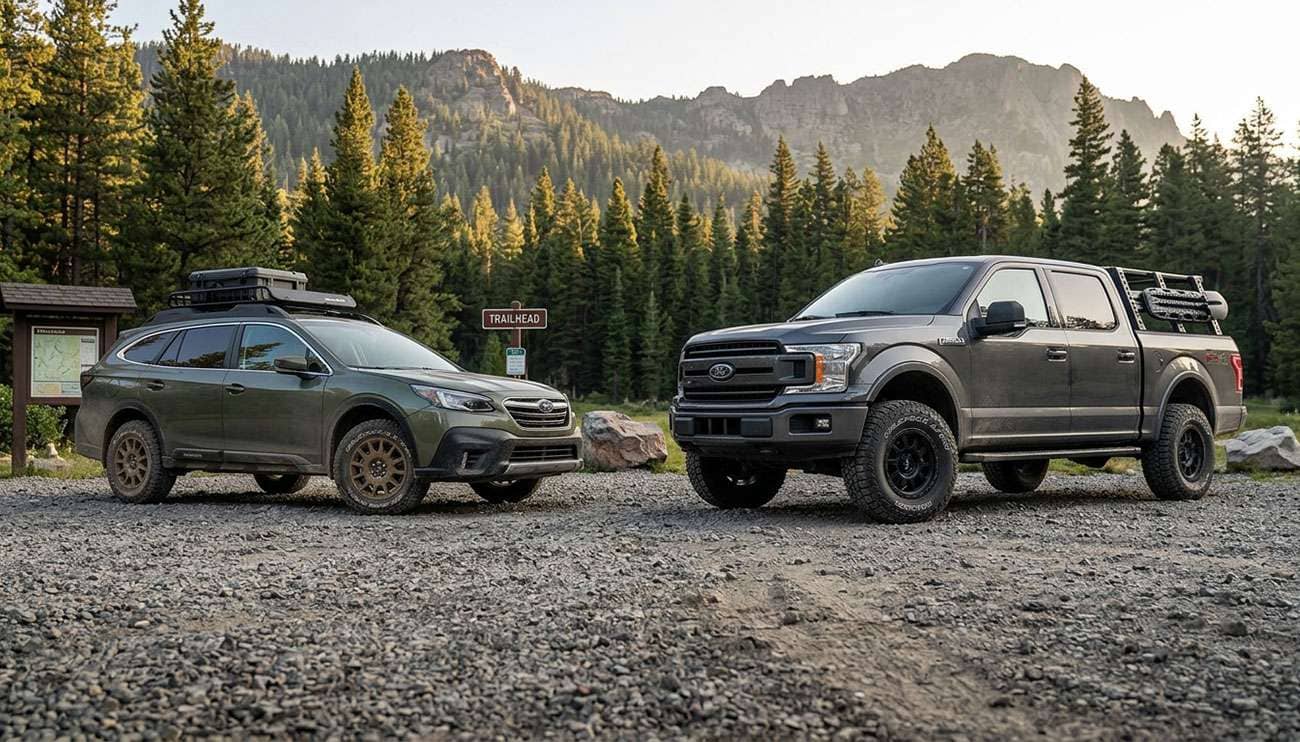
The Wildpeak A/T Trail is a crossover tire. It runs a 2-ply polyester passenger casing, 10/32 to 11/32 inch of tread, and an H or V speed rating in almost every size, built to match what a RAV4 or an Outback wears from the factory. The A/T4W is a truck tire. Its passenger sizes are nearly all T-rated, and most of the line is LT construction in Load Range C through F. Most comparisons tell you it depends on how much off-roading you do. It doesn't. It depends on the speed rating and load index printed on your door jamb.
I've been selling tires out of Long Beach since 1971, and this one comes across my counter every week. A crossover owner sees the A/T4W on a buddy's pickup, likes the look, and wants the same tire. Sometimes that works. Most of the time the sticker inside the driver's door has already made the call, and nobody told them to go read it. So before we talk tread blocks and snow ratings, here's the table I'd hand you at the counter.
Your Vehicle and Door Sticker |
The Wildpeak That Fits |
Why |
|---|---|---|
Compact or mid-size crossover, sticker shows an H or V |
A/T Trail |
Built in H and V in nearly every size; A/T4W passenger sizes are mostly T |
Crossover on 18- to 21-inch wheels with a 45-, 50- or 55-series tire |
A/T Trail |
The A/T4W isn't made in most low-profile crossover sizes |
215/65R17, 225/65R17 or 245/65R17 with an H |
A/T Trail |
The same size in the A/T4W drops to a T |
235/65R17 104H |
Either |
Both hold the H; the Trail is the XL tire in this size |
Older SUV on 15-inch wheels, sticker shows a T |
Either, A/T4W if it tows |
Both are T-rated; the A/T4W adds load, tread depth and an LT option |
Half-ton pickup or body-on-frame SUV |
A/T4W |
Falken built the Trail on a unibody crossover and says it isn't for pickups |
3/4-ton or 1-ton pickup, sticker shows LT Load Range E |
A/T4W LT |
The A/T Trail has no LT sizes at all |
They share a family name, a tread-pattern attitude and a snowflake on the sidewall. Underneath, they're built for two different kinds of vehicle. Falken files the A/T Trail under its Small SUV and Crossover line and the A/T4W under Light Truck and SUV. That one filing decision drives every spec below it.
The A/T Trail was developed on a crossover unibody platform, and Falken tested it on modern crossovers like the Toyota RAV4. Toyota liked it enough to put it on the RAV4 TRD Off-Road and the RAV4 Hybrid Woodland from the factory. The A/T4W replaced the A/T3W as Falken's do-everything all-terrain for Tacomas, F-Series, Silverados, Rams and 4Runners, and Falken gave it heavy-duty LT sizes, a 3-ply sidewall on select sizes and a stiffer tread so it would tow better than the tire it replaced.
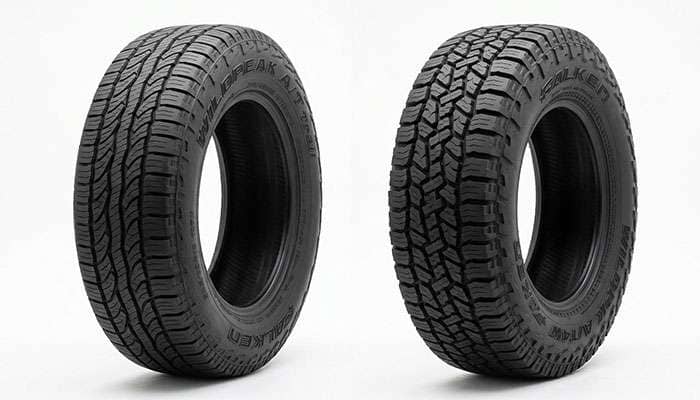
Here's how they line up on paper. Notice which rows most comparisons leave off.
Feature |
Wildpeak A/T Trail |
Wildpeak A/T4W |
|---|---|---|
Built for |
Crossovers and unibody SUVs |
Pickups and body-on-frame SUVs |
Construction |
Passenger only, SL and XL |
Passenger SL and XL, plus LT Load Range C, D, E and F |
Sidewall |
2-ply polyester |
3-ply DURASPEC on select sizes |
Speed ratings |
H or V in almost every size; T on 15-inch |
T on nearly every passenger size; R or S on LT |
Load index range |
92 to 111 (1,389 to 2,403 lb) |
99 to 129 (1,709 to 4,079 lb) |
New tread depth |
10/32 to 11/32 in. |
13/32 to 14/32 in. passenger; 16/32 to 19/32 in. LT |
UTQG |
680 A A |
660 A B (passenger sizes) |
Treadwear warranty |
65,000 miles, all sizes |
65,000 miles passenger; 60,000 miles LT |
Severe snow rating |
3PMSF |
3PMSF |
Rim diameters |
15 to 21 in. |
15 to 22 in., including flotation sizes |
The snow rating and the warranty match on passenger sizes. Everything that actually decides fitment, the speed rating, the load index, the construction and the tread depth, splits. That's the part nobody puts in front of you.
Open the driver's door and look at the jamb. That label is the Tire and Loading Information placard, and Federal Motor Vehicle Safety Standard No. 110 requires your vehicle to carry one. It lists the original tire size and the cold inflation pressures. On most late-model crossovers, the load index and speed symbol are printed right beside the size, something like 225/65R17 102H. If yours shows only the size, the owner's manual has the rest.
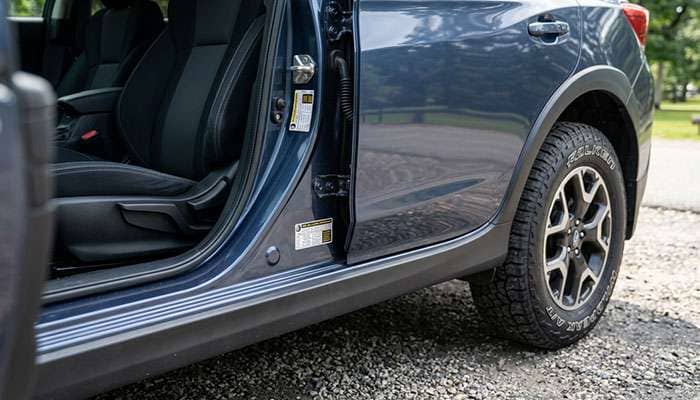
Read 225/65R17 102H this way. The 102 is the load index, which means 1,874 pounds per tire at the tire's maximum pressure. The H is the speed rating, which means the tire passed its lab test at 130 mph under load. The U.S. Tire Manufacturers Association and the Tire Industry Association agree that a replacement tire should match the factory speed rating at minimum, and industry guidance says the same about load index. Higher is fine. Lower is where trouble starts.
Now hold the two Wildpeaks up against that sticker. Nearly every A/T Trail size is H or V, because crossovers leave the factory on H and V tires and Falken built this tire to replace them. Nearly every A/T4W passenger size is T, which is 118 mph, because a deep-tread truck all-terrain is built around load capacity, not top speed. Take a 2019-2025 RAV4 LE. Its placard reads 225/65R17 102H. The A/T Trail in that size is 102H, a dead match. The A/T4W in that size is 106T: more load, less speed. We covered that RAV4 math in detail in our guide to all-terrain tires on a RAV4, and the same logic holds for a CR-V, an Outback, a Rogue or a CX-5.
No. Every A/T Trail size is passenger construction, either Standard Load or Extra Load, on a 2-ply polyester casing. There is no LT version and no load range letter. Falken's own FAQ says the Trail won't work for pickup trucks and points pickup owners to the A/T4W instead.
Here's the mechanism behind that. An LT tire is built with a heavier casing so it can run much higher pressure, up to 80 psi on a Load Range E, and carry more weight at that pressure. A passenger tire maxes out far lower. And when a passenger tire goes on a light truck, the Tire and Rim Association's standard derates it: you divide its load capacity by 1.10. So the biggest A/T Trail, a 111 load index at 2,403 pounds, is good for about 2,185 pounds per corner once it goes on a truck.
The A/T4W covers both sides of that line. Its passenger sizes behave like the Trail's, and its LT sizes carry Load Range C, D, E and F. An LT275/65R18 A/T4W rated 123/120S carries 3,415 pounds per tire single. If you've never sorted out the two systems, our breakdown of P-metric vs. LT tires walks through why an LT tire actually carries less than a passenger tire at the same low pressure, and our guide to load range vs. load index explains why a Load Range E and a 123 aren't the same number.
On most crossovers, yes. The A/T4W's passenger sizes are almost all T-rated at 118 mph, and its LT sizes are R at 106 mph or S at 112 mph. A crossover that came on H tires at 130 mph gives up 12 mph of rated speed, and one that came on V tires at 149 mph gives up 31.
Nobody's going to drive 118 mph in a RAV4, so people shrug this off. They shouldn't, because a speed rating is really a heat rating. The lab test runs the tire against a drum under load and steps the speed up in stages to the rated speed. Survive it, and the tire earns the letter. What a tire has to survive is heat building inside the casing. Deep tread, big blocks and a stiff carcass all generate more heat per mile, and that's a big part of why a 13/32-inch truck all-terrain lands at T while an 11/32-inch crossover all-terrain lands at H.
You can see the same thing in the UTQG temperature grade, the program NHTSA runs for passenger tires. The A/T Trail grades A, meaning it survives above 115 mph on the test wheel. The A/T4W grades B, meaning 100 to 115 mph. On a loaded family crossover doing 75 across the desert in August, that margin matters more than the number on the speedometer.
Industry guidance is plain about it. If a replacement tire carries a lower speed rating than the placard, your vehicle's speed capability drops to the new tire's rating, and the installer is supposed to tell you so. A lot of shops will ask you to sign off on a downgrade before they mount it. One exception: in 235/65R17 the A/T4W is 104H, so a crossover with that sticker keeps its H either way.
Here's what surprises people. The A/T Trail and the A/T4W share only a handful of sizes, mostly 65- and 75-series fitments on 15- and 17-inch wheels. The Trail lives in crossover sizes, from 205/60R16 up through low-profile 20- and 21-inch fitments the A/T4W doesn't come in. The A/T4W lives in truck sizes, LT sizes and 33-, 35- and 37-inch flotation sizes the Trail doesn't come in. For most vehicles, your size already decided.
If you're in one of the shared sizes, this is the table. Prices are ours at the time of writing, per tire.
Size |
Wildpeak A/T Trail |
Wildpeak A/T4W |
What Decides It |
|---|---|---|---|
215/65R17 |
Speed rating. Same load, and only the Trail keeps the H. |
||
225/65R17 |
H speed rating vs. XL load. H placard, take the Trail. |
||
235/65R17 |
Both keep the H. The Trail is the XL here, and it costs less. |
||
245/65R17 |
H speed rating vs. XL load. Tow or haul, look hard at the A/T4W. |
||
235/75R15 |
Load. Both are T, so the A/T4W gives up nothing on speed. |
||
215/75R15 |
Construction. Passenger Trail or LT A/T4W, nothing in between. |
Look at the 225/65R17 and 245/65R17 rows. The A/T4W carries a load index four points higher, and that looks like a free upgrade. On a crossover, it mostly isn't. An Extra Load tire only carries its higher number at its higher maximum pressure, usually around 41 to 42 psi versus about 35 to 36 for a Standard Load tire. At the 35 psi or so your crossover's placard calls for, an XL tire carries roughly what the SL carries. What you actually get is a stiffer casing and a T where your H used to be. Our SL vs. XL tire guide runs the pressure tables if you want the numbers.
The 235/65R17 row flips the usual story. There, the Trail is the Extra Load tire at 108H, the A/T4W is the Standard Load at 104H, and the Trail costs less. If your sticker reads 235/65R17, the Trail is the easy call unless you need the A/T4W's extra 2/32 inch of tread.
By Falken's own numbers, yes, by half a point on each. Here's the chart Falken publishes for both tires on a 1-to-5 scale.
Feature |
Wildpeak A/T Trail |
Wildpeak A/T4W |
|---|---|---|
Quiet ride |
4.0 |
3.5 |
Fuel efficiency |
3.5 |
3.0 |
Dry handling |
4.0 |
4.5 |
Off road |
3.5 |
4.0 |
Wet braking |
4.5 |
4.5 |
Winter performance |
4.5 |
4.5 |
Tread life |
4.5 |
4.5 |
Ride comfort |
4.0 |
4.0 |
Read that chart with one piece of fine print Falken prints itself: each score is relative to other Falken tires in the same category. The Trail is scored against Falken's crossover tires and the A/T4W against its light truck tires. So the A/T4W's 4.5 on dry handling means it handles well for a truck tire. It doesn't mean it will steer a RAV4 better than the Trail does.
The noise and fuel gap comes straight from the tread. The Trail starts with 11/32 inch of tread, the A/T4W with 13/32 inch on passenger sizes and up to 19/32 inch on LT. Taller blocks squirm more as they roll into the contact patch, and that flex turns into heat and rolling resistance. Bigger voids between the blocks pump more air, and that's the hum you hear at 65. Falken also says it kept the Trail lighter than a typical all-terrain so a crossover wouldn't lose the efficiency it was designed around. On a crossover, the A/T4W will be the louder of the two, and you'll notice it on the first freeway on-ramp.
On day one, call it even. Both carry the Three-Peak Mountain Snowflake, and Falken rates both a 4.5 for winter. To earn 3PMSF, a tire has to beat a standard reference all-season by at least 10 percent in medium-packed snow under the ASTM F1805 test. Both did.
Where they split is how long that bite lasts. Snow traction falls off hard once a tire wears to about 6/32 inch, because the tread can't pack and hold snow anymore. The Trail starts at 11/32 inch, so it has about 5/32 inch of good snow tread to give. The A/T4W starts at 13/32 inch on passenger sizes, so it has about 7/32 inch, roughly 40 percent more snow life, and Falken cut its sipes full depth so they keep working to the bottom. The Trail uses Falken's 3D Canyon Sipes, but there's simply less rubber for them to work in.
Neither one is a winter tire, and Falken says as much about the Trail in its own FAQ. If you live where the plows run all season, a dedicated winter tire still wins on ice. For everyone else, our article on whether all-terrain tires are good in snow covers where a 3PMSF all-terrain stops being enough.
On passenger sizes, it's close to a tie. Falken backs the A/T Trail with a 65,000-mile limited treadwear warranty in every size, and the A/T4W with 65,000 miles on non-LT sizes and 60,000 miles on LT sizes. The Trail grades 680 on UTQG treadwear and the A/T4W 660. UTQG numbers only compare fairly within one brand, and since both are Falken, the Trail's compound tested slightly longer on the government course.
The A/T4W answers with depth. It starts with 2/32 inch more rubber in the same passenger size, so there's more tread to wear before you hit the 2/32-inch minimum most states enforce. Put those two facts together on a crossover and you land in the same place either way. On a pickup, the A/T4W is the only one built to carry the weight, so the question answers itself. If you want the long version on the truck side, my Falken Wildpeak A/T4W review covers what we see it deliver over the counter.
One thing that matters more than either compound: keep your rotation receipts. Every treadwear warranty I've ever read requires proof of regular rotation, and an all-terrain left on one axle for 15,000 miles will cup and wear out early no matter whose name is on it.
Falken says no, and I agree. The Trail tops out at a 111 load index, it comes only in passenger construction, and it isn't made in most of the sizes trucks run. You won't find it in 265/70R17, 275/65R18 or 285/70R17, which is where half-ton pickups and mid-size body-on-frame SUVs live.
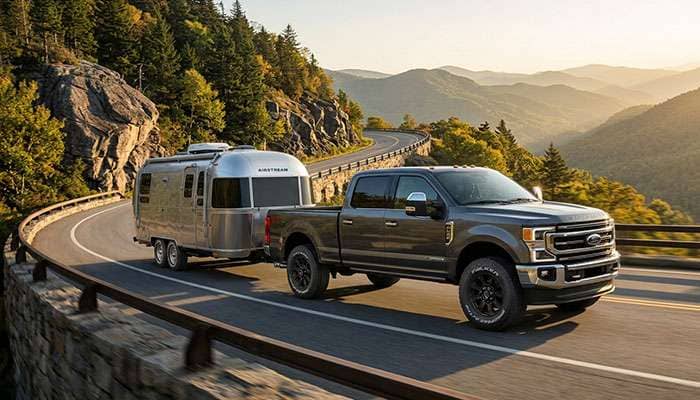
Where a Trail size does match an older small pickup or SUV, like 215/75R15 or 235/75R15, the passenger derating still applies the moment it goes on a truck, and the 2-ply polyester sidewall is carrying more weight over rocks than it was designed for. The A/T4W was built for that job: higher load capacity, the 3-ply DURASPEC sidewall on select sizes, increased tread rigidity for towing and Falken's Heat Diffuser technology to bleed off heat when you're running at full load.
Going the other way works better. The A/T4W fits a crossover in the shared sizes, and it's a sound tire. You'll just pay for it in speed rating, road noise and a little fuel economy, which is why I only steer crossover owners to it when they tow, haul or drive a lot of rough gravel.
Here are the sizes I'd point to by vehicle class, with our current price per tire. Click through for the exact size.
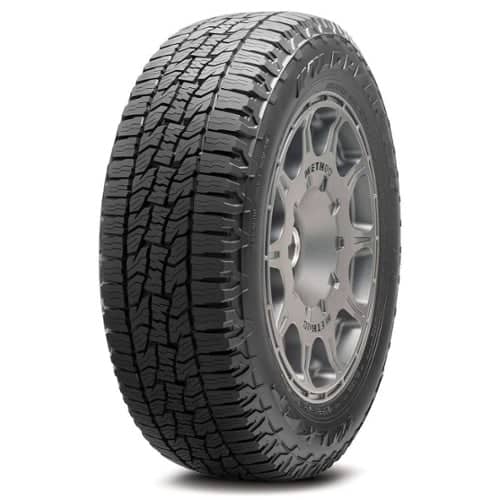
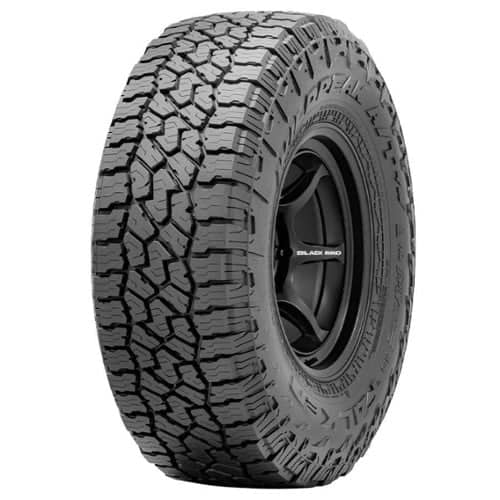
Vehicle Type |
Size |
Wildpeak |
Load and Speed |
Price |
|---|---|---|---|---|
2019-2025 RAV4 LE and XLE, other 17-inch compact crossovers |
225/65R17 |
102H SL |
$208 |
|
RAV4 TRD Off-Road and Hybrid Woodland, 18-inch crossovers |
225/60R18 |
100H SL |
$256 |
|
Larger crossovers on 20-inch wheels |
255/55R20 |
110V XL |
$255 |
|
Half-ton pickups and mid-size SUVs on 17s |
265/70R17 |
115T SL |
$237 |
|
Half-ton pickups that tow, on 18s |
LT275/65R18 |
123/120S, Load Range E |
$333 |
|
3/4-ton pickups on 18s |
LT275/70R18 |
125/122S, Load Range E |
$350 |
Always check your own placard before you order. Trims inside one model line change sizes and ratings, and the 2026 RAV4 moved to different sizes than the 2019-2025 models listed here. You can see the full lineup on our Falken tires page.
Put the wrong Wildpeak on and nothing dramatic happens in the parking lot. The cost shows up over miles, and it climbs.
The A/T4W on a crossover with an H or V sticker:
The A/T Trail on a pickup:
Either way, the fix costs the same as getting it right the first time: four tires that match the sticker.
The A/T Trail and the A/T4W aren't a good tire and a better tire. They're a crossover tire and a truck tire wearing the same family name. The Trail matches the H and V speed ratings and the passenger load ratings crossovers leave the factory with. The A/T4W carries the T ratings, LT load ranges and deep tread that pickups and body-on-frame SUVs need. In most sizes, Falken only makes one of them, so your door sticker has already done the choosing. In the handful of sizes where you do get a choice, match the speed rating first and the load index second, and buy the A/T4W only if you're going to use what it carries. That's the advice I've given at the counter for years, and it hasn't steered anybody wrong yet.
The A/T Trail is a passenger-construction all-terrain built for crossovers, with H or V speed ratings in almost every size and 10/32 to 11/32 inch of tread. The A/T4W is built for pickups and body-on-frame SUVs, with T ratings on nearly all passenger sizes, LT sizes in Load Range C through F, and 13/32 to 19/32 inch of tread. Both carry the 3PMSF snow rating.
Yes, on the vehicle it was built for. Toyota fits it from the factory on the RAV4 TRD Off-Road and RAV4 Hybrid Woodland, it carries a 65,000-mile treadwear warranty and 3PMSF, and it keeps the H or V speed rating most crossovers came with. It is not the right tire for a pickup truck.
Yes. Falken rates the A/T Trail 4.0 for quiet ride and the A/T4W 3.5. The Trail's shallower 11/32-inch tread and smaller voids make less noise at highway speed than the A/T4W's deeper blocks.
Falken says no. The A/T Trail is passenger construction only, tops out at a 111 load index, and loses about 9 percent of its capacity when used on a light truck. Falken recommends the Wildpeak A/T4W for pickups.
Yes. The A/T Trail and the A/T4W both carry the Three-Peak Mountain Snowflake symbol for severe snow service. Neither is a dedicated winter tire, and the A/T4W's deeper tread keeps its snow traction longer as the tires wear.
Falken backs the A/T Trail with a 65,000-mile limited treadwear warranty in every size, the same as the A/T4W on passenger sizes. It grades 680 on UTQG treadwear. Regular rotation is required to keep the warranty and to get the full mileage.