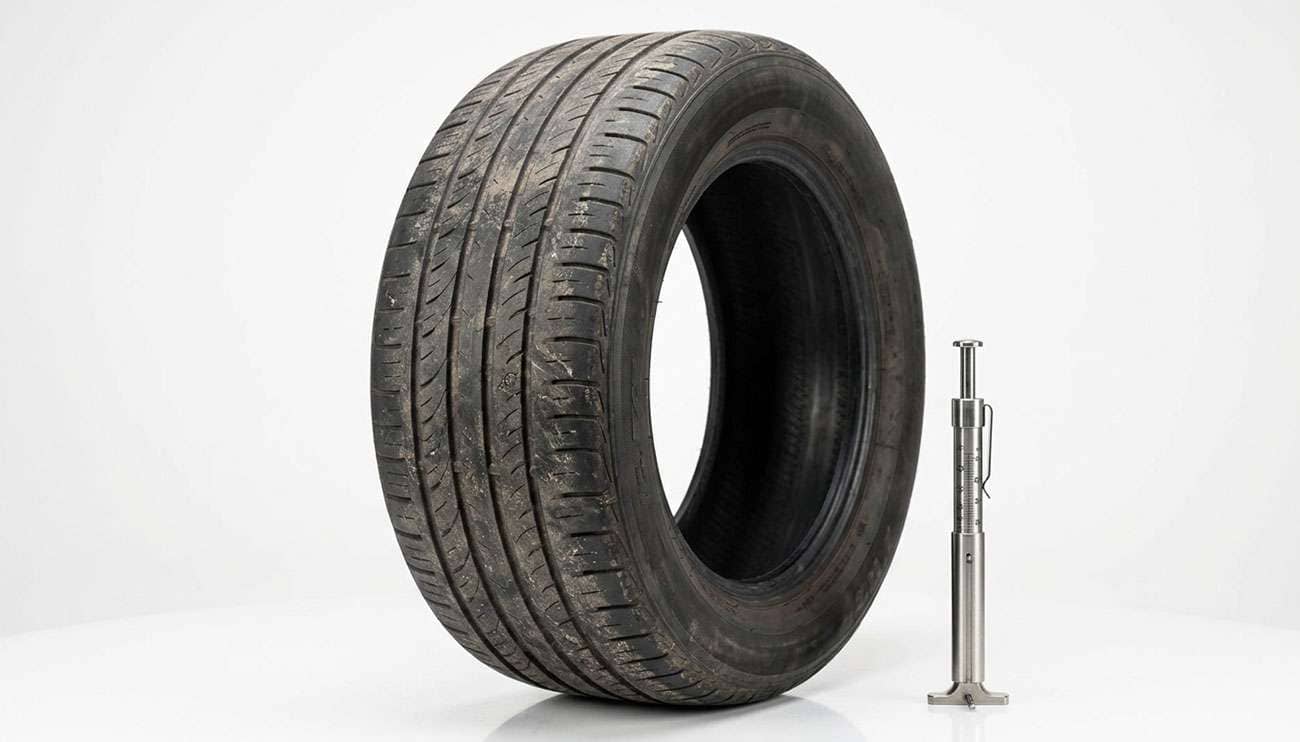
Short answer: the treadwear number on the sidewall tells you whether 30,000 miles was normal or a problem. A tire graded in the 200s or 300s typically carries a 25,000- to 30,000-mile warranty, so it lived a full life. A tire graded 600 or higher typically carries 60,000 miles or more, so something cut it in half. That something is usually pressure, alignment, or skipped rotations. Factory tires, EVs, run-flats, and staggered setups run on their own math.
I'm Dennis Feldman, and I run fitment at Performance Plus Tire. Most answers to this question give you a list of everything that wears out a tire. Each item on that list is true. What a list can't tell you is which one happened to you, or whether anything happened at all. "It depends" doesn't help much until you know what it depends on. So I matched treadwear grades to mileage warranties across current tire lines. The result is one number you can read off your old tires in about 10 seconds.
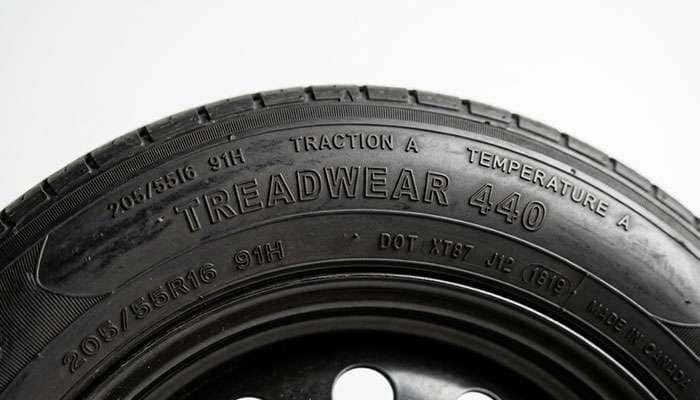
Find the word TREADWEAR on the sidewall and read the number after it. If the tires are already gone, your invoice has the model name, and the maker's spec page has the number. Then find your row.
Treadwear Number |
Typical Mileage Warranty |
What 30,000 Miles Means |
What to Do |
|---|---|---|---|
200s |
25,000 miles, when it has one |
Normal. You beat the warranty. |
Nothing went wrong. Buy a higher number next time if you want more miles. |
300s |
30,000 miles, when it has one |
Normal. Right on the number. |
Same as above. The tire did its job. |
400s |
50,000 miles |
About 40 percent short |
Check pressure habits and rotation history. |
500s |
50,000 miles |
About 40 percent short |
Check pressure, rotation, and how the tread wore. |
600s |
60,000 miles |
Half the warranty |
Find the cause before new tires go on. |
700s |
65,000 miles |
Less than half the warranty |
Get an alignment check. Look at a warranty claim. |
800 and up |
80,000 miles |
Under 40 percent of the warranty |
Something is wrong with the car or the upkeep. |
Three cautions on this chart. First, a treadwear grade isn't a mileage rating. The maker assigns it after a 7,200-mile test against a control tire, and comparing grades across brands is shaky. Tire Review calls it "questionable." Our guide to treadwear ratings explains how the test works. I'm using the grade to tell you what class of tire you bought, and the warranty to tell you what that class usually promises.
Second, the low rows are thin. Only about one tire line in seven graded in the 200s carries a mileage warranty, and about one in four in the 300s. Up in the 600s, nearly nine in 10 do. Makers don't promise miles on tires built for grip.
Third, some tires have no grade at all. LT-metric truck tires and winter tires are exempt from the treadwear grade. For those, use the miles-per-32nd test in the next section.
The treadwear number tells you what the tire promised. Miles per 32nd tells you what it actually did. Take the miles you got and divide by the tread you used up.
Say your tires started at 10/32 and wore to 2/32 in 30,000 miles. You used 8/32, so you got 3,750 miles per 32nd. Here's what a typical tire of each type should deliver, based on current warranties and new tread depths:
So 3,750 is a summer-tire pace. On a summer tire, 30,000 miles is exactly what you should expect. On a touring tire, you wore it twice as fast as the warranty math says you should have. Those benchmarks come from warranties, which are promises and not measurements, so read them as the good end of the range. My guide to how long tires last by type gives the real-world mileage ranges.
Time works as a quick check too. The Federal Highway Administration puts the average driver at 13,482 miles a year, so 30,000 miles is a little over two years of normal driving. If a set was done at two years, you got about 30,000 miles out of it whether you tracked it or not.
Now check one more thing most people skip: how much tread was left when you pulled them. If a shop replaced your set at 4/32, you only used 6/32 of tread. That's 5,000 miles per 32nd, not 3,750. Run the tires to 2/32 at that pace and you'd have seen 40,000 miles. I'm not telling you to run them that far. Replacing at 4/32 is the right call for wet stopping. It just means your set wasn't really a 30,000-mile tire. You stopped early for good reason.
Because long life wasn't the assignment. Automakers engineer original equipment tires together with the tire maker to suit one specific vehicle. A tire engineer quoted by Torque News in 2026 put the top three priorities for most vehicles as fuel economy, a quiet ride, and cost. Long life and all-weather grip come after that.
That's a fair set of priorities for a company selling cars. A soft, low-rolling-resistance tire helps the window sticker and feels great on the test drive. It also means the first set on a new car often comes up short of what you'd get from a replacement tire. Hank covers the differences in OEM vs. aftermarket tires.
Here's the part that matters to your wallet. Factory tires usually have no mileage warranty. Goodyear's tread life warranty excludes tires "supplied as original equipment," and Michelin's excludes original equipment on 2018 and newer model years. So if your 30,000-mile tires came with the car, you likely have no claim, and nothing was defective. The good news is that your replacement set can do far better. Consumer Reports' testing of all-season SUV tires in 245/60R18 projected 60,000 to 95,000 miles.
Weight and torque. J.D. Power's 2024 tire study pointed at both, and it found EV owners expected about the same tire life as gas owners. They don't get it. Consumer Reports' Ryan Pszczolkowski put the difference at roughly 20 percent faster in 2023.
Take that 20 percent off a 60,000-mile tire and you're at 48,000 before anything else goes wrong. Add a heavy foot, because instant torque is fun, and 30,000 miles comes into view fast. Tires built for the job help. I went through HL load ratings and tire choice in why EV tires are different. Rotate an EV every 4,000 to 6,000 miles instead of the usual 5,000 to 7,500.
They can, and owner forums for AWD crossovers are full of this exact complaint. An AWD system sends power to all four corners, so no axle gets to coast, and most of these vehicles leave the factory on tires tuned for quiet and efficiency. That combination is a good recipe for a short first set.
The fix is a tighter schedule. Rotate AWD and 4WD vehicles every 3,000 to 5,000 miles, not 5,000 to 7,500. It matters more here because many AWD systems want all four tires close to the same tread depth. Let one axle wear ahead of the other and you can end up buying four tires when you only needed two. Check your owner's manual for the limit on your system.
Many do, and that's the deal you made. Summer tires in the current market run a median treadwear grade of about 280, and the ones that carry a mileage warranty typically promise 30,000 miles. Most don't carry one at all. Ultra high performance tires run about 300 on treadwear, with about 45,000 miles when they carry a warranty. Consumer Reports has seen some UHP summer tires project as low as 25,000 miles.
Soft rubber grips the road because it gives up a little of itself to the pavement. That's why it's fast and why it's short-lived. If you bought the grip, 30,000 miles was the price. If you bought a sporty car and never asked for the grip, a UHP all-season is the fix. Those tires come in the same sizes, and Consumer Reports has projected some of them at 55,000 to 70,000 miles.
Yes, and the warranties say so. Michelin caps zero-pressure run-flat tires at 30,000 miles of coverage. It also cuts mileage coverage in half on vehicles with different front and rear sizes, and Goodyear shortens coverage on those setups too. When the tire maker's own promise stops at 30,000 miles, that's your benchmark.
Run-flats carry stiff sidewalls, and across current lines they sit around a 300 treadwear grade, well below the all-season median of 500. Only about a third carry a mileage warranty at all. Staggered setups have a different problem. You can't rotate front to back, so the driven rears take all the punishment for their whole lives.
About 15 to 30 percent, by the numbers in my tire rotation guide. On a 60,000-mile tire, that's 9,000 to 18,000 miles gone.
The mechanism is simple. Each corner of the car does a different job. On a front-wheel-drive car, the fronts steer, drive, and take most of the braking. Leave them there for 30,000 miles and they're finished while the rears still have tread. People look at the fronts and say the set only lasted 30,000 miles. Half the set didn't. It's the reason a rotation record matters for a warranty claim too.
More than you'd think. Transport Canada says a single tire running 8 psi low can cut its life by 15,000 kilometers, which is about 9,300 miles. Trucking's Technology and Maintenance Council data shows the same curve on commercial tires: 20 percent under inflation costs about 30 percent of expected life, and 40 percent under cuts it in half.
Low pressure lets the shoulders carry the load, and the sidewall flexes more with every rotation. That makes heat, and heat speeds wear. Set your pressure to the door jamb placard, not the number molded on the sidewall, and check it monthly when the tires are cold. Over-inflation is less common, but it wears the center of the tread instead.
Easily. It can do it in a lot less than that. Toe that's just 1/16 of an inch off spec makes a tire scrub sideways about six to seven feet every mile. It doesn't sound like much until you multiply it out. Over 30,000 miles, that's roughly 35 to 40 miles of each tire being dragged sideways across the pavement.

Worse settings do worse damage. Tire Review reported on one customer whose tires were completely worn out in 10,000 miles after a bad toe setting. A pothole, a curb, or a worn ball joint or tie rod end can all put you there, and you may never feel it in the steering wheel. That's why I want an alignment check before a new set goes on, not after.
Yes. Tread wears when rubber slips against pavement, and city driving is all acceleration, braking, and turning. Highway miles are the easy ones: steady speed, straight line, no scrubbing. A set that sees Long Beach stop-and-go every day leads a harder life than a set that cruises the 405 at 2 a.m. Aggressive driving can cost you up to 25 percent of tire life on its own, and a heavy foot on a heavy vehicle costs you more.
Load counts too. A crossover with kids, gear, and a roof box works its tires harder than the same vehicle driven alone. Hot pavement also takes a toll, since warm rubber is softer rubber. You can't do much about your commute. You can account for it when you judge what your tires did.
Usually not from one cause. Here's how the numbers can stack up on a 60,000-mile touring tire. This is an illustration, not a test result, since these losses overlap.
No single one of those looks like a disaster. You'd never notice any of them from the driver's seat. That's why so many people are surprised when a tire shop tells them the set is done after two years.
If you still have the tires, they'll tell you which cause it was. Look before you let the shop haul them away:
That last one is the most useful result on the list. Even wear on a 300-grade tire means you got what you paid for, and no shop needs to fix anything. I go through each pattern in how to read tire wear patterns.
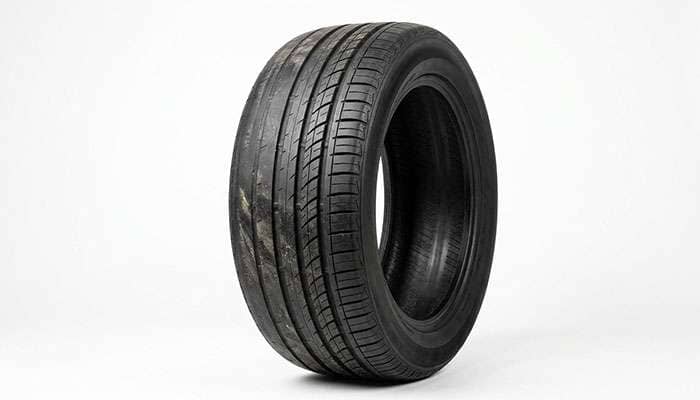
Sometimes, if they were replacement tires with a mileage warranty. Here's how the math works. A tire with a 60,000-mile warranty that wears out at 30,000 miles has used half its coverage, so you'd pay about 50 percent of a comparable tire's price, plus mounting, balancing, and taxes. On a $212 tire, the average Consumer Reports found in its 2024 survey, that's about $106 off each tire.
Now the catches. The tire has to wear evenly down to the 2/32 wear bars. Tires pulled at 4/32 generally don't qualify. Uneven wear from alignment or low pressure doesn't qualify. You need the original invoice and proof of rotations, and coverage usually ends at four to six years. Factory tires are out, as I covered above. My guide to why tires don't reach their mileage warranty walks through who gets paid and who doesn't.
Buy for what ended the last set. If your car was the problem, fix that first. If your tire was the problem, here's what to look for instead.
Your Old Tire |
Why It Stopped at 30,000 |
What to Look For Next |
Target Numbers |
|---|---|---|---|
Factory tires |
Tuned for efficiency, quiet, and cost |
Replacement all-season touring tire |
Treadwear 600 or higher, 60,000-mile warranty |
Summer or UHP |
Soft compound built for grip |
UHP all-season, if you can give up some dry grip |
Treadwear 400 or higher, same speed rating |
EV factory tires |
Weight and torque |
EV-rated replacement tire |
Matching load rating, and a mileage warranty |
Run-flat |
Stiff sidewalls, low treadwear grades |
Another run-flat with a better grade, unless your car has a spare plan |
Highest treadwear in your size |
Winter tires run all year |
Soft rubber on warm pavement |
Seasonal swap, or an all-weather tire |
Three-peak snowflake mark for all-weather |
All-terrain or mud-terrain |
Open tread and heavy trucks |
Highway or milder all-terrain tire, if you stay on pavement |
50,000 to 60,000-mile warranty, same load range |
One warning on those numbers. Don't drop load index or speed rating to chase a longer warranty. Your door jamb placard sets the floor for both.
Only if you're happy with the same mileage. If your factory tires lasted 30,000 miles and you loved the ride, the same tire will likely give you about the same result. Nothing about buying it a second time changes the compound. If you want more miles, step up to a replacement line with a higher treadwear number and a real mileage warranty.
There's one exception. Some cars call for tires marked for that specific model, such as a star on a BMW, MO on a Mercedes-Benz, or N on a Porsche. Those tires carry the automaker's tuning. On those cars, read your owner's manual before you switch. Also know that a factory tire and a retail tire with the same name aren't always the same tire, so check the warranty on your exact size before you assume it has one.
A short-lived set costs more than the price of the next one. Here's how the bill climbs:
Thirty thousand miles can be a full life or half of one, and the tire tells you which. A low treadwear number and even wear mean you got what you bought. A high number and uneven wear mean something on the car or in the upkeep cut that tire in half, and it'll do the same to the next set unless you fix it.
Read the sidewall, run your miles per 32nd, and look at how the tread wore. That takes about five minutes, and it's worth more than any list of possible causes. After that, you'll know whether you need a different tire, an alignment, or nothing at all.
It depends on the tire. For a summer tire, a run-flat, or a factory tire, 30,000 miles is a normal life. For an all-season touring tire with a 60,000-mile warranty, it's half of what you should get. The treadwear number on the sidewall tells you which one you had.
The usual causes are low air pressure, bad alignment, skipped rotations, and aggressive or city driving. The wear pattern points to the cause. Worn shoulders mean low pressure, one worn edge means alignment, and even wear means the tire simply reached the end of its life.
Automakers tune factory tires for fuel economy, a quiet ride, and cost, and long life comes after those. Factory tires also usually have no mileage warranty. A good replacement tire often lasts much longer than the set that came on the car.
It depends on the type. All-season touring tires commonly carry 60,000-mile warranties, all-terrain tires about 50,000, ultra high performance tires about 45,000, and summer tires about 30,000 when they carry a warranty at all.
You may get a prorated credit if they were replacement tires with a mileage warranty, they wore evenly to 2/32, and you have your invoice and rotation records. Factory tires usually don't qualify, and uneven wear from alignment or low pressure generally voids a claim.
Within one brand, generally yes. Across brands, it's less reliable, because each maker assigns its own grade. Use the treadwear number to judge the class of tire, and use the mileage warranty to see what the maker will actually stand behind.