How long do tires last? It sounds like a simple question — but the answer depends on more variables than most drivers realize. Tire type, driving habits, local climate, and maintenance consistency all play a role. Get those factors working in your favor, and a quality set of tires can carry you 60,000 to 80,000 miles or more. Ignore them, and you'll be back in the tire shop far sooner than your budget or your safety margins allow.
This guide gives you the complete picture: how many miles different tire types actually last, when age becomes a safety concern regardless of tread depth, the warning signs that mean replacement is overdue, and exactly what to do to squeeze every last mile out of your investment. Whether you're driving a daily commuter sedan, a lifted pickup, or a sports car on weekend canyon runs, you'll find what you need here.
Tire lifespan isn't a single number — it's two separate limits that can both end your tire's useful life. Industry standards set by organizations like the Rubber Manufacturers Association (RMA) identify tread life measured in miles and calendar age measured in years as the two governing factors. Most passenger tires are engineered to last between 25,000 and 80,000 miles depending on construction and category. On the age side, the industry consensus is clear: replace tires no later than 6 to 10 years from their manufacture date — even if the tread still looks good.
Every tire sold in the US carries a Department of Transportation (DOT) code molded into its sidewall. The last four digits of that code are your manufacture date: the first two digits tell you the week, the last two tell you the year. A tire stamped "2321" came off the line in the 23rd week of 2021. That date starts the clock on age-based replacement — your tread depth has nothing to do with it.
The Uniform Tire Quality Grade (UTQG) treadwear rating is the other number worth understanding. It runs from 100 to 900+ on modern tires and gives you a relative measure of expected tread life. A tire rated 600 should last three times longer under standardized test conditions than a tire rated 200. For everyday touring or all-season use, target a rating of 400 or higher. UTQG ratings aren't a mileage guarantee, but they're one of the most useful comparison tools you have when shopping side by side.
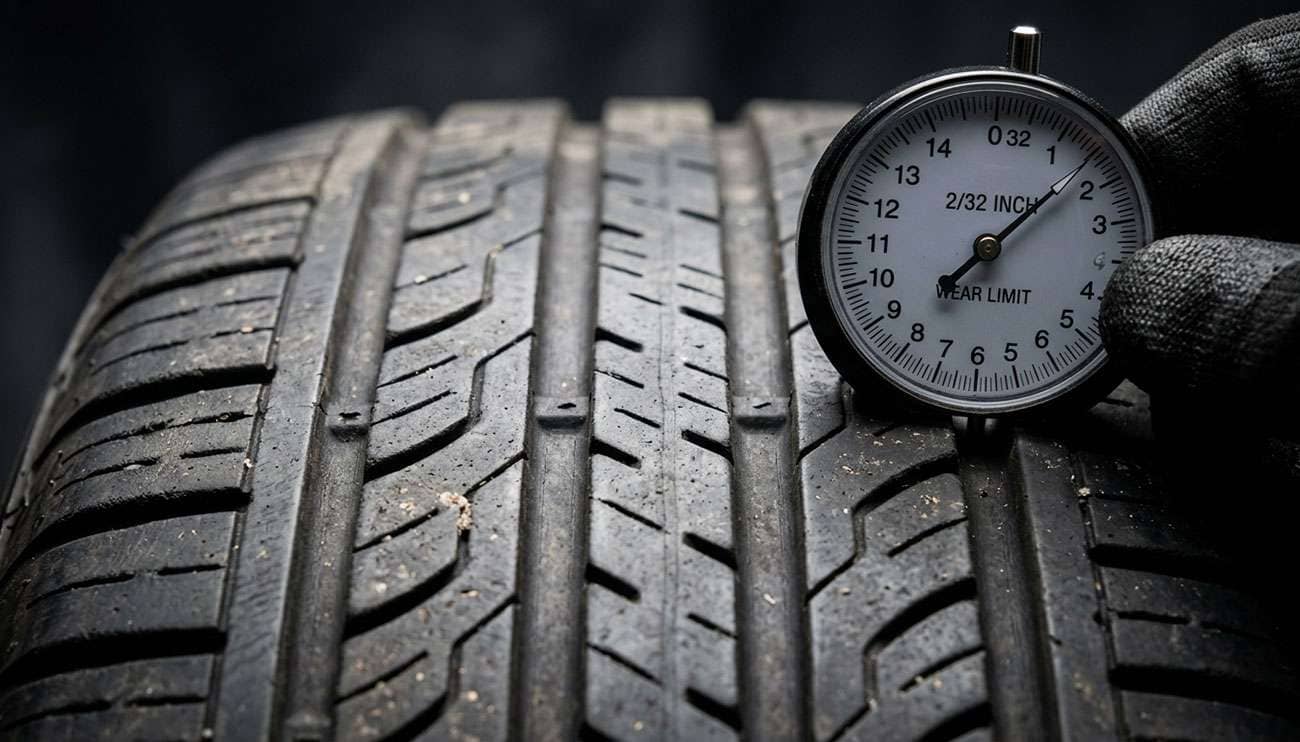
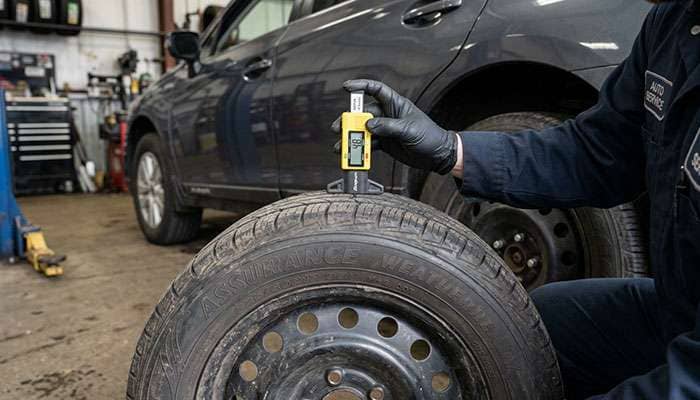
Then there are tread wear indicators (TWI) — small raised bars molded directly into the tire's grooves at 2/32" depth. When your tread wears down to those bars, you've hit the legal minimum in most states. Most tire safety experts recommend swapping tires at 4/32" if you drive in wet conditions, with 2/32" as the absolute floor everywhere else.
The most dangerous mistake drivers make is assuming visible tread means a safe tire. Age-related rubber degradation — oxidation and ozone cracking — can make a tire fail catastrophically even when the tread looks fine. A 12-year-old collector car tire may show almost no wear but still carry serious sidewall failure risk because the rubber compound has broken down internally where you can't see it.
Inflation neglect runs a close second. An underinflated tire generates excess heat that accelerates compound breakdown and causes the outer edges to wear faster than the center. An overinflated tire wears the center down prematurely and shrinks the contact patch, hurting both grip and longevity. Check your tire pressure monthly — don't wait for the TPMS light to tell you there's a problem.
Third on the list: skipping rotations. Most manufacturers call for rotation every 5,000 to 7,500 miles. On a front-wheel-drive vehicle, front tires can wear up to 50% faster than rears if you leave them in place. Regular rotations equalize wear across all four tires and are typically required to keep your mileage warranty valid — skip them, and you may void the coverage you paid for.
Here's a concrete breakdown of expected tire lifespan by category, combining both mileage and age considerations so you know exactly what to plan for:
Tire Type |
Expected Mileage |
Max Age (Years) |
Typical UTQG Range |
|---|---|---|---|
All-Season Touring |
50,000–80,000 miles |
6–10 years |
500–800 |
Summer / Ultra-High Performance |
20,000–40,000 miles |
5–7 years |
200–400 |
Winter / Snow |
25,000–40,000 miles |
5–6 years (seasonal use) |
100–200 |
All-Terrain (Truck/SUV) |
40,000–60,000 miles |
6–10 years |
400–600 |
Mud Terrain |
20,000–40,000 miles |
6–8 years |
300–500 |
Run-Flat |
30,000–50,000 miles |
6–8 years |
300–500 |
Track / Racing |
1,000–10,000 miles |
3–5 years |
60–200 |
These ranges assume proper inflation, regular rotation, and normal driving conditions. Aggressive driving, high ambient temperatures, hard braking, and rough road surfaces push you toward the low end of every range. Consistent highway driving in a moderate climate with disciplined maintenance can take you to the upper end — and occasionally beyond, especially on a premium touring tire backed by a strong mileage warranty.
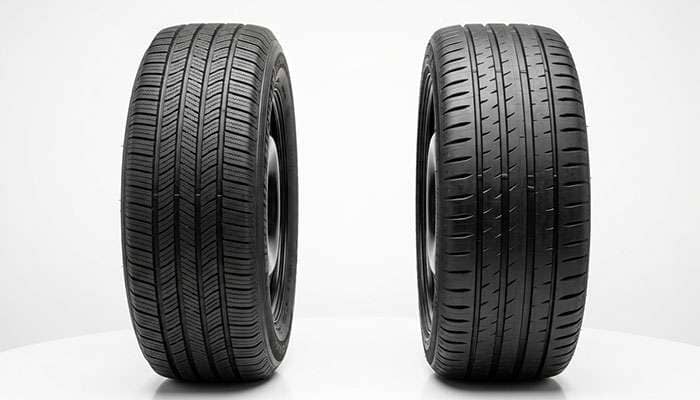
Understanding general tire lifespan is just the starting point — what you really need is the right tire for your specific situation. Choosing the wrong category creates problems that go beyond shorter tread life. A high-performance summer tire on a family sedan in Minnesota is a safety issue. A mud terrain on a crossover that never leaves pavement is a fuel economy and noise issue. Here's how to make the decision with confidence.
Your vehicle's door jamb sticker and owner's manual specify the exact tire size your vehicle was engineered for — diameter, width, aspect ratio, load rating, and speed rating. Deviating from those specs affects speedometer accuracy, load-carrying capacity, and in some cases TPMS sensor calibration. It can also void your mileage warranty if the wrong size is installed. Start with the manufacturer-recommended size as your baseline, then make upgrades with full knowledge of the trade-offs involved.
Trucks and SUVs offer more sizing flexibility, but every additional inch of diameter and width affects fuel economy, hub bearing wear, and braking distances. One or two size steps up is typically manageable. Dramatic upsizes require wheel spacers, suspension lifts, or fender modifications — all of which add real cost and complexity. If you're evaluating sizing options for your truck or SUV, the Tire Size Calculator at Performance Plus Tire is a practical tool to use before you commit to a purchase.
Your driving habits are one of the biggest factors in how long your tires will actually last — and most buyers underestimate this completely. A 30-mile highway commute at steady speeds is the ideal environment for a grand touring all-season tire with a 70,000-mile warranty. That same tire on a sports sedan being pushed through tight mountain corners every weekend will feel vague and wear out faster than it should — and worn touring tires on a performance-driven car are a genuine safety concern.
Hard acceleration, late heavy braking, and aggressive cornering can cut tire life in half compared to gentle driving on the same set. The heat those forces generate breaks down the rubber compound faster and puts uneven stress on the tire carcass. If that's your style, build the faster wear cycle into your budget and treat it as the cost of the performance you're getting — not a product defect. The grip you get from a softer compound is real. So is the faster wear clock.
Climate is a serious factor too. Ozone, UV exposure, and sustained high ambient temperatures accelerate rubber oxidation in ways that aren't visible until it's too late. Drivers in Arizona, Nevada, Texas, and Florida need to be especially strict about age-based replacement timelines. High heat degrades tires from the inside out — it doesn't leave obvious tread wear as a warning sign.
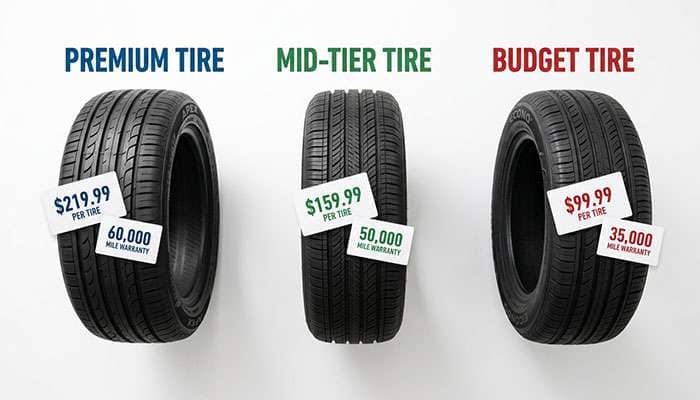
Here's the straight truth: in the tire world, you generally get what you pay for — but the math isn't always what you'd expect. Premium tires from Michelin, Continental, and Bridgestone carry the longest mileage warranties and the most consistent real-world treadwear. The Michelin Defender2, for example, is backed by an 80,000-mile warranty. Divide the purchase price over 80,000 miles, and the cost per mile is often equal to or lower than a budget tire with a 40,000-mile warranty at half the upfront price.
Budget tires from reputable brands can be a smart value play for drivers with lower annual mileage, older vehicles, or short ownership timelines. Where they consistently fall short is wet performance and temperature stability — two factors that directly affect safety and longevity in real conditions. If you're putting 20,000 or more miles per year on a vehicle, the numbers almost always favor a premium or mid-tier tire with a strong warranty and a UTQG rating above 500. At 8,000 to 10,000 miles per year on a city car, the calculation gets more nuanced and worth thinking through carefully.
Forget generic "best tire" lists — the right tire depends entirely on who's driving and how. The ideal tire for a 75-mile daily commuter is a completely different product than the right choice for a weekend track driver or a budget-focused buyer replacing tires on an aging vehicle. Here are specific recommendations by driver profile, with real specs to back every pick.
For maximum mileage, all-weather reliability, and the lowest cost per mile, the grand touring all-season category is where daily drivers should be shopping. These tires deliver tread life, ride comfort, wet traction, and light winter capability in a single package — the most versatile combination available for the majority of American drivers.
The top pick for daily commuters is the Michelin Defender2. It carries an 80,000-mile warranty, earns top scores in independent wet braking and dry handling evaluations, and its EverTred Technology compound is specifically engineered to hold performance as the tire wears — not just when it's brand new. For drivers who want a quieter, more refined ride on a front-wheel-drive or all-wheel-drive sedan, the Continental PureContact LS is an outstanding alternative — 70,000-mile warranty, excellent hydroplaning resistance, and a genuinely comfortable highway ride. If you want to compare options across multiple price points, the all-season tires selection at Performance Plus Tire covers the full range from premium to value-oriented picks.
Performance driving comes with an unavoidable trade-off: the softer, stickier compounds that deliver extraordinary grip and handling precision wear faster than touring compounds. A typical ultra-high-performance summer tire lasts 20,000 to 40,000 miles depending on how hard it's pushed. That's the cost of performance — and for drivers who care about cornering response, braking feel, and emergency handling capability, it's a trade-off worth making.
If you want real performance-oriented handling with the added practicality of all-season capability and a 70,000-mile warranty, the Pirelli Cinturato P7 All Season Plus 2 is a compelling choice. For pure performance without all-season compromise, the ultra-high performance tire category at Performance Plus Tire covers summer-only offerings from Michelin, Pirelli, Continental, and others built specifically for maximum cornering and braking grip.
Track day drivers need to think differently altogether. Street-legal tires aren't built for repeated track sessions — sustained high speeds, heavy braking zones, and continuous cornering forces generate far more heat than normal driving, and most street tires can't safely manage that load across multiple laps.
The budget tire category has improved dramatically over the past decade. Brands like Hankook, Nexen, and Falken now produce mid-tier tires that genuinely compete with premium brands on dry performance and tread life — often at 30 to 40% lower prices. The gap has narrowed most in the all-season passenger category; it remains wider in winter and high-performance categories where compound chemistry is most critical to both performance and safety.
For budget-conscious buyers, target mid-tier brands with UTQG ratings of 500 or higher for touring applications, and check whether the tire comes with a mileage warranty at all. Many entry-level budget tires don't carry one — which tells you something about how much confidence the manufacturer has in its own product. A mid-tier tire with a 50,000-mile warranty at a moderate price often beats a rock-bottom no-warranty tire on total cost of ownership, even when the sticker price is higher. If upfront cost is a concern, Performance Plus Tire offers flexible tire financing that lets you get the right set of tires without compromising on safety to fit today's budget.
How long do tires last? Now you have a real answer — one specific to your vehicle, your driving habits, and your climate. Most all-season touring tires deliver 50,000 to 80,000 miles with proper care. Performance tires trade mileage for grip and typically run 20,000 to 40,000 miles. Winter tires used seasonally can stretch across five or six years of service. And no tire — regardless of how the tread looks — should be trusted past 10 years from its manufacture date. Those are the numbers that matter.
What separates drivers who get full value from their tires from those who replace them too early — or dangerously too late — comes down to consistent habits: monthly inflation checks, rotations every 5,000 to 7,500 miles, regular visual inspections for sidewall cracking and uneven wear, and knowing the manufacture date on every set you run. Those habits cost almost nothing and can add tens of thousands of miles to your tire lifespan across a vehicle's lifetime.
If you're due for a new set or just want to see what's available for your specific vehicle, the team at Performance Plus Tire is ready to help. Browse the full selection at Buy Tires and find the right combination of longevity, performance, and value for your needs.
Here's a quick summary of the most important points from this guide.
• Mileage varies dramatically by tire type: All-season touring tires can last 50,000–80,000 miles, while performance and winter tires typically range from 20,000–40,000 miles depending on use and conditions.
• Age matters as much as tread depth: Replace tires no later than 6–10 years from their manufacture date — the DOT date code on the sidewall tells you exactly when a tire was made.
• Maintenance is the biggest lifespan variable you control: Proper inflation, regular rotations every 5,000–7,500 miles, and alignment checks can meaningfully extend tire life and protect your warranty.
• UTQG treadwear ratings are a useful shopping tool: A rating of 400–600+ is the range to target for long-life touring and all-season tires; higher numbers generally indicate longer wear in real-world use.
• Matching tire type to driving needs maximizes value: A premium touring tire with an 80,000-mile warranty often has a lower cost-per-mile than a budget tire at half the price with no warranty — do the math before you buy.
Most passenger car tires are designed to last between 25,000 and 80,000 miles depending on type and construction. All-season touring tires lead the pack at 50,000–80,000 miles with proper maintenance. Performance-oriented summer tires and winter tires typically fall in the 20,000–40,000 mile range — the softer rubber compounds that make them grip so well wear faster than the harder compounds used in touring tires.
Most tire manufacturers and industry safety organizations recommend replacing tires at or before 10 years from their manufacture date — regardless of tread depth. Many manufacturers recommend a professional inspection starting at the 6-year mark. Rubber compounds oxidize and break down over time in ways that are invisible to the naked eye, creating real risk of sidewall cracking, blowout, and catastrophic failure even when a tire still looks acceptable on the surface.
Replace tires when tread depth reaches 2/32" — the legal minimum in most states — though 4/32" is the recommended threshold if you drive in wet conditions. Other clear warning signs include visible cracking or dry rot on the sidewalls, bulges or blisters in the tire carcass, persistent vibration or pulling at highway speeds, and any tire that has reached 6 or more years from its manufacture date. Check the DOT date code molded into the sidewall to know exactly how old your tires are.
Low mileage doesn't buy you extra time — tires still need to be replaced based on age. If your tires are approaching 6 to 10 years old, have them professionally inspected and plan for replacement even if they still show significant tread depth. Tires on vehicles that sit for extended periods can suffer accelerated UV and ozone degradation, especially when stored outdoors. Extended stationary loading can also create flat spots that affect ride quality and stress the tire's internal structure in ways that don't always show on the surface.
Yes — brand and tier have a real impact on tire lifespan in practice. Premium brands like Michelin, Continental, and Bridgestone consistently produce tires that meet or exceed their stated mileage warranties, and their compounds are engineered to maintain performance as they wear, not just when new. Mid-tier brands have closed the gap considerably and can deliver strong value. Budget tires frequently lack mileage warranties altogether and may wear unevenly or degrade faster in temperature extremes — both of which affect longevity and safety. For maximum tire life, target tires with a stated mileage warranty of 50,000 miles or more and a UTQG treadwear rating of 500 or higher.