
Understanding the difference between OEM and aftermarket tires becomes crucial when it's time to replace what's on your vehicle. OEM tires (Original Equipment Manufacturer tires) come standard on new vehicles, selected by automakers to deliver specific performance characteristics. These factory-installed options meet the exact handling, safety, and performance requirements set by your vehicle's manufacturer.
OEM tires deliver reliable performance under normal driving conditions. Aftermarket tires, however, represent any replacement options that differ from your original equipment. These include different brands, models, or specifications than what came with your vehicle. The term "aftermarket" doesn't mean inferior quality—many aftermarket options match or exceed original equipment performance. You'll find aftermarket choices ranging from budget-friendly to premium, each offering different performance characteristics and price points.
When your current tires have served you well, replacing them with identical OEM options makes perfect sense. But knowing the key distinctions between OEM and aftermarket choices helps you make better decisions based on your performance needs, driving conditions, and budget. We'll break down what separates these tire categories and help you determine which option suits your specific driving situation.
Tire manufacturing involves distinct processes that create the fundamental difference between OEM and aftermarket tires.
OEM (Original Equipment Manufacturer) tires come factory-installed on new vehicles through extensive collaboration between automakers and tire manufacturers. This isn't a random selection process—vehicle manufacturers work directly with tire companies during vehicle development to engineer tires that meet specific performance targets.
Manufacturers rely on "spider charts" during development to evaluate multiple performance characteristics including tread life, wet traction, handling, road noise, and rolling resistance. This collaborative process ensures tires complement the vehicle's unique attributes such as weight distribution, suspension tuning, and braking systems.
Automakers invest substantial resources in this tire selection process because they recognize that even advanced suspension systems fail without properly matched tires. The result delivers the exact ride quality, handling characteristics, and fuel efficiency the vehicle was engineered to achieve.
Aftermarket tires become available after your vehicle leaves the factory. Unlike OEM tires engineered for specific vehicle models, aftermarket options fit multiple makes and models. This broad compatibility gives drivers flexibility to choose tires based on their specific needs, preferences, and budget requirements.
Aftermarket tire manufacturers often specialize in particular performance elements like enhanced traction, improved fuel efficiency, or reduced road noise. The aftermarket marketplace includes options from numerous retailers, online vendors, and select dealerships.
The core distinctions between these tire categories include:
Design focus: OEM tires match vehicle specifications for consistent performance; aftermarket tires offer flexibility to emphasize specific performance characteristics
Customization potential: Aftermarket tires allow changes in tire aspect ratio and width, affecting grip, braking distance, and ride comfort
Availability and options: Aftermarket tires provide more brand choices and often competitive pricing compared to OEM equivalents
OEM tires preserve the manufacturer's intended driving experience, while aftermarket options enable customization based on individual preferences and specific driving conditions.
Performance differences between OEM and aftermarket tires directly impact your driving experience, safety, and long-term value.
Automakers spend considerable resources—sometimes up to $1 million—developing tires that balance multiple characteristics for their vehicles. OEM tires undergo extensive testing to achieve the specific handling profile manufacturers want. They're calibrated to enhance particular vehicle attributes, whether that's delivering the smooth ride of a luxury sedan or the sharp cornering of a sports car.
Aftermarket tires give you the freedom to adjust this balance based on your preferences. High-performance aftermarket options might deliver sharper handling but sacrifice some comfort. The difference becomes clear in testing—when comparing identical-looking Michelin Pilot Sport 4S tires, the OEM-specific version produced lap times two seconds faster than their aftermarket counterparts.
Rolling resistance significantly affects fuel economy, accounting for 20-30% of fuel consumption in gas-powered vehicles. Many OEM tires prioritize low rolling resistance to maximize efficiency ratings, especially important for hybrids and electric vehicles seeking extended range.
Manufacturers like Continental have reduced rolling resistance in passenger-car tire portfolios by approximately 15% over the past decade. Studies show that a 10% reduction in rolling resistance translates to roughly 1% improvement in fuel economy. However, switching from fuel-efficient touring tires to high-performance options can decrease efficiency by 3-8%.
OEM tires typically deliver 30,000-50,000 miles, though many drivers experience shorter lifespans because manufacturers often prioritize comfort over longevity. This reflects the balance automakers strike—softer compounds improve ride quality but wear faster.
Aftermarket options offer a spectrum of durability choices. Performance-oriented tires use specialized compounds that enhance grip but reduce longevity, while touring-focused alternatives emphasize extended tread life, sometimes reaching 70,000-85,000 miles. This variety allows you to select tires matching your specific needs rather than accepting the compromise built into OEM selections.
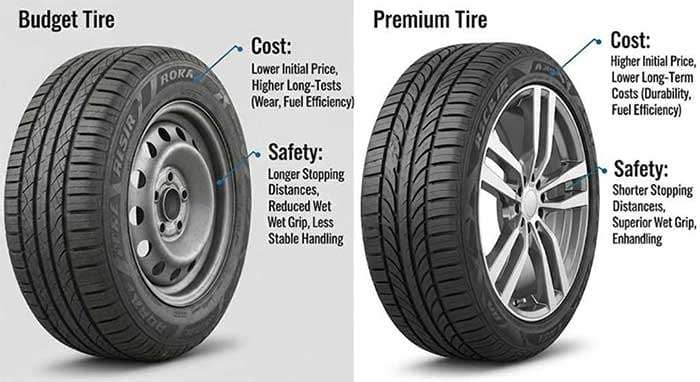
Budget considerations play a major role when choosing between OEM and aftermarket tires. The price gap between these options can surprise vehicle owners shopping for replacements.
OEM tires command premium pricing due to their vehicle brand association and specialized manufacturing processes. Dealerships provide convenient service but charge accordingly—though some offer price match guarantees on select tire brands. Manufacturers sometimes provide rebates ranging from $15 to $60 per tire to help offset higher costs. However, OEM tire selection stays limited, offering fewer customization opportunities.
Aftermarket options deliver substantial savings—typically 10% to 50% on major tire brands. We carry the best selection of aftermarket tires at competitive prices. Pricing varies by size: 17-inch options start around $232.99, while 19-inch sizes run between $303.99-$406.99. A complete set of four new aftermarket tires typically costs between $460 and $1,280, with the median price per tire reaching $223 in 2023. Value-focused options like the Ventus V12 evo2 range from $144.99 to $394.99, providing excellent alternatives to expensive OEM equivalents.
You can find all the major brands in the aftermarket space, from budget-friendly touring tires to high-performance options. This huge selection gives you flexibility to match your specific needs and budget.
Aftermarket tires excel at customization possibilities. You can select tires emphasizing specific performance aspects, such as improved cornering handling or extended tread life. Many enthusiasts use this opportunity to try different tire combinations, including staggered fitments with varied sizes front to back. Changing tire aspect ratio and width can dramatically impact grip, braking distance, and ride comfort. Save on Aftermarket Tires without compromising quality—aftermarket options allow you to prioritize essential features without unnecessary expenses.
The aftermarket marketplace offers choices OEM simply can't match. Whether you need all-season reliability, performance grip, or maximum tread life, aftermarket selections provide the customization freedom to get exactly what your driving demands.
Choosing between OEM and aftermarket tires comes down to your specific driving needs and priorities. Here's how to make the right decision for your situation.
OEM tires make the most sense when you want to preserve your vehicle's original performance characteristics. Stay with OEM options if your car's handling has satisfied you since you bought it. These tires maintain the exact performance attributes your manufacturer engineered and ensure your vehicle's safety systems work as intended. Vehicles with sophisticated handling or those still under warranty typically benefit most from sticking with original equipment replacements.
Aftermarket options excel when you're seeking performance improvements beyond factory specifications. Consider aftermarket alternatives when you want enhanced grip, sportier handling, a smoother ride, better fuel economy, or specialized off-road capability. Save on Aftermarket Tires without compromising quality—these options offer extensive customization possibilities and typically cost significantly less than OEM equivalents.
Your driving style and environment should guide your tire selection. Automakers reveal their priorities through OEM tire choices—hybrids come with low rolling resistance options, while off-road vehicles feature aggressive tread patterns. Consider what matters most for your driving: maximum wet weather traction, quiet highway cruising, or extended tread life.
Several methods help you identify original equipment tires. Look for special markings or symbols molded into the tire sidewall. When shopping online, search for tires marked as "Original Equipment Fitment". Your vehicle's documentation often includes this information as well.
Here's a clear breakdown of the key differences between OEM and aftermarket tires to help you make the right choice for your vehicle:
Characteristic |
OEM Tires |
Aftermarket Tires |
|---|---|---|
Design Focus |
Specifically engineered for particular vehicle models through manufacturer collaboration |
Designed to fit multiple makes and models |
Performance |
Factory-tuned for specific vehicle characteristics and balanced performance |
Can be specialized for specific performance elements (traction, fuel efficiency, etc.) |
Typical Lifespan |
30,000-50,000 miles |
Varies; touring options can reach 70,000-85,000 miles |
Cost |
Premium pricing with occasional manufacturer rebates ($15-$60 per tire) |
10-50% savings compared to OEM; median price $223 per tire (2023) |
Availability |
Limited selection through dealerships |
Extensive options through multiple retailers and vendors |
Customization Options |
Limited to manufacturer specifications |
High flexibility in size, performance characteristics, and specialized features |
Fuel Efficiency |
Optimized for vehicle's intended efficiency ratings |
Varies by design; can impact fuel economy by 3-8% depending on type |
Testing & Development |
Extensive manufacturer testing with up to $1 million investment |
Varies by manufacturer and model |
Best Suited For |
Maintaining original vehicle performance and warranty compliance |
Drivers seeking specific performance improvements or cost savings |
This comparison shows why aftermarket tires offer such compelling value for many drivers. The cost savings alone—typically 10-50% compared to OEM options—make aftermarket choices attractive. Plus, you get access to a huge selection of brands and performance characteristics that OEM selections simply can't match.
Your choice between OEM and aftermarket tires comes down to what matters most for your driving needs. OEM tires deliver the exact performance characteristics your vehicle manufacturer intended. They maintain factory handling dynamics and work seamlessly with your car's systems.
Aftermarket tires offer significant advantages for many drivers. You'll find 10-50% cost savings compared to OEM options, with the median aftermarket tire priced at $223 in 2023. These savings add up quickly when replacing all four tires. More importantly, aftermarket choices let you customize performance based on your specific priorities—whether that's enhanced grip, better fuel economy, or extended tread life reaching 70,000-85,000 miles.
Your driving conditions play a crucial role in this decision. Extreme weather regions benefit from specialized aftermarket designs built for those conditions. Drivers focused on maintaining their vehicle's original characteristics will prefer OEM specifications.
Budget considerations matter significantly. Aftermarket options provide excellent value without sacrificing quality, especially important when facing the cost of four new tires.
The simplest decision-making approach? Consider your satisfaction with current performance. Happy with how your vehicle handles? OEM replacements maintain that experience. Want improvements in specific areas like traction, comfort, or durability? Aftermarket options address those exact needs.
Both tire types serve important purposes depending on your priorities. Understanding these differences helps you balance performance requirements, driving conditions, and budget constraints for your specific situation. The key is matching your choice to your actual driving needs rather than assuming one option fits all scenarios.
Understanding the difference between OEM and aftermarket tires helps you make informed decisions that balance performance, cost, and customization needs for your specific driving situation.
• OEM tires maintain factory performance - They're specifically engineered through manufacturer collaboration to preserve your vehicle's intended handling, safety systems, and ride characteristics.
• Aftermarket tires offer customization and savings - These provide 10-50% cost savings while allowing specialization for specific needs like enhanced grip, fuel efficiency, or extended tread life.
• Performance varies by design focus - OEM tires balance multiple characteristics for consistent performance, while aftermarket options can excel in specialized areas at potential trade-offs.
• Choose based on satisfaction and priorities - If happy with current performance, stick with OEM; if seeking improvements in specific areas or cost savings, consider aftermarket alternatives.
• Match tires to driving conditions - Consider your climate, driving habits, and performance priorities when deciding between factory specifications and customized aftermarket solutions.
The key is aligning your tire choice with your specific needs—whether that's maintaining manufacturer-intended performance or customizing for enhanced capabilities and value.
Not necessarily. While OEM tires are specifically designed for your vehicle, aftermarket tires can offer comparable or even superior performance in certain areas, along with potential cost savings and more customization options.
OEM tires often last between 30,000-50,000 miles, while some aftermarket options can reach 70,000-85,000 miles. However, lifespan varies depending on the specific tire design and priorities (e.g., comfort vs. longevity).
Aftermarket tires typically cost 10% to 50% less than OEM options. In 2023, the median price for an aftermarket tire was $223, offering significant savings, especially when replacing all four tires.
Quality aftermarket tires that match your vehicle's size, load, and speed ratings should not negatively impact performance or safety systems. However, they may alter certain handling characteristics compared to OEM tires.
Consider your priorities: If you're satisfied with your vehicle's current performance, OEM tires maintain that experience. If you're seeking improvements in specific areas (e.g., grip, fuel efficiency, tread life) or cost savings, aftermarket options may be preferable. Also factor in your driving conditions and climate.