
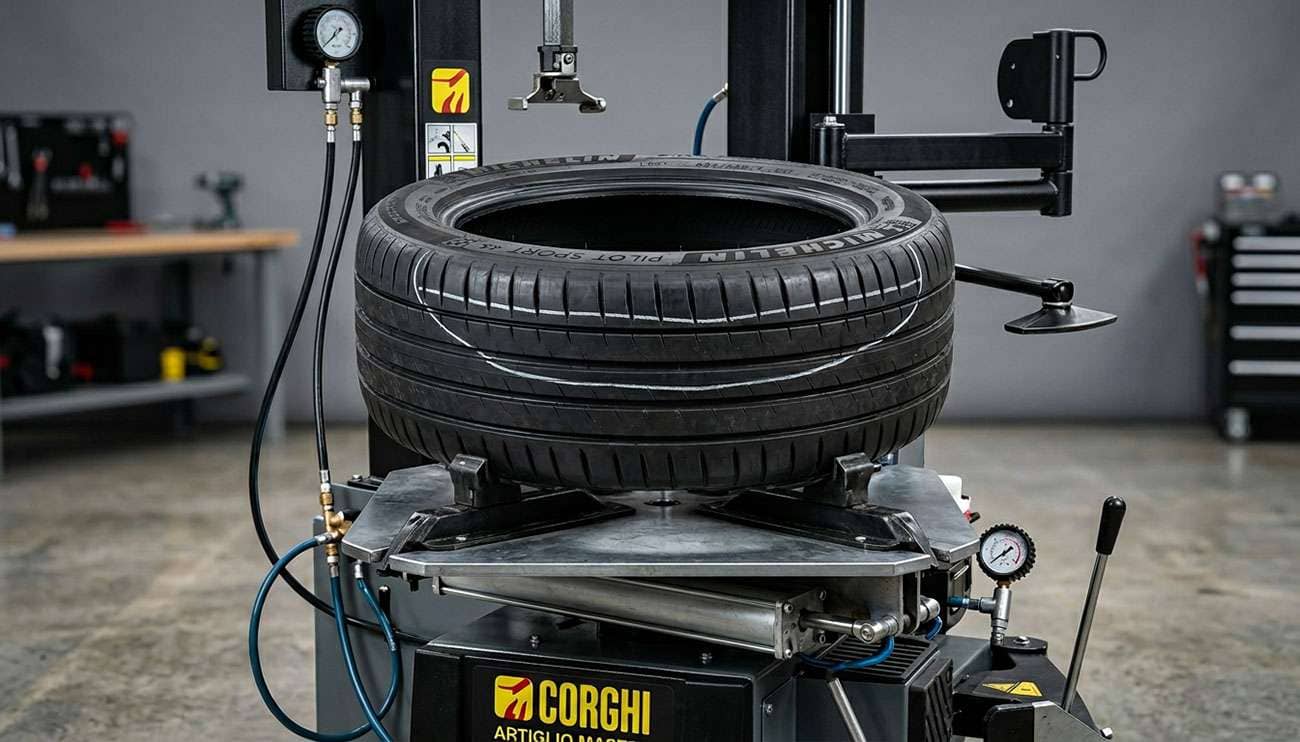
You roll into the shop with a slow leak. There's a nail sticking out of the tread. The tech takes one look, shakes his head, and tells you the tire's done. You're staring down a $250 replacement when a $25 repair was right there — or so you thought.
I've been on the floor more than 40 years, and I've turned away more tire repairs than I can count. Almost every time, the customer thinks the shop's just trying to upsell. Almost every time, they're wrong. There are real, hard rules that decide whether a tire can be safely repaired, and most of them aren't even up to the shop. The industry wrote them, manufacturers back them, and federal safety regulators reference them. When the tech says no, he's usually following a checklist — not chasing a commission.
Here are the 9 things we look at before we'll touch a flat tire, and why each one is a hard line.
Three organizations write the rulebook on tire repair, and any reputable shop in the country follows them: the U.S. Tire Manufacturers Association (USTMA), the Tire Industry Association (TIA), and the National Highway Traffic Safety Administration (NHTSA). All three publish the same core guidance — repair must be inside the tread crown, no larger than 1/4 inch, and use a combination plug-patch unit installed from the inside after the tire's been demounted and inspected.
Here's the part most drivers miss: a shop that ignores those guidelines isn't being generous. They're taking on liability. If a "creatively repaired" tire blows out at 70 mph and somebody gets hurt, the shop's name is on the work order, and a personal-injury attorney will find them. That's why a serious shop won't bend on this — even when the customer's mad, even when there's a tip on the table, even when the tire looks fine to a layman. The standards exist for a reason, and the reason is that tires that fail at speed kill people.
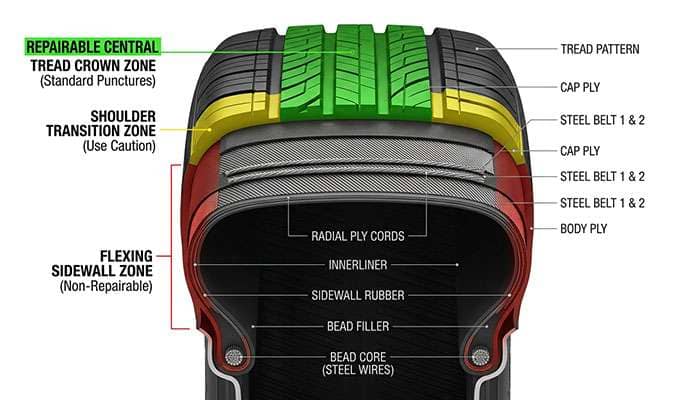
This is reason number one in my shop, by a wide margin. The repairable area on a passenger tire is the central tread crown — and the crown ends roughly half an inch inboard from the outermost circumferential groove on each side. Anything outside that line is the shoulder or sidewall, and the shoulder is just as dead as the sidewall when it comes to repairs.
The reason isn't arbitrary. Sidewall and shoulder rubber flex constantly while the tire's rolling — that's their job. A patch glued onto a flexing surface will eventually peel, blister, or pop loose. When that happens, you don't get a slow leak. You get a sudden deflation at speed. The tread crown has steel belts running through it that hold the patch in a fixed shape, so the bond stays put. The shoulder and sidewall don't, so the bond doesn't. End of story. If you want the longer version, our guide on tire sidewall damage and whether it's safe to drive walks through the structural reason in detail.
USTMA caps the maximum repairable injury at 1/4 inch (6 mm) for passenger and light-truck tires through Load Range E. Light truck tires above that range get 3/8 inch. Past those numbers, the steel belts that give the tire its shape and load capacity have been compromised too far for a patch to restore.
This one trips up customers all the time, because a screw head looks bigger than the actual hole. The tech measures the puncture channel itself, not the head of whatever caused it. A 5-inch lag bolt with a wide head can leave a perfectly repairable 3/16 inch puncture. A jagged piece of scrap metal can leave a tear that measures 5/16 inch even though it didn't look like much going in. Size and shape both matter — clean round holes from straight-in punctures are the gold standard. Slits, gashes, and angled tears that wander through the belts get scrapped even when the entry point is small.
This one breaks customers' hearts. The puncture is in the right spot, the hole's the right size, but you drove three blocks on a soft tire to get to the shop — and now the tire's done. When a tire runs at low pressure or fully flat, the sidewall folds against itself with every revolution. The internal liner abrades against the belts. Heat builds up. The cords inside the sidewall start to delaminate.
None of that shows from the outside. But the second we demount the tire and look inside, it's obvious. We see scuff rings on the inner liner, rubber dust around the bead, sometimes blue or brown discoloration from heat. USTMA explicitly lists "indication of having been run flat, underinflated, and/or overloaded" as a scrap-tire criterion. Once you see those tells, the tire's structural integrity is already gone — patching it would just paper over a tire that's going to fail anyway. If you've got a slow leak, our breakdown of whether you can drive with a nail in your tire explains how to get to the shop without killing the tire on the way.
2/32 of an inch is the federal legal minimum tread depth, and it's also the line at which USTMA classifies a tire as a scrap. A tire with worn-out tread isn't just illegal — it doesn't have the rubber depth left to seat a proper patch, the wet-traction is shot, and you'd be replacing it within weeks anyway. No reputable shop is going to charge you $30 to repair a tire you'll be throwing away by next month. We just point you toward when to replace tires based on tread depth and put you on a fresh set.
If you're wondering whether your tread is borderline, take a quarter — not a penny — and stick it upside down in a tread groove. If you can see the top of Washington's head, you're already at or below 4/32 and replacement time is closer than you think.
USTMA allows multiple repairs in a tire, but with a hard rule: repair units cannot overlap, and they need adequate spacing — most reputable shops won't put a second patch within 16 inches of an existing one along the tread circumference. The reason is simple: every patch is a small structural compromise, and stacking compromises in the same area weakens the casing too far.
I've seen tires come in with three or four patches scattered around the tread, and at that point I'm not putting a fifth one in even if the geometry technically allows it. The customer's pulling nails out of the same parking lot every other week, and that's not bad luck — that's a screw-magnet route they need to change. But the immediate answer is the same: when a tire's been patched too many times or the new puncture is too close to the old one, it gets retired.
This one comes up more than you'd think, and it's almost always self-inflicted. A driver gets a nail, picks up a plug kit at the auto parts store, jams the rope plug in from the outside, airs the tire up, and goes about their life. Six months later they pick up a second nail, bring it to a shop expecting a clean repair — and find out the first plug killed the tire's repairability forever.
USTMA classifies plug-only repairs as improper. The same goes for canned tire sealant — that white goop you spray in to limp home. Both are listed as scrap-tire conditions because neither one seals the inner liner properly, both can hide developing damage, and the residue contaminates the patching surface so a proper combination repair won't bond. If the tech sees an old rope plug or sealant residue when he demounts the tire, that tire is done. We've covered exactly why in our piece on why you shouldn't plug your tires, and the difference between plugs and proper repairs in our guide on choosing between tire plug vs. patch.
Run-flats are a special case, and most shops won't repair them — even when the puncture's in the right zone and the right size. The reason is the same one that makes them useful: their stiff reinforced sidewalls can carry the car for 50 miles after the tire goes flat. But that 50-mile capability comes at a cost. Once a run-flat has run while flat, the internal sidewall structure is almost always damaged in ways no inside inspection can fully assess.
Some manufacturers permit limited run-flat repair under strict conditions, others ban it outright. In practice, most shops err on the side of replacement for run-flats because the liability of a botched repair on a tire that's been driven deflated is just too high. If you're driving on run-flats and want the full picture on what they trade off for that flat-tolerance, our breakdown of run-flat tires vs. regular tires covers it.
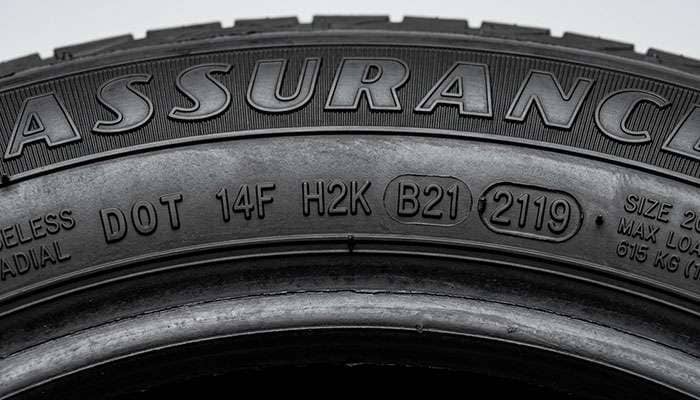
Every tire has a DOT identification number stamped on the sidewall, and the last four digits are the manufacture date — first two for the week, last two for the year. A tire stamped 2418 was built the 24th week of 2018. Most major manufacturers, including Michelin, Continental, and Bridgestone, recommend tire replacement at six years from the manufacture date regardless of tread, and treat any tire over ten years as out of service.
Those numbers aren't marketing. They reflect real chemistry — rubber compounds harden and develop microscopic cracking with age, and aged rubber doesn't bond reliably with patch cement. A puncture in a 7-year-old tire might technically sit in the repair zone, but if the rubber's already brittle, the patch isn't going to hold the way it needs to. We'll show you the date code, point at the calendar, and recommend you replace. Tire age is also covered in our deeper look at how many miles car tires actually last.
This is the catch-all reason, and it covers everything we find on inside inspection that wasn't visible from the outside. Sidewall bubbles or bulges that the customer never spotted. Bead damage from a previous mounting that's letting air past. Cord exposure on the inner liner. Cracking in the lower sidewall from chronic underinflation. Blue or brown heat staining from a past flat-driving incident the customer forgot about.
USTMA's scrap-tire bulletin lists every one of these — innerliner damage, bead damage, internal separation indicators, defaced DOT numbers, evidence of fire or chemical damage, recall involvement. Any one of them disqualifies the tire from repair. The whole point of demounting the tire and inspecting the inside is to catch the things you couldn't see from the outside. Sometimes that's bad news for the customer. It's still the right call.
Everything I've laid out above is the legitimate reasoning behind a refusal. But not every shop is on the level, and you have a right to push back when something feels off. Here's what to ask before you accept a "no" on faith:
What to Ask |
What a Good Answer Sounds Like |
Red Flag |
|---|---|---|
"Did you demount the tire and inspect the inside?" |
"Yes — here's what I saw." |
"We could tell from the outside." |
"Which guideline is this refusal based on?" |
"USTMA repair zone / size / scrap criteria." |
"Shop policy" with no specifics. |
"Can you show me where the puncture is?" |
The tech walks you to the tire and points it out. |
The tire's already off the rack and out of sight. |
"Is the inside damage visible to me?" |
"Come over here, I'll show you the heat ring." |
"You'll just have to trust me on it." |
An honest shop will demount the tire, show you exactly what they're seeing, and reference the standard they're applying. If you're getting hand-waving instead of evidence, take the tire somewhere else for a second opinion. We charge nothing for an inside inspection at PPT, and most reputable shops do the same.
Once the verdict comes back as replace, you've got a few decisions to make — and the wrong one is going to cost you more than the tire itself.
How many tires do you actually need to replace? The answer depends on your drivetrain and how worn the rest of your set is. On a two-wheel-drive vehicle with three healthy tires that are reasonably close in tread depth, you can usually replace just the one — get the same model, the same size, and ask the shop to put the new tire on the rear axle for stability. On all-wheel-drive and four-wheel-drive vehicles, the math gets more complicated. Most AWD systems are sensitive to tread-depth differences between axles, and running one fresh tire against three worn ones can stress the center differential or transfer case. Many AWD manufacturers — including Subaru, Audi, and Volvo — recommend replacing all four tires when one is damaged, or at minimum shaving the new tire down to match the worn ones (yes, that's a real service).
What about matching the rest of the set? If your existing tires are already three or four years old with significant tread wear, a single replacement might be a stopgap at best. You'll be replacing the others within a year regardless. Sometimes the smarter long-term move is replacing two on the same axle now, then planning the second pair on a known timeline.
What tire do you replace it with? Same model and same size is the safest path. Mixing tire models across an axle creates handling differences in wet conditions and during emergency braking that can surprise you at the worst moment. If the original model is discontinued or you're due for a category upgrade — say, moving from worn-out all-seasons to dedicated winter tires — make the change as a full set, not a mismatched pair.
If you're sizing up replacements, our full tire inventory covers most popular fitments, and the tire and rim warranty guide walks through what coverage to ask about so the next puncture isn't a full out-of-pocket expense.
A shop that won't repair your tire isn't necessarily trying to sell you something — most of the time, they're following industry standards that exist because tires that fail at highway speed cause crashes. The repair zone is small. The size limit is firm. The disqualifiers are real. When you understand what the tech is looking at, the "no" makes a lot more sense, and the path forward gets cleaner.
The next time you walk into a shop with a flat, ask the right questions, expect a real inspection, and if the verdict is replace, ask them to walk you through what they saw. A shop that can't or won't show their work is a shop you should leave. A shop that does is doing the job right.
There's no fixed number, but USTMA guidelines require that repairs not overlap and that they have adequate spacing along the tread — most shops use a 16-inch minimum between repairs as a working rule. In practice, most reputable shops won't put more than two or three repairs in a single tire even if the geometry technically allows it. Each repair is a small structural compromise, and stacking them weakens the casing.
A roadside plug from a kit can get you off the highway and to a tire shop, but it's not a permanent repair. USTMA classifies plug-only repairs as improper, and a plug doesn't seal the inner liner — moisture and air will eventually work past it and damage the belts. Treat a DIY plug like a spare tire: a way to get to a proper shop repair, not a forever fix. And don't skip the shop visit, because a future tech will scrap the tire if they find an old plug inside.
A proper combination plug-patch repair runs roughly $20 to $40 at most shops. A new passenger tire ranges from about $80 for a budget all-season up to $400 or more for a premium performance tire, plus mounting and balancing. The math obviously favors repair when it's an option — which is exactly why a shop refusing repair on a perfectly good tire would lose money on every transaction. Refusals aren't profit decisions; they're safety decisions.
Depends entirely on what the shop found. If the tire's been refused for a sidewall bubble, prior flat-driving damage, or visible cord exposure, no — you should put the spare on before leaving. If the refusal is for tread depth, age, or proximity to a previous repair and the tire is still holding air, you can usually drive carefully on it short-distance until you've sourced a replacement. Always ask the tech for their judgment on this specific question before you leave the shop. They've just looked inside the tire and they know whether it's safe to roll.



