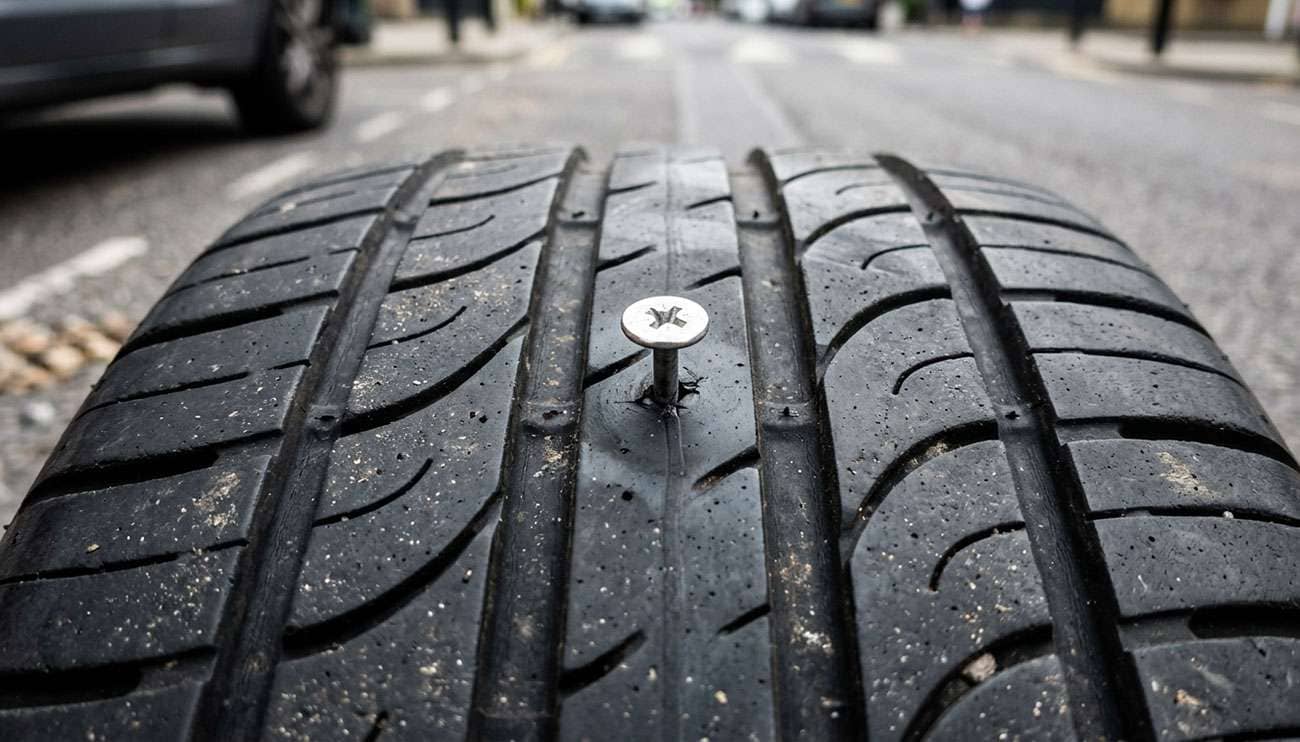
You walk out to your car and spot it — a nail sitting flush in your tire tread, or sticking up at an angle, or you notice your TPMS light just came on and a walk-around reveals the culprit. Now you're standing there asking the question millions of drivers ask every year: can I still drive on this? The answer is yes in some situations and absolutely not in others, and the difference between those two answers determines whether you pay $25 for a repair or $200 for a new tire. This guide gives you the specific decision framework to know exactly what you're dealing with and exactly what to do about it — right now, in the parking lot or driveway where you're standing.
Before anything else, run through these three questions. They determine your immediate course of action in under two minutes.
Look at the tire. Is it visibly flat or noticeably softer than the others? Check your TPMS reading if available. If the tire is maintaining normal shape and pressure, the nail may be sealing the hole — giving you a narrow window to get to a shop. If the tire is visibly deflated, low, or your TPMS warning is lit and pressure is dropping: don't drive on it. Put on your spare and go.
Is the nail in the center of the tread — the flat part of the tire that contacts the road? Or is it in the shoulder (the curved edge where tread transitions to sidewall) or in the sidewall itself (the vertical face of the tire)? Tread punctures are potentially repairable. Shoulder and sidewall punctures are not — the tire is done. More on exactly where those boundaries are in a moment.
Get in and move the car a few feet if it's safe to do so. Does it pull strongly to one side? Is there vibration, thumping, or unusual noise from the affected corner? Any of those symptoms mean the tire is already compromised enough that driving it — even to a nearby shop — risks making the damage significantly worse. Use your spare.
If the tire is holding pressure, the nail is in the tread, and the vehicle handles normally: you can drive carefully to a tire shop. If any of those three conditions fails: spare goes on first, then drive to the shop.
Understanding the physics of a nail puncture helps you make better decisions — particularly around why the nail staying in is actually better than pulling it out, and why driving on it even briefly when pressure is dropping can destroy repairability.
When a nail penetrates your tire tread, it doesn't create a clean round hole — it creates a puncture that the nail itself partially fills. The nail's shaft displaces rubber around it, and the tire's internal air pressure actually helps push the surrounding rubber against the nail, partially sealing the channel. This is why you can sometimes drive over a nail and not notice an immediate flat: the nail is plugging its own hole.
The key word is "partially." Air is still escaping — slowly, along the channels between the nail and the rubber. You may hear a faint hiss if you put your ear near the tire. Spray soapy water on the nail and you'll see bubbling around the shaft. The leak is real. It's just slow enough to be deceptive.
A nail doesn't stay static in your tire. Every revolution of the tire flexes the tread. Every bump, pothole, and road irregularity transmits force through the puncture site. Over miles and time, nails work deeper into the tire — enlarging the puncture, contacting and potentially damaging the steel belts beneath the tread, and creating more air loss. A small puncture that was easily repairable when you first spotted it can become irreparable after a few days of driving on it as the nail works down into the belt structure.
Your TPMS system doesn't alert you until tire pressure drops approximately 25% below the recommended inflation — typically around 8–10 PSI below spec on most passenger tires. This means you can be driving on a tire that's lost significant pressure, has compromised handling and braking, and is accumulating internal damage — all without any warning light. By the time the TPMS light comes on, you've likely already been running low for some distance.
This is the critical risk of "it's holding air, I'll deal with it later" reasoning. The tire may not be holding as much air as you think, and the internal damage from driving underinflated can happen before any visible symptom appears. Get to a shop today — not this week, not when it's convenient. Today.
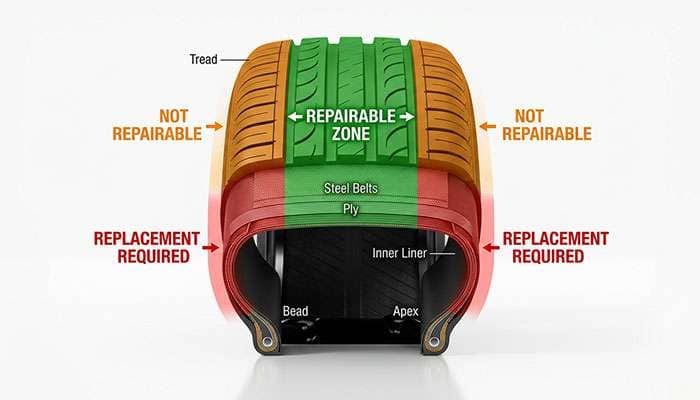
The single most important factor in determining whether your tire can be repaired is where the nail is. Tire industry repair standards define specific repairable zones with hard boundaries. Here's exactly what those zones are.
The repairable zone for any tire puncture is the center 3/4 of the tread width — roughly the flat portion of the tire that makes contact with the road. Specifically, the Tire Industry Association (TIA) and US Tire Manufacturers Association (USTMA) define the repairable area as the tread region, excluding the area within approximately 1 inch of the tread edge on either side. This zone is supported by the steel belts beneath it, which means a proper repair (plug-patch combination, installed after demounting) can restore structural integrity reliably.
If the nail is squarely in the middle of the tread, clearly away from the shoulder on both sides, you're in the repairable zone. A professional repair is appropriate.
The shoulder is the curved transition zone between the flat tread and the vertical sidewall. This area looks like tread — it may even have tread pattern on it — but it behaves structurally more like the sidewall than the tread. The shoulder experiences significant flex as the tire compresses under load and rotates, and a repair in this area is subject to the same dynamic stress failure risks as a sidewall repair.
Industry standards are clear: punctures in the shoulder area are not repairable. If you're unsure whether your nail is in the tread or the shoulder, have a professional assess it. The visual inspection takes 30 seconds and gives you certainty. Don't guess when the alternative is driving on an improperly repaired tire.
Any puncture in the sidewall — the vertical face of the tire from the tread edge to the wheel rim — cannot be repaired. This is absolute. The sidewall flexes with every rotation of the tire, and any repair material inserted into a sidewall puncture will be subjected to that continuous dynamic stress until it fails — usually suddenly and completely. A nail in the sidewall means the tire is done, period. No legitimate tire shop will repair a sidewall puncture, and any shop that offers to do so is creating a dangerous situation regardless of their intention.
This is one of the most common mistakes drivers make, and it almost always makes the situation worse. The instinct to remove the nail is understandable — it looks like the problem, so removing it seems like addressing the problem. It isn't. It makes it worse. Here's exactly why.
As described above, the nail is partially plugging its own hole. Pull the nail out and you've removed the only thing slowing the air loss. What was a slow leak — potentially holding enough pressure to drive carefully to a shop — becomes a rapid deflation that could strand you immediately. A tire that would have gotten you to a shop with the nail in can be flat within minutes of pulling the nail out.
When a tire professional demounts the tire to inspect and repair the puncture, the nail's position, angle, and depth tell them crucial information about what happened internally. A nail removed before they see it leaves them without that information and forces them to work blind on the inspection. Leave it in. Let the professionals remove it as part of the repair process.
If you're changing to your spare tire before driving to the shop — which is the right move when the tire is losing air fast or the nail is in a non-repairable location — you can remove the nail from the tire after it's off the rim, safely on the ground. At that point the seal doesn't matter because you're not driving on it. But if the tire is on the car and you're deciding what to do: leave the nail in and drive to the shop, or leave the nail in and call for help. Don't pull it out.
Assuming the tire is in the driveable scenario — nail in tread, tire holding pressure, no handling abnormality — here's the practical guidance on distance.
There is no universal mileage number for "safe to drive with a nail in your tire" because the variable is the leak rate, and leak rates vary enormously. A small nail in thick tread may lose pressure at 1 PSI per hour. A larger nail at a bad angle may lose 5 PSI per mile. You don't know your leak rate without measuring it, and you can't accurately measure it without professional equipment.
The correct answer is: drive only as far as the nearest qualified tire repair shop, by the most direct route, at moderate speed (no highway driving unless it's the only practical route). That's it. Not "I'll drive it for a few days and see." Not "I'll go to the shop this weekend." Today, direct, done.
At highway speeds, tires generate significantly more heat through flexion and road friction. More heat means the rubber around the puncture becomes more pliable, the nail moves more, and air loss accelerates. A nail that's losing pressure slowly at 30 mph on city streets may be losing pressure much faster at 65 mph on the highway. The USTMA and AAA both advise avoiding highway speeds with a nail in the tire. If your nearest shop requires highway travel, consider calling roadside assistance to transport the vehicle rather than driving it.
Adding air to a leaking tire is a temporary measure that gives many drivers a false sense of having addressed the problem. The puncture is still there. The nail is still working deeper. The structural inspection still hasn't happened. Adding air extends the window between now and when the tire goes flat, but it doesn't address the underlying damage or preserve repairability. The only time adding air makes sense is if the tire has dropped enough that you can't safely drive to the shop on it — in that case, inflate to spec, drive directly to the shop, and get it repaired the same day.
Here's the thing most drivers don't know, and it's what separates a $25 repair from a $200 replacement: driving on a tire while it's losing air — even briefly — can permanently damage it beyond repair, even if the original puncture was in a perfectly repairable location.
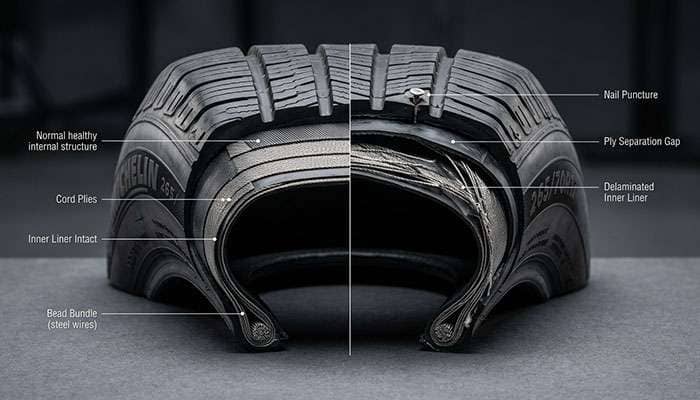
When a tire is underinflated, the sidewall flexes more than it was designed to. Each rotation of the tire bends the sidewall beyond its normal range, generating heat in the rubber and cords. That heat builds up rapidly — much faster than when the tire is properly inflated. The excess flexing also stresses the adhesion between the tire's internal components: the inner liner, the ply cords, the belt package. When those components begin to separate due to heat and stress, the tire is damaged in ways that are invisible from the outside but make it unrepairable and unsafe.
This is the hidden cost of "I'll deal with it later" or "I drove it home from work and it seemed fine." The tire may look intact. The tread may be unmarked. But inside, the ply separation has already happened, and when a professional demounts the tire and inspects the inside, they'll see the damage and tell you it needs to be replaced — even though the original puncture was a simple tread nail that would have cost $25 to fix if you'd gone straight to the shop.
After driving on a low tire, look for these indicators of internal damage that may have already pushed the tire past repair: sidewall cracking or discoloration at the base of the sidewall, uneven appearance of the sidewall when inflated, any bulge or waviness in the sidewall profile, and vibration or thumping that wasn't present before. If you see any of these, the tire needs professional inspection before you drive further — and replacement is likely.
When you get to the shop, you may hear different options for how to repair the puncture. Understanding what each method involves — and which one is actually correct — helps you make sure you're getting a proper repair rather than a quick fix that fails down the road.
A roadside plug — the rubber strip or mushroom plug pushed through the puncture from the outside without removing the tire from the wheel — is an emergency temporary measure, not a permanent repair. It doesn't seal the inner liner. It doesn't allow for interior inspection of the tire. It doesn't address any damage the nail may have caused to internal components. Both the USTMA and the TIA explicitly state that plug-only repairs performed without demounting the tire are not an acceptable permanent repair method. Some shops still offer plug-only repairs because they're faster and cheaper to perform. If a shop offers to plug your tire without removing it from the rim, that's not the industry-standard repair — it's a shortcut.
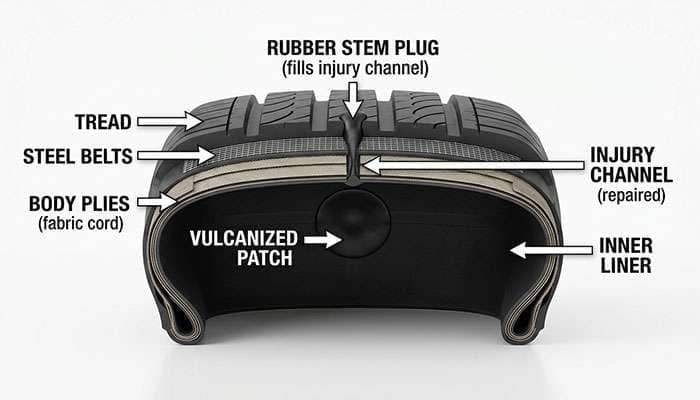
A patch applied to the inner liner from the inside of the tire (requiring demounting) seals the inner liner effectively. But a patch alone doesn't fill the injury channel through the tread — it seals the inside but leaves the puncture channel open to moisture and debris from the outside. This can allow moisture to contact the steel belts, leading to corrosion over time. Better than a plug only, but still not the complete repair.
The correct repair — specified by USTMA, TIA, and endorsed by every major tire manufacturer — is a combination repair: a plug stem that fills the injury channel through the tread from the inside, plus a patch that seals the inner liner. This two-component repair fills the puncture channel (preventing moisture intrusion and further nail-path damage), seals the air barrier (inner liner), and requires a complete interior inspection of the tire before the patch is applied. It's done with the tire demounted from the wheel. It costs more than a roadside plug — typically $25–$50 vs. $5–$15 — but it's the only repair that actually addresses the complete puncture damage and meets manufacturer safety standards.
When you get to a tire shop, ask specifically: "Will the tire be removed from the rim for this repair?" If the answer is no, they're doing a plug-only repair. That's your signal to either insist on a proper repair or find a shop that will do it correctly.
A nail puncture doesn't always mean a repair. Here are the specific conditions that make replacement the only safe outcome.
The nail is in the sidewall or shoulder area — no exceptions, no matter how small the nail or how minimal the visible damage. The structural repair standards don't permit sidewall or shoulder repairs and no legitimate professional should offer one.
The puncture is larger than 1/4 inch (6mm) in diameter. Industry repair standards specify a maximum repairable puncture size of 1/4 inch. Larger objects, or nails that have shifted and enlarged the puncture hole, exceed this limit.
The tire has been driven significantly while underinflated and shows signs of internal damage — ply separation, sidewall irregularities, or internal heat damage identified during the interior inspection that's part of a proper repair.
There are multiple punctures, or the existing puncture is within 16 inches of a previous repair. Overlapping repair zones compromise the structural integrity of the repair area.
The tire is already at or near replacement age — less than 2/32" tread remaining, or 6+ years old from manufacture date. A nail puncture on a tire that's due for replacement anyway is the right moment to replace rather than repair. Use the tire age DOT date checker to confirm your tire's manufacture date before deciding whether repair is worth the cost.
When replacement is necessary, the decision of what to replace with should follow normal tire-buying guidelines — match the size exactly, meet or exceed the original load index and speed rating, and ideally replace both tires on the axle rather than a single tire if the remaining partner has significant wear. Browse replacement tires at Performance Plus Tire by vehicle to find the exact size in the right performance category for your car.
Nails get the most attention because they're the most common, but you'll find plenty of other objects embedded in tires. Here's how the rules apply to the other common culprits.
Screws behave similarly to nails in most respects — they can plug their own hole, they're typically in the tread area, and a small screw in the center tread is potentially repairable with a plug-patch combination. The difference is that screws have threads, which can engage with the rubber differently and sometimes create a larger or more irregular puncture channel than a smooth nail. The same location rules apply: tread = potentially repairable, shoulder or sidewall = replacement.
Glass embedded in the tread that hasn't fully penetrated to cause a leak is often just working its way through — remove it promptly before it does puncture fully. Glass that has penetrated and caused a leak follows the same location-based repair rules as a nail. The challenge with glass is that it often shatters on removal, leaving fragments in the puncture channel that complicate proper repair. A professional inspection handles this correctly; pulling glass out of a tire yourself often makes the repair harder.
Any puncture larger than 1/4 inch — caused by larger debris, a bolt, a piece of metal — falls outside the repairable size limit and requires replacement regardless of location. If the object has created a ragged or irregular hole rather than a clean puncture, replacement is also the right call since the plug-patch repair requires a reasonably clean channel to fill.
You've read the framework. Here's the exact sequence of actions to take from the moment you find the nail.
Take a breath. A nail in the tread is a common, manageable situation. Leave the nail exactly where it is.
Check the tire pressure with a gauge or your TPMS reading. Look at where the nail is — center tread, shoulder, or sidewall. Look at the tire profile — is it visibly low compared to the others? Listen for any hiss. This assessment takes two minutes and determines everything that follows.
Nail in center tread, tire holding pressure, vehicle handling normally → drive directly to the nearest tire shop at moderate speed, no highway if avoidable. Don't stop anywhere else first.
Tire visibly low, losing pressure rapidly, nail in shoulder or sidewall, or handling is abnormal → install your spare before driving anywhere. Then drive to the shop on the spare.
No spare, tire is flat, not safe to change → hazard lights on, call roadside assistance. Do not drive on a flat standard tire.
Ask whether the tire will be removed from the rim for the repair. Ask whether they'll inspect the inside of the tire before repairing it. Ask whether the repair method is a combination plug-patch. A professional shop doing a proper repair will answer yes to all three without hesitation. If the answer to any of these is no, you're getting a substandard repair on a component that your life depends on.
If the nail requires replacement, confirm whether both tires on that axle should be replaced (recommended if tread depth difference is significant), check whether you're on an AWD vehicle that requires matched tread depths across all four tires, and use the tire size comparison calculator if you're considering a size change at the same time. If cost is a factor, tires now pay later options let you get the right replacement immediately without putting off a safety repair for budget reasons.
A nail in your tire is one of the most common automotive inconveniences you'll face. It's also one of the most consequential if you handle it wrong. The difference between a $25 same-day repair and a $200 replacement often comes down to one decision: how quickly you get to a shop after finding it. Leave the nail in. Assess pressure and location. Drive directly to a professional if the tire is holding and the nail is in the tread. Put the spare on if it isn't. Get a proper plug-patch combination repair — not a roadside plug — from a shop that demounts the tire and inspects the inside. And if replacement is the outcome, use it as the opportunity to get properly matched tires in the right size and load rating for your vehicle.
Performance Plus Tire carries every size in the catalog — from standard passenger car tires to performance and truck applications — with full spec details including load index and speed rating for every option. Find your size and get back on the road correctly.
The nail-in-tire decision, condensed to what actually matters.
• Location determines everything: Center tread punctures are potentially repairable. Shoulder and sidewall punctures are not — those tires are done regardless of nail size or air loss rate. If you can't clearly confirm the nail is in the center tread, get professional assessment before driving further.
• Do not remove the nail: The nail is partially sealing its own hole. Removing it before you're ready to repair converts a slow leak into rapid deflation. Leave it in and drive to the shop, or leave it in and call for help.
• Driving on it low destroys repairability: Even brief driving on a significantly underinflated tire can cause internal ply separation that turns a $25 repair into a $200 replacement. Today means today — not this weekend.
• Plug-only repairs are not the correct standard: The industry standard is a combination plug-patch repair with the tire demounted and interior inspected. Any repair that doesn't involve removing the tire from the rim is a temporary measure, not a permanent fix. Ask before you approve the repair.
• Replacement triggers are specific: Sidewall or shoulder location, puncture larger than 1/4 inch, internal damage from underinflation, multiple punctures, proximity to a prior repair, or a tire that was already near end of life — any of these means the nail ends the tire's service life regardless of how driveable it feels.
Yes, in one specific scenario: the nail is in the center tread area (not the shoulder or sidewall), the tire is maintaining normal pressure, and the vehicle handles normally with no pulling, vibration, or thumping. In that situation, you can drive directly and carefully to the nearest tire repair shop — no highway if avoidable, no stops, same day. If the tire is visibly low or losing pressure, if the nail is in the shoulder or sidewall, or if handling is abnormal, install your spare before driving anywhere.
No — do not remove the nail. The nail is partially sealing the puncture hole, slowing the rate of air loss. Removing it before you're ready to repair the tire converts what may be a slow, manageable leak into rapid deflation that can strand you immediately. Leave the nail in, assess the situation, and either drive carefully to a shop (if conditions allow) or install your spare and then drive to the shop. Let the professional remove the nail as part of the repair process.
Only as far as the nearest tire repair shop, by the most direct route. There is no reliable mileage number because leak rate varies enormously depending on nail size, location, and angle. A small nail may hold pressure for days. A larger nail at a bad angle may go flat within miles. More importantly, every mile you drive on a punctured tire risks the nail working deeper, enlarging the hole, and potentially destroying repairability — turning a $25 repair into a $200 replacement. Get to the shop today.
It depends on where the nail is and whether the tire has sustained internal damage. A nail in the center tread area, with a puncture no larger than 1/4 inch, in a tire that hasn't been driven significantly while underinflated, can be repaired with a combination plug-patch (the industry standard repair, done with the tire demounted from the rim). A nail in the shoulder or sidewall requires replacement — those areas cannot be safely repaired. Internal damage from driving underinflated, punctures over 1/4 inch, or proximity to a previous repair also require replacement.
A plug fills the injury channel through the tread from the outside (or inside) but doesn't seal the inner liner. A patch seals the inner liner from the inside but doesn't fill the injury channel. The correct repair — per USTMA and TIA industry standards — is a combination plug-patch that does both: fills the injury channel to prevent moisture intrusion and corrosion of the steel belts, and seals the inner liner to restore the air barrier. This requires demounting the tire from the rim to access the inside. A plug-only repair done without removing the tire from the rim is not an acceptable permanent repair per industry standards.