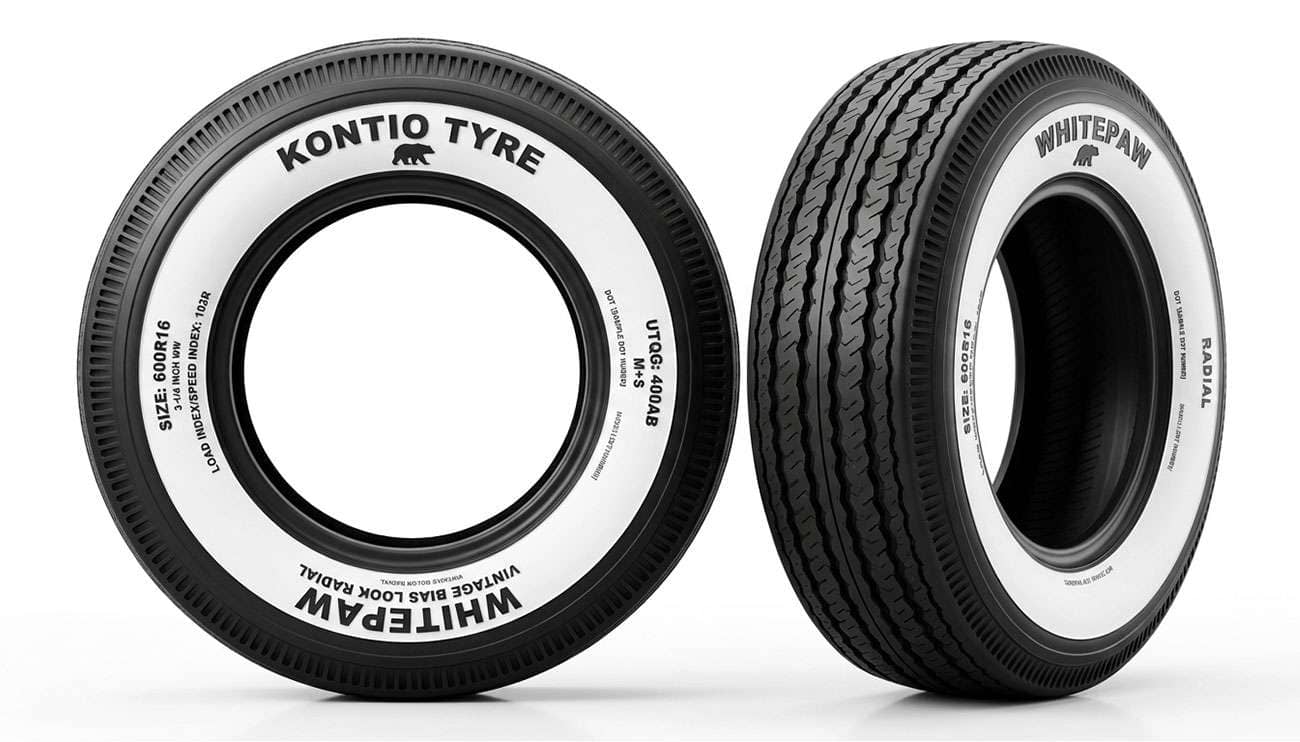
I've been selling whitewalls out of the Cherry Avenue shop for the better part of fifty years, and I can tell you the question has changed. It used to be "who still makes them." Now it's "which kind do I want," and that's a much better problem to have. The 2026 shelf is deeper than it's been in decades, and the most interesting corner of it is one most buyers walk right past.
So this roundup isn't another ranked list of the thirteen best whitewalls. My son Dennis already did that work, and did it well, in his rundown of the 13 best whitewall tires for classic cars in 2026. Go read it if you want the full ranking across every construction and era. What I want to talk about here is the bias-look whitewall, the two house brands we build our own classic program around, and the handful of questions customers ask me at the counter that nobody seems to answer straight.
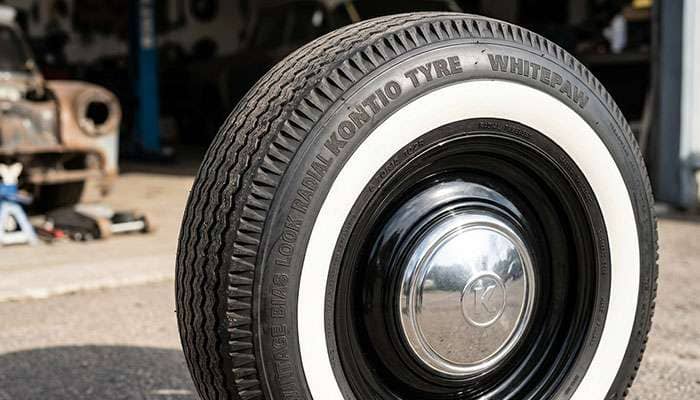
Here's the thing that took the industry thirty years to figure out. For a long time you had two choices and they were both compromises. You could run a true bias-ply tire and get the correct look with 1930s road manners, or you could run a modern radial and get safe handling on a sidewall that looked wrong for the car. Guys who drove their cars picked the radial and lived with the look. Guys who trailered picked the bias-ply and lived with the tread life.
The bias-look radial ended that argument. Underneath, it's a modern radial casing: belts running straight across, radial ply, modern compound, modern wet grip and tread life. On the outside, the mold gives you the tall, rounded, slightly pinched sidewall profile that a real bias-ply tire has, plus the vintage size markings on the sidewall. It looks correct standing at the fender. It drives like something built this century.
I want to be careful about one thing, because people mix it up constantly. A bias-look radial is not a bias-ply tire. It's a radial wearing the right clothes. If you're chasing a concours trophy where a judge is going to check construction against the build sheet, this is not your tire and you should be shopping true bias-ply. For everybody else, and that's the overwhelming majority of the people who walk into my shop, the bias-look is the smarter buy. If you want the deeper technical comparison, we laid it out in our piece on bias-look radial tires.
What makes 2026 different is depth. We're carrying 43 distinct bias-look whitewall SKUs across four brands right now. Five years ago that number was a fraction of it. The vintage sizes that used to be special-order-and-wait items, your 670-15, your 600-16, your 560-15, are sitting on the shelf.
Before you look at a single brand, answer these three questions. This is exactly how I'd walk a customer through it standing at the counter, and it takes about ninety seconds.
How You Use the Car |
Construction to Buy |
Whitewall Width |
Why |
|---|---|---|---|
Driven weekly, real road miles |
Modern radial whitewall |
Match your era |
Best tread life and wet grip. The sidewall profile reads modern but nobody notices at twenty feet. |
Weekend cruiser, shows and drives |
Bias-look radial whitewall |
Match your era |
Correct sidewall shape at the show, modern casing on the drive home. The sweet spot for most owners. |
Prewar car, vintage rim sizes |
Bias-look radial in 16-inch |
Wide, 3 inches and up |
The 550-16, 600-16 and 700-16 fitments a prewar car needs barely exist outside the bias-look lines. |
Concours or judged competition |
True bias-ply only |
Exactly period-correct |
A judge will check construction. Bias-look will not pass, no matter how right it looks. |
Lowrider or custom, modern rim |
Modern radial whitewall |
Wide, by taste |
Period-correctness is not the goal. Pick the width you like and buy the durable compound. |
Width is the part people get wrong most often, and it's era-specific rather than taste-specific on a restoration. Roughly: three inches and up for prewar, around two and a half to three for postwar through about 1962, an inch to an inch and a half through the mid sixties, and a thin stripe after that. Our whitewall width guide breaks it down year by year if you need to be precise.
Kontio is one of our own brands, so take my enthusiasm with whatever grain of salt you like. But I'd tell you the same thing if we didn't own it: the WhitePaw line covers more of the classic whitewall market at a better price than anything else on our shelf, and the durability has been the pleasant surprise.
These come out of Finland, and that matters more than it sounds like it should. A tire compound engineered for Northern European winters gets tested against temperature swings and road salt that most American classic tires never see. What we've found is that the whitewall compound holds its color longer than the price would lead you to expect. The yellowing complaint that follows budget whitewalls around has not followed this one.
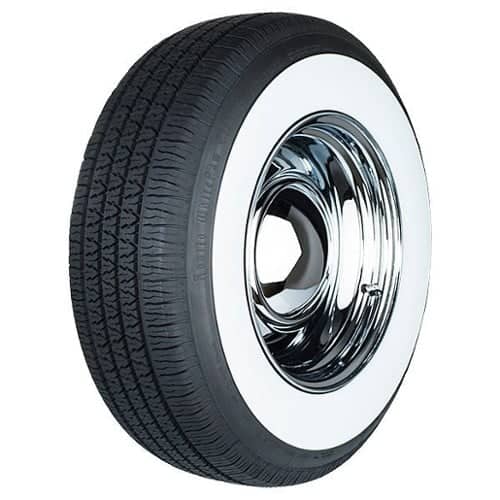
WhitePaw Classic WW-Wide is the workhorse for postwar and fifties cars. The 205/75R15 at $253 is the size that moves fastest out of our shop, and it covers an enormous range of American sedans. On the small end the 155/80R15 at $219 handles Beetles and compact classics, and on the large end the 235/75R15 at $268 covers the big cruisers.

WhitePaw Classic WW-Narrow is the same tire with the mid-sixties stripe, and it's the best value in this whole article. The 155/80R15 starts at $149, the 205/75R15 at $169, and the 235/75R15 at $199. When somebody tells me they can't afford whitewalls, this is the line I point at.
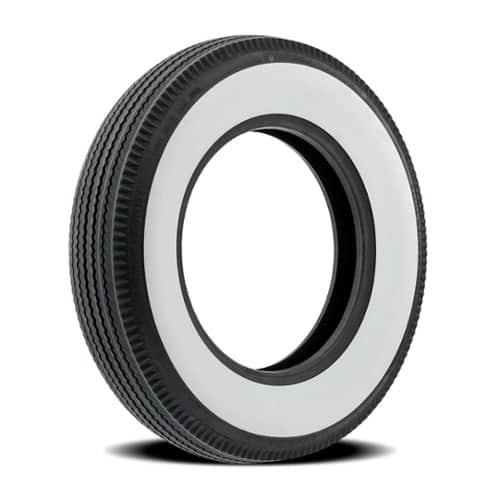
WhitePaw Vintage Bias Look Radial-WW is the one this article is really about. Two sizes, both of them the hard-to-find vintage kind: 670-15 at $289 and 600-16 at $299. If you've got a car that wants a tall, skinny, correct-looking sidewall on a fifteen or sixteen inch rim, that's the tire.
Autobahn is our other house brand in this space, and it's a narrower tool than Kontio. Six SKUs total, every one of them a bias-look radial. That sounds thin until you look at which sizes they are, and then it makes sense: 560-15, 640-15, and 500-16. Those are European and compact classic fitments that the big American whitewall lines mostly ignore.
If you're running a Beetle, a Karmann Ghia, an early Porsche, a Morris, a Fiat, or anything else that came from the factory on a skinny fifteen or a 16-inch wheel, this is where you look. Trying to force an American 205-series onto one of those cars is how you end up with a tire that rubs, sits wrong in the arch, and throws the speedometer off.
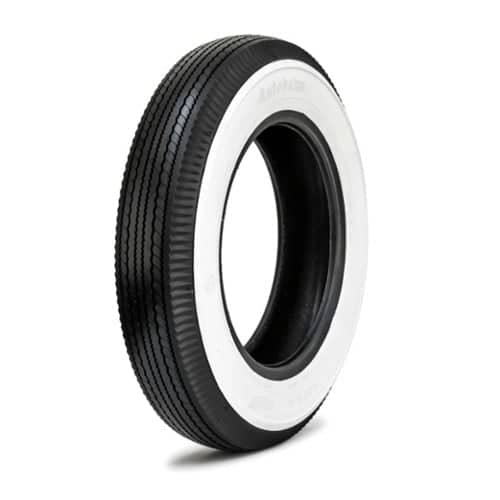
For the whitewall versions, the Bias Look Radial-WW 560-15 at $329 and the Bias Look Radial-WW 640-15 at $339 are the two to know. There's a Narrow WW 560-15 at $329 for later-look builds. And if you want the vintage sidewall shape without any white at all, the blackwall Bias Look Radial 560-15 at $289 and 500-16 at $334 do the same job.
One honest caution. Six SKUs means if your size isn't one of those three, Autobahn doesn't have an answer for you, and I'd rather tell you that than sell you the wrong size. Call the shop and we'll find the right fitment somewhere in the catalog.
We don't only sell our own brands, and I'd be doing you a disservice if I pretended the bias-look field stopped at Kontio and Autobahn. Two outside lines are worth your money.
American Classic has the deepest bias-look catalog on our shelf, 22 SKUs across three configurations. The Wide Whitewall Bias Look Radial 560-15 at $324 and the 670-15 at $346 cover the postwar and fifties American sizes properly, and the 820-15 at $369 handles the big-body cars. There's also a Narrow Whitewall Bias Look Radial 670-15 at $335 for sixties builds.
Coker brings the sixteen-inch prewar sizes and a name that's been on classic tires since 1958. The Classic Radial / Bias Look 710-15 at $216.78 is quietly one of the best-value bias-look whitewalls anywhere. Step up to sixteens with the 550-16 at $356 or the 600-16 at $378 for a Model A, an early Ford, or a prewar restoration.
If you're wondering why these numbers look high next to a modern touring tire, the short version is low production volume and dedicated tooling for sizes nobody else makes. We went into the full economics in why whitewall tires cost what they do.
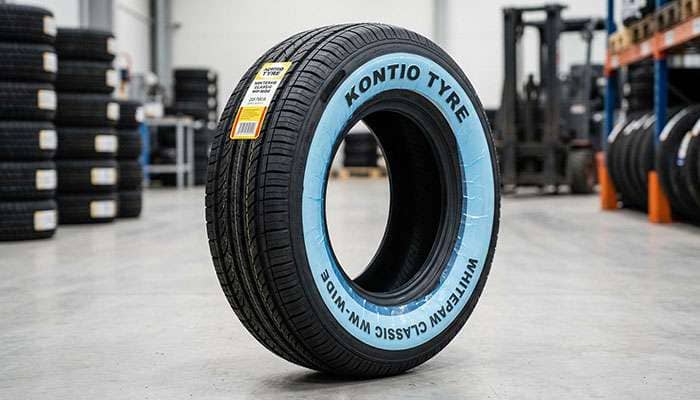
I get this call two or three times a month, and the tone is always the same: somebody opens the box, sees a blue stripe where the white should be, and figures we sent the wrong tire. We didn't. That blue is a temporary protective coating, and it comes off.
Here's the mechanism, because it's actually interesting. Every tire is built with oils in the rubber, conditioners, emollients, UV protectants, and those oils are designed to migrate slowly through the tire over its life. That migration is what keeps the rubber from drying out. But when tires get stacked sidewall-to-sidewall in a container or a warehouse, those oils transfer between touching surfaces. On a blackwall, nobody notices. On a bright white sidewall, that transfer shows up as a brown stain that's a real nuisance to remove.
So the last step at the factory is a thin blue-tinted protectant sprayed over the white areas only. It's tinted on purpose, so it's obvious it's there and obvious where it's been applied. It survives shipping and storage, and it takes the abuse instead of your whitewall.
Getting it off is straightforward but it does want effort. Hot water is the key variable, hotter than you'd think, because the film is built to resist cold rain. Mild soap or an all-purpose cleaner, a stiff brush or a scouring pad, and some elbow grease. Work in sections and expect to go over stubborn spots twice.
Two things I'd tell you not to do. Don't reach for brake cleaner, even though people swear by it, because the solvents in it are hard on the rubber compound and you're trading a short job for long-term damage. And don't leave the film on for months meaning to get to it later. It dries and cures over time, especially in dry heat, and a coating that would have come off in twenty minutes fresh becomes an afternoon of scrubbing. Do it the week the tires get mounted.
No. There is nothing in the California Vehicle Code that regulates the color of a tire sidewall, and I've had this conversation enough times to be confident about it. Whitewalls are legal in California and legal in every other state, on a classic car or a modern one.
Where I think the confusion comes from is that California does regulate tires, just not their appearance. Article 4 of the Vehicle Code covers tread depth, and CVC 27465 sets minimums of one-eighth inch in the major grooves on front tires and one-sixteenth inch on the rear. CVC 27460.5 prohibits selling recut or regrooved passenger tires. CVC 27454 deals with studs and protuberances. All of those are about the tread and the contact patch. None of them mention sidewall color.
The one real requirement that applies to your whitewall is the same one that applies to every street tire: it needs a DOT marking, meaning it was manufactured to meet federal safety standards. Every whitewall we sell for road use carries one. The place people occasionally get caught out is buying vintage new-old-stock rubber at a swap meet, which may predate DOT marking entirely and may be forty years old regardless of tread depth. That's a genuine safety problem, not a paint problem.
Fleet rules are a separate world and probably the other source of the rumor. Some government fleet purchasing standards specify that if whitewall tires get supplied, they're to be mounted with the white side facing inward. That's a procurement preference for unmarked vehicles, not a traffic law, and it has nothing to do with what you can drive. For the broader picture on what actually does make a tire unlawful, see what makes a tire illegal. And as always, we sell tires rather than legal advice, so if you're dealing with an unusual registration or an inspection question, check with your DMV.
Easily, and in more variety than at any point in my career. The premise behind this question is that whitewalls went extinct sometime in the eighties. What actually happened is that the mainstream manufacturers walked away from them and specialty manufacturers picked them up, which is a different thing entirely.
Right now we stock over 135 distinct whitewall product lines. Active makers include Coker, Diamond Back, American Classic, our own Kontio and Autobahn, plus heritage lines from BFGoodrich under the Silvertown name and Firestone under Deluxe Champion and Wide Oval. That covers every era from brass-era through the eighties, in wide whitewall, narrow whitewall, thin stripe, redline, and blackwall vintage profiles.
The catch isn't availability, it's size. If your car takes a common fifteen-inch radial size, you have dozens of options and you'll have them in a week. If your car takes a 760-15 or a 700-16, you have maybe two or three options and one of them might be a special order. That's the real constraint in 2026, and it's why I tell people to check fitment before they fall in love with a brand. Our roundup of which manufacturers still make whitewall tires goes through the current landscape maker by maker.
A whitewall is a maintenance item in a way a blackwall isn't, and the guys who are happiest with theirs are the ones who accepted that up front.
Clean them on a schedule, not on inspiration. Road film builds up gradually and you stop noticing it, then one day you see a photo of your own car and wonder why the tires look gray. Once a month with soap, water, and a brush keeps them ahead of it.
Skip the petroleum-based tire dressings. This is the mistake I see most. Those glossy sidewall shines are fine on a blackwall, but the petroleum distillates in many of them will yellow a white sidewall over time, and the yellowing goes into the compound rather than sitting on top of it. Use a water-based product or nothing at all.
Bleach is not the answer. It'll brighten the wall for a weekend and degrade the rubber permanently. Same story with abrasive powders used hard. A dedicated whitewall cleaner and patience beats aggression every time.
Sun is the enemy of white rubber. Ozone and UV are what actually drive the browning and cracking you see on neglected whitewalls. A car kept in a garage or under a cover will hold its sidewalls years longer than one parked out under a Long Beach summer. If yours have already gone yellow, they're often recoverable, and we wrote the process up in our guide to restoring faded whitewall tires.
Mind the age, not just the tread. Classic cars don't put on many miles, so a set of whitewalls will usually age out before it wears out. Check the date code on the sidewall. Rubber that's been sitting for ten years is a different animal from rubber with ten years of tread left on it, no matter how good the whitewall looks.
If I had to compress this whole roundup into one piece of advice, it's this: for a car you actually drive, buy a bias-look radial whitewall in the correct width for your era, and stop agonizing over it. You get a sidewall that looks right at the show and a casing that behaves on the freeway, and that combination didn't reliably exist a generation ago.
For most fifteen-inch American fitments, the Kontio WhitePaw line is where I'd start, and the WhitePaw Vintage Bias Look Radial covers the tall vintage sizes. For the small European and compact fitments, Autobahn is the specific answer. For deep size coverage across the postwar era, American Classic, and for sixteen-inch prewar cars, Coker. And if you're chasing a judged trophy, none of these are your tire and you should be shopping true bias-ply.
Come see us at Cherry Avenue or call the Fitment Team with your year, make, and rim size, and we'll tell you honestly which of these lines actually makes your size before you get attached to a brand. Browse the full whitewall tire selection to see what's on the shelf today.
The blue is a temporary protective coating applied at the factory over the white areas only. Tires contain oils that migrate through the rubber over time, and when tires are stacked sidewall-to-sidewall in shipping those oils transfer and stain white rubber brown. The tinted film takes that abuse instead. Remove it with hot water, mild soap, and a stiff brush or scouring pad. Avoid brake cleaner, which damages the rubber compound, and don't leave the film on for months, because it cures and becomes much harder to remove.
No. Nothing in the California Vehicle Code regulates tire sidewall color, and whitewall tires are legal in California and every other state. The Vehicle Code does regulate tires in other respects, including minimum tread depth under CVC 27465 and a prohibition on recut or regrooved passenger tires under CVC 27460.5, but none of those provisions address appearance. Any street tire needs a DOT marking, which every whitewall sold for road use carries.
Yes, in more variety than at any point in decades. Mainstream manufacturers largely exited the category, but specialty makers took it over. Active lines include Coker, Diamond Back, American Classic, Kontio, Autobahn, plus heritage lines from BFGoodrich Silvertown and Firestone. Performance Plus Tire stocks over 135 distinct whitewall product lines. The practical constraint is size rather than availability, since uncommon vintage fitments may come down to only two or three options.
A bias-look radial uses modern radial construction underneath with a mold that reproduces the tall, rounded sidewall profile of a traditional bias-ply tire, along with vintage size markings. You get period-correct appearance with modern tread life, speed rating, and wet-weather performance. It is not a true bias-ply tire, so it will not satisfy concours judging where original construction is verified, but for any classic that gets driven it is generally the better choice.
Production volume is the main driver. Specialty manufacturers produce whitewalls in thousands of units where mainstream tire lines run into millions, so tooling and setup costs spread across far fewer tires. The white compound itself requires ozone-resistant chemistry to resist yellowing, which adds material cost, and premium lines mold the whitewall into the tire during manufacturing rather than applying it afterward. Vintage sizes compound the problem because they need dedicated molds that will never see high volume.
Avoid petroleum-based tire dressings, which are the most common cause of yellowing because the distillates soak into the white compound rather than sitting on the surface. Use water-based products or none at all. Clean monthly with mild soap and a brush rather than waiting for visible discoloration. Keep the car out of direct sun where possible, since UV and ozone drive browning and cracking. Never use bleach, which brightens temporarily but degrades the rubber permanently.
Reviewed by Hank Feldman, Founder, Performance Plus Tire