
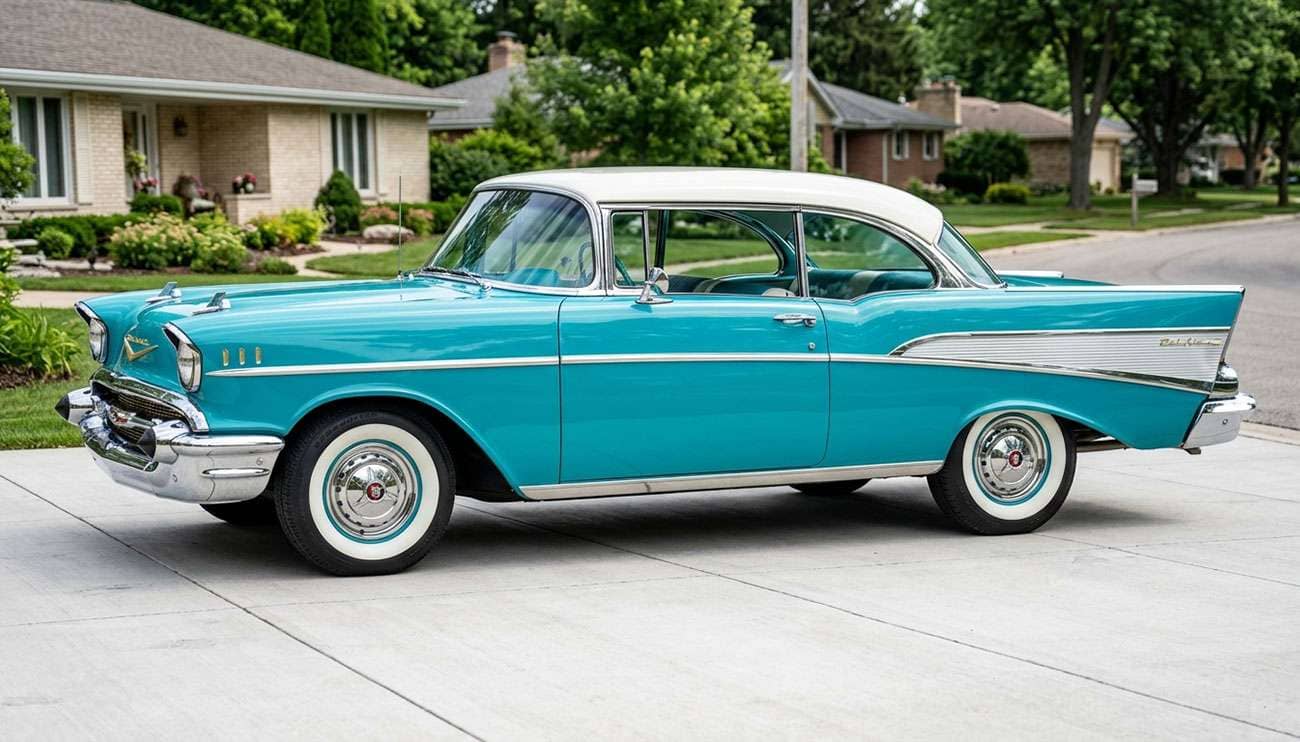
A set of brilliant white whitewall tires can make a classic car, vintage truck, or retro-styled ride look absolutely dialed in. But when those whites go brown, yellow, or gray, the whole look falls apart fast. Oxidation from UV exposure, road grime baked into the rubber, bleed-through from the tire's black carbon compounds — all of it attacks your whitewalls, and all of it is fixable. You just need to know exactly what you're dealing with and how to fight it.
This guide walks you through the complete process of restoring faded whitewall tires — from diagnosing the specific cause of your discoloration to selecting the right cleaner, applying it correctly, and keeping those whites brilliant for the long haul. This isn't a rinse-and-wipe tutorial. This is the same method tire professionals and serious enthusiasts actually use. If you've been fighting yellowing whitewalls and nothing's worked, you're about to change that.
Know your enemy before you reach for a brush or crack open a cleaner. The cause of your whitewall discoloration directly determines which product and method will actually solve the problem. Treating chemical browning like surface grime is one of the most common — and costly — mistakes enthusiasts make. You end up damaging the rubber or burning money on products that were never right for the job.
Whitewall tires are built with a layer of white rubber — typically natural rubber with titanium dioxide for whiteness — bonded to the outer sidewall over the black carbon-rubber compound underneath. The white band can range from a narrow 3/8-inch pinstripe to a classic wide 2.5-inch or 4-inch whitewall on vintage bias-ply tires. Modern whitewall tires use synthetic rubber compounds that resist browning better, but no whitewall is completely immune.
At a microscopic level, the white compound is porous — which means it absorbs road contaminants, oils, and the antiozonants and antioxidants that migrate upward from the black rubber beneath it. These chemical antidegradants are intentionally added to black sidewall rubber to prevent cracking and ozone degradation, but they leach into your white layer over time. That process is called "blooming" or chemical migration, and it's the primary cause of that stubborn brownish-yellow stain that regular car wash soap will never touch.
The single biggest mistake you can make is reaching for household bleach. Yes, bleach whitens rubber on contact — sometimes dramatically. But chlorine degrades rubber compounds at the molecular level. Use it repeatedly and you'll see cracking, surface crazing, and premature sidewall failure. Steel wool and abrasive scouring pads are equally destructive — they scratch the white rubber layer and create a rough surface that traps more grime going forward, making every future cleaning session harder. Wire brushes are out for the same reason.
Another common error: applying tire dressings or shine products to your whitewalls before you've properly cleaned them. Many tire dressings contain silicone or petroleum distillates that seal in existing stains and accelerate chemical browning. And skip the WD-40, engine degreaser, and general-purpose solvent cleaners — these strip the rubber's protective oils and cause the white compound to dry out and crack. Use only products specifically formulated for whitewall tires or white rubber.
Product labels for whitewall tire cleaners often list pH ratings — and understanding those numbers helps you choose the right product without damaging your rubber. Neutral pH is 7.0. The most effective whitewall cleaners fall between pH 9 and pH 12, mildly to moderately alkaline, which is strong enough to break down carbon-based staining and road grime without attacking your rubber compounds. Products above pH 13 can cause surface degradation with extended contact. Acid-based wheel cleaners, typically pH 1–3, should never touch white rubber — permanent discoloration and compound breakdown can happen within minutes.
For browning caused specifically by chemical blooming, look for products containing oxalic acid at low concentrations — typically 3–5% in commercial tire cleaners — or specialty whitewall restorers that use mild oxidizing agents to reverse antiozonant discoloration. These products work chemically on the stain rather than just scrubbing at the surface.
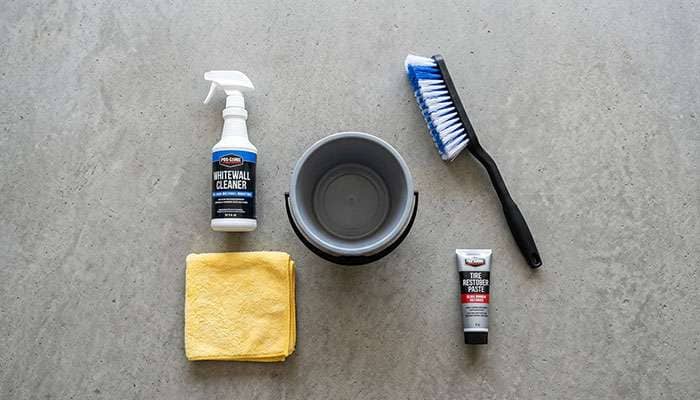
Not every whitewall situation calls for the same product, and not every cleaner is built to handle the same type of staining. Matching the right cleaner to your specific problem — and your specific tire — is what separates a mediocre result from whitewalls that look genuinely restored. Three variables drive that decision: the type of whitewall tire you have, the severity and type of staining, and how often you plan to clean.
The age and construction of your whitewall tire matters when choosing a cleaner. Genuine antique or vintage bias-ply whitewalls from the 1930s through the 1960s often have thick white rubber layers — sometimes 3/16 inch or more — which can handle more aggressive mechanical scrubbing. Modern radial whitewalls and whitewall-style tires with thinner cosmetic white bands, some as thin as 1/16 inch, require gentler treatment. Aggressive scrubbing on a thin white stripe can wear through the white layer entirely. That's not recoverable.
If you're running wider whitewalls on a classic American car — think a '57 Chevy or a '64 Galaxie 500 — you have real surface area to work with and can use a dedicated whitewall restorer foam or paste applied with a stiff nylon brush. For narrow-band whitewalls on a 1970s muscle car or a retro-styled modern vehicle, a spray-on cleaner with a medium-stiffness brush is the safer approach. Always check the sidewall for existing micro-cracking before applying any chemical product.
How you use your vehicle determines how dirty your whitewalls get and how often you need to clean them. A show car that sees 500 miles a year on dry pavement needs a very different maintenance strategy than a daily-driven classic handling rain, road salt, and parking lot grime. For show cars, a thorough quarterly deep clean using a dedicated whitewall restorer — followed by a light protective coating of white rubber conditioner between shows — keeps the whites looking sharp without over-stressing the rubber.
For vehicles you drive regularly, you want a cleaner you're comfortable using every two to four weeks, which means pH-balanced, easy-rinse formulas that won't dry out the rubber with repeated application. In wet climates or winter driving conditions, road salt dramatically accelerates chemical blooming and surface staining, so keep a stronger formula in your rotation. If your car sits in storage for winter, clean the whitewalls thoroughly before you park it and apply a UV-protective rubber conditioner — UV exposure near windows or under fluorescent garage lighting is a major contributor to yellowing that most owners overlook.
Whitewall tire cleaners range from under $10 for basic spray foam to $30–$50 for professional-grade restorers with oxidizing agents that tackle deep chemical browning. For light, maintenance-level cleaning on whitewalls already in good shape, a mid-range product in the $12–$18 range does the job cleanly. Where enthusiasts consistently go wrong is buying budget cleaners to tackle deep-set blooming stains — those products simply lack the chemistry to reverse antiozonant migration, so you burn twice the product and twice the elbow grease for half the result.
Cleaner Type |
Best For |
Typical Price |
Handles Chemical Browning? |
Safe for Thin Whitewalls? |
|---|---|---|---|---|
Spray Foam (General) |
Light surface grime, maintenance cleaning |
$8–$15 |
No |
Yes |
Alkaline Gel / Paste |
Moderate staining, wide whitewalls |
$12–$22 |
Partially |
With care |
Oxalic Acid-Based Restorer |
Deep blooming / yellow/brown stains |
$18–$35 |
Yes |
Use diluted |
Professional Oxidizing Restorer |
Severely discolored, show-quality results |
$30–$50 |
Yes — deeply |
Follow dilution guidelines |
DIY (Baking Soda + Dish Soap) |
Very light grime, budget maintenance |
Under $3 |
No |
Yes |
Now that you know what you're dealing with and what to look for in a product, here's the actual step-by-step process — organized by your specific situation. Whether you're doing regular maintenance on a daily driver, preparing a show car for competition, or working within a tight budget, these procedures deliver real results. These aren't vague suggestions — these are specific, tested techniques with the products and methods that actually work.
For a car you drive regularly, you want a quick, repeatable process that keeps whitewalls clean without over-stressing the rubber. Start by rinsing the tire thoroughly with a garden hose or pressure washer on a wide-fan, low-pressure setting — never use a narrow jet directly on white rubber, because high-pressure water at close range forces contaminants deeper into the porous surface. Once loose grime is rinsed away, apply a quality spray-on whitewall cleaner — Blue Magic Whitewall Tire Cleaner and Westley's Bleche-Wite are longtime favorites at around $10–$14 per bottle — directly to the wet white surface.
Let the product dwell for 60–90 seconds before you touch a brush. Most people shortchange themselves by scrubbing immediately — that dwell time is where the alkaline chemistry breaks down carbon-based grime and road film. Then work a stiff nylon-bristle brush in circular motions across the full white band. Use a dedicated tire brush with a long handle — never metal bristles. Rinse thoroughly, inspect under good light, and repeat if needed. For routine maintenance, budget 10–15 minutes per tire. Finish with a dedicated rubber conditioner — not a silicone tire shine — applied sparingly to the black sidewall only. Keep it off the white band.
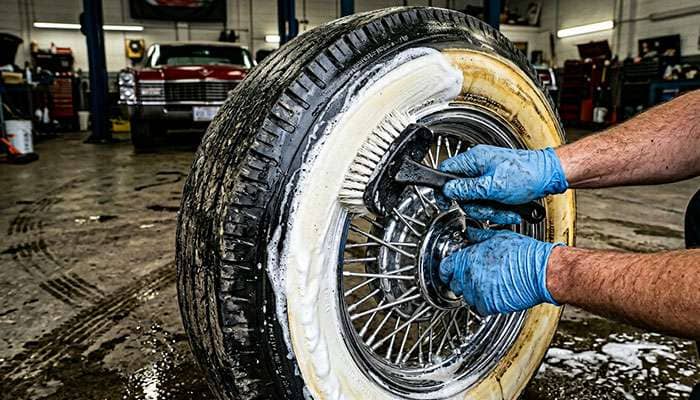
Preparing for a show — or dealing with whitewalls that have gone noticeably yellow or brown after months of neglect — calls for a two-stage deep restoration. Stage one removes surface contamination. Stage two reverses the chemical browning that's penetrated into the white rubber compound itself.
Stage one runs identically to the maintenance clean above — rinse thoroughly, apply a quality alkaline whitewall cleaner, dwell 90 seconds, scrub with a nylon brush. After rinsing stage one, inspect the whitewalls carefully. If you still see yellowish or tan discoloration that won't come off, that's antiozonant migration, and it requires a different product entirely. For stage two, apply a dedicated whitewall restorer with oxalic acid chemistry — products like Pinnacle Black Label Tire Cleaner or a professional oxalic acid solution — directly to the dry or slightly damp white band. Let it dwell for 2–4 minutes (always check the product instructions — never exceed recommended contact time on thin whitewalls), then scrub firmly with your nylon brush using overlapping circular strokes. Rinse completely and assess. Severely discolored tires may need two rounds of stage two.
Here's a technique professional detailers use for maximum show-quality results: after the two-stage chemical clean, while the tire surface is still slightly damp, apply a paste-style whitewall cleaner — Mothers Mag & Aluminum Polish works surprisingly well on white rubber — with a foam applicator pad and buff lightly. This lifts the last traces of surface oxidation and leaves the white rubber bright with a slightly polished finish. Lock in your work by applying Aerospace 303 UV Protectant to the entire sidewall, white and black sections both, to slow future UV-driven yellowing. Keep any silicone-based dressing off the white band entirely.
You don't need a $40 specialty product to get clean whitewalls if the staining is surface-level and relatively recent. A DIY solution of one tablespoon of dish soap (Dawn original), one tablespoon of baking soda, and one cup of warm water — applied with a scrub brush — handles light-to-moderate road grime effectively for pennies. For slightly tougher jobs, a paste of cream of tartar and lemon juice, both mild acids, can brighten moderately yellowed rubber without the rubber-destroying risks of bleach. Apply the paste, let it sit five minutes, scrub with a nylon brush, rinse thoroughly.
For the most effective budget option, a Magic Eraser (melamine foam) used gently on a wet whitewall surface after an initial soap scrub removes a surprising amount of embedded staining through micro-abrasion. Use light pressure only — melamine foam is mildly abrasive and should never be used aggressively on thin modern whitewall bands. Here's the honest budget reality: if your whitewalls have deep chemical browning from antiozonant migration, no truly budget solution will fully reverse it. That requires oxalic acid chemistry. But for maintaining already-clean whitewalls and tackling surface contamination, the DIY route is completely viable and costs you almost nothing.
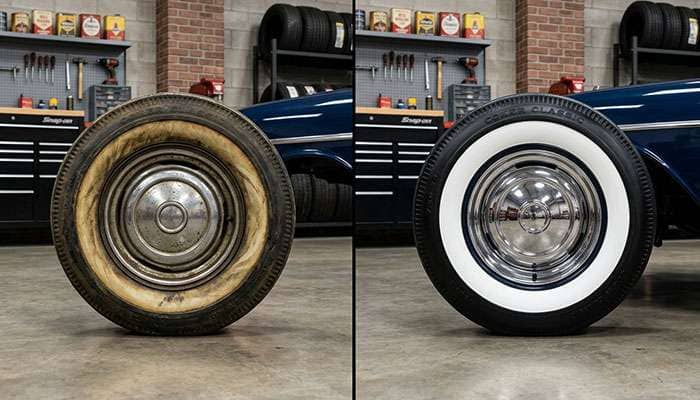
Regardless of your budget or product choice, consistency is the most important factor in long-term whitewall maintenance. Cleaning every two to four weeks on a driven vehicle prevents staining from bonding deeply into the rubber — which means you're always doing the quick, easy maintenance clean instead of a grueling deep restoration. If you're shopping for new whitewalls or replacing a damaged set, browse the full selection of whitewall tires at Performance Plus Tire to find the right fit for your classic or custom build.
If you're working on a vintage vehicle, it's worth knowing your tire size options. Older cars used sizing formats that differ significantly from modern metric sizing. The antique and classic tire size conversion tool at Performance Plus Tire makes it straightforward to cross-reference old sizing to compatible modern equivalents — essential when you're replacing whitewalls on a car that originally ran 7.50-14 or 8.00-15 sizing. And if you're considering upgrading to a fresh set of classic tires alongside your restoration work, Performance Plus Tire stocks a wide range of options built specifically for vintage and collector vehicles.
Restoring faded whitewall tires looks intimidating until you understand the chemistry — then it becomes completely manageable. The fundamentals are straightforward: diagnose whether you're dealing with surface grime or chemical browning, match your product to the actual problem, use the right tools (nylon brush, proper cleaner, never bleach or metal bristles), and give your product adequate dwell time before you scrub. A two-stage process handles even severely yellowed whitewalls that look beyond saving, and consistent maintenance every few weeks keeps the problem from building back up.
Whether you're running wide vintage whitewalls on a '50s cruiser, narrow pinstripes on a '70s classic, or modern whitewall-style tires on a custom build, the fundamentals don't change. Respect the rubber, use chemistry that's formulated for the job, and don't take shortcuts with household chemicals that can permanently destroy what you're trying to restore. Do it right, and your whitewalls come out genuinely bright white — not just less yellow than before.
If your whitewalls are beyond cleaning and it's time for a fresh set, or if you're building out a classic or custom vehicle and want expert guidance on the right tire, visit Performance Plus Tire's whitewall tire selection. We carry whitewalls in a wide range of sizes and styles for vintage, classic, and custom applications — and our team is here to help you find exactly the right fit.
Here are the five most important things to remember when restoring and maintaining whitewall tires:
• Diagnose before you clean: Surface grime and chemical browning (antiozonant migration) look similar but require different products. Using the wrong approach wastes time, money, and can damage rubber.
• Never use bleach or metal brushes: Both cause irreversible rubber damage — bleach degrades the compound at the molecular level, while metal bristles physically abrade and scratch the white layer, making future staining worse.
• Dwell time is critical: Let your cleaner sit on the tire for 60–120 seconds before scrubbing. This allows the product's chemistry to break down contaminants rather than relying entirely on mechanical force, which protects the rubber surface.
• Match product to problem severity: Light grime responds well to alkaline spray cleaners ($8–$15). Deep yellow or brown chemical staining requires an oxalic acid-based restorer ($18–$35) — budget products won't reverse this type of discoloration no matter how hard you scrub.
• Consistency beats intensity: Cleaning whitewalls every two to four weeks on a driven vehicle prevents deep staining from forming, making every future cleaning session easier and protecting the rubber from cumulative chemical exposure.
Yellowing that returns quickly after cleaning is almost always chemical blooming — the migration of antiozonant and antioxidant compounds from the black rubber beneath the white layer up through the white compound. These chemicals protect black rubber from cracking and UV degradation, but they're a natural enemy of your white band. Standard cleaners don't reverse this type of staining. You need a product containing oxalic acid or a dedicated chemical oxidizing restorer. Once you address the blooming with the right product, apply a UV protectant to the sidewall to slow the reoccurrence cycle.
No — and this is one of the most damaging things you can do to whitewall tires. Bleach whitens rubber on contact, but chlorine attacks the molecular structure of rubber compounds, causing accelerated drying, micro-cracking, and eventual sidewall failure. Repeated bleach use visibly degrades the surface of your whitewalls, making them rough and porous — which actually traps more staining going forward. Stick to products specifically formulated for white rubber, particularly those in the pH 9–12 alkaline range or oxalic acid-based restorers for chemical browning.
For deep yellow or brown staining caused by chemical migration, you need a product formulated with oxalic acid chemistry or a professional-grade oxidizing restorer. Well-regarded options include Westley's Bleche-Wite for general cleaning, and for more severe cases, a commercial oxalic acid solution diluted per label instructions. Apply the product to the wet or slightly damp white band, let it dwell for 2–4 minutes, scrub firmly with a nylon-bristle brush in circular motions, and rinse thoroughly. Severely discolored tires that haven't been treated in a year or more typically need a second application.
For regularly driven vehicles, every two to four weeks is the ideal maintenance cadence. That frequency prevents road grime, brake dust, and chemical compounds from bonding deeply into the porous white rubber — which means you're always doing a quick maintenance clean instead of a time-consuming deep restoration. Show cars driven infrequently should be cleaned thoroughly before each event and treated with a UV protectant after cleaning. Before winter storage, always clean whitewalls fully and apply a rubber conditioner — UV exposure from fluorescent garage lighting during storage contributes meaningfully to yellowing that catches most owners off guard.
Always use a stiff nylon-bristle brush — never wire, metal, or steel bristle brushes. A dedicated tire brush with a long handle gives you the leverage to scrub effectively without pressing your fingers into the cleaning product. For wide whitewalls on vintage tires, a 2–3 inch wide nylon brush delivers full coverage efficiently. For narrow pinstripe whitewalls, a smaller detail brush gives you better control and reduces the risk of accidentally scrubbing the adjacent black rubber and contaminating the white band. Avoid natural fiber brushes — they hold too much product and tend to leave residue in the rubber pores.



