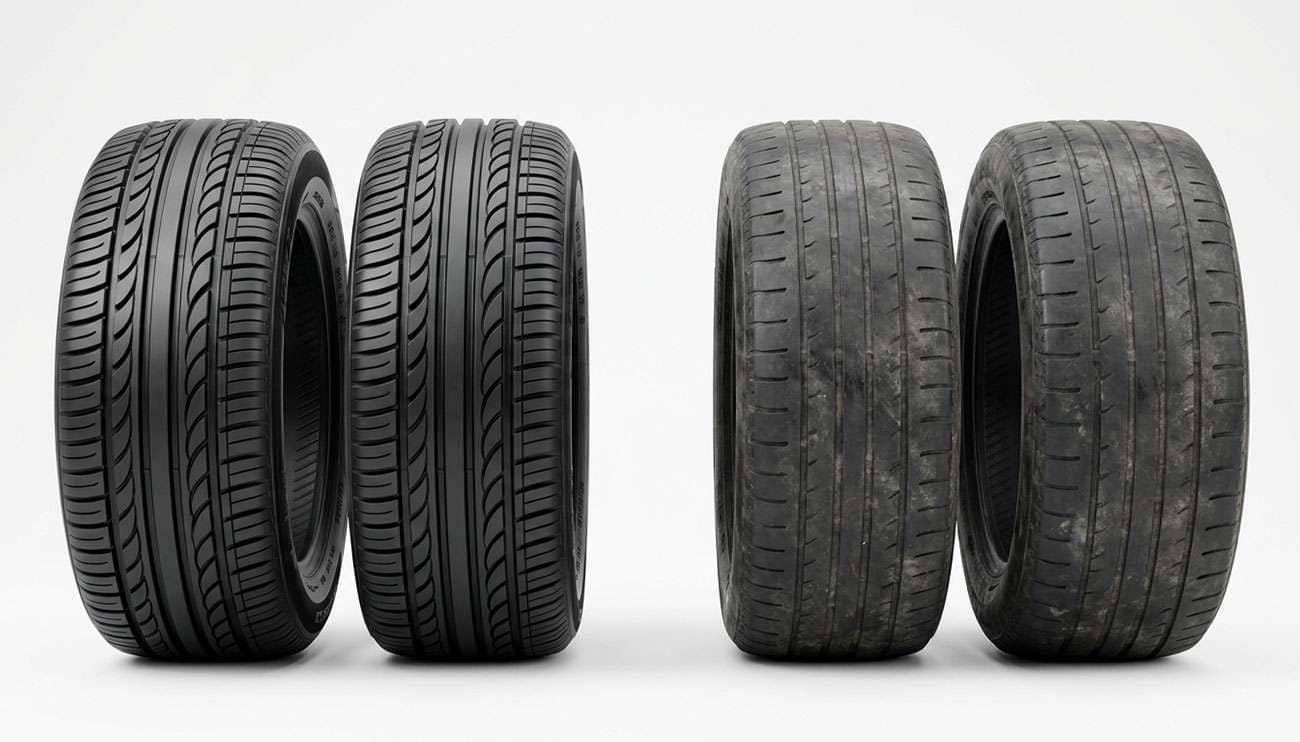
Replace the two tires with the least tread or the worst damage, which on most cars means the fronts, and then install the new pair on the rear axle. That is the rule, and it's a good one. But the question everybody skips is about the other two tires: the pair you're keeping. If they are too old, too far apart in tread depth, built to a different load index or construction, or sitting on an AWD vehicle with a tight tread-spread limit, then two new tires is the wrong purchase no matter which pair you pick. The two you keep decide whether two will do.
I'm Hank Feldman. My family has been mounting tires in Long Beach since 1971, and I've watched a lot of folks walk in asking for two tires. Most of them should get exactly that. A few of them, once we look at the pair they planned to keep, end up glad somebody checked.
Start by finding your situation in the left column. This table tells you which two tires come off the car and where the new ones get mounted.
Feature |
Which Two to Replace |
Where the New Pair Goes |
|---|---|---|
Fronts worn more than rears (most FWD cars) |
The two fronts |
Rear; move the old rears up front |
Rears worn more than fronts (hard-driven RWD, trucks that tow) |
The two rears |
Rear |
One tire damaged beyond repair, others healthy |
The damaged tire and its partner on the same axle |
Rear |
Two damaged tires on different axles |
Usually both; compare the remaining two first |
Rear, with the best used pair up front |
All four evenly worn, budget for two |
Any two on one axle |
Rear; plan the other two soon |
Staggered setup (wider rears) |
Whichever axle is worn |
Same axle; sizes can't swap |
AWD vehicle |
Only if the tread gap stays inside the owner's manual limit |
Rear, or replace all four |
Classic car changing from bias-ply to radial |
Never mix on one axle; all four is best |
If mixed by axle, radials on the rear |
Now look hard at the two tires you plan to keep. This second table decides whether two new tires is the right buy, or whether you're better off with a full set.
Feature |
Keep Them and Buy Two |
Buy Four Instead |
|---|---|---|
Tread depth on the pair you keep |
6/32 inch or more |
4/32 inch or less |
Age (DOT date code) |
Under six years |
Six years or older, or any cracking |
Load index and speed rating |
Same as the new pair, and meets the door placard |
Below the placard or mismatched |
Construction |
Same type as the new pair (radial with radial) |
Bias-ply kept with new radials, or P-metric with LT |
Wear pattern |
Even across the tread |
Cupping, feathering, or one-edge wear |
AWD tread spread |
Inside the manufacturer limit |
Outside the limit |
This is the part that sounds backward to a lot of people, and it surprised plenty of my customers over the years. Your fronts wore out. They steer. They do most of the braking. Why wouldn't the new ones go up there?
Because of what happens when grip runs out on a wet road. Tread grooves exist to move water out from under the tire. Shallow grooves clear less water, so the tire with less tread starts to ride on a film of water sooner. Now ask yourself which end of the car you would rather have let go first.
If the front tires lose grip first, the car pushes straight ahead in a turn. Engineers call that understeer. It's not pleasant, but your instinct is to lift off the gas and slow down, and that is the right move. The front tires regain grip and the car comes back.
If the rear tires lose grip first, the back of the car swings around. That's oversteer, and on a wet highway at speed it can turn into a spin before you have time to react. Most drivers never practice catching a slide, and the natural reaction, braking hard, often makes it worse.
That's why tire manufacturers and the Tire Industry Association recommend putting the deeper tread on the rear when you replace two tires on a vehicle with the same size all around, regardless of whether it's front-wheel drive, rear-wheel drive, or all-wheel drive. Worn tires up front give you a warning you can feel through the wheel. Worn tires in back give you very little. We go deeper on that placement call in new tires: front or back.
So on most front-wheel drive cars, the job goes like this: the worn fronts come off, the half-worn rears move up front, and the new pair goes on the back. You bought tires for the front axle. You installed them on the rear.
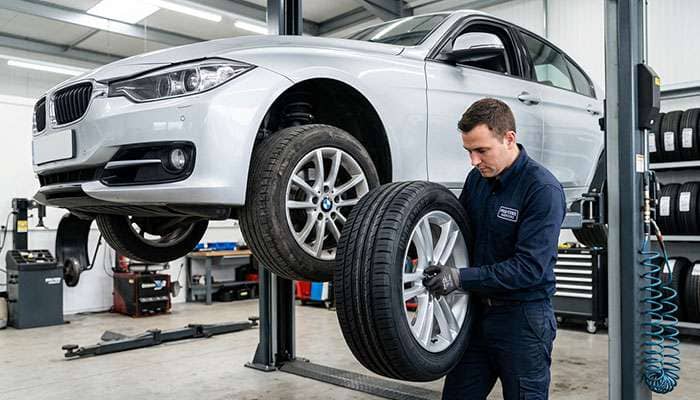
Two is a perfectly good answer more often than tire counters admit. If your other pair has plenty of tread, is under six years old, matches the new tires in size and spec, and wears evenly, two new tires is a smart way to spend money. Rotating regularly afterward will bring all four closer together over time.
Four makes more sense when the pair you keep is close to done anyway. If those two are at 4/32 inch, you're going to be back in a few thousand miles, and you'll have paid for two separate mount-and-balance visits. It also makes sense when the car handles noticeably different front to rear, or when the vehicle requires matched tires to keep the drivetrain happy.
Here's the way I explain it at the counter. A new tire starts at roughly 10/32 to 11/32 inch of tread on most passenger cars. The legal minimum in most states is 2/32, marked by the wear bars molded across the grooves. Wet-road grip starts dropping well before that, around 4/32. So if the two you're keeping sit at 6/32 or better, they still have meaningful life. If they're at 4/32, the two-tire purchase only buys you a short stretch before you're doing it again. Our breakdown of whether to replace all 4 tires or not walks through the dollars both ways.
The new pair has to match the old pair on the same axle exactly, and it should match the pair on the other axle on every number that matters for safety. That's where a lot of two-tire jobs go sideways, because "same size" isn't the same tire.
Take a common crossover size like 235/65R17. On the market today you'll find it sold at a load index of 103, 104, or 108, depending on whether it's a standard-load or extra-load tire. A 104 carries 1,984 pounds per tire. A 108 carries 2,205 pounds. That's more than 200 pounds of capacity difference per tire in what looks like the exact same size on the sidewall. Speed ratings in that size run from S all the way through V and higher.
Here's what to check on the pair you're keeping, and match on the new pair:
If the pair you're keeping can't be matched anymore, maybe the model is discontinued or the specs are wrong for the car, that's a strong argument for four.
Sometimes, but this is the case where the pair you keep matters most. On an all-wheel drive vehicle, all four wheels are connected through the drivetrain. A worn tire has a slightly smaller rolling diameter than a new one, so it turns a few more times every mile. On a two-wheel drive car, the front and rear axles aren't linked, so nobody notices. On AWD, the center differential or coupling has to absorb that difference constantly.
That's why several AWD manufacturers publish a maximum tread-depth difference between tires, commonly somewhere in the 2/32 to 4/32 inch range. Your owner's manual has the number for your vehicle. If two new tires next to your old pair would exceed that limit, the manufacturer's answer is four tires.
There's a middle path some shops offer: tire shaving. A new tire is trimmed down on a machine to match the tread depth of the others. It costs a little and wastes some fresh tread, but it can save buying two extra tires when only one or two were damaged early in the set's life. If your set is mostly new and one tire gets ruined, ask about it.
Part-time 4WD trucks are a different animal. In two-wheel drive, the axles aren't locked together, so they behave like a regular rear-drive truck on the street. Still, keep the gap small, because you'll engage 4WD exactly when you need everything working right.
On a staggered setup, with wider tires on the rear than the front, the rules change. You replace whichever axle is worn, and the new pair goes right back on that same axle, because the sizes can't swap. The new-on-rear rule doesn't apply here, simply because there's no way to follow it.
In practice, the rears are almost always the pair that goes first. They're wider, they put the power down, and they can't be rotated to the front to spread out the wear. On a lot of muscle cars and sport sedans with staggered fitments, you'll buy rear tires about twice as often as fronts. That's normal, and it's worth budgeting for. If you're still deciding whether staggered is for you, plan on that cost going in.
One thing to watch: when you buy new rears, check the front pair's age and tread too. Those fronts can last so long they time out by age before they wear out.
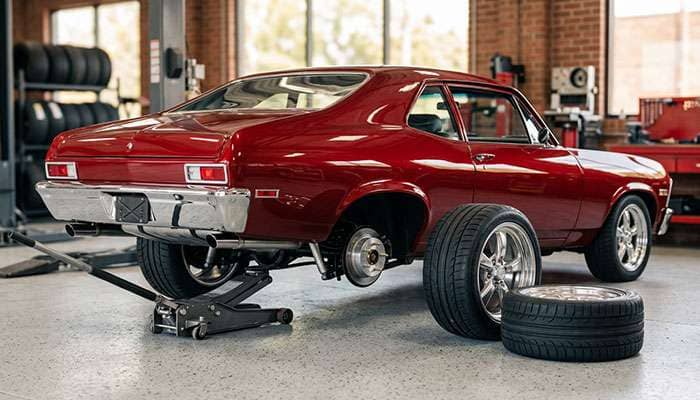
Here's where I get to talk about the cars I grew up with. A lot of classic owners replace two tires at a time, and a lot of them are tempted to put a pair of modern radials on a car still wearing bias-ply tires at the other end. I've seen it plenty.
The short answer is don't, and never on the same axle. Bias-ply and radial tires are built completely differently. A bias-ply tire has cords running diagonally across the tire in overlapping layers, which makes the sidewall and tread move together. A radial has cords running straight across from bead to bead, with steel belts under the tread, so the sidewall flexes independently and the tread stays flat on the road. They respond to steering input and cornering load in very different ways, and they build grip at different slip angles.
Mix them on one axle and the two sides of the car do different things in a corner. Mix them by axle and the car's balance changes. Industry guidance has long been firm on this: never mix construction types on the same axle, and if you absolutely must run them on different axles, the radials go on the rear. The best answer is to switch all four at once. Our comparison of radial vs. bias-ply tires for classic cars lays out the pros and cons of each before you commit.
If you love the bias-ply look but want radial handling, bias-look radials give you the period appearance with modern construction. Just do the whole car.
One more thing classic owners run into: whitewall widths and sidewall styles vary from maker to maker. Even when the construction matches, a new pair that doesn't match the old pair's whitewall width will be obvious the second somebody looks at the car. On a show car, that alone is a reason to buy four.
This is the question that sinks more two-tire jobs than any other, and it's the one hardly anybody asks.
Rubber ages whether the car moves or not. Oxygen and heat break down the compound over time, so it hardens, loses grip on wet roads, and gets more prone to cracking and to separating inside. A tire can look perfectly good from the outside and still be the oldest, weakest thing on the car. NHTSA notes that some vehicle manufacturers recommend replacing tires six years after they were made, no matter how much tread is left, and many tire makers put the outside limit at ten years.
Here's the trap. On a car that doesn't get rotated, the fronts wear out and get replaced. The rears sit there with good-looking tread. Next time, the fronts go again. By then, those rears might be seven or eight years old. If you put the new pair on the rear and move those old tires to the front, you've just put your oldest tires on the axle that steers and does most of the braking.
Check the DOT code on the sidewall of every tire you plan to keep. The last four digits tell you the week and year it was built, so 2219 means the 22nd week of 2019. Our walkthrough on how to tell how old your car tires are shows exactly where it is. Classic cars are the worst offenders here. A collector car that sees 1,500 miles a year can sit on tires with half their tread left that are well past ten years old. On those cars, age decides, not tread.
When people put off the worn pair, it usually isn't because they don't care. It's because the car still drives fine. Here's what's going on underneath while it does.
As tread drops toward 4/32 inch, those grooves clear water less effectively. Wet stopping distances stretch out, and hydroplaning begins at lower speeds. You won't feel it on a dry day.
With one axle much more worn than the other, the car starts acting differently front to back. Worn fronts push wide in turns. Worn rears make the back end feel loose. It creeps up slow enough that you get used to it.
Worn tires often wore out for a reason: alignment, a tired suspension part, or the wrong pressure. Leave that cause in place and it starts chewing on the next set. That's why it pays to check alignment when you replace the worn pair.
On an all-wheel drive vehicle, a growing tread gap keeps the center differential or coupling working against itself. Repairs to those parts commonly run into four figures, a lot more than the tires would have cost.
A tire worn to the cords, aged and cracked, or bulging in the sidewall is a blowout waiting for a hot day on the freeway. If you've spotted a bulge, cut, or bubble, read tire sidewall damage: is it safe to drive before you go anywhere.
Every stage on that list ends at the same counter, buying tires. The only choice is whether you do it on your timeline or the tire's. When you're ready, you can shop tires for sale by size and match the load index and speed rating your car calls for.
Here's the same process I'd walk you through if you pulled into the shop.
Replace the two tires with the least tread or the worst damage. On most cars, that's the fronts. Then mount the new ones on the rear, so the back of the car keeps its grip when the road gets wet. That's the rule, and it's been the right call for a long time.
But before you buy, look at the pair you're keeping. If they're old, worn close to 4/32, built to a different spec, or sitting on an AWD car with a tight tread-spread limit, two new tires is the wrong purchase. On a staggered car, the new pair goes back where it came from. On a classic running bias-ply, don't mix in radials; switch all four. Take ten minutes to check the other two, and you'll know whether you're buying two tires or four before you ever reach the counter.
On a vehicle with the same tire size front and rear, new tires go on the back. Deeper tread on the rear helps keep the back of the car from sliding out on a wet road, which is much harder to control than the front pushing wide. This applies to front-wheel, rear-wheel, and all-wheel drive vehicles.
Yes, on most two-wheel drive vehicles, as long as the two tires you keep have about 6/32 inch of tread or more, are under six years old, wear evenly, and match the new pair in size, load index, speed rating, and construction. If the pair you keep falls short on any of those, replacing all four is the better buy.
Only if the tread-depth difference between the new and old tires stays within the limit in your owner's manual, commonly 2/32 to 4/32 inch. Beyond that, the drivetrain has to compensate for mismatched rolling diameters, which can damage the center differential or coupling. Your options are four new tires or having a new tire shaved to match.
It's a good idea, especially if the old tires wore unevenly on one edge or showed cupping or feathering. Those patterns usually point to an alignment or suspension issue that will start wearing the new tires the same way.
Yes, on different axles, as long as both pairs share the same size, load index, speed rating, and construction. Keep the two tires on any single axle identical in brand and model, so both sides of the car respond the same way.
A single new tire next to a worn one on the same axle gives that axle uneven grip and rolling diameters, which can make the car pull and brake unevenly. Replace tires in pairs on the same axle unless the other tire is nearly new, and on AWD vehicles check the tread-spread limit first.