
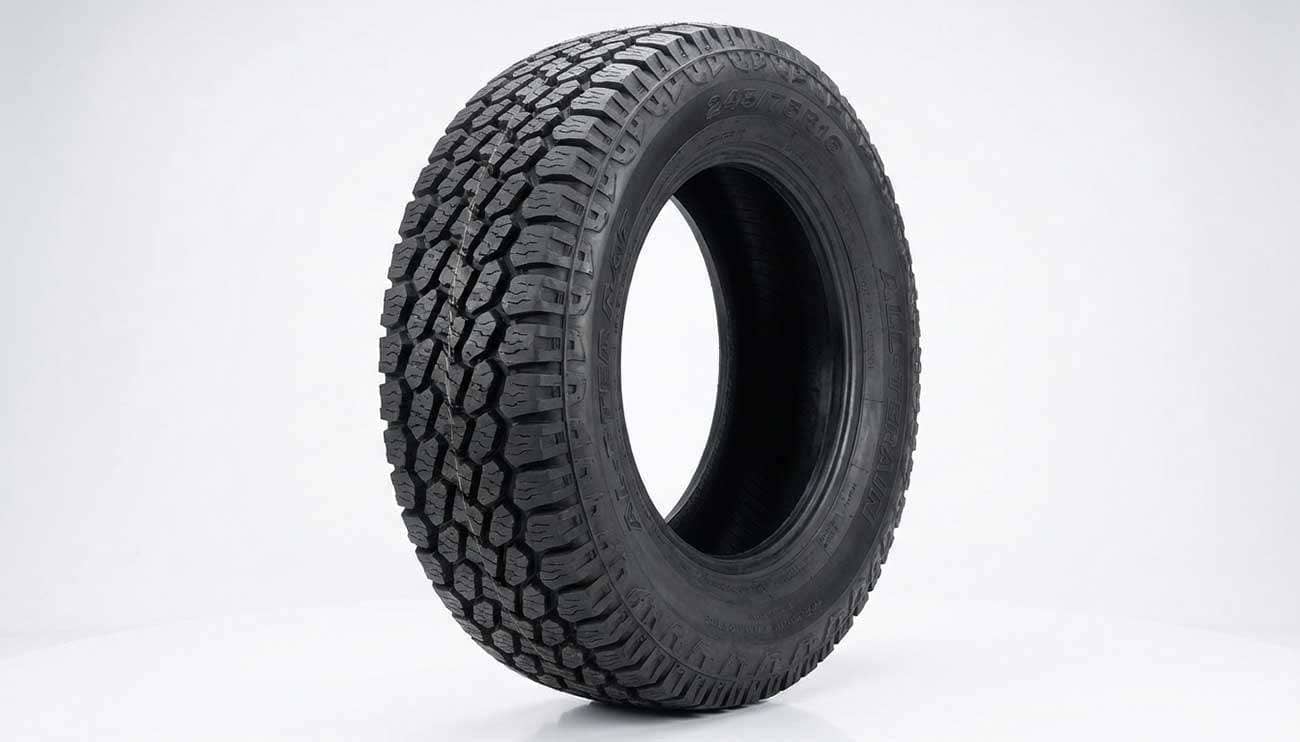
The 245/75R16 tire size delivers specific measurements that matter for your vehicle selection. A 245/75R16 tire measures 30.5 inches in diameter (774 mm), with a tread width of 9.6 inches (245 mm), designed to fit 16-inch wheel diameters. The sidewall stands 7.2 inches tall (184 mm), creating enhanced cushioning compared to shorter sidewall alternatives.
These precise dimensions directly impact your vehicle's performance and compatibility. The tire circumference spans 95.8 inches (2430.4 mm), completing approximately 661 revolutions per mile. This measurement influences speedometer readings, gear ratios, and overall driving dynamics.
The 245/75R16 size excels for drivers who want balanced performance between highway comfort and off-road capability. The taller sidewall profile absorbs road imperfections effectively while maintaining durability for varied terrain. We'll examine each component of this tire designation, compare it with similar sizes, and provide the technical details you need to make the right choice for your specific driving requirements.
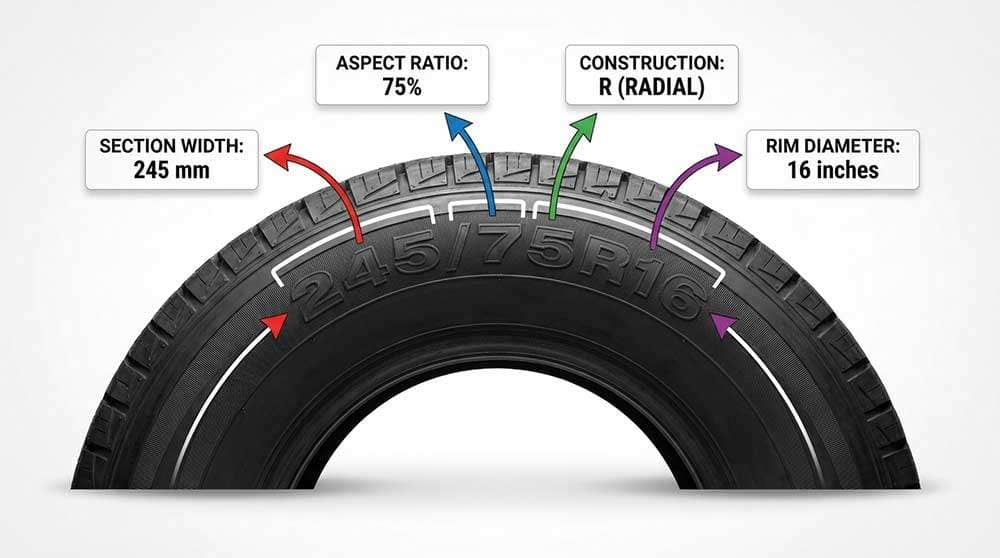
When it comes to tire sizes, 245/75R16 contains specific information about construction and dimensions. Each number and letter tells you exactly what to expect from the tire's performance and fitment. Breaking down this code helps you understand the tire you're considering for your vehicle.
The number 245 represents the tire's section width measured in millimeters from sidewall to sidewall. This 9.65-inch width provides substantial road contact for enhanced traction and stability, especially important when hauling loads or driving off-road.
Wider tires like the 245mm create a larger contact patch with the road surface. This increased contact improves handling characteristics and traction but comes with higher rolling resistance that can affect fuel economy. The 245mm width strikes a balance between performance benefits and efficiency considerations.
The 75 following the slash indicates the sidewall height as a percentage of the tire width. This means the sidewall measures 75% of 245mm, calculating to 183.75mm or about 7.23 inches.
Higher aspect ratios like 75 prioritize ride comfort through enhanced shock absorption. The taller sidewall acts like additional suspension, smoothing out road irregularities. Lower aspect ratios provide sharper steering response but transmit more road vibration to passengers.
For light trucks, SUVs, and vans that encounter varied driving conditions, the 75 aspect ratio delivers the versatility and comfort these vehicles require.
The "R" designates radial construction, now the standard for modern tires. Radial tires feature internal plies arranged perpendicular to the direction of travel, typically using polyester, steel, and fabric cords coated with rubber.
This construction method offers superior road grip, lower rolling resistance for better fuel efficiency, enhanced ride comfort, and improved durability compared to older tire designs. The flexible sidewall combined with a stable tread creates better overall performance characteristics.
The final number specifies the wheel diameter in inches that the tire fits. This measurement represents the distance between bead seat areas where the tire seals against the wheel. Sixteen-inch wheels are common on many light trucks and SUVs.
The total tire diameter combines the 16-inch wheel with twice the sidewall height (7.23 inches × 2), resulting in a 30.47-inch overall diameter. This measurement affects ground clearance, gear ratios, and speedometer accuracy.
These four components work together to describe the tire's dimensions and construction, allowing precise matching between tires and specific vehicle requirements.
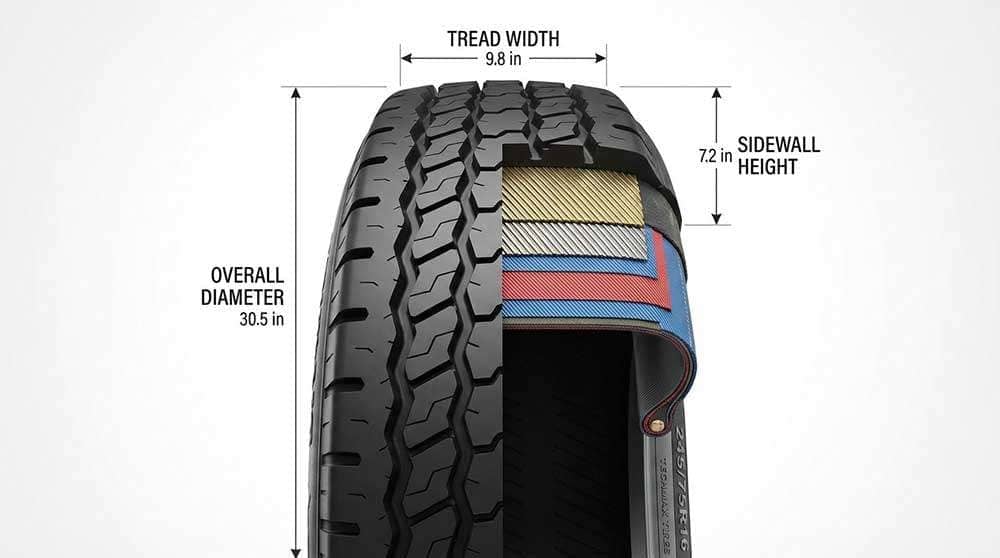
Getting the exact measurements helps you make the right decisions for your vehicle setup. Here are the key dimensions that matter most for practical applications.
Your 245/75R16 tire measures 30.5 inches from top to bottom, or 774 millimeters. Some manufacturers list this as 30.47 inches (773.9 mm), but the difference is minimal for real-world use.
This overall diameter determines how much ground clearance you'll have and whether the tire fits properly in your wheel wells. The moderate 30.5-inch size provides good clearance for light off-roading without creating fitment issues.
The contact patch measures 245mm wide, converting to 9.6 inches. You might see this listed as 9.65 inches depending on rounding. This width gives you solid traction and stability, especially important when hauling loads or driving on varied terrain.
The sidewall stands 7.2 inches tall (184mm), calculated as exactly 75% of the 245mm width, or 7.23 inches (183.75mm). This height creates the comfortable ride quality these tires are known for by flexing over bumps and road imperfections.
The tire circumference measures 95.8 inches (2430.4mm) around. This means your tire completes 661-683 revolutions per mile, depending on the specific model and load.
Why does this matter? These measurements affect:
Your speedometer readings
Gear ratio calculations
Engine RPM at highway speeds
Overall vehicle performance
When you're selecting tires, these dimensions ensure compatibility with your existing setup while maintaining the performance characteristics your vehicle was designed for.
The 245/75R16 dimensions create distinct driving characteristics that impact your vehicle's behavior across different conditions. These measurements affect passenger comfort, fuel consumption, and handling performance in ways that matter for daily driving.
That 7.2-inch sidewall height delivers exceptional shock absorption for enhanced driving comfort. The taller profile functions as supplemental suspension, cushioning road impacts effectively. Testing data shows occupants experience smoother rides with 245/75R16 tires versus lower-profile alternatives. Some models incorporate 5-degree noise reduction technology that generates sound-canceling waves to reduce road noise significantly. This makes them particularly effective for extended highway travel where comfort becomes essential.
The 245mm width provides fuel economy benefits compared to wider tire options. Less rolling resistance occurs with the narrower contact patch, reducing energy needed to maintain speed. Drivers often see approximately 1 MPG improvement in city driving when switching from wider tires to 245/75R16. Highway efficiency gains remain modest since aerodynamic factors become more important than tire width at sustained speeds.
These dimensional characteristics produce specific handling traits worth understanding. Continuous closed shoulder blocks enhance cornering stability while promoting uniform tread wear. The taller sidewall improves ride quality but reduces some cornering precision compared to shorter profiles. The 245mm width minimizes tram-lining on grooved pavement, creating better straight-line tracking than wider alternatives. R-Tech construction in certain models enhances responsiveness during lane changes.
Despite the moderate width, these tires offer substantial load-carrying capability. A standard 245/75R16 supports up to 3,042 pounds per tire, making them suitable for light trucks and SUVs. Load index ratings typically fall between 109-111, translating to approximately 2,271-2,403 pounds per tire depending on the specific model. Maintaining proper air pressure becomes critical when hauling heavy loads to prevent excessive sidewall flex that can compromise stability and handling.
Choosing the right tire size requires understanding how different options affect your vehicle's performance. Here's how 245/75R16 tires compare with other popular sizes to help you make the best selection.
These two sizes offer nearly identical height but different width characteristics. The 265/70R16 measures 20mm (0.79 inches) wider than the 245/75R16, creating an 8.2% increase in section width. Height-wise, they're remarkably close—the 265/70R16 has a diameter of 30.61 inches (777.4mm), just 0.14 inches (3.5mm) taller than the 245/75R16. This minimal 0.5% height difference creates only 3 fewer revolutions per mile, so speedometer accuracy remains virtually unchanged.
You can typically replace 245/75R16 tires with 265/75R16 tires without issues. The 265/75R16 keeps the same 75 aspect ratio but adds 20mm of width, resulting in approximately 1-inch larger diameter (31.66 inches vs. 30.5 inches). Many truck manufacturers offer this size as an optional upgrade. The benefits include about 5mm additional ground clearance and better off-road performance from the enhanced impact absorption of the taller sidewall. For those interested in exploring 245/75R16 tire options, check out this comprehensive selection.
The 245/75R16 is definitively wider than the 225/75R16 by 20mm (0.8 inches), representing a 9% increase in section width. This additional width delivers better traction and stability for heavier loads. The 245/75R16 also has a larger overall diameter—774mm versus 744mm for the 225/75R16. This 30mm (1.2 inch) difference represents a 4% diameter increase and will affect speedometer readings accordingly.
The 75 aspect ratio creates a taller sidewall than the 70 series. For identical tire widths, the 75-series sidewall stands approximately 5% taller than its 70-series counterpart. Comparing 265/70R16 with 265/75R16 shows a full 1-inch difference in overall diameter (30.61" vs 31.66"). The taller 75-series provides better off-road performance and ride comfort through superior shock absorption capacity. The 70-series offers sharper on-road handling with reduced sidewall flex during cornering.
The right 245/75R16 tire depends on your specific driving requirements and vehicle applications.
The 245/75R16 size delivers excellent performance for light trucks and SUVs that need versatile capability. Standard passenger versions support 2,403 pounds per tire, while LT-rated options handle up to 3,042 pounds, making them ideal for towing and hauling applications. Speed ratings from 106-118 mph suit everyday driving rather than high-performance use. For exploring tire options that match these specifications, visit Performance Plus Tire's 245/75R16 selection.
Follow the critical 3% rule when changing tire sizes. This threshold—approximately 0.75 inches in diameter for passenger vehicles—ensures safety systems work properly. Exceeding this limit can void warranties and compromise handling. Narrower tires work better for winter driving because they cut through snow more effectively. Upsizing slightly within the 3% limit improves off-road capability through increased ground clearance without affecting vehicle systems significantly.
Larger tires make your speedometer read slower than your actual speed. At an indicated 60 mph, you might actually travel 63.3 mph with tires just 3% larger than stock. Smaller tires create the opposite effect. These variances affect odometer readings, potentially complicating maintenance schedules and fuel economy calculations. Use a GPS speedometer app for accurate speed verification after changing tire sizes.
The 245/75R16 size offers wide availability across major brands. Complete sets typically range from $750-1100, with premium options featuring 50,000-70,000 mile warranties. Manufacturers offer specific versions optimized for highway comfort, all-terrain capability, or winter performance. Match load and speed ratings to your vehicle's requirements rather than choosing based on price alone.
The 245/75R16 tire size offers proven dimensions that work well for light trucks and SUVs. The 30.5-inch diameter, 9.6-inch width, and 7.2-inch sidewall height create reliable performance for both daily driving and weekend adventures. The taller sidewall provides better shock absorption compared to lower-profile alternatives, making long drives more comfortable.
These tires deliver practical benefits for most drivers. The narrower width helps improve fuel economy while the 75 aspect ratio maintains ride quality on rough roads. The load capacity ranges from 2,403 to 3,042 pounds per tire depending on the specific rating, handling typical truck and SUV requirements.
When comparing similar sizes, the 265/70R16 offers nearly identical height with added width, while the 265/75R16 provides extra ground clearance. The key difference lies in your specific needs—comfort, load capacity, or off-road capability.
Follow the 3% rule when changing tire sizes to avoid speedometer issues and maintain vehicle systems. Larger tires read slower on your speedometer, while smaller ones read faster than actual speed.
The 245/75R16 size works best for drivers who want balanced performance across different conditions. Complete sets typically range from $750-1100, with extensive availability across major brands. Choose based on your vehicle's load and speed requirements rather than price alone.
Ready to find the right 245/75R16 tires for your vehicle? Focus on matching your specific driving needs with the proper load and speed ratings for optimal performance and safety.
Understanding tire dimensions helps you make informed decisions about vehicle performance, safety, and comfort. Here are the essential measurements and insights for 245/75R16 tires:
• 245/75R16 measures 30.5 inches in diameter with 9.6-inch width - providing balanced on-road comfort and off-road capability for light trucks and SUVs
• The 75 aspect ratio creates a 7.2-inch sidewall height - delivering superior ride comfort by absorbing road imperfections better than lower-profile tires
• Follow the 3% rule when changing tire sizes - staying within 0.75 inches of original diameter prevents speedometer errors and maintains vehicle safety systems
• Narrower 245mm width improves fuel efficiency - reducing rolling resistance compared to wider alternatives while maintaining adequate traction and stability
• Load capacity ranges from 2,403 to 3,042 pounds per tire - making them suitable for everyday driving, towing, and hauling applications depending on the specific rating
When selecting tires, remember that larger diameters cause speedometers to read slower than actual speed, while smaller tires have the opposite effect. The 245/75R16 size offers excellent availability across major brands with complete sets typically ranging from $750-1100, making it a practical choice for drivers seeking versatile performance.
A 245/75R16 tire has an overall diameter of 30.5 inches, a tread width of 9.6 inches, and a sidewall height of 7.2 inches. It fits on a 16-inch wheel diameter.
The 265/70R16 is 20mm (0.79 inches) wider than the 245/75R16, but they have a very similar height. The 265/70R16 is only about 0.14 inches taller, resulting in minimal impact on speedometer accuracy.
Yes, you can typically replace 245/75R16 tires with 265/75R16 tires. The 265/75R16 is 20mm wider and about 1 inch larger in diameter, providing slightly more ground clearance and improved off-road capability.
The 75 aspect ratio creates a taller sidewall, which provides better shock absorption and a more comfortable ride. It offers improved off-road performance and ride comfort compared to lower-profile tires, but may have slightly less precise on-road handling.
When selecting tire sizes, consider factors such as vehicle manufacturer recommendations, the 3% rule for size changes, impact on speedometer accuracy, fuel efficiency, handling characteristics, and load capacity. Also, ensure the new size is compatible with your vehicle's wheel wells and suspension system.



