
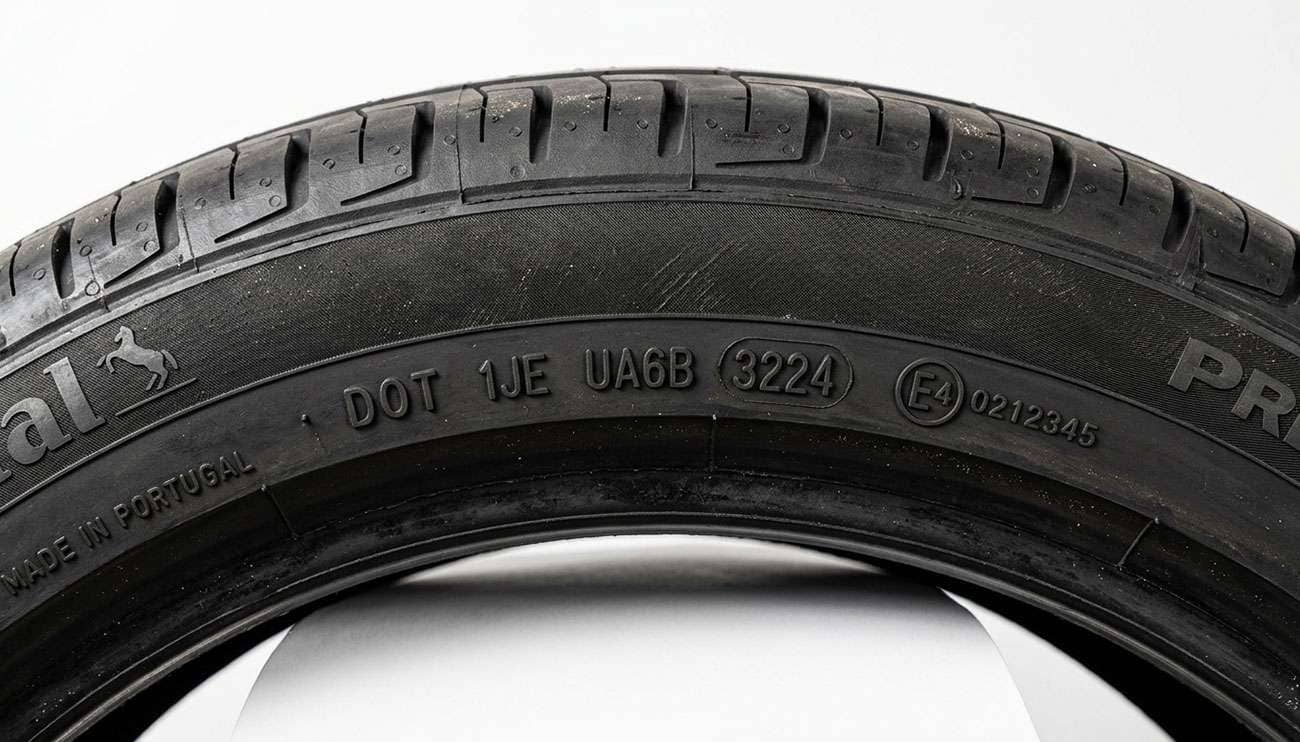
Both are correct. "Tires" is the American and Canadian spelling. "Tyres" is the spelling in the UK, Australia, India, and most of the Commonwealth. That is where most answers stop: it depends on where you live. What it actually depends on, once you are holding a tire instead of a dictionary, is which certification is molded into the sidewall. A tyre built for the UK and European market carries an E-mark. A tire built for the US market carries a DOT code. Those two systems also travel with different sizing standards, and the same load index number does not reach its rated weight at the same pressure in both. Only one of those marks makes a new tire legal to sell for highway use in the United States.
The word on the box tells you which standards body wrote the rules the tire was built to. Here is how to read that, case by case.
Feature |
What It Tells You |
Legal for New-Tire Sale in the US? |
What to Check Next |
|---|---|---|---|
DOT code, size starts with P (P225/60R16) |
Certified to FMVSS, sized to the Tire and Rim Association P-metric system |
Yes |
Max load is reached at 35 psi (SL) or 41 psi (XL); capacity drops to 91% on a light truck |
DOT code, no prefix (225/60R16) |
Certified to FMVSS, sized to the European Euro-metric system |
Yes |
Max load is reached at 36 psi (SL) or 42 psi (XL or RF) |
DOT code plus circled E-mark |
Dual-certified, built to sell in both markets |
Yes |
Read the size prefix to know which pressure standard applies |
E-mark only, no DOT symbol |
Built for UK, EU, or other ECE markets only |
No |
Replace with a DOT-certified tire before regular highway use |
"C" suffix (215/65R16C) |
European commercial or van tyre, ECE Regulation 54 |
Only if it also carries a DOT code |
Read the dual load index (single/dual) and compare it to the LT load range you are replacing |
Period size like 165HR14 or 185VR15, no load index |
Pre-load-index European sizing from a classic owner's manual |
Depends on the DOT mark of the replacement |
Find the modern replacement's load index before you buy |
The second axis is your vehicle. The same spelling question routes to a different purchase depending on what you drive.
Feature |
What You Will Usually See |
What to Buy in the US |
Watch For |
|---|---|---|---|
American car or truck |
"Tire" everywhere, DOT code, P-metric or Euro-metric size |
DOT-certified tire in the door-placard size and load |
A P-metric to Euro-metric swap changes the reference pressure |
Modern European import (BMW, Audi, VW, Volvo) |
Euro-metric sizes, often XL or RF, DOT and E-mark together |
DOT-marked Euro-metric tire in the OE size, matching XL if the original was XL |
RF and XL mean the same thing |
European-design van (Sprinter, Transit, ProMaster) |
"C" commercial sizes with dual load indexes |
DOT-marked C-type or LT tire with equal or greater load capacity |
Dual index means single-axle and dual-axle ratings differ |
British classic (MG, Triumph, Jaguar, Austin-Healey, Mini) |
"Tyres" in the manual, sizes like 165SR14 or 185VR15 |
DOT-certified period-style radial or bias-ply from a classic specialist |
Manual pressures were written for period construction |
25-year-rule import from the UK, Australia, or Europe |
Whatever tyres were fitted overseas, often E-mark only |
A full DOT-certified set before regular road use |
No US tire registration means no recall notices |
Tire. Every federal document that governs what rolls under your car uses that spelling: the National Highway Traffic Safety Administration (NHTSA), the Federal Motor Vehicle Safety Standards (FMVSS), the Federal Motor Carrier Safety Administration (FMCSA), the Tire and Rim Association (TRA), and the Tire Industry Association. Canada uses the same spelling.
Here is the part that matters for fitment. The spelling follows the standards body, and the standards body sets the numbers. Look at who writes the specifications in each market:
When you see "tyre" in a US context, ask one question: is it the brand name, or the paperwork? Plenty of companies keep "Tyre" in their corporate name and still sell DOT-certified tires here, so a brand name is no issue. An owner's manual, import documents, or a sidewall with no DOT code means you have work to do.
Both spellings circulated in English for centuries. British usage settled on "tyre" during the 19th century, around the time the rubber pneumatic tire arrived, while American usage kept "tire." By the time the auto industry wrote its standards in the 20th century, each market's engineers had their own spelling baked into their organizations, regulations, and catalogs.
If you want the full word history, from the old word "attire" through railway wheels, we cover it in Tire or Tyre: The Real Story. This article picks up where the word history ends: what the spelling tells you about the rubber itself.
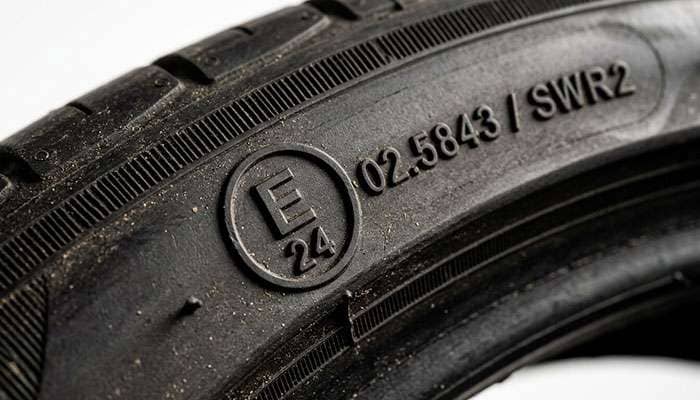
The E-mark is the European approval stamp. Look on the lower sidewall for a capital "E" inside a circle, followed by a number, then a longer approval number. The number next to the E identifies the country whose authority granted the approval. A few you will see often:
The approval itself is issued under a specific UNECE regulation. The ones that matter for passenger and light commercial tyres:
Older tyres sometimes show a lowercase "e" inside a rectangle, from earlier European directive approvals.
This is the mechanism most guides skip, and it explains why the two marks are not interchangeable. The European system is type approval. Before a tyre goes on sale, a government-designated technical service tests samples and the approval authority issues the number. The manufacturer then submits to conformity-of-production checks to keep that approval.
The US system is self-certification. The manufacturer tests its own tires against FMVSS, molds the DOT symbol to certify compliance, and NHTSA runs its own compliance testing on tires pulled from the market after the fact. If a tire fails, NHTSA can force a recall and pursue penalties.
Neither system is simply "stricter." They test different things and answer to different laws. A tyre that passed Regulation 30 has not been certified to FMVSS, and the reverse is also true, which is why manufacturers selling in both markets mold both marks onto the same sidewall.
The letters "DOT" on a sidewall are the manufacturer's certification that the tire complies with the Federal Motor Vehicle Safety Standards that apply to it. For most of what you drive, that means:
Following the DOT symbol is the Tire Identification Number, required under 49 CFR Part 574. It contains a plant code identifying the factory, a size and manufacturer code, and a four-digit date code showing the week and year of manufacture. "2324" means the 23rd week of 2024. We walk through every character in How to Read DOT Tire Date Codes.
The TIN is not paperwork for its own sake. It is the recall system. When a tire is sold new, the seller is required to make tire registration available so the manufacturer can contact the owner. A tire with no DOT TIN cannot enter that system. If its batch is recalled anywhere in the world, there is no US channel to reach you.
Most US passenger tires also carry a Uniform Tire Quality Grading (UTQG) block: a treadwear number, a traction grade, and a temperature grade, required by NHTSA. European tyres do not use UTQG. They use the EU tyre label instead, which rates rolling resistance, wet grip, and external noise on a printed sticker, not a molded sidewall grade. So if you are comparing a UK-market tyre to a US-market tire and looking for the treadwear number, it will not be there.
You can use a European-made tyre in the USA when it carries the DOT symbol. That covers an enormous share of what is sold here. Many tires on US shelves are produced in European plants and carry both the DOT code and the E-mark.
What you cannot do is buy, sell, or import a new E-mark-only tyre for highway use. NHTSA's position, stated in its interpretation letters for decades, is that tires subject to a safety standard must have the DOT symbol molded into the sidewall, and that importing a tire without it is a violation subject to civil penalties. Used tires are not exempt: a used passenger tire needs the original DOT marking or proof that it was made before Standard 109 took effect on January 1, 1968.
Here is where real owners run into it:
In each case the fix is the same: if there is no DOT symbol, replace that set with DOT-certified tires before the car goes into regular service on US roads.
No, and this is the variable that turns a spelling question into a fitment question. A P225/60R16 and a 225/60R16 have the same section width, aspect ratio, and rim diameter. They look identical. They do not reach their rated load at the same pressure.
Feature |
P-Metric (TRA, US) |
Euro-Metric (ETRTO, Europe) |
|---|---|---|
Size example |
P225/60R16 |
225/60R16 |
Standard Load reference pressure |
35 psi (240 kPa) |
36 psi (250 kPa) |
Extra Load reference pressure |
41 psi (280 kPa) |
42 psi (290 kPa) |
Extra Load marking |
XL |
XL or RF (Reinforced) |
Use on a light truck or SUV |
Capacity reduced to 91% of the sidewall figure |
Rated per the vehicle maker's placard |
Heavy-duty cousin |
LT (Load Range C, D, E) |
C-type commercial with dual load index |
A tire does not carry load with rubber. It carries load with air. The load index on the sidewall tells you the maximum weight the tire supports at its reference pressure, and only at that pressure. Drop below it and the capacity drops along the load and inflation table published by TRA or ETRTO.
Real numbers make the point. Under TRA tables, a P235/75R15 in passenger car use carries 2,028 lb at 35 psi and 1,543 lb at 20 psi. Put that same tire on a light truck and the rating is divided by 1.10, which leaves 1,845 lb: 183 lb less per tire, 732 lb less across four corners, from a sidewall that did not change.
Above 35 psi, only the XL version keeps gaining capacity: 2,105 lb at 38 psi and 2,183 lb at 41 psi. A standard-load tire inflated past 35 psi does not carry more weight. It just rides harder. We break that down in SL vs XL Tires: Which Should You Really Choose?
Your door placard lists a pressure and a size. If the car left the factory on P-metric tires and you replace them with Euro-metric tires of the same size, the new tire's load table is built around a different reference pressure, so its capacity at your placard pressure is not automatically the same as the original's. On most cars with plenty of margin, that difference is small. On a loaded SUV, a minivan near its gross weight, or a vehicle where the OE tire was already chosen close to its limit, it can be the difference between adequate and short.
The fix is a lookup, not a guess. Find the replacement tire's load index, look up its capacity at your placard pressure in the correct table, and confirm it meets or beats the original tire at the same pressure. If you are replacing a P-metric on a truck, the full comparison against LT construction is in P-Metric vs LT Tires.
European-design vans arrive on C-type commercial tyres, sized like 215/65R16C with a load index pair such as 109/107. The first number is the single-wheel rating, the second is the rating when mounted in a dual configuration. Those tyres run much higher reference pressures than passenger tires. Replace a C-type with a passenger tire of the same size and you can lose a large share of the van's carrying capacity without any visible change.
Closer than you would expect. The units differ. The legal floor almost does not.
One thirty-second of an inch is 0.79 mm, so 2/32 inch works out to 1.59 mm. The UK and most US states drew the line at effectively the same depth in different units.
Legal is not the same as safe in the wet. Groove volume evacuates water, and wet-braking distance grows well before a tire reaches the legal floor. We lay out the real replacement point in Tread Depth: When to Replace Tires.
The practical takeaway for anyone reading a UK manual or a UK forum: when they say 3 mm, read about 4/32 inch. When they say 1.6 mm, read 2/32 inch.

This is where the spelling question turns into a purchase most often in the US. MG, Triumph, Jaguar, Austin-Healey, Morris, Sunbeam, Lotus, and the classic Mini all came with workshop manuals that say "tyres," list pressures for period construction, and give sizes in a format modern buyers do not always recognize.
A modern size reads 185/70R15 89V: width, aspect ratio, construction, rim, load index, speed rating. A period European radial size reads 185VR15. Two differences matter:
So when you buy a replacement, you are matching three things: the overall diameter the speedometer and gearing were set up for, a speed rating at or above the original letter, and a load index that covers the car's corner weights. That last one is the step that gets skipped, because the old size never stated it.
Buy a DOT-certified tire built in the period style. The brand name may well use the British spelling, and that is fine. What matters is the DOT symbol and a date code that shows the tire is fresh. Period-style radials and bias-ply tires in classic sizes are a specialty category, and you will find them in our classic tires lineup.
If your British car has been sitting on old tyres, possibly the ones it arrived on from overseas, check the date code before the tread. Rubber ages whether it rolls or not. Our breakdown of aging, cracking, and when to replace a set that still looks fine is in Are Vintage Tires Safe to Use?
A 1960s manual lists pressures for the tires the car left the factory on, whether crossply or early radial. A modern reproduction may use different construction. Start from the manual figure, then confirm with the replacement tire's load table that it carries the car's weight at that pressure. If the numbers disagree, the tire's load table wins.
Treating "tyre" and "tire" as interchangeable is harmless in an essay. On a car, the assumption underneath it, that every tire of a given size carries the same load at the same pressure under the same certification, costs you in stages.
Stage 1: Pressure set to the wrong reference. You set the replacement to the placard figure written for a different load standard. The tire runs a little below the pressure its index assumes. Nothing feels wrong.
Stage 2: Extra sidewall flex. A tire underinflated for its load flexes more with every revolution, and flexing rubber generates heat. Loaded, at highway speed, in summer, that heat attacks the bond between rubber, steel belts, and body plies.
Stage 3: Shoulder wear and handling loss. The flex shows up as faster wear on both shoulders and slower steering response in an emergency lane change.
Stage 4: Sidewall damage. A tire running hot and soft is more vulnerable to impact damage at the sidewall, where there is no tread to protect it. If you are already looking at a bulge, a cut, or a scuff, read Tire Sidewall Damage: Is It Safe to Drive? before your next trip.
Stage 5: Belt or tread separation. Heat cycles weaken internal bonds over thousands of miles. The end state is a separation, typically at speed and under load, exactly when it is most dangerous.
Stage 6: No recall safety net. An E-mark-only import has no DOT TIN, no US registration, and no way for a recall to find you.
Every stage ends at the same place: a new set of DOT-certified tires with the correct load index for your vehicle. Buying them at Stage 1 costs exactly the same as buying them at Stage 5, minus everything that happened in between.
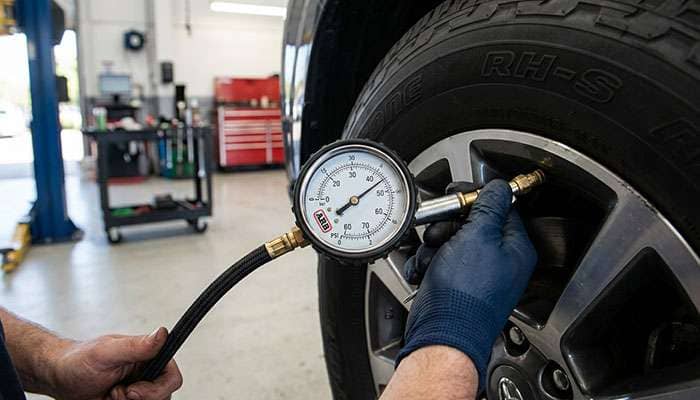
Whether the box says tyre or tire, this takes five minutes per tire.
Step 1: Find the DOT symbol. Look on the lower sidewall, usually on one side only. If you see "DOT" followed by a string of letters and numbers, the tire is certified to FMVSS. If it is on neither side, that tire needs replacing before regular highway use.
Step 2: Look for the E-mark. A circled "E" with a number means the tire is also approved for European markets. Alongside a DOT code it is a bonus, not a concern. On its own, without DOT, it is a gray-market tyre.
Step 3: Read the size prefix. "P" means P-metric under TRA tables. No prefix means Euro-metric under ETRTO tables. "LT" means light truck construction. A "C" suffix means a European commercial tyre. A size like 185VR15 is a period European format with no load index.
Step 4: Match the load index to the right pressure. Note the load index and whether the tire is SL, XL, or RF. Look up its capacity at your door-placard pressure in the correct table. If it is a P-metric going on a light truck or SUV, divide by 1.10. Confirm the result meets or beats the tire you are replacing.
Step 5: Read the date code and the tread. The last four digits of the DOT TIN give the week and year. Then check depth: 2/32 inch, or 1.6 mm, is the legal floor in most places, not the replacement target.
Tyres and tires are both correct spellings of the same thing. "Tire" is American and Canadian. "Tyre" is British and Commonwealth. For writing, choose the one your reader expects and stay consistent.
For buying, the spelling is a signal, not an answer. It tells you which standards body wrote the rules: TRA and NHTSA, or ETRTO and UNECE. Those systems use different certification marks and slightly different reference pressures for the same load index, and in the US only DOT makes a new tire legal for highway sale. Read the sidewall, match the load index to the right pressure, and the spelling on the box stops mattering.
Canada uses "tire," the same spelling as the United States. You will still see "tyre" in some brand names on Canadian shelves, but Canadian regulations, retailers, and most automotive writing use "tire."
"Tyre" is British. It is standard in the UK, Ireland, Australia, New Zealand, India, South Africa, and most Commonwealth countries. "Tire" is the American spelling. European standards bodies such as ETRTO and the UNECE regulations also use "tyre."
Both spellings existed in English for centuries. American usage kept "tire" while British usage settled on "tyre" in the 19th century. When US safety standards and industry organizations formed, they wrote "tire" into their names and regulations, which locked the spelling in.
An E-marked tire is legal in the US when it also carries the DOT symbol, and many do. A new tire with only an E-mark and no DOT symbol is not certified to FMVSS and cannot legally be sold or imported for highway use in the United States.
RF stands for Reinforced. It is the European marking for an Extra Load tire and means the same thing as XL. A Euro-metric RF or XL tire reaches its maximum rated load at 42 psi (290 kPa), compared with 36 psi for a standard-load Euro-metric tire.
The load index numbers map to the same weights worldwide, but the pressure at which a tire reaches that weight differs. Euro-metric tires reach it at 36 psi (SL) or 42 psi (XL), P-metric tires at 35 psi or 41 psi, and P-metric tires used on light trucks are derated to 91% of the sidewall figure.



