
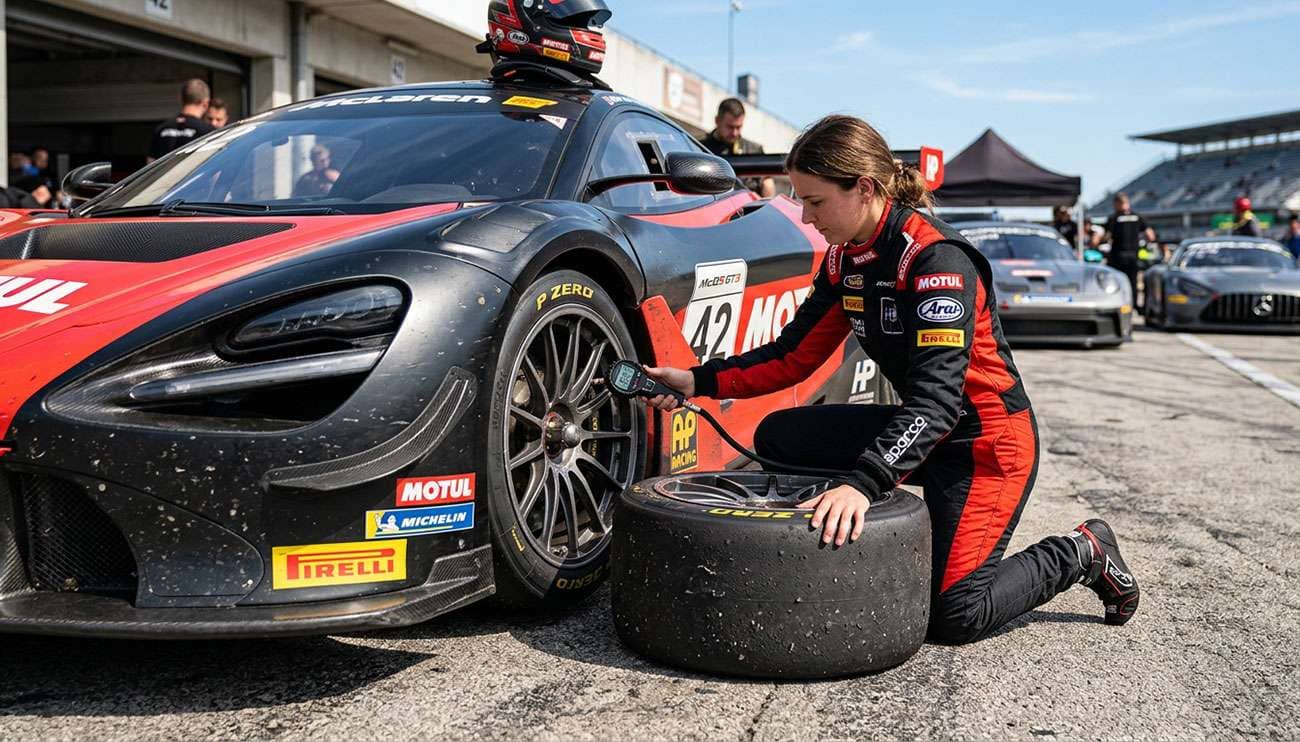
Set pressure to a hot target, not a cold one. For most street-based performance tires, that hot window is roughly 33 to 39 psi. For DOT R-compound tires, it scales with car weight, from about 32 psi on a light car to 40-plus on a heavy one. What usually goes unsaid is that the rise from cold to hot isn't a fixed number. It depends on how hot the air inside the tire gets, the temperature you set it at that morning, and whether there's moisture in the fill. That's why "start 4 psi low" works one day and misses by 3 psi the next.
I'm Dennis Feldman, and I spend a lot of track days with a gauge in my hand. Most track pressure advice gives you a cold number and a hot number and stops there. The physics in between is what lets you hit your hot target on the first session instead of the third. Find your tire type below, then read how to get there.
Tire Type |
Typical Cold Start |
Typical Hot Target |
Where the Number Comes From |
|---|---|---|---|
Max-performance summer (300+ treadwear) |
3 to 6 psi below door placard |
33 to 39 psi |
Tire maker's track guidance |
Extreme performance (around 200 treadwear) |
Mid-to-high 20s to low 30s |
Commonly 35 to 40 psi |
Tire maker's guidance, then pyrometer |
Track-focused street-legal (Cup-style) |
3 to 6 psi below placard, never under 28 |
33 to 39 psi |
Tire maker's track guidance |
DOT R-compound |
26 psi minimum, scaled by weight |
32 to 42+ psi by car weight |
Tire maker's weight chart |
Racing slick |
Supplier-specific |
Supplier-specific |
Tire supplier or race engineer |
Usually somewhere between 4 and 12 psi, and the spread is the point. The rise isn't a property of the tire. It's a property of the air inside it, and it follows the ideal gas law.
Your gauge reads pressure above the atmosphere. Physics works on absolute pressure, which adds the roughly 14.7 psi of atmosphere at sea level. Temperature works the same way: the math uses absolute temperature, which on the Fahrenheit scale means adding about 460 degrees. Inside a sealed tire whose volume barely changes, absolute pressure rises in direct proportion to absolute temperature.
So a tire set to 30 psi cold is really holding 44.7 psi absolute. If the air inside goes from 70 degrees to 160 degrees, absolute temperature rises from about 530 to about 620, a 17 percent increase. Absolute pressure rises 17 percent with it, to about 52.3 psi absolute, or 37.6 psi on your gauge. That's a 7.6 psi rise from heat alone.
Air Temp Inside Tire |
Set to 30 psi at 70 F |
Set to 30 psi at 50 F |
Difference |
|---|---|---|---|
100 F |
32.5 psi |
34.4 psi |
+1.9 psi |
130 F |
35.1 psi |
37.0 psi |
+1.9 psi |
160 F |
37.6 psi |
39.6 psi |
+2.0 psi |
190 F |
40.1 psi |
42.3 psi |
+2.2 psi |
The figures assume dry air and ignore the small stretch of the carcass, so treat them as a model, not a promise. But look at the right-hand column. Set your tires to 30 psi on a 50-degree morning instead of a 70-degree one, and you'll come off track about 2 psi higher at the same tire temperature. The cold reading was the same. The amount of air in the tire was not. That's the single most common reason a pressure plan that worked last month misses today.
The air inside the tire is cooler than the tread surface and the carcass, which is where the heat starts. A tread that probes at 180 to 200 degrees may have internal air well below that. That's why you can't predict hot pressure from a tread temperature reading alone, and why the reliable method is simple: run a session, measure, adjust, repeat.
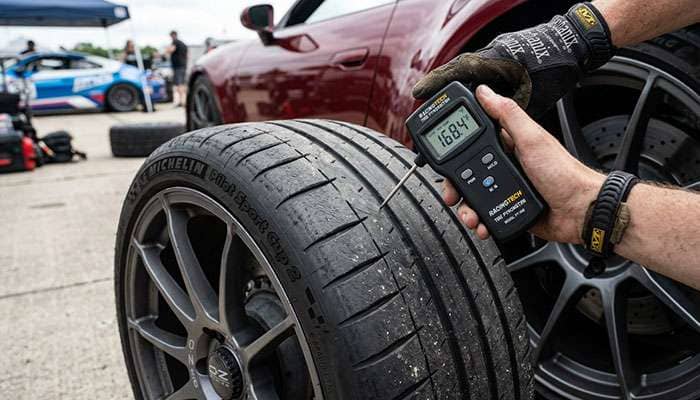
Start from the tire maker's published guidance, because the right hot pressure depends on the tire's construction, not on the car's door placard. Two examples show how differently manufacturers frame it.
Michelin's track guidance for its Pilot Sport 4S and Pilot Sport Cup 2 is a good model of how the street-based categories work. Start cold at 3 to 6 psi below the vehicle's road pressure, keep any front-to-rear split the vehicle maker specifies, and never set a Cup 2 below 28 psi cold. After four fast laps, the hot pressures should land between 33 and 39 psi. If one reads below 33, add air to bring it into the window. If one reads above 39, bring it down to 39. If the shoulders show heavy wear, raise pressure by at least 3 psi, still without exceeding 39 hot.
That 33-to-39 window is a useful default for most max-performance summer tires when the manufacturer doesn't publish its own track figure. Extreme-performance tires in the 200-treadwear class usually run at the upper end of that range or a bit above, commonly 35 to 40 psi hot, but they vary more by model. Check the maker's guidance first and let the pyrometer refine it.
R-compound guidance is built around car weight instead of placard pressure. Hoosier's published guidance for its R7 road-race tire is a clear example:
Car Weight |
Cold Start |
Hot Target |
|---|---|---|
1,800 to 2,200 lb |
26 to 28 psi |
32 to 34+ psi |
2,200 to 2,600 lb |
26 to 28 psi |
34 to 36+ psi |
2,600 to 3,000 lb |
26 to 30 psi |
36 to 40+ psi |
Over 3,000 lb |
30 to 34 psi |
40 to 42+ psi |
Two details in that guidance matter. The minimum cold pressure on any of these DOT radials is 26 psi, and the target pit-lane tread temperature for the road-race compound is 180 to 200 degrees, measured with a needle probe. A heavy modern sports car on R-compounds therefore runs hotter pressures than many drivers expect. If you're new to the category, our explainer on what R-compound tires are covers how they differ from street tires.
Your placard pressure is a cold street number chosen for comfort, load, and treadwear at legal speeds. On track, the tire carries sustained cornering loads the placard never considered. The goal on track is a hot pressure that keeps the sidewall stable and the contact patch flat under load. That's why track guidance starts lower cold and finishes higher hot than anything on the door. For a refresher on where the placard number comes from in the first place, see how to find your recommended tire pressure.
Work backward from your hot target. If your target is 37 psi hot and your tires typically gain 7 psi, start at 30. For a first day with a new tire and no data, use the maker's cold starting range and accept that the first session is a measurement run.
Three adjustments make that first guess better:
Never go below the manufacturer's stated cold minimum to "make room" for the rise. Too little pressure early in the session lets the sidewall roll and the bead area flex before the tire is up to temperature.
Yes, but only down to your hot target, never down to your cold starting number. This is one of the most common mistakes in the paddock.
When you come in at 42 psi with a 38 psi target, let air out until the gauge reads 38, measured within a minute or two of stopping. That's correct. What you should not do is let a hot tire down to 30 because "30 is what I started at." When that tire cools, it will drop several psi below 30, and next session it will start badly underinflated. Hoosier's guidance says this directly: don't lower hot pressures to cold set points.
Pressure starts falling the moment the tire starts cooling. A full cooldown lap and a long walk to the gauge can drop readings 1 to 3 psi. Pick a routine and repeat it every session: same cooldown lap, measure within the same minute or two of stopping, same gauge, same order around the car. Consistency matters more than precision. A reading taken five minutes late isn't wrong, it's just not comparable to the one before it.
Once you've bled a tire hot, it holds less air than it did that morning. Write that down. Before the next session, either check it cold and note the new starting number, or plan to recheck it hot after the next session. Most drivers settle on a cold starting pressure by mid-morning and stop bleeding after that.
Because several variables move at once, and most pressure plans account for only one or two of them.
Shop compressors and many gas-station air lines put water vapor, and sometimes liquid water, into the tire. Water behaves very differently from dry air when heated. As the tire heats, any liquid water evaporates and adds its own pressure on top of the gas law rise, and that addition grows steeply with temperature. The result is a bigger and less predictable rise. This is the real benefit of filling with nitrogen or dry air on track: it's not the nitrogen, it's the absence of water. Our article on why people fill tires with nitrogen covers the street side of that debate. On track, if your rises are erratic from session to session, a dry fill is one of the cheapest fixes there is.
Your gauge reads pressure relative to the outside air. Atmospheric pressure is about 14.7 psi at sea level and about 12.2 psi at 5,000 feet. Air your tires to 30 psi at home near sea level, drive or trailer to a mountain track, and the same air will read about 32.5 psi on the gauge before you turn a lap. Always set pressures at the track, not at home.
A cool morning session and a hot afternoon session start from different baselines and shed heat at different rates. Expect afternoon hot pressures to run higher even if you didn't change anything.
A clockwise track with mostly right-hand corners loads the left-side tires harder, so they heat more. Counterclockwise does the opposite. It's normal for one side of the car to need a slightly lower cold start than the other.
Two gauges can easily disagree by a psi or two. Use one quality gauge for everything, compare it against a known reference now and then, and never swap gauges mid-day.
Pressure tells you what the air is doing. A pyrometer tells you what the tread is doing, and that's what actually decides grip.
The goal is a fairly even middle-to-edge temperature at your hot pressure. When pressure and pyrometer readings disagree, trust the pyrometer for direction and the gauge for magnitude. Move pressure 1 to 2 psi at a time, then run another session before judging.
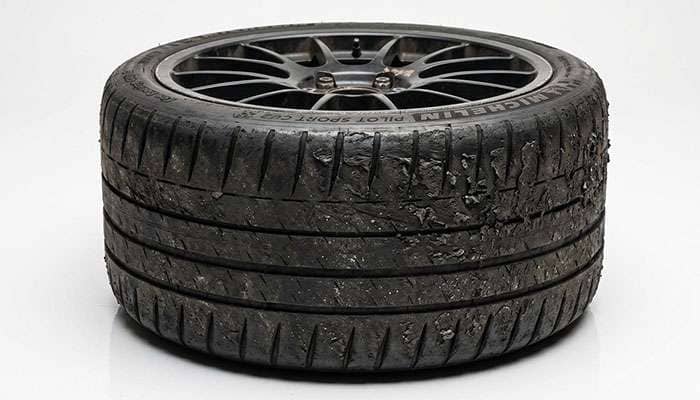
Wrong pressure on track costs grip first, then tread, then the tire itself. It happens faster than on the street because every lap is a load case most street driving never reaches.
Too high, and the contact patch crowns. The center carries the load, the car feels skittish, and it slides early. Too low, and the sidewall rolls under cornering load. Steering response gets vague, the car feels lazy changing direction, and it takes longer to settle mid-corner. Either way you're slower, and the car feels less predictable at the limit, which is exactly where you need it to be predictable. Our article on what overinflated tires do covers the crowned-patch effect in more detail.
Underinflated street tires on track roll onto their shoulders. Many performance tires have small marks on the shoulder; when the scrub line goes past them, the tire is rolling over too far. That wear eats the shoulder blocks fast. Overinflated tires wear the center and overheat the middle of the tread, which can cause graining or blistering.
An underinflated tire flexes more with every load cycle, and flex makes heat inside the carcass. On track, that heat builds lap after lap. Overheated rubber chunks, blisters, or loses its compound properties after too many heat cycles. On a street-based tire, excess heat can also start breaking down the bond between the tread and the belts. If you see bubbles, cracks, or scuffs on the sidewall after a session, stop and read whether sidewall damage is safe to drive on before going back out.
Pushed far enough, a heat-damaged tire separates or fails at speed. Tire makers set their minimum cold pressures and maximum hot windows to keep tires out of that zone. Sticking to them isn't conservatism. It's the line between a worn tire and a failed one.
Run pressures in the window and a set of track tires wears evenly across the tread and gives up its grip gradually. Run them outside it and you'll replace a set with half its tread left because the shoulders are gone or the compound is cooked. Getting pressure right is the cheapest way to make a set of track tires last.
If you're still choosing what to run, our list of the best track day tires breaks down how each category behaves on track. When it's time for a fresh set, you can compare treadwear ratings and compounds across our ultra high performance tires.
Track tire pressure is a hot-pressure problem with a cold-pressure starting point. The right hot target comes from the tire maker, and it depends on the tire's construction and, for R-compounds, on the car's weight. The rise between cold and hot depends on physics, not habit: absolute temperature, the morning you set them, moisture in the fill, and the altitude of the track. Set cold at the track, measure hot the same way every session, bleed only to the hot target, and let the pyrometer confirm the contact patch is flat. Do that and your tires give you consistent grip all day and wear the way they were designed to.
Run to a hot target from the tire maker. For most street-based performance tires that's roughly 33 to 39 psi hot, starting 3 to 6 psi below placard cold. R-compound tires use weight-based targets from about 32 to 42-plus psi hot.
Typically 4 to 12 psi. A tire set to 30 psi at 70 degrees reaches about 37.6 psi when its internal air hits 160 degrees. The rise is larger if you set pressures on a cold morning or if there is moisture in the fill.
Yes, but only down to your hot target, measured within a minute or two of coming off track. Never bleed hot tires down to your cold starting pressure, or they will be badly underinflated when they cool.
Both. Set a cold starting pressure at the track before the first session, then check hot immediately after every session and adjust to the hot target. Hot readings are the ones that decide grip.
The advantage is that nitrogen fills are dry. Moisture in shop air makes pressure rise more, and less predictably, as tires heat. Dry air gives most of the same consistency.
It depends on the compound. For R-compound road-race tires, tire makers commonly cite pit-lane tread temperatures around 180 to 200 degrees with a needle probe. More important than the number is an even temperature from the middle of the tread to the edges.



