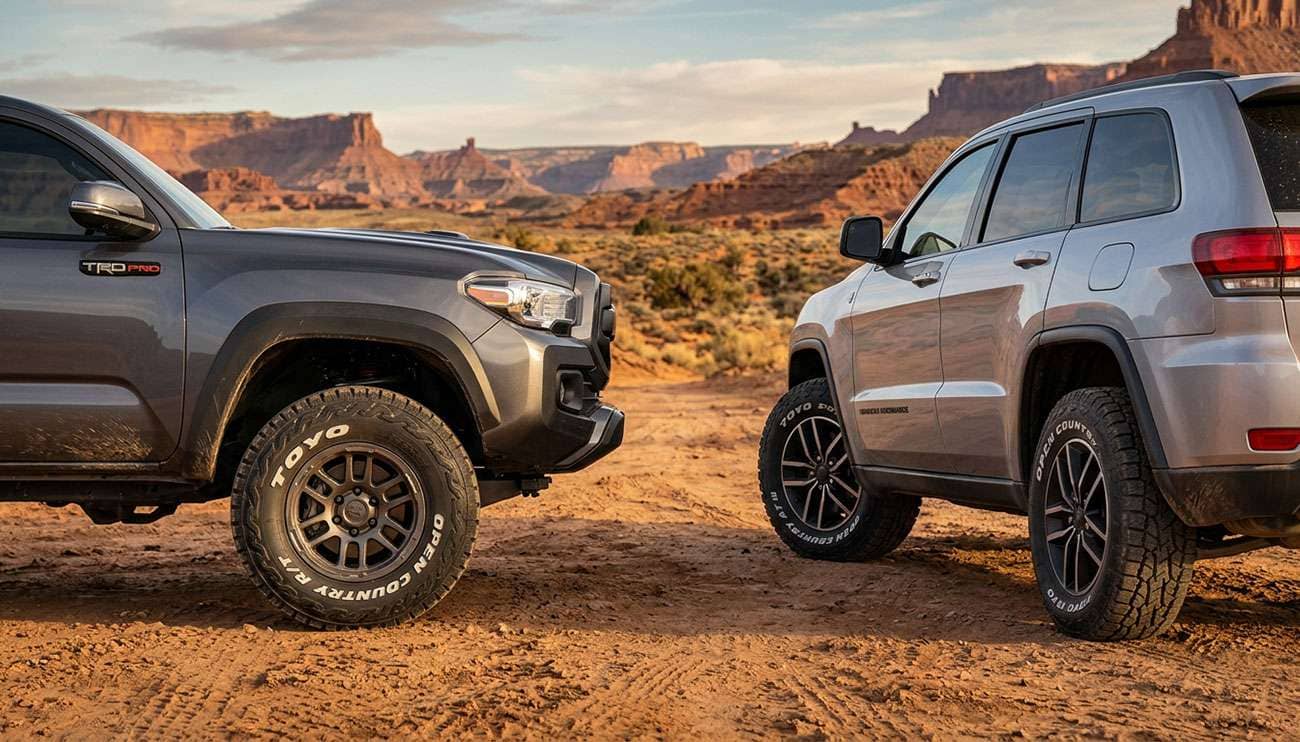
In a passenger size, the Open Country A/T III is the better buy for most people. Toyo backs it for 65,000 miles against the R/T Trail's 45,000, it carries the three-peak snowflake the R/T Trail doesn't, and it costs a little less. In an LT size, the math tightens. The A/T III's warranty drops to 50,000, so the gap shrinks to 5,000 miles, and in several 17-inch Load Range E sizes the R/T Trail is rated to carry 220 to 775 pounds more per tire. Most comparisons treat this as a looks question. Start with the two letters in front of your tire size.
I've been selling tires in Long Beach since 1971, and I've watched a lot of good-looking tires get bought for the wrong truck. The R/T Trail is one of the best-looking tires Toyo has ever built, and it's a good tire. Whether it's the right tire for you depends on whether your size starts with LT and whether you ever see snow. Here's the short version I'd give you at the counter.
Your Size and How You Drive |
The Toyo I'd Put On |
Why |
|---|---|---|
Passenger size, daily driver, any chance of snow |
A/T III |
65,000 vs. 45,000 warranty miles, 3PMSF, and it costs less |
Passenger size, mild climate, you want the look and a tougher sidewall |
R/T Trail |
Thicker sidewall and more off-road bite, if you accept 20,000 fewer warranty miles |
285/70R17 passenger size (the 33-inch) |
A/T III |
The R/T Trail is rated Q (99 mph) in this size; the A/T III is 117T |
LT Load Range E, you drive in real winters |
A/T III |
The only one of the two with the severe snow rating |
LT265/70R17, LT285/70R17 or LT285/75R17 on a heavy overland build, little snow |
R/T Trail |
Rated 220 to 775 lb more per tire; the warranty gap is only 5,000 miles |
LT size, long highway towing at speed |
A/T III |
S or R speed ratings in most LT sizes vs. mostly Q on the R/T Trail |
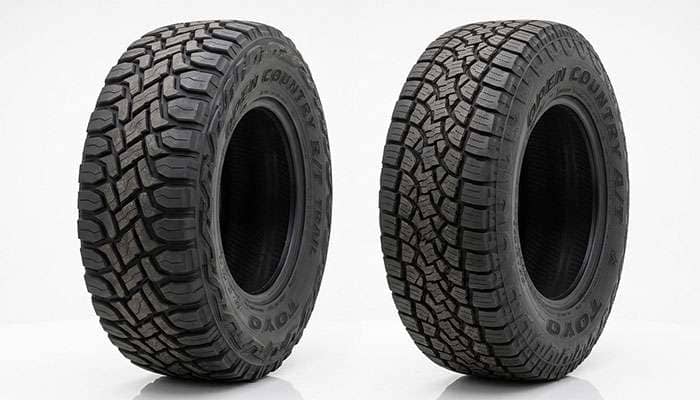
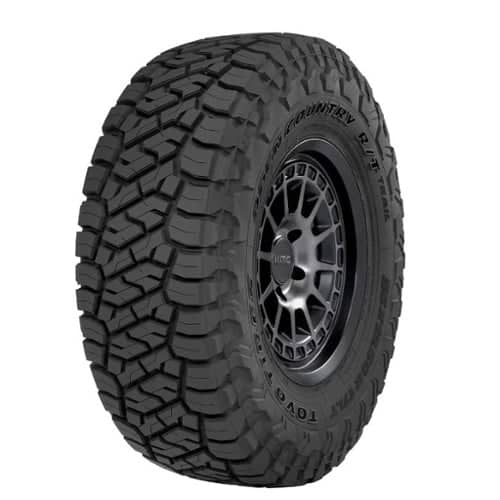
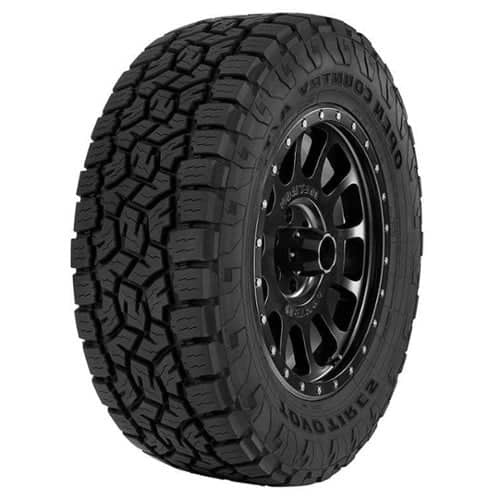
The A/T III is Toyo's all-terrain, the do-everything tire of the Open Country family. The R/T Trail is a rugged-terrain tire that sits between the A/T III and the more aggressive Open Country R/T. It was added to the lineup, not swapped in for anything, so the A/T III isn't going anywhere. Both were developed in the United States, and the reviewers who drove the R/T Trail at launch said the same thing I'd tell you: it drives a lot like the A/T III and looks a lot like the M/T. If you're new to the category, our guide to what R/T tires are explains where rugged-terrain tires fit between all-terrain and mud-terrain.
Feature |
Open Country R/T Trail |
Open Country A/T III |
|---|---|---|
Category |
Rugged terrain |
All-terrain |
Treadwear warranty, passenger sizes |
45,000 miles |
65,000 miles |
Treadwear warranty, LT sizes |
45,000 miles |
50,000 miles |
Three-Peak Mountain Snowflake |
No |
Yes |
Sidewall |
Extra-thick, with internal rim protectors |
Standard; LT sizes use a cut-and-chip resistant compound |
Speed ratings, passenger sizes |
Mostly T; Q in a few sizes |
Mostly T; H in some |
Speed ratings, LT sizes |
Mostly Q (99 mph) |
Mostly S (112 mph) or R (106 mph) |
New tread depth |
About 13/32 to 14/32 in. passenger; 16/32 to 17/32 in. LT |
About 13/32 to 14/32 in. passenger; 16/32 to 17/32 in. LT |
Rim diameters |
16 to 24 in. |
15 to 22 in. |
Price in the same size |
About 3 percent more, $8 to $20 per tire |
Base price |
Toyo publishes its own 1-to-5 ratings for both tires side by side on the same chart, which makes them fair to compare:
Feature |
Open Country R/T Trail |
Open Country A/T III |
|---|---|---|
Off-road traction |
4.5 |
4.0 |
Wet handling |
4.5 |
4.5 |
Winter handling |
4.5 |
5.0 |
Dry handling |
4.0 |
4.0 |
Tread life |
4.0 |
5.0 |
Quiet ride |
4.0 |
4.0 |
Ride comfort |
3.5 |
4.0 |
Fuel efficiency |
3.0 |
3.5 |
Toyo gives the R/T Trail one category, off-road traction. The A/T III wins tread life, winter, ride comfort and fuel efficiency. That's the honest shape of the trade, and it's why the size question matters so much.
Toyo backs the R/T Trail with one 45,000-mile treadwear warranty, no matter the size. The A/T III gets 65,000 miles on P-metric and Euro-metric sizes and 50,000 on LT and flotation sizes. So the gap isn't one number. It's 20,000 miles if you run a passenger size and 5,000 if you run an LT size.
Put that in dollars. In 265/70R17, a passenger size, the A/T III is $267.25 per tire at our current price and the R/T Trail is $275.28. Divide by the warranty and you're paying about $4.11 per 1,000 warranted miles for the A/T III and $6.12 for the R/T Trail. That's 49 percent more per warranted mile. Now go to LT285/70R17 Load Range E: the A/T III is $362.09 and the R/T Trail is $372.95. That works out to $7.24 against $8.29 per 1,000 warranted miles, a 14 percent premium. Same two tires, very different deal.
Why does Toyo rate a rugged-terrain tire for fewer miles? Here's what I see on the shop floor. The R/T Trail runs bigger, more widely spaced tread blocks, and big blocks flex more as they roll onto pavement. That flex scrubs the leading and trailing edge of each block unevenly, the wear we call heel-toe, and it's what shortens the life of aggressive tires on trucks that spend most of their time on the highway. Keep in mind that a treadwear warranty is prorated, too, so you never get the full price of a tire back for missing the mileage. Our article on how tire mileage warranty proration works shows what a claim actually pays. If you want the full rundown on the A/T III by itself, read our Toyo Open Country A/T III review.
It's good in deep, soft snow, and it isn't severe-snow rated. Toyo itself says the R/T Trail's extra grip over a traditional all-terrain shows up most in sand, mud and deep snow. The A/T III carries the Three-Peak Mountain Snowflake. The R/T Trail doesn't. Toyo doesn't list the symbol for it, and the reviewers who tested it at launch confirmed it isn't rated. On Toyo's own chart, the A/T III scores 5.0 for winter handling and the R/T Trail 4.5.
The mechanism explains both halves of that answer. The 3PMSF test measures acceleration on medium-packed snow, and packed snow is gripped by sipes, the thin slits that open up and bite into the surface. The A/T III uses 3D multi-wave sipes across its blocks. The R/T Trail's big lugs and deep voids do their best work in deep, loose snow, where they can dig and throw it out, which is why one launch reviewer expected it to be considerably better than an all-terrain in that kind of snow. Packed, plowed and freezing roads are a different job.
If you live where the plows run all winter, the A/T III is the call. For more on where any all-terrain stops being enough, see our article on whether all-terrain tires are good in snow.
In some of the most popular 17-inch LT sizes, yes, and by a lot. In most 18- and 20-inch LT sizes, the two carry the same load index. Here's where they split:
LT Size, Load Range E |
R/T Trail |
A/T III |
R/T Trail Carries |
|---|---|---|---|
LT265/70R17 |
123/120Q, 3,415 lb |
121/118S, 3,195 lb |
220 lb more |
LT255/80R17 |
123/120Q, 3,415 lb |
121/118R, 3,195 lb |
220 lb more |
LT35x12.50R17 |
125Q, 3,640 lb |
121R, 3,195 lb |
445 lb more |
LT285/70R17 |
126/123Q, 3,750 lb |
121/118S, 3,195 lb |
555 lb more |
LT285/75R17 |
128/125Q, 3,970 lb |
121/118S, 3,195 lb |
775 lb more |
Look at the speed ratings in that table, because that's the other half of the trade. The R/T Trail carries more weight at a Q rating, good to 99 mph. The A/T III carries less at an S or R, good to 112 or 106 mph. Load ratings and speed ratings both come down to how much heat a tire can shed under load, so this is really one trade-off seen from two ends: more weight at a lower speed, or less weight at a higher one. Both are Load Range E at 80 psi. If load index and load range still blur together for you, our guide to load range vs. load index straightens it out.
For a heavy overland 4Runner, Tacoma or Gladiator on LT285/70R17s, with a rooftop tent, drawers, water and recovery gear, that extra 555 pounds per corner is real margin. For a lighter truck that never comes close to 3,195 pounds per tire, it's margin you'll never use.
It depends on what runs out first on your trip, load capacity or speed. If your trailer and gear push the rear tires toward 3,195 pounds and you tow at moderate speeds, the R/T Trail's higher load index in those 17-inch LT sizes gives you more room. If you tow at 75 across the desert in July, the A/T III's S rating is the better kind of margin, because a tire that's rated for 112 mph has been built to shed more heat at highway speed than one rated for 99.
For a truck that mostly commutes and tows a boat a few times a summer, I'd lean A/T III on the strength of the warranty alone. And whichever you buy, remember that an LT tire only carries its rated load at its rated pressure. If you're coming off a passenger tire, our guide to P-metric vs. LT tires explains why the air pressure has to go up.
Not louder, by Toyo's numbers, but a little firmer. Toyo rates both tires 4.0 for quiet ride, and the reviewer who drove the R/T Trail at launch was surprised at how quiet it was on pavement. Ride comfort is where it gives up half a point, 3.5 to 4.0, and that's the sidewall talking. A thicker, stiffer sidewall resists cuts on the trail, and it also passes more of the road's sharp edges into the cab. Fuel efficiency drops half a point too, 3.0 to 3.5, which tracks with bigger blocks and more rolling resistance.
The tread-life difference also shows up as noise over time. When aggressive blocks start to heel-toe, they get louder. Rotate the R/T Trail on schedule, every 5,000 miles or so, and you'll keep that in check longer.
The R/T Trail, and that's what you're paying for. Toyo built it with an extra-thick sidewall to protect against cuts, impacts and punctures, internal rim protectors, staggered scalloped shoulder blocks for side bite in ruts, and stone ejectors in the lateral grooves. One launch reviewer aired down to about 14 psi on rock and reported good flex and grip. Toyo rates it 4.5 for off-road traction against the A/T III's 4.0.
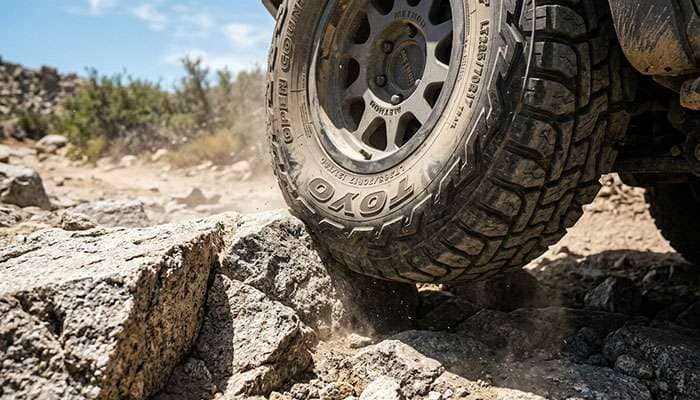
The A/T III is no pushover. Its LT sizes use a cut-and-chip resistant compound, and it has staggered shoulder lugs and stone-ejecting blocks of its own. But if your weekends involve sharp shale, desert washes and ledges, the R/T Trail's sidewall is the feature that saves a trip. A sidewall gash is the one tire injury a plug kit can't fix; our guide on whether sidewall damage is safe to drive on covers what to do when it happens.
Half the people who ask me about the R/T Trail actually mean the Open Country R/T, so let's sort the family out. Toyo's rugged-terrain line started with the Open Country R/T, which Toyo still sells with the same 45,000-mile warranty as the R/T Trail and a 3-ply polyester casing. The R/T Pro is Toyo's newer, more aggressive take on that original rugged-terrain tire. The R/T Trail slots in below both of them, closer to the A/T III.
Toyo's own chart puts numbers on where the R/T Trail lands against the original R/T. They tie on off-road traction at 4.5, tie on tread life at 4.0 and tie on fuel efficiency at 3.0. The R/T Trail scores higher on wet handling, 4.5 to 4.0, on winter handling, 4.5 to 4.0, and on quiet ride, 4.0 to 3.5. So if you were drawn to the R/T for the look, the R/T Trail gives you the same off-road score with better wet-road manners and a quieter cabin. If you were drawn to the R/T Trail because the A/T III looked too tame, you're already shopping the right tire. You only need to step up to the R/T or R/T Pro if your weekends look more like a mud-terrain tire's job than an all-terrain's.
Here are the sizes I see most for both tires, at our price per tire as of this writing. Click through for the exact size.
Size |
Open Country R/T Trail |
Open Country A/T III |
What Decides It |
|---|---|---|---|
265/70R17 |
Warranty: 45,000 vs. 65,000 miles |
||
285/70R17 |
Speed rating and warranty both favor the A/T III |
||
275/60R20 |
Warranty: 45,000 vs. 65,000 miles |
||
LT265/70R17 E |
Load vs. speed rating; warranty gap only 5,000 |
||
LT285/70R17 E |
555 lb more capacity vs. 3PMSF and S rating |
||
LT285/75R17 E |
775 lb more capacity vs. 3PMSF and S rating |
||
LT275/70R18 E |
Same load; A/T III has the higher speed rating and 3PMSF |
||
LT35x12.50R17 E |
445 lb more capacity for lifted builds |
You'll notice the R/T Trail runs about 3 percent more than the A/T III in every matching size. The full Toyo lineup is on our Toyo tires page, and you can compare the R/T Trail against other brands on our rugged terrain tires page.
Neither of these tires is a bad tire. The cost of the wrong one shows up slowly, and it climbs.
The R/T Trail on a passenger-size daily driver in snow country:
The A/T III LT on a heavy overland build in a 17-inch size:
The fix either way costs the same as getting it right the first time: four tires matched to your size, your load and your weather.
The R/T Trail and the A/T III aren't a good tire and a better tire. They're two different trades, and the size on your sidewall tells you which trade you're making. In a passenger size, the A/T III gives you 20,000 more warranty miles, the snowflake and a lower price, so the R/T Trail only makes sense if you want its sidewall and its look badly enough to pay for them. In an LT size, the warranty gap shrinks to 5,000 miles, and in a handful of 17-inch sizes the R/T Trail carries hundreds of pounds more per tire, at the cost of a Q speed rating and no snowflake. That's the version of this decision I'd actually spend time on at the counter. Everywhere else, the A/T III is the tire I'd put on most trucks that come through my door.
The A/T III is Toyo's all-terrain tire, with a 65,000-mile warranty on passenger sizes, 50,000 on LT sizes, and the 3PMSF severe snow rating. The R/T Trail is a rugged-terrain tire with an extra-thick sidewall, more off-road traction, a flat 45,000-mile warranty, and no 3PMSF rating. In several 17-inch LT sizes, the R/T Trail carries a higher load index at a lower Q speed rating.
No. The R/T Trail does not carry the Three-Peak Mountain Snowflake symbol. The Open Country A/T III does. The R/T Trail's big lugs can work well in deep, loose snow, but it is not rated for severe snow.
Toyo backs the R/T Trail with a 45,000-mile treadwear warranty in every size. Regular rotation, roughly every 5,000 miles, is the biggest factor in reaching it, because large tread blocks are prone to uneven heel-toe wear on pavement.
Not by Toyo's ratings. Toyo rates both tires 4.0 for quiet ride. The R/T Trail rates half a point lower for ride comfort, 3.5 against 4.0, because of its thicker, stiffer sidewall.
No. The R/T Trail was added to the Open Country lineup between the A/T III and the Open Country R/T. The A/T III remains Toyo's main all-terrain tire.
Yes, in a mild climate. It's quiet for a rugged-terrain tire and rides a little firmer than the A/T III. For a daily driver in a passenger size, the A/T III's longer warranty and 3PMSF rating usually make it the better value.