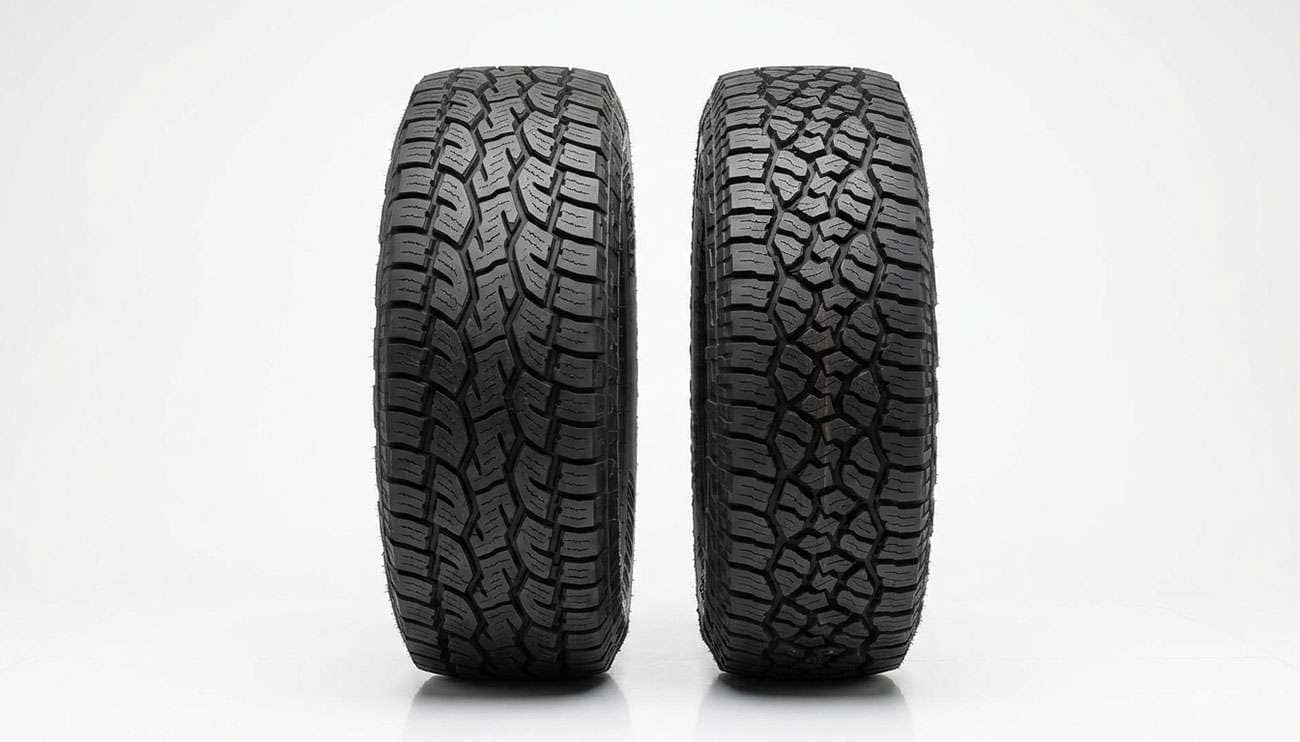
In passenger sizes, the Falken Wildpeak A/T4W is the better buy for most drivers: the same 65,000-mile warranty as the Toyo, a lower price in most sizes, and shorter wet and dry stops in the testing so far. In LT sizes, the answer depends on your exact size. Load Range E is not one number. In LT265/70R17, LT285/70R17 and LT285/75R17, the A/T4W carries 218 to 771 lb more per tire than the Open Country A/T III. In LT275/70R17, LT285/70R18 and the 20-inch 275s, the Toyo is the only one of the two built in Load Range E. Most comparisons stop at tread pattern and warranty. Check the load index on your size first.
I spend most of my day matching tires to load ratings, and this pair is a clean example of why the size chart matters more than the brochure. Both are severe-snow-rated off-road all-terrains. Both come in passenger and LT construction. Both sell in the same price band. The real differences sit in the size tables, and they flip direction from one size to the next.
Your Size |
Toyo Open Country A/T III |
Falken Wildpeak A/T4W |
Edge |
|---|---|---|---|
Passenger sizes (265/70R17 115T, 275/65R18 116T and similar) |
65,000-mile warranty |
65,000-mile warranty |
Tie on warranty; Falken lower price and shorter stops |
LT265/70R17 E |
121: 3,197 lb |
123: 3,415 lb |
Falken, +218 lb per tire |
LT285/70R17 E |
121: 3,197 lb |
126: 3,748 lb |
Falken, +551 lb per tire |
LT285/75R17 E |
121: 3,197 lb |
128: 3,968 lb |
Falken, +771 lb per tire |
LT275/65R18, LT275/70R18, LT265/75R16 E |
Same load index |
Same load index |
Tie on load; Falken by 10,000 warranty miles |
LT275/70R17 |
E 124: 3,527 lb |
C 114: 2,601 lb |
Toyo, +926 lb per tire |
LT285/70R18 |
E 127: 3,858 lb |
C 117: 2,833 lb |
Toyo, +1,025 lb per tire |
LT275/60R20 |
E 123: 3,415 lb |
D 119: 2,998 lb |
Toyo, +417 lb per tire |
LT275/55R20 |
E 120: 3,086 lb |
D 115: 2,679 lb |
Toyo, +407 lb per tire |
No, and this is the part most buyers never see. The load range letter and the load index measure two different things.
The Tire and Rim Association publishes the standardized load ratings, and a tire maker can engineer the same size to more than one of them. In several popular 17-inch sizes, Falken built the E-range A/T4W to a higher rating than Toyo did for the E-range A/T III. Same letter on the sidewall, same 80 psi ceiling, very different capacity:
LT Size, Load Range E |
Toyo Load Index |
Falken Load Index |
Difference per Tire |
Difference per Set of Four |
|---|---|---|---|---|
LT255/80R17 |
121 (3,197 lb) |
123 (3,415 lb) |
+218 lb Falken |
+872 lb |
LT265/70R17 |
121 (3,197 lb) |
123 (3,415 lb) |
+218 lb Falken |
+872 lb |
LT285/70R17 |
121 (3,197 lb) |
126 (3,748 lb) |
+551 lb Falken |
+2,204 lb |
LT285/75R17 |
121 (3,197 lb) |
128 (3,968 lb) |
+771 lb Falken |
+3,084 lb |
The extra capacity shows up on the scale. In LT285/70R17, the Falken weighs about 65.4 lb against about 56 lb for the Toyo, and it starts with 18/32 inch of tread against 17/32. That heavier casing is what lets it carry 551 more pounds at the same 80 psi. In LT265/70R17 the gap is smaller: about 53.2 lb for the Falken against 48 lb for the Toyo.
Then the direction flips. In LT275/70R17 and LT285/70R18, Falken builds the A/T4W only in Load Range C. In LT275/60R20 and LT275/55R20, it tops out at Load Range D. Toyo builds all four of those sizes in Load Range E, so in those sizes the Toyo is the higher-capacity tire by 407 to 1,025 lb. Our guide to load range vs. load index walks through reading both numbers off a sidewall.
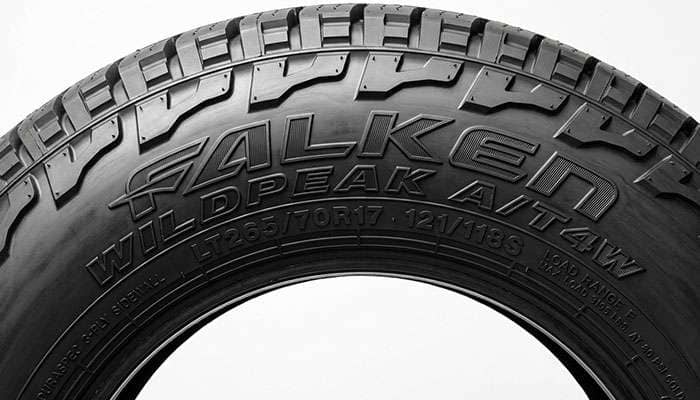
Load index is a floor, not a score. If your truck needs 3,000 lb per tire, a 3,197 lb tire and a 3,968 lb tire both do the job at the right pressure. The difference matters in three situations.
You are replacing tires on a heavy-duty truck. The industry rule is simple: the replacement tire's load index must meet or exceed what the vehicle's tire placard calls for. Most 3/4-ton and 1-ton pickups specify an E-range LT tire with a specific index. If your placard calls for a 123 in LT265/70R17, the Toyo's 121 does not meet it, and the Falken's 123 does. Read why that matters in our piece on whether a lower load index tire is safe.
You run close to your truck's gross vehicle weight rating. Built-up mid-size trucks and full-size SUVs are the common case: a 4Runner or Tacoma with drawers, a rooftop tent, water, recovery gear and a hitch-mounted carrier can sit at or near its rating every day. A tire working close to its maximum load flexes more and runs hotter than one with reserve. On an LT285/70R17 build, 551 lb of reserve per tire is a meaningful margin.
You tow or haul heavy. Tongue weight and payload stack on the rear axle. The rear tires on a loaded truck can see far more weight than the fronts, so the per-tire number that matters is the rear axle load divided by two, not the truck's curb weight divided by four.
Now the other side. If your truck rides on LT275/70R17, LT285/70R18 or a 20-inch 275 and you want Load Range E, the Toyo is the only one of these two that offers it. A Falken C or D in those sizes may still cover a lightly loaded half-ton. It will not cover the same work an E-range tire does, and it will not meet an E-range placard.
Start with the door placard. Most half-ton pickups and mid-size SUVs leave the factory on passenger tires, meaning the size has no LT in front of it. If that is your truck, both of these tires come in a matching passenger size, and in the most common ones the load indices are identical:
With capacity and warranty tied, the passenger-size decision comes down to price, pavement braking and weight. The Falken is the lower price in every passenger size we compared and posted the shorter wet and dry stops. The Toyo is several pounds lighter per tire. A few passenger sizes do split on load index. In 245/75R16 the Falken is an Extra Load 115 against the Toyo's Standard Load 111, and in P285/70R17 the Toyo's 117 edges the Falken's 116. If your placard calls for a specific index in one of those sizes, that settles it.
What I steer half-ton owners away from is buying LT construction by reflex. Size for size, an LT tire carries less weight than a passenger tire at the same pressure, so moving from a passenger size to an LT size means running more air than the placard says, set from the tire maker's load and inflation table. That trade makes sense if you tow near your rating, carry a camper or run sharp rock. If you do not, the passenger version of either tire is the better daily driver, and it carries the longer warranty.
By warranty, they tie in passenger sizes and the Falken wins in LT sizes:
Construction |
Toyo A/T III Warranty |
Falken A/T4W Warranty |
Edge |
|---|---|---|---|
Passenger (P-metric / Euro-metric) |
65,000 miles |
65,000 miles |
Tie |
LT and flotation |
50,000 miles |
60,000 miles |
Falken, +10,000 miles |
Staggered rear tires |
50 percent of the stated mileage |
See Falken's warranty terms |
Check before buying a staggered set |
The staggered line catches people. Toyo covers rear tires on a staggered fitment for half the stated mileage, so a passenger-size rear carries 32,500 miles and an LT rear carries 25,000. If your truck runs wider tires out back, read our breakdown of square vs. staggered setups before you order.
Starting tread depth favors the Falken by about a thirty-second in every matched size I checked: 14/32 inch against 13/32 in passenger 265/70R17, 17/32 against 16/32 in LT265/70R17 E, and 18/32 against 17/32 in LT285/70R17 E. A treadwear warranty is a floor, not a forecast, but if a set wears out early, the longer warranty is worth real money back. Our guide to tire mileage warranty proration shows how that credit gets calculated.
The cleanest head-to-head I have found is a 2025 independent all-terrain test run in 35x12.50R17, where both tires were LT flotation construction. That matters, because a lot of comparison data quietly pits a passenger tire against an LT tire. In that test the Falken finished first of five and the Toyo fourth:
One spec cuts the other way. The Toyo is the lighter tire. In passenger 265/70R17 it weighs about 41 lb against 47.6 lb for the Falken. Less rotating mass helps acceleration, braking feel and fuel economy a little, and it is part of why some owners describe the Toyo as the smoother daily driver. For a dedicated pavement commuter on passenger sizes, the Falken's braking numbers carry more weight with me than the Toyo's weight advantage.
For the full rundown on the Toyo by itself, see our Toyo Open Country A/T III review.
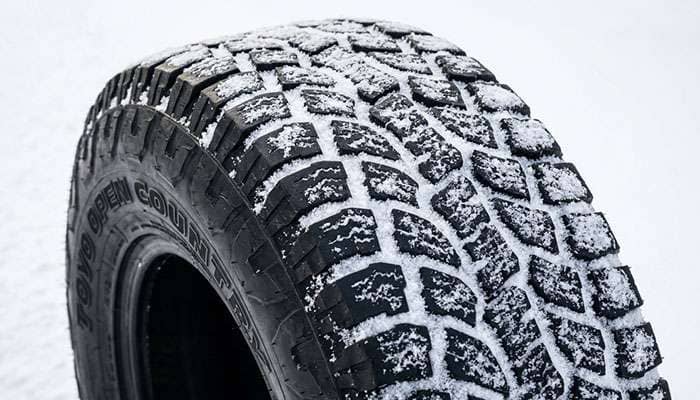
Both carry the Three-Peak Mountain Snowflake symbol, so both met the industry's severe-snow traction standard. Past that, the tests split, and I would not buy either one on snow data alone:
Two of three tests favored the Toyo in snow, and the largest test favored the Falken. On ice, the two were nearly even in the winter test, and the Falken stopped shorter in the 30-tire test. If snow is the deciding factor for your truck, the Toyo has a slight edge on the evidence, but it is not decisive.
There is less hard data off-road than on pavement, so I weigh what exists carefully. The same 2025 test that ran both tires in 35x12.50R17 included a dirt handling course. The Falken lapped it in 71.8 seconds against 73.11 for the Toyo, about 1.8 percent quicker, and the testers rated its dirt handling higher.
Past that, compare the construction each maker publishes:
The one hard number on toughness is casing mass. In the 17-inch E-range sizes where the Falken carries a higher load index, it is also the heavier tire, and that extra rubber and cord sits in the sidewall and casing. Neither maker publishes a puncture or sidewall cut test, so I will not claim one is tougher on rocks. For mud, both are all-terrains with the trade-offs that come with that. If you spend real time in deep mud, look at a rugged-terrain or mud-terrain tire instead.
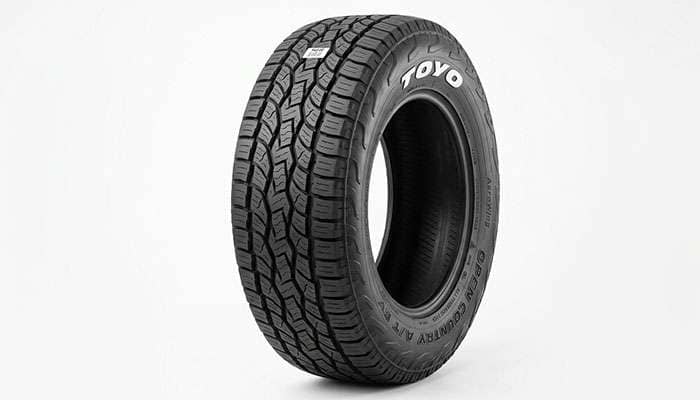
Appearance is a small but real difference. Toyo builds select A/T III sizes with outline white letters. The A/T4W is a black sidewall tire. For more on the A/T4W's sidewall options and towing manners, see our Falken Wildpeak A/T4W review.
If you drive an electric pickup or SUV, Toyo is the one of these two with an EV-specific version: the Open Country A/T III EV. Toyo launched it with an LT275/60R20 size aimed at the Ford F-150 Lightning, and the line now covers several 18-, 20-, 22- and 24-inch sizes. The EV version uses an aerodynamic sidewall design and a compound Toyo says cuts rolling resistance by about 20 percent, which protects range. Toyo's own engineers have noted the trade-off: the EV compound uses more synthetic rubber, which gives up some cut-and-chip resistance compared to the standard A/T III.
EVs are heavy, so load index matters even more. If you run the standard A/T4W or A/T III on an electric truck, match or beat the factory load index and set pressure from the tire maker's chart. Our explainer on why EV tires are different covers the weight, torque and range side of the decision.
Prices are per tire at the time of writing. Click through to confirm current pricing and the exact load and speed rating for your size, or browse the full Toyo Open Country A/T III and Falken Wildpeak A/T4W size lists.
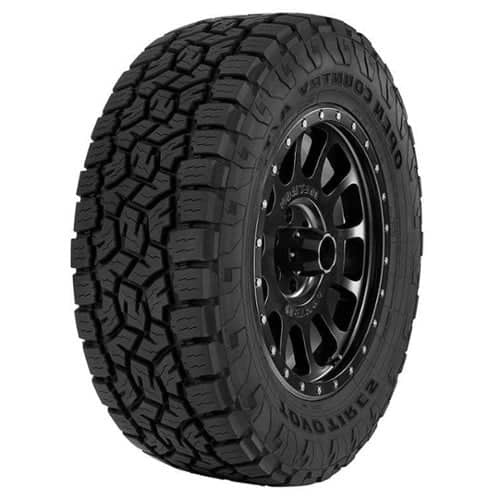
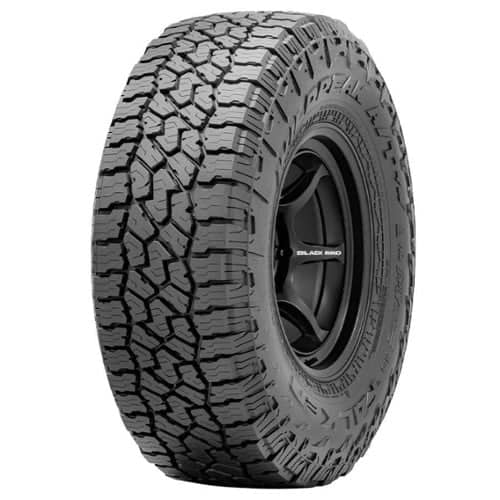
Size |
Toyo Open Country A/T III |
Falken Wildpeak A/T4W |
|---|---|---|
245/75R16 (passenger) |
||
265/70R17 (passenger) |
||
285/70R17 (passenger) |
||
275/65R18 (passenger) |
||
275/55R20 (passenger) |
||
LT265/70R17 |
||
LT285/70R17 |
||
LT275/65R18 |
||
LT275/70R18 |
||
LT275/70R17 |
||
LT275/60R20 |
||
LT275/55R20 |
Two patterns stand out. At our prices, the Falken is the lower number in every row. And in the two 17-inch LT sizes in the table where the Falken also carries the higher load index, it costs $29 to $46 less per tire than the Toyo, so you pay less and carry more. The Toyo earns its premium in the last three rows, where it is the only Load Range E option of the two.
An undersized load index does not fail on day one. It costs you a little at a time, and then all at once:
The cheap fix is at the start: match or exceed the placard load index, and when you have a choice between two good tires, take the one with reserve in your size.
The Toyo Open Country A/T III and the Falken Wildpeak A/T4W are both excellent all-terrains, and it is easy to treat them as interchangeable with different tread patterns. In LT sizes, they are not. In passenger sizes, the warranty is a tie and the Falken wins on price and pavement braking. In LT sizes, Falken gives you 10,000 more warranty miles, and in the most popular 17-inch E-range sizes it also carries 218 to 771 more pounds per tire. Toyo answers in the 20-inch 275s, LT275/70R17 and LT285/70R18, where it is the only E-range choice of the two, and it has the only EV-specific version.
Start with the load index your truck needs, then let warranty, price and snow decide the rest. Shop the full lineups from Toyo and Falken, or call us in Long Beach and we will check your placard numbers with you.
In most passenger sizes and in the popular 17-inch LT sizes, yes: it matches or beats the Toyo's warranty, usually costs less, and in LT265/70R17, LT285/70R17 and LT285/75R17 it carries a higher load index. The Toyo is the better pick where it offers Load Range E and the Falken does not, and for snow-focused drivers.
They tie at 65,000 miles in passenger sizes. In LT and flotation sizes, Falken warrants the A/T4W for 60,000 miles and Toyo warrants the A/T III for 50,000. Toyo covers staggered rear tires for 50 percent of the stated mileage. The Falken also starts with about 1/32 inch more tread in matched sizes.
Yes. A higher load index than your placard calls for is fine. What you should not do is go lower than the placard's load index. Set inflation pressure from the tire maker's load and inflation table for the tire you install.
Both carry the Three-Peak Mountain Snowflake symbol. The Toyo won two of three recent independent snow comparisons on traction and handling, while a 30-tire snow test in 2026 ranked the Falken well ahead. On ice, the Falken was even or slightly better. Neither replaces a dedicated winter tire in severe winters.
In the cleanest head-to-head test, run with both tires in LT flotation construction, testers scored the Falken slightly ahead on noise and comfort. The Toyo is the lighter tire, which some owners notice as a smoother feel. Expect both to be quieter in passenger sizes than in Load Range E.
Yes. The Open Country A/T III EV is built for electric trucks and SUVs, starting with an LT275/60R20 size for the Ford F-150 Lightning. It uses an aerodynamic sidewall and a lower rolling resistance compound to protect range, with some trade-off in cut-and-chip resistance.