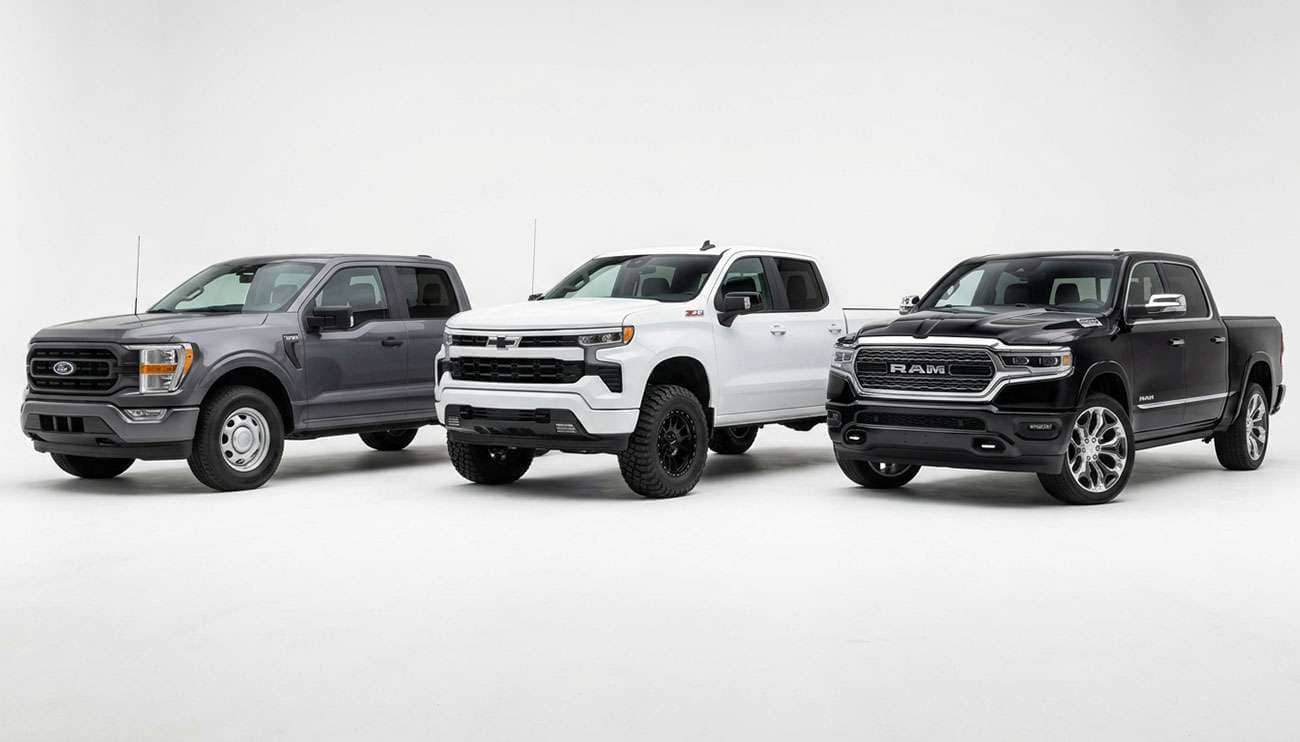
The 2025 Silverado 1500 runs nine factory tire sizes, from 255/70R17 on a WT to 275/50R22 on an LTZ or High Country. Trim sets the wheel diameter, and the Trail Boss and ZR2 ship on a factory lift with 32- and 33-inch off-road tires. Most size guides stop at the size string. The part nobody puts in front of you is the prefix: the Trail Boss and ZR2 wear LT tires in Load Range C, and that one letter decides what you can safely replace them with.
That last point trips up more Silverado owners than any other. A 275/65R18 on one Silverado and an LT275/65R18 on another look like the same tire at the counter. They are not built the same, they do not run the same pressure, and the replacement market for the LT version is almost entirely a heavier tire than the one GM installed. I'll walk through every trim, then the numbers that sit behind the size.
Start with the whole lineup on one screen. Find your trim, then find your wheel diameter. The wheel diameter is the variable that narrows nine sizes down to one or two.
Trim |
Wheel Diameter |
Factory Tire Sizes |
Construction |
What Sets It Apart |
|---|---|---|---|---|
WT |
17 in. standard, 18 in. optional |
255/70R17, 265/70R17, 18-in. option on 265/65R18 or 275/65R18 by package |
Passenger (P-metric) |
Tallest sidewalls in the street lineup |
Custom |
20 in. |
275/60R20 |
Passenger (P-metric) |
One size, street-focused |
Custom Trail Boss |
18 in. standard, 20 in. optional |
LT275/65R18, 275/60R20, 265/60R20 |
LT Load Range C on the 18; P-metric on the 20 |
2-in. factory lift |
LT |
17, 18, 20, or 22 in. |
255/70R17, 265/70R17, 265/65R18, 275/60R20, 275/50R22 |
Passenger (P-metric) |
Widest size range of any trim |
RST |
18 in. standard, 20 or 22 in. optional |
265/65R18, 275/60R20, 275/50R22 |
Passenger (P-metric) |
Sport trim, three diameters |
LT Trail Boss |
20 in. standard, 18 in. optional |
275/60R20, 265/60R20, LT275/65R18 |
P-metric on the 20; LT Load Range C on the 18 |
2-in. factory lift, locking rear differential |
LTZ |
20 in. standard, 22 in. optional |
275/60R20, 275/50R22 |
Passenger (P-metric) |
Chrome and luxury trim on street tires |
High Country |
20 in. standard, 22 in. optional |
275/60R20, 275/50R22 |
Passenger (P-metric) |
Shortest sidewall in the lineup on the 22 |
ZR2 |
18 in. |
LT275/70R18 |
LT Load Range C, mud-terrain |
Tallest tire, Multimatic DSSV dampers, factory lift |
Look at the Construction column before you look at anything else. Seven of nine trims ride on passenger-construction tires. Two off-road configurations, the 18-inch Trail Boss and the ZR2, ride on light truck tires. That split matters more than the numbers in the size, because passenger and LT tires are rated on different load tables, inflated to different pressures, and counted differently on a pickup. I'll put numbers on that in the LT section below.
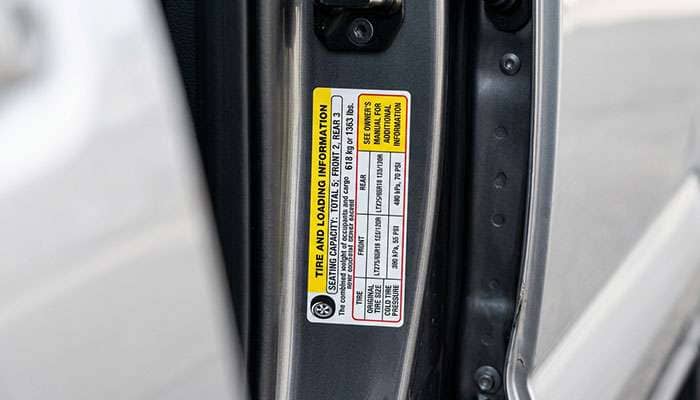
Your truck's own door placard is the final word. GM lists the factory size, the load index, and the cold inflation pressure on the Tire and Loading Information label on the driver's door opening, the label NHTSA requires under FMVSS 110. If your placard and this table disagree, the placard wins.
Every 2019 and newer Silverado 1500 shares the same 6x139.7 bolt pattern and 78.1 mm hub bore, and the size lineup has stayed close since the 2022 refresh. The Trail Boss has worn an LT275/65R18 Load Range C on its 18-inch wheel since 2019. The ZR2 joined the lineup for 2022 on the LT275/70R18. Earlier trucks carry some sizes that dropped out later, so read the placard on anything older than a 2022.
The Custom Trail Boss comes standard on 18-inch wheels with LT275/65R18 tires. The LT Trail Boss flips it: 20-inch wheels with 275/60R20 all-terrains are standard, and the 18-inch wheel with LT275/65R18 is an option. Some 20-inch builds list 265/60R20. Both trucks get the Z71 off-road package with a 2-inch factory lift.
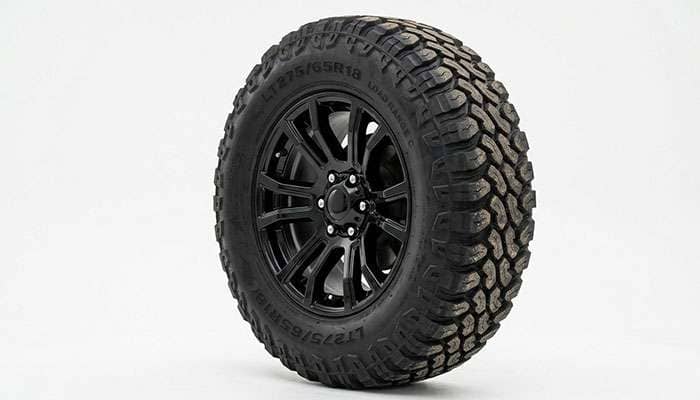
Same lift, same shocks, different defaults. If you own a Custom Trail Boss, odds are you're on the 18-inch LT tire. If you own an LT Trail Boss, odds are you're on the 20-inch passenger tire. Two trucks with the same name on the tailgate, and one of them has a completely different tire construction than the other. That is the exact situation where buying by trim name goes wrong.
GM spec'd the 18-inch Trail Boss on an LT275/65R18 rated 113/110Q, Load Range C. The 113 is the single-tire load index, good for 2,535 pounds. The 110 is the dual-mounted index. Q is a 99 mph speed rating. Load Range C is the lightest LT construction on the market, with a maximum inflation of 50 psi.
GM chose C for the ride and the weight. A C-range tire has a more compliant sidewall than an E, which keeps a half-ton from riding like a three-quarter-ton on the highway and lets the tread wrap over rock on the trail. The LT construction still gives you a tougher sidewall ply than a passenger tire, and that's the point on an off-road package: puncture resistance, not extra capacity.
Here's the catch. Most LT275/65R18 tires sold as replacements are Load Range E, load index 123, rated for 3,415 pounds at 80 psi. Load Range C versions of this size are a small slice of the market. Put an E on a Trail Boss at the placard pressure written for a C and the tire is underinflated for its construction. Pump it to its rated pressure and the truck rides hard and wears the center of the tread. The fix is simple: an E-range tire on a Trail Boss gets its pressure from a load inflation table, not from the door, and it should never go below the pressure that carries the same load the C tire carried.
Every ZR2 rolls on LT275/70R18 tires, 33.2 inches tall, on 18-inch wheels. GM fits the Goodyear Wrangler Territory MT at the factory, rated 115/112Q, Load Range C. It is the tallest factory tire on any Silverado 1500, and it pairs with Multimatic DSSV spool-valve dampers and front and rear electronic locking differentials.
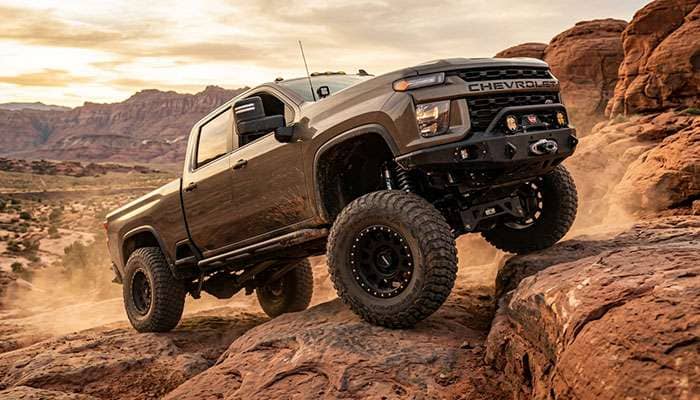
A 115 load index carries 2,679 pounds per tire at 50 psi. That's the same number as a passenger 275/60R20 115, the tire on a Custom or LTZ. The ZR2's tire has an inch more sidewall, weighs more, and is far tougher, and it carries no more weight on paper. Owners assume the big mud-terrain adds capacity. It adds clearance and puncture resistance.
The replacement picture is even more lopsided than the Trail Boss. Nearly every LT275/70R18 on the market is Load Range E, load index 125, rated for 3,638 pounds at 80 psi. Load Range C versions are uncommon. So when a ZR2 owner replaces tires, the realistic choice is an E-range tire that carries about 960 more pounds per corner than the factory tire and weighs more. That extra unsprung weight is real on a truck tuned around spool-valve dampers, and the stiffer sidewall changes how the truck rides on washboard. It is not dangerous. It is different, and you want to set pressure on purpose rather than by habit.
Also worth knowing: the ZR2 carries the lowest payload rating in the 2025 lineup, down to 1,520 pounds in a crew cab short bed with the 6.2L V8 per GM's published figures. The extra capacity of an E-range tire does not raise that number. Payload comes from the truck's axle and gross vehicle weight ratings, not the tire.
These four trims cover the bulk of the Silverados on the road, and they all ride on passenger-construction tires. The size depends on the wheel.
The WT comes standard on a 17-inch painted steel wheel, and the LT on a 17-inch aluminum wheel. Factory sizes are 255/70R17 (typically 112 load index, 2,469 pounds) and 265/70R17 (typically 115, 2,679 pounds). The 265/70R17 is about half an inch taller and carries 210 pounds more per tire. If you run a WT as a work truck and your placard shows the 255, moving to the 265 is one of the few size changes that adds capacity without adding a lift. Confirm clearance on your specific truck, and recheck your speedometer.
The RST comes standard on an 18-inch wheel with 265/65R18, typically a 114 load index at 2,601 pounds. The LT offers the same size. The WT's 18-inch option pairs with 265/65R18 or 275/65R18 depending on package, and a 275/65R18 at 116 carries 2,756 pounds, the highest rating of any passenger size in the lineup.
The Custom is 20-inch only, on 275/60R20. That size is also the 20-inch option on the LT and RST, and the standard size on the LTZ and High Country. Typical rating is 115, 2,679 pounds. At 33.0 inches tall, the 275/60R20 is almost an inch taller than the 18-inch 275/65R18, which surprises owners who assume the 18 is the bigger tire.
Both run 275/60R20 as standard and 275/50R22 as the upgrade. GM offers the 22-inch wheels on the LT, RST, LTZ, and High Country, and the factory tire on those 22s is listed as 275/50R22 SL, a standard-load passenger tire.
A 275/50R22 SL typically carries a 111 load index, 2,403 pounds. An XL (Extra Load) version carries 115, 2,679 pounds. That's 276 pounds per tire, more than 1,100 pounds across four corners, between two tires with the identical size string. The replacement market for 275/50R22 splits close to evenly between SL and XL, so this is a choice you will actually face at the counter. If your High Country tows, the XL is the tire to put on it.
The 275/50R22 has a 5.4-inch sidewall, compared with 7.0 inches on a 255/70R17. Less sidewall means sharper steering and a more planted feel at highway speed. It also means less cushion between a pothole and the wheel lip, a harsher ride, and more exposure to bent wheels and pinch cuts. Pricier tires, pricier wheels, and less margin for error on a truck that weighs 5,000-plus pounds.
Not automatically, and this is the section most guides skip. An LT tire is tougher. Whether it carries more weight depends entirely on load range. The Silverado's factory LT tires are Load Range C, and once you compare them fairly to passenger tires, the capacity gap mostly disappears.
Under Tire and Rim Association practice, a passenger (P-metric) tire used on a light truck, SUV, or trailer-towing vehicle has its load rating divided by 1.10. The tire industry and vehicle makers apply this derate because pickups carry weight differently from cars. So a 275/65R18 116 rated for 2,756 pounds on a car is good for about 2,505 pounds on your Silverado. LT tires carry no derate.
Here is what that looks like across the Silverado lineup. The last column is the number that matters.
Tire Size |
Height (in.) |
Typical Rating |
Rated Load per Tire (lb) |
Counted on a Silverado (lb) |
|---|---|---|---|---|
255/70R17 |
31.1 |
112 SL |
2,469 |
2,245 |
265/70R17 |
31.6 |
115 SL |
2,679 |
2,435 |
265/65R18 |
31.6 |
114 SL |
2,601 |
2,365 |
275/65R18 |
32.1 |
116 SL |
2,756 |
2,505 |
LT275/65R18 (Trail Boss) |
32.1 |
113/110Q Load Range C |
2,535 at 50 psi |
2,535 |
LT275/65R18 Load Range E |
32.1 |
123/120 Load Range E |
3,415 at 80 psi |
3,415 |
265/60R20 |
32.5 |
112 SL |
2,469 |
2,245 |
275/60R20 |
33.0 |
115 SL |
2,679 |
2,435 |
275/50R22 |
32.8 |
111 SL or 115 XL |
2,403 / 2,679 |
2,185 / 2,435 |
LT275/70R18 (ZR2) |
33.2 |
115/112Q Load Range C |
2,679 at 50 psi |
2,679 |
LT275/70R18 Load Range E |
33.2 |
125/122 Load Range E |
3,638 at 80 psi |
3,638 |
Same outside size, 32.1 inches. The passenger 275/65R18 116 counts for 2,505 pounds on a Silverado. The Trail Boss's LT275/65R18 Load Range C counts for 2,535. Thirty pounds apart. The LT prefix bought a tougher carcass for rocks and sharp gravel. It did not buy a meaningful jump in capacity. The jump only arrives at Load Range E, and that comes with an 80 psi maximum and a firmer ride.
For the full breakdown of how the two systems differ, see our guide to P-metric vs. LT tires, and if the index-versus-range numbering still reads like a code, load range vs. load index decodes it.
On paper, a P275/65R18 116 on a Trail Boss comes within 30 pounds of the factory tire. In practice, you give up the ply construction the off-road package was built around, and a passenger tire aired down on a trail is far more vulnerable to sidewall cuts. If you bought the Trail Boss to use it, keep it on LT tires. If you bought it for the look and never leave pavement, a passenger all-terrain in that size is legal and workable, as long as its derated capacity meets the axle ratings on your placard.
The Trail Boss size, yes, in most cases. The ZR2 size usually needs help. The reason is the factory lift. GM sized these tires for trucks that already sit higher, and a standard-height Silverado has to find that room somewhere else.
A 275/65R18 is 32.1 inches tall, only half an inch taller than the 265/65R18 on an RST. GM already fits a 275/65R18 to some WT packages at standard ride height, so the size itself clears a stock Silverado on a factory-offset wheel. Where owners get into trouble is combining that size with an aftermarket wheel that pushes the tire outward. Offset changes the arc the tire sweeps at full lock, and that's what finds the plastic liner.
The LT275/70R18 is 33.2 inches tall, 1.6 inches taller than a 265/65R18. That puts the tread about 0.8 inch closer to the fender all the way around. On a stock-height Silverado, a 33 commonly rubs the front liner at full lock or under compression, and most owners add a leveling kit to run it cleanly. If you're thinking bigger than a 33, our walkthrough on 35s on a leveled Silverado covers what the coil-over T1 front end needs.
Moving from a 31.6-inch 265/65R18 to a 33.2-inch LT275/70R18 raises the outside diameter about 5 percent. At an indicated 65 mph, you're traveling about 68. Transmission shift points and the traction and stability control systems all read wheel speed, so a tire this much taller should be followed by a recalibration.
Every 2019 and newer Silverado 1500 uses a 6x139.7 bolt pattern with a 78.1 mm center bore, so Trail Boss and ZR2 wheels bolt up to any other trim. Bolting up and fitting are two different questions: the ZR2 wheel has its own width and offset, built around the ZR2's track. Our Silverado 1500 wheel guide covers offset and backspacing in detail.
Tire size doesn't raise the truck's ratings. It can quietly lower them. GM sets payload and towing from the frame, springs, axles, and brakes, and prints the limits on the door. The tire's job is to meet or exceed those limits. Replace a tire with one that carries less, and the tire becomes the new limit, whatever the door says.
GM's published 2025 payload figures run from 2,530 pounds on a regular cab long bed 2WD with the 5.3L V8 down to 1,520 pounds on a ZR2 crew cab with the 6.2L. That's a 1,010-pound spread between two Silverado 1500s. Your trim, cab, bed, drivetrain, and engine all move that number, which is why the only payload that counts is the one on your own door label.
Here's the check I run on any truck. Take the rear gross axle weight rating (GAWR) from the label on the driver's door. For this example, say it reads 4,000 pounds. Take the capacity of one tire as counted on a pickup, and double it.
A 275/50R22 SL at 111 counts for 2,185 pounds on a Silverado. Two of them carry 4,370 pounds. That clears 4,000, with 370 pounds of margin. The XL version at 115 counts for 2,435, so two carry 4,870, with 870 pounds of margin. Both pass. The XL simply leaves more room for heat, underinflation, and a trailer tongue that weighs more than the sticker says. Run the same math with your real GAWR and your real tire. If the number ever comes out below the axle rating, that tire is wrong for the truck.
Tongue weight lands almost entirely on the rear axle, which is why the rear tires are where capacity runs out first. If your Silverado pulls a camper or a loaded equipment trailer, our guide to towing tire load range on a half-ton walks through when an XL or LT upgrade actually earns its place, and what XL load range means covers the 22-inch choice above.
A tire that doesn't match the truck rarely fails on day one. It costs you in stages. Here's how that ladder usually climbs.
An E-range tire run at a C-range placard pressure is underinflated for its construction. The shoulders carry the load, the center goes light, and the edges wear first. The reverse happens when you air an E up to 80 psi with an empty bed: the center crowns and wears out ahead of the shoulders. Either way, you're throwing away tread you paid for.
A tire that's carrying close to its limit, or running underinflated, flexes more with every rotation. Flex makes heat. Heat breaks down the bond between the rubber and the cords inside the sidewall. You can't see it from outside until it shows up as a bulge, and a bulge is a tire that is done.
A standard-load passenger tire at the edge of its capacity squirms under tongue weight. The rear of the truck feels vague, the trailer takes longer to settle after a lane change, and crosswinds push harder. That's the tire telling you it's working at its limit.
Sustained heat plus load plus highway speed is how tread separations and blowouts happen. On a 5,000-pound truck pulling a trailer, a rear blowout is the most dangerous tire event you can have. At that point, the savings from buying the cheaper tire are gone many times over, and the fix is four new tires that matched the truck in the first place.
Five minutes at the truck settles every question in this article.
Step 1: Read the door placard. Open the driver's door and find the Tire and Loading Information label. Write down the tire size, the load index, and the cold inflation pressure front and rear. This is what GM built your specific truck around.
Step 2: Read the tire on the truck. Check the sidewall of a tire that's actually mounted. Note whether the size starts with LT or has no prefix, and read the service description after the size, such as 116T or 113/110Q. If the tire on the truck doesn't match the placard, a previous owner or shop changed it.
Step 3: Check for a load range letter. On an LT tire, look for "Load Range C" or "Load Range E" and the maximum pressure. On a passenger tire, look for "XL" or "Extra Load." No marking means standard load.
Step 4: Read the axle ratings. On the certification label in the door opening, find the front and rear GAWR. Double the capacity of your chosen tire (divided by 1.10 if it's a passenger tire) and confirm it meets or beats each axle rating.
Step 5: Decide what you're changing. Same size, same construction is the simplest replacement. Changing construction (C to E, SL to XL, P to LT) is often a smart upgrade, but it changes the pressure you run. Changing size means checking clearance, wheel offset, and your speedometer.
Step 6: Match it to your exact truck. Pull up the 2025 Chevrolet Silverado 1500 fitment page, select your trim, and shop tires and wheels filtered to what fits.
The Silverado 1500 lineup looks simple until you look at the construction behind the size. Seven trims ride on passenger tires from 17 to 22 inches. The 18-inch Trail Boss and the ZR2 ride on LT tires in Load Range C, a lighter construction than almost every replacement you'll be offered in those sizes. The C-range LT tire carries about what a passenger tire of the same size carries once the 1.10 derate is applied, so the LT prefix on a Silverado is about toughness, not capacity.
Buy by the placard, not by the trim name. Check the prefix, the load index, and the load range. Then match the tire's capacity to your axle ratings and set pressure for the tire you actually bought. If you run a Sierra alongside your Silverado, our Sierra 1500 tire size by trim breakdown covers the GMC side of the same platform.
The 2025 Silverado 1500 uses nine factory sizes: 255/70R17, 265/70R17, 265/65R18, 275/65R18, LT275/65R18, 265/60R20, 275/60R20, 275/50R22, and LT275/70R18. Trim and wheel diameter decide which one your truck has, and the Tire and Loading Information label on the driver's door opening lists the exact size.
The 18-inch Trail Boss runs LT275/65R18 Load Range C tires, standard on the Custom Trail Boss and optional on the LT Trail Boss. The 20-inch Trail Boss runs passenger 275/60R20 all-terrains, with 265/60R20 on some builds. Both trims include a 2-inch factory lift.
Every Silverado ZR2 rides on LT275/70R18 mud-terrain tires, about 33.2 inches tall, on 18-inch wheels. The factory tire is rated 115/112Q, Load Range C. Most replacement tires in that size are Load Range E, which carry more weight but need a higher inflation pressure.
A 33-inch LT275/70R18 fits the ZR2 from the factory. On a standard-height Silverado, a 33 commonly rubs the front liner at full lock or under compression, so most owners add a leveling kit. Wheel offset matters as much as tire size, and a 33 reads about 5 percent slow on the speedometer compared with a 265/65R18.
Yes. A 275/60R20 is about 33.0 inches tall, and a 275/65R18 is about 32.1 inches. The 20-inch tire is almost an inch taller overall, even though its sidewall is shorter, because the wheel is two inches larger in diameter.
Only if your truck came on them or your use calls for them. Most Silverado 1500 trims leave the factory on passenger tires. The 18-inch Trail Boss and the ZR2 come on LT Load Range C tires and should stay on LT tires. If you tow heavy or haul near your payload limit, an XL passenger tire or an LT Load Range E tire adds capacity, as long as you set pressure for that tire.