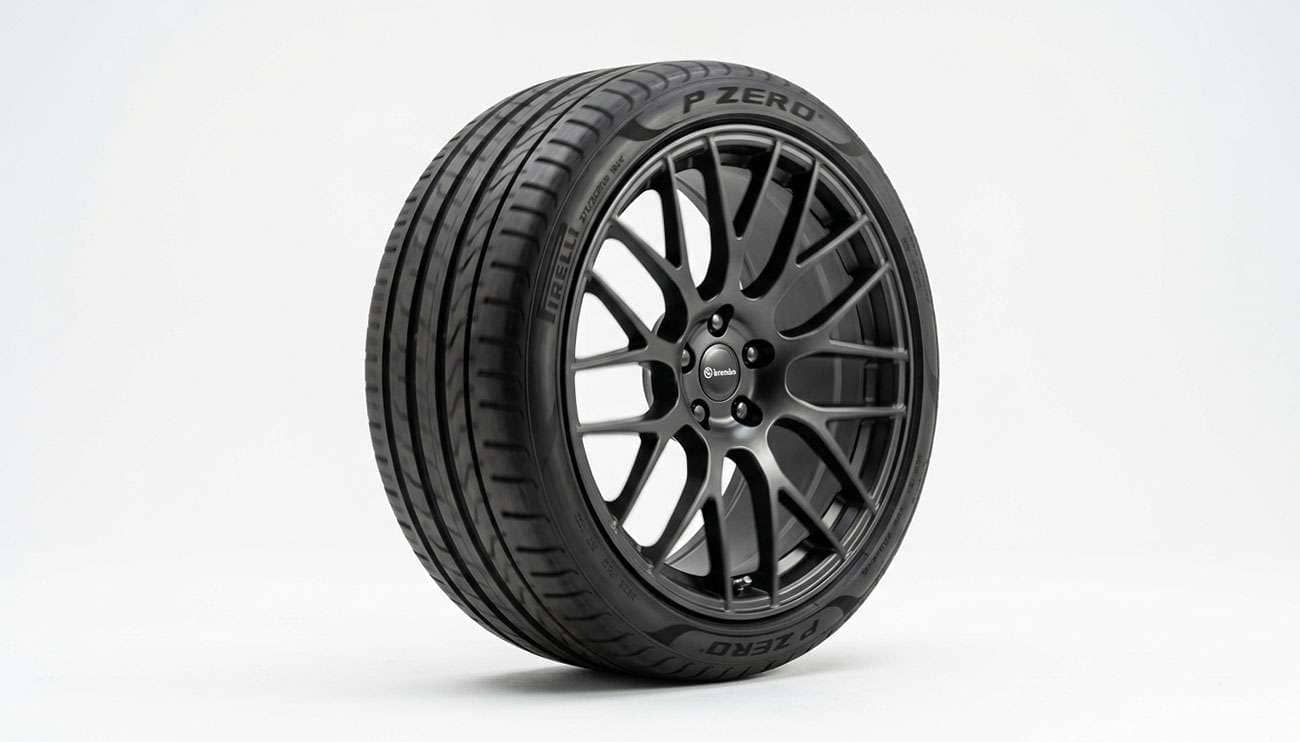
Buried in every tire's spec sheet, a few lines under the load index and tread depth, sits a number most drivers never read: revolutions per mile. It looks like trivia. It is not. That single figure is the cleanest way to predict how a tire will change your gearing, your highway cruise RPM, and whether your speedometer still tells the truth after a size swap. If you are choosing tires by diameter alone, you are reading half the spec sheet.
Here is the part that trips people up: revolutions per mile is not something you can pin down with a tape measure and a calculator. The number a manufacturer publishes is lower than the rolling distance you would expect from the tire's stated diameter, and there is a real reason for that gap. Let's break down what the figure measures, why simple geometry always overstates it, and how to actually use it when you spec a set.
Revolutions per mile is exactly what it sounds like: the number of complete rotations a tire makes while carrying your vehicle one mile down the road. A tire rated at 638 revolutions per mile turns 638 times to cover those 5,280 feet. A taller tire covers more ground per turn, so it logs fewer revolutions; a shorter tire turns more often to cover the same distance.
Manufacturers arrive at the published figure one of two ways. Some measure it directly on a test wheel under a standardized load, watching how far the tire actually travels per rotation. Others derive it from accumulated test data on similar constructions. Either way, the number reflects a loaded, rolling tire under weight, not a free-spinning circle in the air. That distinction is the whole story, and it is why the spec is so much more useful than the overall diameter printed next to it.
Think of revolutions per mile as the tire's true "gear teeth." Your drivetrain does not care how tall the tire looks sitting in the showroom. It cares how many times that tire has to spin to move you a mile, because that is what the transmission, axle, and speedometer pickup are all counting.
The textbook calculation is straightforward. One mile is 63,360 inches, so:
Revolutions per mile = 63,360 ÷ rolling circumference (in inches)
And rolling circumference is just π multiplied by the tire's overall diameter. To get that diameter from a size code, you convert the section width from millimeters to inches, multiply by the aspect ratio for sidewall height, double it, and add the wheel diameter. If you want a full walk-through of that conversion, our guide on how to read a tire size and find its diameter lays out every step.
Run the numbers on a 265/70R17 and you get an overall diameter near 31.6 inches, a circumference around 99.3 inches, and roughly 638 revolutions per mile. Clean and tidy. The problem is that the real tire never matches it. A mounted, weighted tire always logs more revolutions per mile than the geometry predicts, and the reason is physical, not a rounding error.
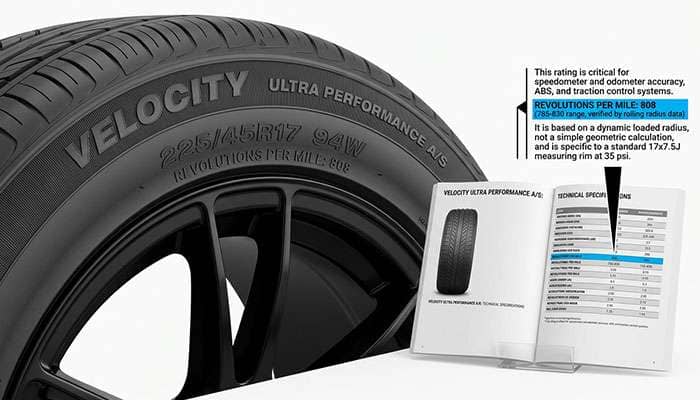
When a tire carries weight, the contact patch flattens. The loaded radius, measured from the axle center to the ground, is shorter than half the published overall diameter, which only describes the unloaded tire. A shorter effective radius means a shorter effective circumference, which means more turns per mile. On top of that, the tread is constantly transitioning from round to flat and back as it rolls, and that flexing produces a small amount of tread slippage. Both effects push the real revolutions-per-mile count above the simple calculation. So treat the formula as a fast estimate for comparing sizes, not as a calibrated value. When precision matters, the manufacturer's published figure wins.
Two tires of the same nominal size can post different revolutions-per-mile figures, and the same tire can drift over its life. Here are the variables that move the number, and which direction they push it.
Factor |
What Happens |
Effect on Revs/Mile |
|---|---|---|
Larger overall diameter |
Taller tire covers more ground per turn |
Fewer revolutions |
Smaller overall diameter |
Shorter tire covers less ground per turn |
More revolutions |
Underinflation |
Loaded radius shrinks as the tire squats |
More revolutions |
Heavy load |
Contact patch flattens further |
Slightly more revolutions |
High speed |
Centrifugal force grows the diameter |
Slightly fewer revolutions |
Tread wear |
Shallower tread reduces the radius |
Slightly more revolutions |
Diameter is the dominant lever by a wide margin, and diameter is set by the size code. Width feeds in through the section measurement, which is why understanding the difference between section width and tread width helps you predict how a size change reads on paper. Sidewall height does the heavy lifting on overall diameter, so the aspect ratio number matters as much as the wheel size; our breakdown of what the aspect ratio actually controls shows why a 70-series and a 60-series in the same width are not the same tire. The remaining factors are real but secondary, the kind of thing that shifts your number by a percent or two rather than reshaping it.
This is where the spec earns its keep. Your axle ratio, say 3.55, was chosen by the factory to pair with a specific tire's revolutions per mile. The engine spins, the transmission and axle multiply that motion, and the tire's rotation rate determines how fast you actually move. Change the revolutions per mile and you have effectively changed the gearing, even though you never touched the differential.
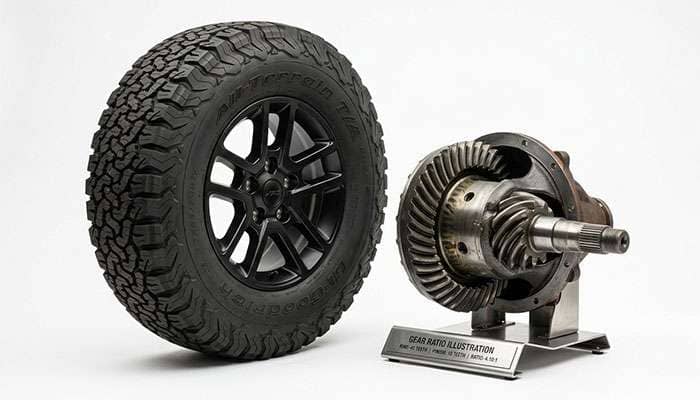
Fewer revolutions per mile, from a taller tire, behaves like a numerically lower (taller) gear. The engine turns slower at any given road speed, which can be quieter and more efficient on the highway, but it also means less mechanical advantage off the line. That is the exact sensation people describe when they say a truck "feels lazy" after going to bigger tires. The reverse is true too: a shorter tire with more revolutions per mile acts like a numerically higher (shorter) gear, sharpening acceleration at the cost of higher cruise RPM and worse fuel economy.
The relationship is proportional, which makes it easy to estimate. Your effective gear ratio after a tire change equals your stock ratio multiplied by the ratio of old diameter to new diameter. A 3.55 axle paired with tires that grow from 31.6 to 35.0 inches behaves like roughly a 3.20, a meaningful drop in mechanical advantage. That math is the foundation of every regearing decision, and it is why serious builds plan tire size and axle ratio together rather than one at a time.
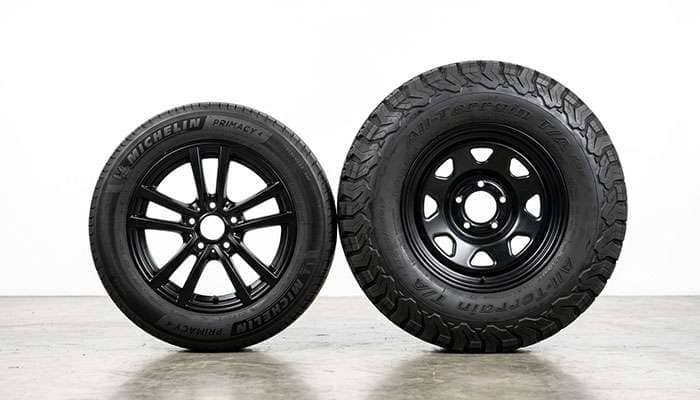
Numbers make this concrete. The table below starts from a common 265/70R17 and steps up through two popular upsizes, holding a stock 3.55 axle ratio. Diameters and revolutions are geometric estimates; published figures run a touch higher for the reasons covered above, but the comparison between sizes holds.
Tire Size |
Overall Diameter |
Revs per Mile (est.) |
Change vs. Stock |
Effective Ratio (from 3.55) |
|---|---|---|---|---|
265/70R17 |
31.6 in |
638 |
Baseline |
3.55 |
285/70R17 |
32.7 in |
617 |
−3.3% |
3.43 |
35x12.50R17 |
35.0 in |
576 |
−9.7% |
3.20 |
The jump to 35s drops revolutions per mile by nearly ten percent and pulls the effective ratio down to a 3.20, which is why a build like that usually calls for a regear toward 3.73 or 3.93 to restore stock drivability. The modest step to 285/70R17 is far gentler and often livable without touching the axle. If you are weighing those exact off-road sizes, our comparison of 31s versus 33s versus 35s pairs the revolutions math with real fitment and performance trade-offs, and the lift kit and tire size chart helps confirm what will actually clear before you commit.
Your speedometer and odometer count tire rotations and convert them to speed and distance using the factory revolutions-per-mile assumption. Change that figure and both readouts drift, predictably and in the same direction. Because the relationship is an inverse one, a tire with fewer revolutions per mile makes the speedometer read low: the gauge says 60 while you are actually doing closer to 66 on those 35s from the table.
The correction is the inverse ratio of the two revolution counts, applied to the indicated speed. Most modern vehicles can be recalibrated through the body control module or a programmer once you know your new tire's figure. We cover the full calibration picture, including the recalibration options, in our dedicated piece on how bigger tires affect your speedometer, so we will keep it short here: if your revolutions per mile moves more than a couple of percent, plan on recalibrating rather than living with the error.
Once you start reading the figure, the buying decision gets sharper. Three habits make it practical.
First, compare revolutions per mile, not just the size code, when shopping replacements. Two tires labeled the same size can differ by a percent or more depending on construction and tread depth, and that difference shows up at the speedometer and the pump. Second, keep your change inside a sensible window. Staying within roughly three percent of stock revolutions per mile generally keeps your speedometer honest and your gearing in its comfort zone without recalibration; this is exactly why proper plus-sizing targets a constant overall diameter, holding revolutions per mile steady while the wheel grows and the sidewall shrinks. Third, if you are deliberately going taller for clearance or stance, treat revolutions per mile as your early-warning system for a regear decision rather than discovering the lazy throttle response after the install.
If you are replacing in stock size, modern touring options such as the Nitto Crosstek 2 or the BFGoodrich Advantage Control hold their published revolutions-per-mile figures consistently and keep your calibration untouched. Going taller for a truck or SUV build is where the gearing conversation starts, and the right all-terrain in the right size keeps it manageable. Browse the full lineup at Performance Plus Tire, or jump straight to Nitto and Falken if you already know the brand, and check the spec sheet for revolutions per mile before you commit.
Revolutions per mile is the quiet spec that connects a tire's geometry to how your vehicle actually drives. It tells you what the diameter alone cannot: how the tire behaves under load, how it reshapes your effective gearing, and how far your speedometer will drift if you resize. The published number sits below the simple-math estimate for solid physical reasons, so trust the manufacturer's figure for precision and the formula for quick comparisons. Read that line on the spec sheet, keep your changes inside a sane window, and plan tire size and gearing as one decision. Do that and your next set will feel dialed in rather than merely taller.
It depends entirely on the tire's overall diameter. Common passenger and light-truck tires fall roughly between 600 and 850 revolutions per mile, with taller tires turning fewer times. A 31.6-inch tire logs about 638 revolutions per mile, while a 35-inch tire drops to around 576. Check the specific tire's spec sheet for its published figure.
Divide 63,360 (the number of inches in a mile) by the tire's rolling circumference in inches. Rolling circumference is pi times the overall diameter. The result is an estimate; a real tire under load turns slightly more often than this formula predicts, so the manufacturer's published figure is more accurate.
Because the tire carries weight. The loaded radius from axle center to road is shorter than half the unloaded overall diameter, which shortens the effective circumference. The constant flexing of the contact patch also causes slight tread slippage. Both effects raise the real revolutions per mile above the simple geometric estimate.
Yes, effectively. Fewer revolutions per mile from a taller tire behave like numerically lower, taller gearing, slowing engine RPM at cruise but reducing off-the-line response. Your effective ratio equals your stock axle ratio multiplied by the old diameter divided by the new diameter, which is why large tire jumps often call for a regear.
Staying within roughly three percent of your stock revolutions per mile usually keeps the speedometer error small and the gearing comfortable. Beyond that, plan to recalibrate the speedometer and consider whether a gear change is warranted to restore stock drivability.