
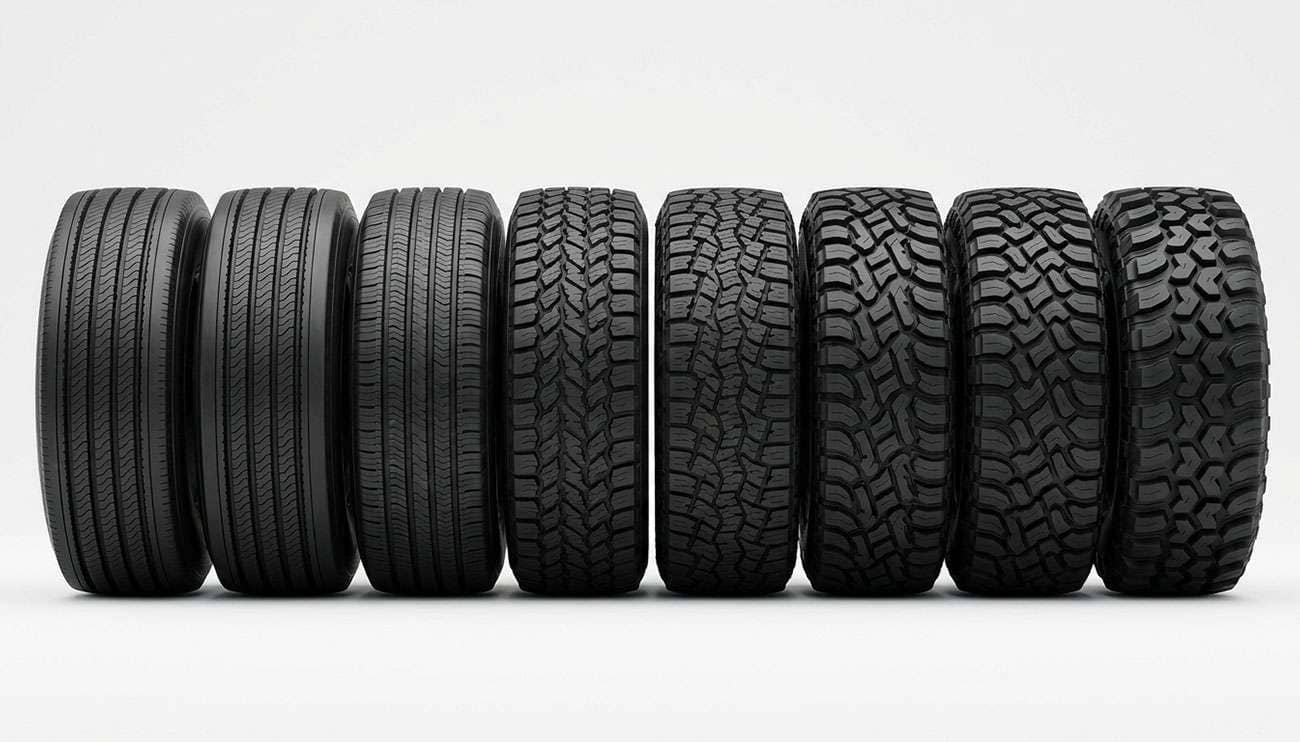
Almost every guide to off-road tire types sorts them by how aggressive the tread looks. That ranking is close to useless, because it does not tell you the one number that decides which tire belongs on your truck: the percentage of your annual miles that happen on pavement. A 4x4 that sees 90 percent asphalt and 10 percent forest road needs a fundamentally different tire than one that sees 40 percent asphalt, even if both owners describe themselves as off-roaders. Get that percentage honest, and the other eight decisions make themselves.
There is a second number nobody puts in these guides, and it costs people more than the first one. It is whether the tire carries the Three-Peak Mountain Snowflake symbol. Most drivers assume an aggressive off-road tread implies winter capability. In the most common case, the opposite is true, and the marking on your sidewall that keeps you legal in a traction-law state certifies nothing whatsoever about whether you will stop.
Work out roughly what share of your miles are paved. Most people overestimate their off-road use by a wide margin, because the memorable miles are the trail miles. Add up the commute, the grocery runs, the highway tow to the trailhead, and the honest number usually lands north of 80 percent for anyone with one vehicle.
Once you have it, this table settles most of the decision. Everything after it explains the reasoning and the exceptions.
Tire Type |
Best Pavement Mix |
3PMSF Available? |
Est. Cost Per Mile (Set of 4) |
Common Load Range |
|---|---|---|---|---|
Highway-Terrain (H/T) |
95 to 100 percent |
On select models only |
About 0.9 cents |
SL, XL, C, E |
All-Terrain (A/T) |
70 to 95 percent |
Widely, on most modern lines |
About 1.8 cents |
SL, XL, C, D, E |
Rugged-Terrain (R/T) |
50 to 80 percent |
Rarely |
About 3.0 cents |
C, D, E, F |
Mud-Terrain (M/T) |
Under 60 percent |
Almost never |
About 4.0 cents |
C, D, E, F |
Extreme-Terrain / Rock |
Under 40 percent |
No |
About 3.2 cents |
D, E |
Desert and Sand |
Trailered or minimal |
No |
About 9.3 cents |
Varies by application |
Dedicated Winter |
Seasonal, mostly paved |
Always, by definition |
Seasonal, see below |
SL, XL, C, E |
SxS and UTV |
Off-highway only |
No |
About 16.5 cents |
Ply-rated, 6 to 10 ply |
Cost-per-mile figures are estimates built from current catalog pricing on a set of four in a common size, divided by the manufacturer's published treadwear warranty where one exists and by typical observed service life where none does. They exclude fuel, which is covered separately below because on aggressive tires it is the larger number.
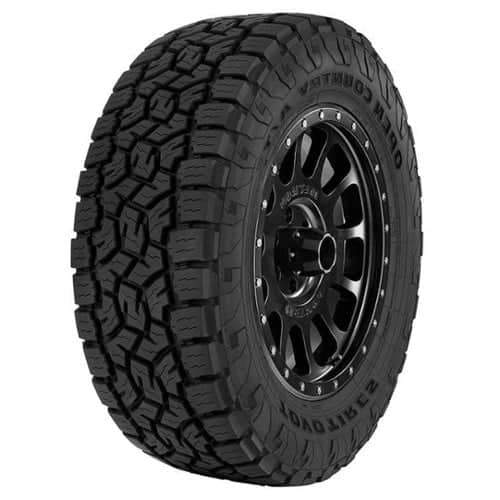
The all-terrain is the default answer for the overwhelming majority of 4x4 owners, and the segment has moved further in the last five years than any other. The defining spec is void ratio, the share of the tread face that is empty space between blocks. All-terrains generally run between 20 and 35 percent. Toward the low end you get quieter operation, longer tread life, and more rubber on dry pavement. Toward the high end you get better mud and snow ejection at the cost of noise and dry contact area.
What makes the modern A/T genuinely different from its predecessors is siping combined with a cold-flexible compound. Sipes are the small slits cut into the tread blocks, and they create biting edges that work in packed snow. This is why the A/T is the only aggressive off-road category where the Three-Peak Mountain Snowflake is common rather than exotic.
The Toyo Open Country A/T III is the reference point in the category and carries 3PMSF certification. Performance Plus Tire stocks it across 157 sizes from about USD 179 to USD 654 per tire. The Yokohama Geolandar A/T G015 covers 151 sizes starting near USD 96, and the Nitto Terra Grappler G2 runs 115 sizes from about USD 155. For a deeper ranking of the category, our 7 best all-terrain tires for SUVs expert test results 2026 breaks down the current field on measured performance.
Choose it when: pavement is 70 to 95 percent of your miles, you want one tire for the year, and you need real winter capability without a second set of wheels.
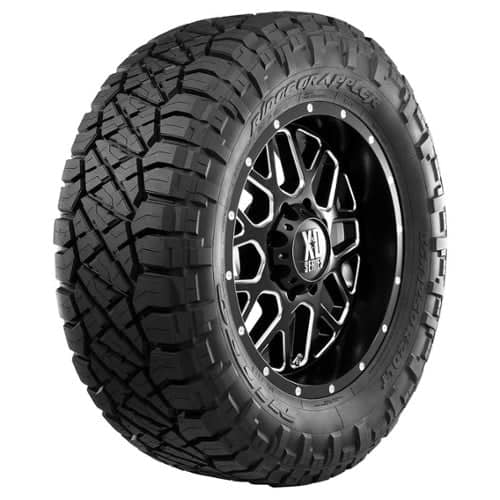
The rugged-terrain, sometimes called a hybrid, is the fastest-growing off-road category and the most misunderstood one. It splits the difference between A/T and M/T: mud-terrain shoulder aggression and sidewall styling, all-terrain center-tread manners and noise levels. For overlanding and mixed-surface duty it is a genuinely excellent compromise.
Here is the part that gets people in trouble. R/T tires look more capable than all-terrains, and in mud, rock, and dirt they are. In packed snow they are usually worse, and most of them do not carry 3PMSF. The Nitto Ridge Grappler is the category's best-known example and is not severe-snow rated, largely because it lacks the sipe density that packed-snow acceleration testing rewards. Independent comparison testing has put its packed-snow stopping distance meaningfully longer than the Toyo A/T III's, despite the Ridge Grappler being the more aggressive-looking tire by a wide margin.
That is the trap in one sentence: the tire that looks more winter-capable is the one that stops worse. Our full Nitto Ridge Grappler review covers where the tire genuinely excels, which is most places that are not snow.
Performance Plus Tire carries the Ridge Grappler across 102 sizes from about USD 228 to USD 882, the Toyo Open Country R/T across 61 sizes from about USD 241, and the Falken Wildpeak R/T01 across 49 sizes from about USD 313.
Choose it when: you are 50 to 80 percent paved, you want mud-terrain looks and capability without mud-terrain noise, and you either do not see snow or you run a dedicated winter set.
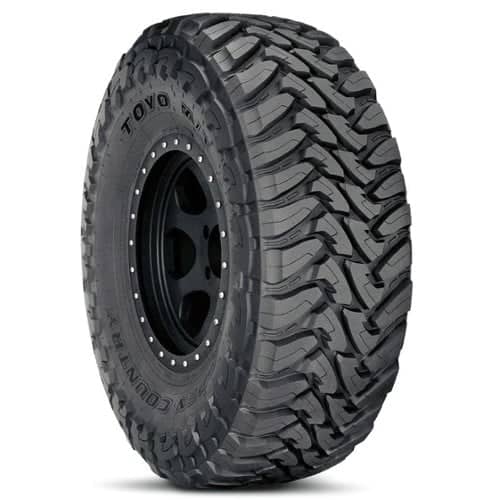
Mud-terrains push past a 35 percent void ratio, and the large gaps between blocks are the entire engineering point. Mud has to leave the tread as the tire rotates, or the tread packs solid and the tire turns into a slick. Wide voids plus block geometry designed to fling material outward is what self-cleaning means in practice.
The costs are proportionate to the benefit. Less rubber touching dry pavement means longer dry stopping distances. The large blocks generate substantially more noise. Tread life drops, and most mud-terrains carry no mileage warranty at all, which is itself a signal from the manufacturer about expected service life. Wet-pavement braking suffers because the large blocks squirm under load.
Nearly all mud-terrains carry the M+S marking, and almost none carry 3PMSF. For the distinction that matters, see the section below and our guide to all-terrain vs mud tires and the truth about off-road performance.
Current stock includes the Toyo Open Country M/T across 84 sizes from about USD 264 to USD 1,219, the BFGoodrich Mud-Terrain T/A KM3 across 68 sizes from about USD 198, and the Nitto Trail Grappler M/T across 64 sizes from about USD 299.
Choose it when: under 60 percent of your miles are paved and deep mud or technical terrain is a regular part of your use, not an occasional one.
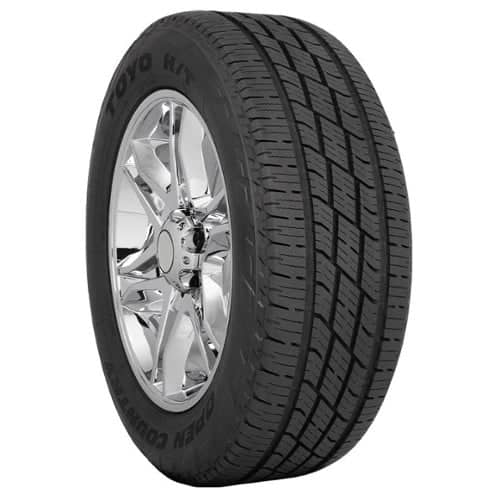
Highway-terrains are on this list because a large share of the people shopping for off-road tires should be buying these instead, and nobody tells them. If your truck's off-road duty amounts to a gravel driveway, a boat ramp, and a fire road twice a summer, an H/T will outperform an all-terrain on every metric that describes 98 percent of your driving: braking, noise, fuel economy, tread life, and ride quality.
The closed rib pattern maximizes rubber on pavement and minimizes rolling resistance. Tread life is the longest of any category here, and per-mile cost is roughly half that of an all-terrain. A handful of H/T models carry 3PMSF, though it is far from standard.
Performance Plus Tire stocks the Toyo Open Country H/T across 109 sizes from about USD 68 to USD 368, the General Grabber HTS60 across 78 sizes, and the Maxxis Bravo HT-770 across 80 sizes from about USD 108.
Choose it when: you are 95 percent or more paved and you have been talking yourself into an all-terrain for appearance rather than for use.
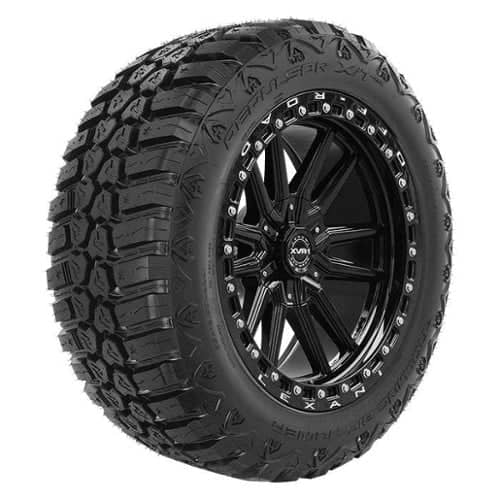
Extreme-terrain tires go beyond mud-terrain aggression with taller, more widely spaced lugs and heavily reinforced sidewalls designed to survive sharp rock at low pressure. Rock crawling depends on airing down so the carcass can deform around obstacles and grow the contact patch, and that only works if the sidewall can take repeated impact without cutting.
Sidewall construction is what you are actually buying. Three-ply polyester sidewalls are common, and the sidewall lugs are functional rather than cosmetic, providing bite when the tire is aired down and partially rolled under. Because these tires spend real time at low pressure against sharp rock, sidewall damage is the failure mode to understand before you run them, and our guide on tire sidewall damage and whether it is safe to drive covers what is repairable and what ends the tire.
The RBP Repulsor X/T RX is the current extreme-terrain option in stock, spanning 16 sizes from about USD 193 to USD 281.
Choose it when: technical rock is your primary use, you air down routinely, and highway comfort is not part of the decision.
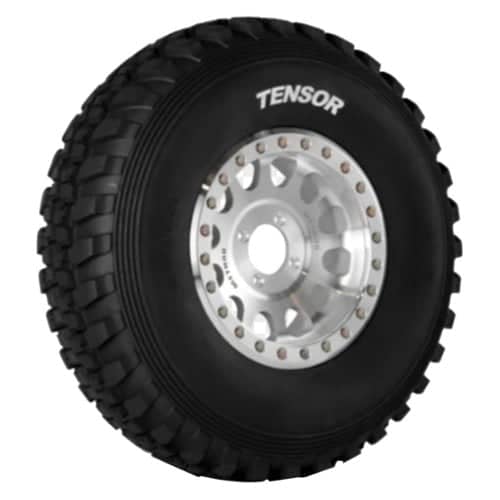
Sand is the one terrain where the usual logic inverts. Everywhere else, traction comes from biting into the surface. In sand, digging in is exactly how you get stuck. Sand tires are built for flotation: wide footprint, shallower and straighter tread, and a design that keeps the vehicle riding on top of the surface rather than trenching through it.
Desert-racing tires are a related but distinct animal, engineered for sustained high speed over rough open terrain where heat buildup and impact resistance dominate. These are specialist purchases with short service lives and the highest per-mile cost of any full-size category on this list.
Stock includes the Tensor DS30 Desert Series across 15 sizes from about USD 249 to USD 534, the EFX MotoRally across 14 sizes, and the Tensor DSR Desert Series Race from about USD 419.
Choose it when: dunes or open desert are the point of the vehicle and you trailer it or accept a short highway life.
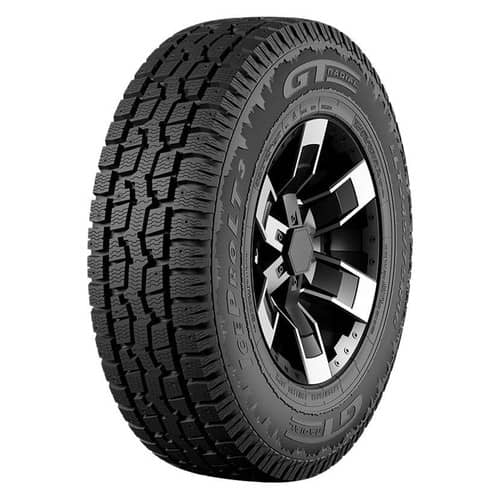
A dedicated winter tire is not an off-road tire, but it belongs in this comparison because for a large number of 4x4 owners it is the correct second set, and because it defines the ceiling that every 3PMSF all-terrain is measured against.
Winter compounds stay pliable below roughly 40 degrees Fahrenheit, where standard all-season and off-road compounds harden and lose grip regardless of tread depth. That temperature threshold, not snow depth, is the real trigger for switching. Siping density is far higher than any all-terrain, and studded options add mechanical bite on ice, which is the one surface where no rubber compound is sufficient on its own.
Every dedicated winter tire carries 3PMSF by definition. Current stock includes the GT Radial IcePro LT3 for light trucks across 20 sizes from about USD 257 to USD 393, the GT Radial IcePro SUV3 across 44 sizes, and the Continental ContiWinterContact TS870 P.
Choose it when: you face sustained sub-40-degree temperatures, ice is a regular condition, and you are willing to run a second set on separate wheels.
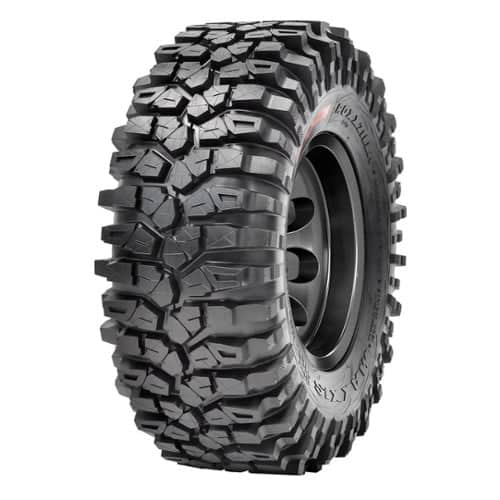
Side-by-side and UTV tires operate under rules that do not transfer from full-size vehicles. Vehicle weights are a fraction of a truck's, operating pressures are far lower, and many models use specialized soft compounds that trade tread life for grip in a way no street-legal tire could justify.
These are ply-rated rather than load-range rated, typically 6 to 10 ply, and per-mile cost is by far the highest on this list because service life is measured in single-digit thousands of miles. That is not a defect. It is the correct tradeoff for a machine that is trailered to the trail and driven hard once it arrives.
Stock includes the Maxxis Roxxzilla ML7 across 8 sizes from about USD 310 to USD 358, the Maxxis Ceros across 15 sizes from about USD 134, and the Milestar Patagonia SXT across 14 sizes.
Choose it when: the machine is a UTV or side-by-side. Full-size tire logic does not apply here.
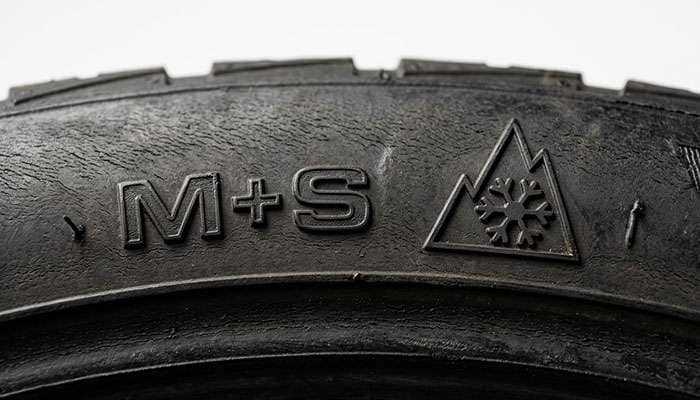
This is the section that should change what you buy, and it is the one no other off-road tire type guide includes.
The M+S marking is awarded on tread geometry alone. A tire qualifies based on the proportion of its tread dedicated to grooves and voids, generally around 25 percent or more. No vehicle is driven. No snow is involved. Nothing is measured except the shape of the tread. Because mud-terrains by definition have enormous void ratios, virtually every mud-terrain on the market carries M+S automatically.
The Three-Peak Mountain Snowflake is a different instrument entirely. It was introduced in 1999 by the U.S. Tire Manufacturers Association together with the Rubber Association of Canada, precisely because M+S had turned out to certify nothing useful. To earn it under FMVSS 139, a tire must be tested to ASTM F1805, which measures acceleration traction on medium-packed snow using an instrumented vehicle. The tire has to deliver at least 110 percent of a standardized reference tire's traction to pass.
Now put those two facts against how traction laws are written. Colorado's passenger vehicle traction law accepts tires carrying the mountain-snowflake icon or M+S with at least 3/16-inch tread depth. Washington's traction-tire definition likewise accepts either M+S or 3PMSF. So a truck on 35-inch mud-terrains is fully compliant when the traction law goes active on I-70, and its packed-snow braking is worse than a 3PMSF-rated all-terrain that looks half as serious.
Two more details worth carrying with you. First, ASTM F1805 measures acceleration only. It does not test braking, cornering, or ice, so 3PMSF is a floor rather than a complete picture. Second, the identical snowflake symbol can be applied in Europe under UNECE R117, a different protocol, and compliance with one does not establish compliance with the other. If snow performance is a real requirement, look for a tire whose manufacturer states ASTM F1805 testing rather than treating the symbol as self-explanatory. Our complete guide to the snowflake tire symbol goes further into what the mark does and does not promise.
Tread life is the cost people plan for. Fuel is the cost that quietly exceeds it.
Aggressive off-road tires raise rolling resistance through three mechanisms at once: greater unsprung and rotational mass, tread blocks that deform and squirm under load, and in most cases a taller overall diameter that changes effective gearing. Owners moving from a highway-terrain to a mud-terrain on a half-ton truck commonly report losing somewhere in the range of one to three miles per gallon. At 12,000 miles a year and a starting point of 20 mpg, a 2 mpg loss is roughly 67 additional gallons annually.
Stack that against the tread-life difference and the gap widens further. A highway-terrain set running to a 65,000-mile warranty costs roughly 0.9 cents per mile. A mud-terrain set with no mileage warranty at all, realistically retired near 35,000 miles, runs closer to 4.0 cents per mile. Over 12,000 annual miles that is a difference of about USD 372 in rubber, before fuel enters the calculation.
None of this argues against buying a mud-terrain. It argues against buying one you do not need, which is the more common mistake by a considerable margin. If you genuinely wheel, the cost is the price of capability. If you do not, you are paying an annual premium for appearance and giving up braking distance in exchange. For a closer look at how these categories wear in service, see our breakdown of off-road tire tread life.
1. What is your honest pavement percentage? Above 95 percent, buy a highway-terrain. Between 70 and 95, buy an all-terrain. Between 50 and 80 with real trail use, consider a rugged-terrain. Below 60 with regular mud, buy a mud-terrain.
2. Do you face sustained temperatures below 40 degrees Fahrenheit? If yes, your off-road tire needs 3PMSF, or you need a dedicated winter set. This question overrides the first one. A rugged-terrain plus a winter set beats a compromise tire that does neither job.
3. What does your payload actually require? Load range is not a styling choice. Moving from an SL or P-metric tire to an E-load changes required inflation pressure, ride quality, and the load your wheels must support. Confirm the numbers before you commit, using our guide on how to read tire load range and ply ratings.
Answer those three honestly and the eight types collapse to one obvious choice. You can browse the full range of off-road tires at Performance Plus Tire once you know which category you are shopping.
The eight off-road tire types are not a ladder from mild to serious, with better tires at the top. They are eight different answers to eight different questions, and the aggressive end of the range carries real penalties in braking, noise, fuel, and tread life that only make sense when the terrain demands them.
The single most valuable thing you can take from this guide is the M+S distinction. An enormous number of drivers are running aggressive off-road tires through winter believing the tread pattern is doing work it is not doing, protected by a legal marking that was never a performance standard. Check your sidewall for the mountain and snowflake. If it is not there and you drive in cold weather, that is the gap worth closing first.
The eight categories are highway-terrain, all-terrain, rugged-terrain hybrid, mud-terrain, extreme-terrain and rock-crawling, desert and sand, dedicated winter, and SxS or UTV tires. They differ primarily in void ratio, sidewall construction, and compound, and each is suited to a different balance of paved and unpaved mileage.
Generally no. Mud-terrain tires carry the M+S marking because of their large void ratio, but almost none carry the Three-Peak Mountain Snowflake certification. They lack the sipe density and cold-flexible compound that packed-snow traction requires, and a 3PMSF-rated all-terrain will typically stop shorter on packed snow despite appearing far less aggressive.
M+S is granted based on tread geometry alone, requiring roughly 25 percent or more of the tread to be grooves and voids, with no performance testing. 3PMSF requires the tire to pass ASTM F1805, an instrumented test measuring acceleration traction on medium-packed snow, at a minimum of 110 percent of a standardized reference tire.
Rugged-terrain tires use mud-terrain shoulder aggression and sidewall design with a more highway-friendly center tread, placing them between all-terrain and mud-terrain. They offer better mud, rock, and dirt performance than all-terrains, but usually worse packed-snow performance, and most are not severe-snow rated.
Yes. Increased rotational mass, tread block squirm, and larger overall diameter all raise rolling resistance. Owners stepping from highway-terrain to mud-terrain tires on a half-ton truck commonly report losing one to three miles per gallon, which over 12,000 annual miles often exceeds the additional cost of faster tread wear.
In most cases yes. Colorado's passenger vehicle traction law accepts tires marked with either the mountain-snowflake icon or M+S with at least 3/16-inch tread depth, and Washington's traction-tire definition accepts either marking. Because mud-terrains carry M+S by default, they satisfy the legal requirement without demonstrating any tested snow capability.



