
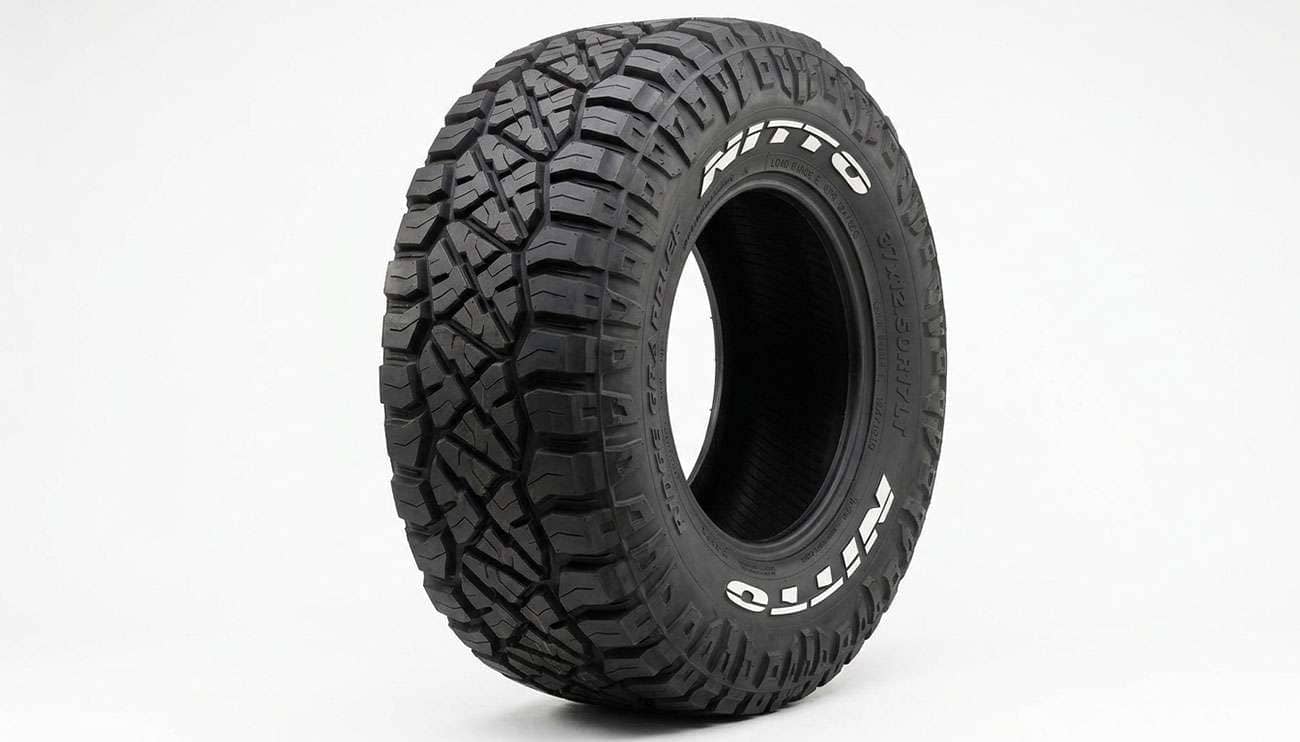
Yes, Nitto Ridge Grapplers are good tires, but whether they are good for you comes down to one variable every other review dances around: your duty mix. This is a hybrid terrain tire with a high-void tread and light siping, which means it is outstanding for pavement-plus-trail trucks, heavy towing, and drivers who want mud-tire looks without mud-tire noise, and it is the wrong choice for icy winters and pure-commuter duty. It carries no Three-Peak Mountain Snowflake rating and no mileage warranty, and both of those facts matter.
Here is my problem with everything else you will read about this tire. The reviews all say some version of "great all-around tire, decent in light snow," and then you go read actual owner reports and they flat-out contradict each other. One guy plows his driveway with them every winter and swears by them. Another guy got stuck in two inches because the tread packed up. They are both telling the truth, and I will explain why in a minute, because the answer depends on which kind of snow and which kind of driving you actually do. That is the whole review, right there: this tire is not good or bad, it is right or wrong for your specific mix. So let us sort out which one you are.
Your Duty Mix |
Verdict |
What You End Up Buying |
|---|---|---|
Pavement daily, gravel and trails on weekends |
Yes. This is the exact truck the Ridge Grappler was invented for |
A set of Ridge Grapplers in your stock or one-up size |
You want the aggressive look without mud-tire noise and wear |
Yes. This is the category the Ridge Grappler created in 2016 |
Ridge Grapplers, and you skip the mud-terrain premium entirely |
Heavy towing or hauling with highway miles |
Yes. Load ranges up to F make it one of the strongest tow tires in the class |
Load range E or F Ridge Grapplers matched to your door placard |
Snow-belt daily driver, regular ice and slush |
No. No 3PMSF rating and light siping; pick a snow-rated all-terrain |
A 3PMSF-certified all-terrain, or Ridge Grapplers plus a winter set |
Deep mud or serious rock crawling every weekend |
No. Step up to a true mud-terrain like the Trail Grappler |
A dedicated mud-terrain and the noise that comes with it |
Commuter truck chasing lowest cost per mile |
No. A milder all-terrain or highway tire wears longer and drinks less fuel |
A touring all-terrain with a 50,000-plus mile warranty |
I am Hank Feldman, and I have been selling tires since before "hybrid terrain" was a phrase anybody used. We stock the Ridge Grappler in over a hundred sizes, and I have watched a decade of these tires roll out of our shop and come back for rotations, so what follows is not a press-kit summary. It is what the tire actually does.
Let me tell you what the truck world looked like before the summer of 2016. You had two choices. All-terrains: civilized, decent everywhere, a little boring to look at. Mud-terrains: gorgeous, aggressive, capable, and loud enough to drown out your radio by 40,000 miles, wearing out fast the whole way. Customers stood in my showroom every single week wanting the mud-tire look with the all-terrain manners, and for decades the honest answer was "pick your compromise."
Then Nitto shipped the Ridge Grappler and split the difference for real. The trick is what they call a dynamic hybrid tread: the center of the tire runs tighter block spacing with a variable-pitch pattern that Nitto tuned using sound equipment to cancel the drone that makes mud-terrains howl, while the outboard tread and shoulders go full aggression, with deep staggered lugs, alternating Z-grooves that clear mud, and stone ejectors that spit gravel before it can drill into the casing. Quiet in the middle where the highway lives, nasty on the edges where the trail lives. Every major brand has copied the formula since, and if you want to see exactly where the hybrid slot sits in the lineup, our H/T vs A/T vs M/T guide lays out the whole spectrum.
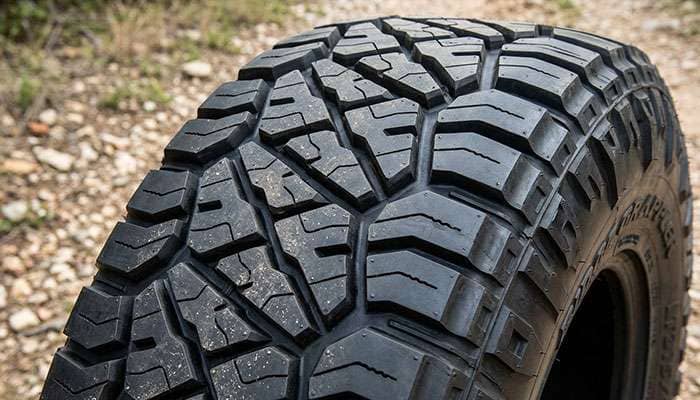
Underneath, it is a two-ply reinforced polyester casing offered in load ranges C, D, E, and F. That F rating is rare in this class and it matters, and we will get to why in the towing section. But first, the question I get most.
For most trucks, yes, and honestly better than the tread pattern has any right to be. That variable-pitch center is the reason. A fresh set of Ridge Grapplers on a crew cab is quieter than tires this aggressive looked ten years ago, and most owners report the noise stays civil deep into the tread life as long as rotations happen on schedule. Skip your rotations and any blocky tire will chop, and a chopped Ridge Grappler will remind you about it at 65 mph.
Now the honest trade-offs, because they are real. This is a heavy tire. Thick casing, deep tread, big shoulder lugs, all of it is mass, and mass costs you a little fuel and a little throttle response versus the highway tire that came off. Steering is stable but relaxed; the tall blocks flex a beat before the truck responds, which is normal for the class. And the ride runs firm in the heavy load ranges. If your half-ton does not tow anything serious, do not let anybody upsell you into a load range F tire; the C and D sizes ride noticeably softer, and matching load range to actual duty is the single biggest comfort decision you will make with this tire. If your truck splits time between the commute and the dirt, our guide to daily driving on off-road tires covers the rest of the ownership picture.
In our catalog the Ridge Grappler runs from 16 to 24 inch fitments across more than a hundred sizes, from stock-size metric fitments in the mid 200-dollar range up to big flotation sizes past 800, so there is a version of this tire for a bone-stock Tacoma and a version for a lifted dually, and they are not the same ownership experience. Size and load range are the whole ballgame.
Here is the section where I settle the argument, because this is where the owner reports split, and both camps are right.
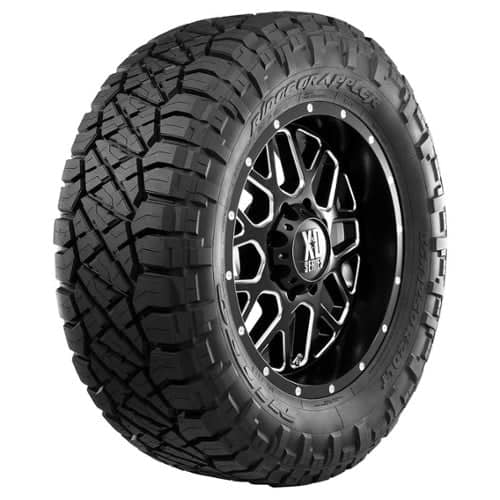
Start with the facts. The Ridge Grappler does not carry the Three-Peak Mountain Snowflake symbol. That rating requires a tire to pass the ASTM F1805 test, beating a reference tire's acceleration traction on medium-packed snow by a set margin, and Nitto never certified this tread for it. Look at the pattern and you can see why: the tread blocks carry far less siping than a snow-rated all-terrain. Siping is what grips snow and wet ice, thousands of little knife-cut edges that open up under load. The Ridge Grappler traded siping density for solid blocks that grip rock and resist chunking, because that is what a hybrid terrain is for.
So why does one owner plow his driveway with them happily while another gets stuck in two inches? Because snow is not one surface. On cold, packed, plowed snow, the Ridge Grappler's big biting edges and open shoulders do respectable work, and plenty of owners in dry-cold states run them year-round without drama. In deep snow or the wet, heavy stuff that falls right around freezing, the story flips: that high-void tread packs full of dense snow, the voids stop clearing, and suddenly you are riding on snow-slicked rubber donuts. Same tire, different snow, opposite outcome. Wet ice is worse still; with light siping there is simply not much edge to bite, and no honest tire man will tell you otherwise.
The verdict writes itself. Mild winters or dry-cold packed snow: run them and do not worry. Real snow-belt duty with ice and slush cycles: either pick a 3PMSF-certified all-terrain instead, and our KO3 vs Ridge Grappler head-to-head covers the strongest snow-rated rival directly, or run Ridge Grapplers three seasons and a dedicated winter set when it counts. What you should not do is buy the aggressive look for an icy commute and hope. Hope is not a traction compound.
This is quietly one of the best towing tires in the class, and the load range F option is the reason. Most hybrid and all-terrain lines top out at load range E. The Ridge Grappler's F-rated sizes carry more air and more load; a common configuration carries a 126 load index, which works out to 3,750 pounds per tire at its maximum 80 psi. Four of those under a diesel pickup is 15,000 pounds of rated tire capacity, which is why you see so many Ridge Grapplers under gooseneck and fifth-wheel rigs.
The mechanism matters here, so let me give it to you straight. A tire's load capacity is a function of its air pressure; the casing is just the container. Tow heavy on the pressure you daily-drive at and the sidewall flexes more per revolution, flex builds heat, and heat is what kills a loaded tire at highway speed. So the rule is simple: air up to the inflation your load actually requires before you hook up, check it cold, and drop back down for empty driving so you are not beating your kidneys and wearing the tread centers. Long-term owner reports towing 10,000-pound trailers at max pressure describe the truck staying planted even in crosswinds, and that tracks with what our towing customers tell us. One more shop rule that applies double on a heavy rig: after any tire install, re-torque the lug nuts at 50 to 100 miles, per Tire Industry Association guidance. And keep those deep sidewall lugs in mind for what they are, armor. Sidewall cuts are the wound that ends a tire's life on the spot, and our guide to tire sidewall damage explains exactly why there is no fixing one.
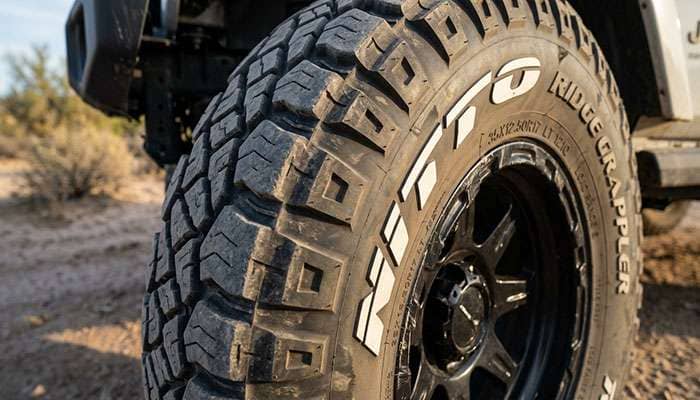
Here is a fact the glowing reviews tend to bury: the Ridge Grappler comes with no treadwear mileage warranty. None. Most of its all-terrain competition carries 50,000-mile paper. Nitto sells this tire on performance, not on a mileage promise, and you should walk in knowing that.
Now the good news: the real-world numbers are better than "no warranty" sounds. Rotated on time and run at placard pressures, most owners see somewhere in the 40,000 to 50,000 mile range, and the tire has a reputation for wearing evenly rather than chunking or cupping, which is the failure mode that ruins aggressive treads early. Light-truck sizes are exempt from UTQG treadwear grading, so there is no government number to point at either; what you have is a decade of owner history, and the history is solid.
The levers that decide where you land in that range are the same three I preach for every tire in the shop. Rotate every 5,000 miles, no exceptions, because the steer axle scrubs shoulders while the drive axle eats centers, and only rotation averages the two. Check cold pressure monthly; a tire loses roughly one psi a month just sitting there through normal permeation, and an underinflated hybrid terrain wears its shoulders fast and runs hot. And get an alignment when you install them, especially on a lifted truck, because a quarter degree of extra toe drags every one of those big blocks sideways down the road and feathers the tread long before your eye catches it. Do those three things and this warranty-free tire will quietly outlast plenty of tires that came with paper.
Here is where the hybrid actually sits between its neighbors, in the numbers that decide the purchase.
Feature |
All-Terrain (e.g. Terra Grappler G3) |
Ridge Grappler (Hybrid) |
Mud-Terrain (e.g. Trail Grappler) |
|---|---|---|---|
Void ratio and tread aggression |
Moderate; tight blocks, road-first |
High; tight center, aggressive shoulders |
Very high; maximum bite everywhere |
Siping and snow rating |
Dense siping; many carry 3PMSF |
Light siping; no 3PMSF |
Minimal siping; no 3PMSF |
Highway noise |
Quietest of the three |
Mild hum; variable-pitch center keeps it civil |
Loud, and louder as it wears |
Mileage warranty |
Typically 50,000 miles or more |
None; 40,000-50,000 typical real-world |
None; 30,000-40,000 typical real-world |
Load range options |
Through E in most sizes |
C, D, E, and F |
Mostly D and E |
Best for |
Commuting, mileage, snow states |
Pavement-plus-trail trucks, towing, looks |
Deep mud, rocks, dedicated wheelers |
If that middle column reads like your truck, you found your tire. If the left column keeps winning rows, take a look at our Nitto Terra Grappler G2 review, because the milder Grappler with a mileage warranty and better snow manners might be the smarter money for your mix.
Forty years of watching people buy tires has taught me that the expensive mistake is almost never the tire itself. It is buying the wrong category for the duty and paying for it in installments.
Buy the Ridge Grappler for an icy commute it was never built for, and the cost shows up as following-distance pucker all winter and, worst case, one slide into a curb that bends a wheel and tweaks an alignment, and now you are shopping for parts on top of regret. Buy a mud-terrain for the look when a Ridge Grappler would have done, and you pay a decibel tax every mile plus a tread life penalty of 10,000 miles or more, which at mud-terrain prices is real money left on the road. Buy a mild all-terrain to save up front when you actually tow heavy, and you are flirting with the one that really hurts: an overloaded, overheated tire failure at speed with a trailer pushing you. And whichever way you go, chase the sizing honestly; oversizing into 35s for looks costs fuel, braking, and drivetrain wear every single day, and our 31s vs 33s vs 35s guide runs that math before you commit.
Match the duty mix from the first table and every one of those costs disappears. That is the whole trick, and it is why I put the table first.
Step 1: Be honest about your duty mix. Count your last 20 drives: how many touched dirt, how many touched snow, how many towed. The tire follows the count, not the daydream.
Step 2: Find your row in the first table. If the Ridge Grappler row is you, move to step 3. If the snow or mud rows are you, follow the redirect; you will thank me in February.
Step 3: Match load range to duty, not to bragging rights. Read your door placard, know your real towing weight, and take C or D if your truck qualifies; the ride is worth it. Take E or F only when the math says so.
Step 4: Size honestly. Stock or one size up keeps the truck's manners; big flotation sizes change the whole vehicle and the whole budget.
Step 5: Protect the investment. Re-torque at 50 to 100 miles, rotate every 5,000, check cold pressures monthly, align on install. No warranty means your maintenance is the warranty.
So, are Nitto Ridge Grapplers good tires? They are one of the best ideas the tire business has had this century, and a decade of copycats proves it. For the pavement-plus-trail truck, the tow rig, and everybody who wants the aggressive look without the mud-tire tax, they are not just good, they are the default answer. For the icy commute and the mileage-first commuter, they are the wrong tool wearing the right look, and the honest move is a snow-rated or touring all-terrain instead.
We stock the Ridge Grappler deep, over a hundred sizes from 16 to 24 inches in load ranges C through F, alongside the whole Grappler family. Browse the full Nitto tire lineup at Performance Plus Tire, and if you are still not sure which row of that table your truck lives in, call the shop and describe your week. We have been matching trucks to tires for a long time, and we would rather sell you the right tire once than the wrong one twice.
The short version from a guy who has mounted a lot of these.
• The verdict depends on your duty mix: Pavement-plus-trail trucks and tow rigs love this tire; icy commutes and mileage-first commuters should pass.
• It invented the hybrid terrain category: Quiet variable-pitch center, aggressive shoulders and sidewall lugs, launched in 2016 and copied ever since.
• No 3PMSF and no mileage warranty: Fine on packed dry-cold snow, poor in deep or wet snow and on ice; real-world life runs 40,000 to 50,000 miles on maintenance alone.
• Load range F makes it a towing standout: Up to 3,750 pounds per tire at 80 psi in common F-rated sizes; air up to the load, then back down empty.
• Match load range and size to real duty: C and D ride softer for unloaded trucks; honest sizing protects fuel, braking, and your budget.
On cold, packed, plowed snow they perform respectably. In deep or wet snow the high-void tread packs full and traction drops sharply, and on ice the light siping gives little bite. They carry no Three-Peak Mountain Snowflake rating, so snow-belt daily drivers should choose a 3PMSF-certified all-terrain or add a winter set.
Most owners see 40,000 to 50,000 miles with 5,000-mile rotations, correct cold pressures, and good alignment. Nitto offers no treadwear mileage warranty on this tire, so consistent maintenance is what earns the mileage.
They are notably quiet for how aggressive they look. Nitto tuned the variable-pitch center tread with sound equipment to cancel the drone typical of mud-terrains, and owners report the noise stays civil through the tread life as long as rotations happen on schedule.
Yes, among the best in the class. Load range F sizes carry up to 3,750 pounds per tire at 80 psi, and long-term owners towing 10,000-pound trailers report stable, planted behavior. Inflate to the pressure your actual load requires before towing and return to placard pressure when empty.
Neither. The Ridge Grappler is a hybrid terrain tire, the category it created in 2016, combining a quiet, tighter-blocked center tread with mud-terrain-style shoulder lugs and sidewall armor. It sits squarely between an all-terrain and a mud-terrain in noise, tread life, and off-road bite.
No. The Ridge Grappler carries no treadwear mileage warranty, unlike most all-terrain rivals that offer 50,000-mile coverage. Real-world tread life still runs 40,000 to 50,000 miles for well-maintained sets, but the mileage is earned through rotations and pressure checks rather than promised on paper.



