
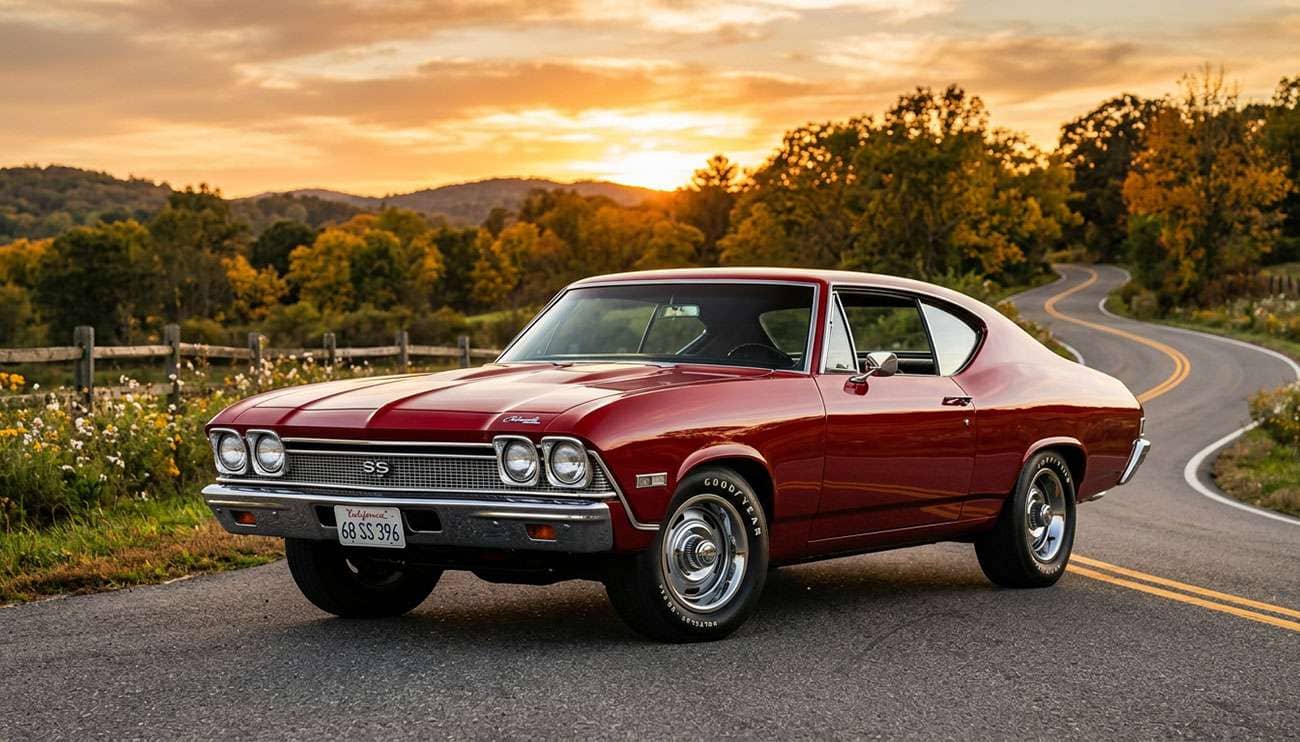
Tracking down the right tires for a classic or antique car is one of the more frustrating parts of any vintage build. The sizing systems are different, the terminology has changed, and a size that was everywhere in 1965 can be hard to find today. Add in the debate between staying period-correct and running modern radials, and it's easy to get lost. This guide cuts through the confusion — covering the most popular vintage tire sizes, what eras they came from, and how to find the right fit for your car whether you're restoring it to factory spec or building something custom.
Before you can find the right vintage tire, you need to understand how they were sized — because it's nothing like the metric system used today. Classic and antique cars used a variety of sizing conventions that evolved significantly through the 20th century, and knowing which system your car falls under is the first step to getting the right rubber.
Older antique vehicles — roughly pre-1960 — used a simple numeric sizing system. A tire labeled 6.00-16 means the tire is approximately 6 inches wide and fits a 16-inch rim. The number before the dash is the cross-section width in inches, and the number after is the rim diameter. You'll see sizes like 5.50-17, 6.50-15, and 7.00-15 on vehicles from the 1930s through the early 1950s. These are true bias-ply construction tires and were nearly universal on American vehicles of the era.
Through the 1960s, American automakers transitioned to an alphanumeric sizing system. Sizes like E78-14, F70-14, and G78-15 defined an entire generation of muscle cars and classic Americana. The letter indicates the load-carrying capacity and approximate width (A being narrowest, N being widest), the two-digit number is the aspect ratio, and the final number is the rim diameter in inches. This system was the standard on most American vehicles from the mid-1960s through the late 1970s.
If you know your vintage size but need to find a modern equivalent — or want to verify what size will fit your rims and wheel wells — the Antique/Classic Tire Size Conversion tool takes the guesswork out of the process. It cross-references vintage sizing with modern metric equivalents so you can find tires that actually fit.
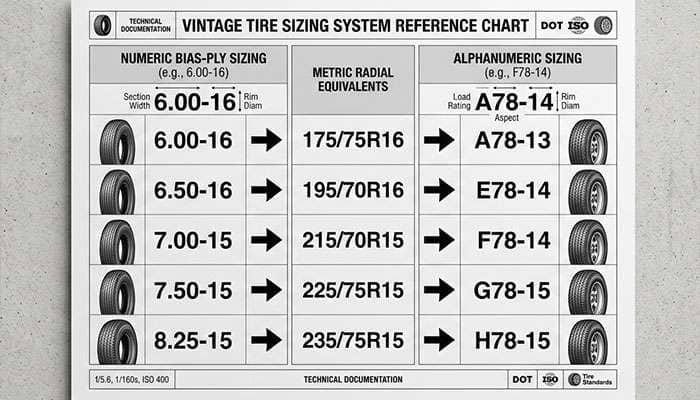
Different eras of American automotive history had their signature tire sizes. If you know your vehicle's year and model, you can generally narrow down the correct size quickly. Here are the most commonly sought vintage sizes organized by decade.
Cars from this era ran on tall, narrow tires with large rim diameters — typically 15, 16, or even 17-inch wheels. The most popular sizes include:
Vintage Size | Modern Equivalent (approx.) | Common Vehicles |
|---|---|---|
6.00-16 |
185/85R16 |
1940s–50s Ford, Chevy, Plymouth |
6.50-16 |
205/80R16 |
1940s–50s full-size sedans |
7.00-15 |
215/75R15 |
Early 1950s Buick, Oldsmobile |
6.70-15 |
205/75R15 |
1950s Chevrolet, Ford |
5.50-17 |
175/80R17 |
Late 1930s–early 1940s vehicles |
These sizes are available as antique tires in both bias-ply and modern radial construction, giving you the option to stay period-correct or upgrade to a safer, longer-lasting radial that fits the same rim.
The 1960s brought wider, lower-profile tires as American cars got bigger and more powerful. Alphanumeric sizing took over, and these are the sizes most commonly associated with golden-era muscle cars and classic cruisers:
Vintage Size | Modern Equivalent (approx.) | Common Vehicles |
|---|---|---|
E70-14 |
225/70R14 |
Early Mustang, Camaro, Chevelle |
F70-14 |
235/70R14 |
1967–69 Camaro, Firebird |
G78-14 |
225/75R14 |
Mid-60s full-size GM, Ford |
E78-14 |
205/75R14 |
Compact and mid-size 1960s cars |
F78-14 |
215/75R14 |
1966–68 Mustang, Falcon |
By the early 1970s, 15-inch wheels became dominant on American performance cars, and wider tires were the norm as the muscle car era reached its peak before emissions and fuel economy concerns changed everything:
Vintage Size | Modern Equivalent (approx.) | Common Vehicles |
|---|---|---|
F60-15 |
235/60R15 |
1970–71 Camaro Z28, Mustang Boss |
G70-15 |
235/70R15 |
Pontiac GTO, Chevelle SS |
H70-15 |
255/70R15 |
Full-size Chevys, Pontiacs |
G78-15 |
225/75R15 |
Early 70s full-size American cars |
L60-15 |
295/60R15 |
Trans Am, high-performance builds |
This is the question every classic car owner has to answer at some point. Bias-ply tires are period-correct for vehicles built before the late 1970s — they're what the car was designed around, and for show-quality restorations, authenticity matters. But radials offer real-world advantages in safety, handling, and longevity that are hard to ignore if you're actually driving the car.
If concours-level authenticity is your goal, bias-ply is the answer. The correct construction, tread pattern, and sidewall markings can make or break a judged show car. Bias-ply tires also have a distinctive look and ride character that radials simply don't replicate — a slightly softer, more wallowy feel that some classic car owners consider part of the driving experience. Several manufacturers still produce quality bias-ply tires in the most common vintage sizes specifically for the restoration market.
For drivers who actually put miles on their classics — road tours, weekend drives, shows that require driving in — radials are the practical choice. They run cooler, last longer, handle better in emergency situations, and offer dramatically better wet-weather grip than bias-ply. Many radials are available in vintage-correct sizes with period-appropriate tread patterns and sidewall styling, so the visual difference can be minimal. The classic tire category includes both bias-ply and radial options across the most popular vintage sizes.
One rule is absolute: never mix bias-ply and radial tires on the same vehicle. The handling characteristics are so different that mixing them creates a genuinely dangerous situation, especially in emergency maneuvers. Whatever you choose, run the same construction type on all four corners.
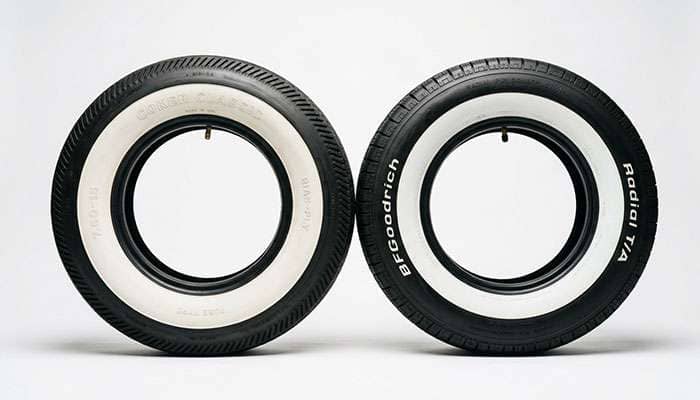
The tire itself isn't the only consideration for a classic car build — the sidewall style matters too. Whitewalls, raised white letters, and redline tires are as much a part of period-correct authenticity as the size itself, and the right sidewall can define the entire look of a classic vehicle.
Wide whitewalls — typically 3 to 4 inches — were the dominant style from the 1930s through the late 1950s. Narrower whitewalls, sometimes called "slim lines" at around 1 inch wide, became popular in the early 1960s as tastes shifted. If you're building a pre-1960 American car, a wide whitewall is almost certainly the period-correct choice. Whitewall tires are still manufactured in many of the most popular vintage sizes in both bias-ply and radial construction.
Raised white letter (RWL) tires defined the muscle car era of the late 1960s and early 1970s — think of the aggressive lettering on a Trans Am or a Chevelle SS. Redline tires, with their distinctive red pinstripe on the sidewall, were closely associated with 1960s sports and performance cars. Both styles remain available in the most popular sizes from the era, and choosing the right sidewall style for your build's year and model is just as important as getting the size correct.
Once you know your original size and preferred construction, the practical challenge is finding tires that actually fit and are available. The vintage tire market has improved significantly over the past decade, but it's still more limited than the modern tire market, and knowing where to look saves a lot of time.
Your first stop should always be the vehicle's original equipment specification — the tire placard in the door jamb or the owner's manual. If the car has been modified or the original information is gone, a marque-specific club or forum is usually the most reliable source for confirmed original fitment specs. Getting the original size right before you start shopping prevents buying tires that won't fit the rims you have.
Vintage rim widths were narrower than modern wheels, and not every tire width works correctly on every rim width. A tire mounted on a rim that's too narrow will be overinflated in appearance and handle poorly; too wide and you risk bead seating issues. Use the tire size calculator to confirm that your target tire size is compatible with your actual rim width before purchasing.
Not every tire retailer carries vintage sizes — most are focused on modern metric fitments. Performance Plus Tire carries a broad range of antique tires and classic sizes across both bias-ply and radial construction, including whitewalls, raised white letters, and standard blackwalls. Browsing by the original vintage size is the fastest way to find what's actually in stock and available to ship.
Getting the right tires for a vintage vehicle is part research, part decision-making, and part knowing where to look. The most popular sizes — from 6.00-16 on a 1940s Ford to G70-15 on a 1970 GTO — are still available today, and the choice between bias-ply authenticity and radial practicality is one every classic car owner has to make based on how the car will be used. Get the size right, match the sidewall style to the era, and you'll have tires that look correct and perform reliably whether you're on the show field or the open road.
Performance Plus Tire carries antique, classic, and vintage tire sizes across a wide range of constructions and sidewall styles. If you're not sure where to start, the antique/classic size conversion tool can help you cross-reference your original size with what's currently available. Browse the full selection and find the right tires for your build.
Here's a quick summary of what you need to know about vintage tire sizes.
• Two main vintage sizing systems: Pre-1960s cars used numeric sizing (e.g. 6.00-16); 1960s–70s cars used alphanumeric sizing (e.g. G70-15). Knowing which system your car uses is the starting point for everything else.
• The most popular vintage sizes are still available: Common sizes like 6.70-15, F70-14, G78-15, and G70-15 are still manufactured today in both bias-ply and radial construction by specialty tire makers.
• Bias-ply vs. radial is a real choice with trade-offs: Bias-ply is period-correct and preferred for show restorations; radials offer better safety, handling, and longevity for drivers who put miles on their classics. Never mix the two.
• Sidewall style is part of the fitment decision: Wide whitewalls, slim whitewalls, raised white letters, and redlines are each associated with specific eras. Matching the sidewall to the car's year is as important as the size.
• Use conversion tools before you buy: The antique/classic size conversion tool and tire size calculator help you find the right modern equivalent for a vintage size and confirm rim compatibility before purchasing.
F70-14 and G70-15 are among the most commonly sought sizes for late 1960s and early 1970s muscle cars. F70-14 was standard on many 1967–69 Camaros and Firebirds, while G70-15 appeared on GTOs, Chevelles, and other performance vehicles as 15-inch wheels became dominant in the early 1970s. The specific correct size depends on the exact year and model — always verify against the original equipment specification for your vehicle.
In most cases yes, as long as the rim width is compatible with the radial tire size you choose. Vintage steel and alloy wheels are generally strong enough to handle radial tires, but rim width matters — a tire mounted on a rim that's too narrow or too wide won't seat correctly or perform safely. Always verify rim width compatibility before purchasing radials for vintage wheels. If your rims are damaged or corroded, replacement is worth considering before mounting new tires.
Use the Antique/Classic Tire Size Conversion tool at performanceplustire.com. It cross-references numeric and alphanumeric vintage sizes with their closest modern metric equivalents, accounting for the differences in how the two systems measure width, aspect ratio, and overall diameter. Keep in mind that modern equivalents are approximations — exact overall diameter and width can vary slightly between manufacturers even within the same nominal size.
Yes. Several specialty tire manufacturers still produce bias-ply tires specifically for the classic and antique car restoration market. They're available in the most popular vintage sizes in both blackwall and whitewall styles. Availability is more limited than for radials, and prices tend to be higher due to lower production volumes, but period-correct bias-ply tires are still obtainable for most commonly restored American vehicles from the 1930s through the 1970s.
Wide whitewalls — typically 3 to 4 inches across — are period-correct for most American cars from the late 1940s through the mid-1950s. By the late 1950s and into the early 1960s, whitewall width began narrowing, with 1.5 to 2-inch "slim line" whitewalls becoming fashionable. The exact correct width depends on the specific year and model, so checking marque-specific sources or owner's clubs for confirmed original specs is always the safest approach.



