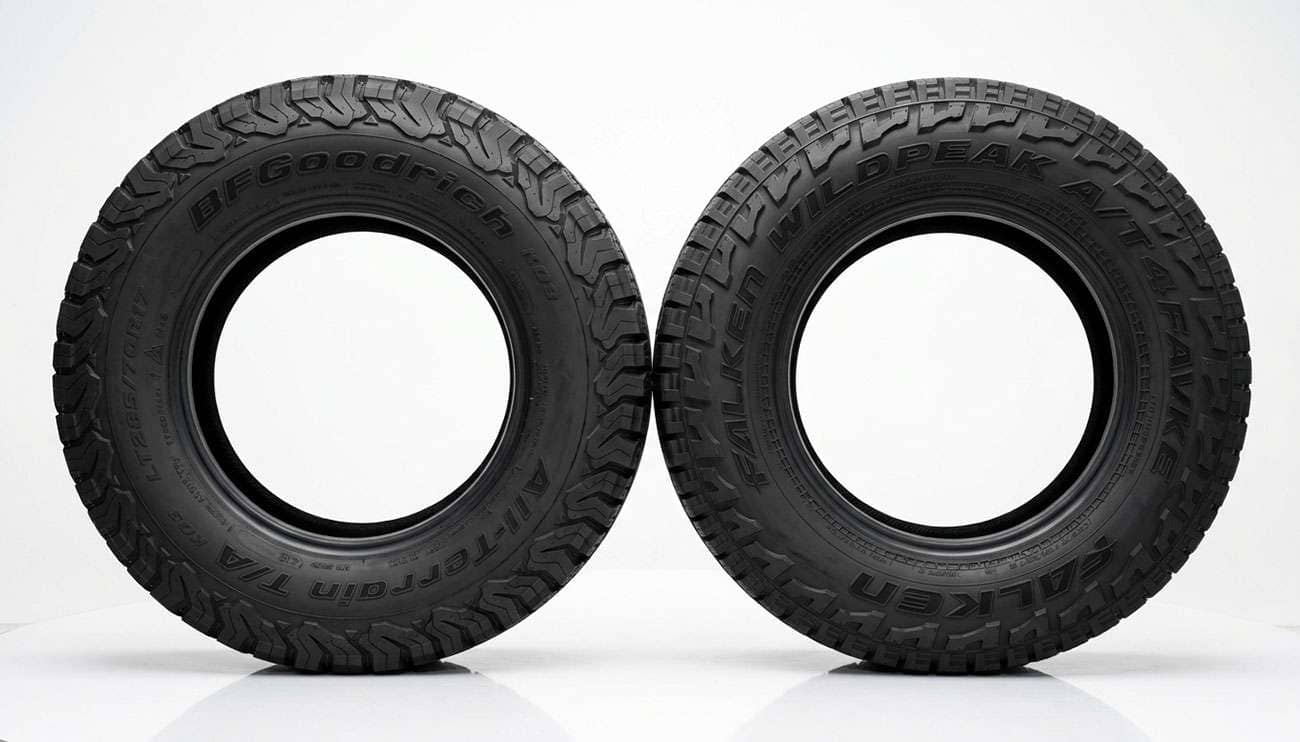
For most half-ton pickups and SUVs, the Falken Wildpeak A/T4W is the better buy. For trucks that already ride on LT tires, it is a much closer fight, and the BFGoodrich KO3 earns its spot on snow traction and sidewall toughness. The variable that decides it is not the tread pattern. It is construction. BFGoodrich builds every KO3 as an LT (light truck) tire. Falken builds the A/T4W both ways. Most head-to-heads tell you it depends on how you drive. It really depends on the first two letters of the size printed on your door placard.
I have been selling tires on Cherry Avenue in Long Beach since 1971, and I hear the KO3-or-Falken question every week. The folks asking usually own an F-150, a Tacoma or a 4Runner, and they have watched every video. Almost none of them have checked whether their truck left the factory on passenger tires or light truck tires.
Your Truck |
Placard Size Looks Like |
Better Pick |
Why |
|---|---|---|---|
Half-ton pickup or mid-size SUV, mostly pavement |
265/70R17 115T (no LT) |
Wildpeak A/T4W, passenger size |
Same construction as the factory tire, placard pressure still works, 65,000-mile warranty vs. 50,000 |
Half-ton that tows near its rating or runs sharp-rock trails |
265/70R17 115T (no LT) |
Either one in LT; KO3 if deep snow matters most |
You are choosing an LT casing on purpose, so plan on running more air than the placard says |
3/4-ton or 1-ton pickup |
LT265/70R17 Load Range E |
Close call: A/T4W for warranty, KO3 for snow bite and sidewall |
Both are LT E; Falken backs its LT sizes for 60,000 miles vs. 50,000 |
Crossover or small SUV |
225/65R17 or 235/65R17 (no LT) |
Wildpeak A/T4W, passenger size |
The KO3 sizes that fit crossovers are LT Load Range D, built for far more weight than the vehicle carries |
Lifted rig on 35s or bigger |
Aftermarket LT or flotation size |
Toss-up; KO3 if you want raised white letters or 39s and 40s |
Both come in heavy load ranges in big sizes; the KO3 adds white letters and taller sizes |
No. Every KO3 size BFGoodrich builds carries the LT prefix, from LT215/75R15 all the way up through the 40-inch flotation sizes. Even the sizes that fit crossovers, like LT225/65R17 and LT235/65R17, are Load Range D light truck tires. BFGoodrich markets the KO3 for CUVs, SUVs and pickups, and that is true in the sense that it fits them. It just fits them in one construction.
The Wildpeak A/T4W goes the other way. Falken builds it in passenger (P-metric and Euro-metric) sizes with Standard Load and Extra Load ratings, in LT sizes from Load Range C through F, and in a group of heavy-duty LT sizes aimed at towing. In 265/70R17, one of the most common half-ton sizes on the road, you can buy the A/T4W as a 115T passenger tire or as an LT265/70R17 123/120S Load Range E. The KO3 gives you LT, in Load Range C, D or E. No passenger option.
Why would BFGoodrich do that? Because the heavy casing is the whole point of the tire. The CoreGard Max sidewall, the bruise resistance, the Baja Champion badge: all of it sits on a light truck carcass. Falken took the other road and made the A/T4W match whatever your truck came with.
Here is what LT actually means on the sidewall. A light truck tire has a heavier casing and is built to carry its rated load at much higher pressure. A Load Range E tire reaches its maximum load at 80 psi. A Standard Load passenger tire reaches its maximum load at 35 psi. That difference in pressure is where this whole decision lives. Our guide to P-metric vs. LT tires goes deeper on the construction itself.
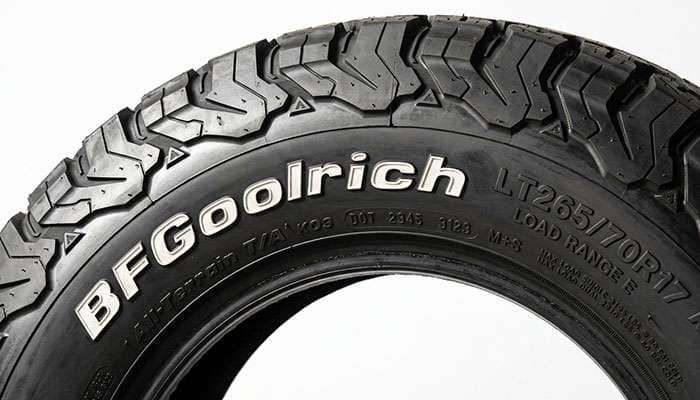
This is the part nobody puts in front of you. When a truck maker fits passenger tires to a pickup or SUV, Federal Motor Vehicle Safety Standard 120 has it count the tire's load rating divided by 1.10. A 265/70R17 115 passenger tire is rated for 2,679 lb at 35 psi. On a truck, the maker counts it as about 2,435 lb. The axle ratings and the pressure on your door placard were built around that derated number.
Now swap in an LT tire. LT tires follow their own load and inflation table from the Tire and Rim Association, and size for size they carry less weight at the same pressure than a passenger tire does. On the standard light truck table, an LT265/70R17 carries roughly 1,890 lb at 35 psi. To get back to the 2,435 lb the factory tire was carrying, it needs about 50 psi. For a Load Range C tire, like the lightest KO3 in this size, 50 psi is its maximum. There is no headroom left.
That is the mechanism behind the complaint I hear most from half-ton owners on E-range all-terrains: the truck rides like a buckboard. They are running 50 psi because that is what the tire needs. Or worse, they are running the 35 psi on the door sticker, and the tire is underinflated for the load on it. The tire makers' own technical bulletins are clear: when you change from P-metric to LT, the pressure comes from the tire maker's load table, not the placard.
Here is 265/70R17 in the versions a half-ton owner usually ends up choosing between:
265/70R17 |
A/T4W Passenger |
KO3 LT C |
KO3 LT E |
A/T4W LT E |
|---|---|---|---|---|
Load index / max load |
115 / 2,679 lb |
112 / 2,469 lb |
123 / 3,415 lb |
123 / 3,415 lb |
Max inflation |
51 psi |
50 psi |
80 psi |
80 psi |
Pressure to carry the factory tire's load |
Placard pressure |
About 50 psi, its limit |
Above placard; use BFGoodrich's chart |
Above placard; use Falken's chart |
Tread depth, new |
14/32 in |
15/32 in |
16/32 in |
17/32 in |
Weight |
47.6 lb |
46 lb |
55 lb |
53.2 lb |
Treadwear warranty |
65,000 miles |
50,000 miles |
50,000 miles |
60,000 miles |
Price each |
Read that table the way a half-ton owner should. The C-range KO3 weighs about the same as the passenger Falken, so weight is not the story at that level. Pressure is. The C-range KO3 has to run at its ceiling to do the job the passenger tire does at the placard number. Step up to the E-range KO3 and you buy headroom, but you also buy about seven extra pounds per corner and a tire that costs roughly $68 more than the passenger A/T4W in this size. That is about $272 a set before you turn a wheel.
On paper, the Falken, in every size. BFGoodrich backs the KO3 with a 50,000-mile limited treadwear warranty across the line. Falken backs the A/T4W for up to 65,000 miles on non-LT sizes and 60,000 miles on LT sizes. So the size of the gap depends on construction again:
Construction |
KO3 Warranty |
A/T4W Warranty |
Falken's Edge |
|---|---|---|---|
Passenger (P-metric / Euro-metric) |
Not offered |
65,000 miles |
15,000 miles over any KO3 |
LT, Load Range C through F |
50,000 miles |
60,000 miles |
10,000 miles |
A treadwear warranty is a floor and a contract, not a promise of how long your set will last. What it does is set the math if the tire wears out early. On most mileage warranties, the credit is the share of the warranty miles you fell short of. Say both sets wear out at 40,000 miles. On the KO3 you fell 10,000 miles short of 50,000, so the credit is about 20 percent of a new tire. On a passenger A/T4W you fell 25,000 short of 65,000, so the credit is about 38 percent. Same truck, same miles, nearly twice the money back. Our breakdown of tire mileage warranty proration shows how the paperwork works and what voids a claim.
Look at tread depth too. The passenger A/T4W starts with the least rubber in the 265/70R17 table, 14/32 inch, and still carries the longest warranty, so depth is not what Falken is betting on. In LT, the A/T4W starts deeper than the KO3: 17/32 inch against 16/32 in that size, and 18/32 to 19/32 inch in the 35-inch sizes, where every KO3 tops out at 16/32. I covered what wears a KO3 out early, and how to get the most out of one, in our review asking are KO3 tires any good.
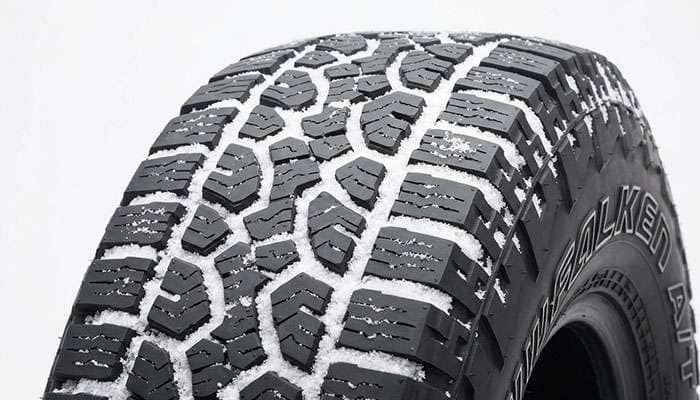
Both tires carry the Three-Peak Mountain Snowflake symbol, which means each one passed the industry's severe-snow traction test. That puts both ahead of an all-terrain with only an M+S marking. If you want the background on what that symbol does and does not promise, start with our piece on whether all-terrain tires are good in snow. Past the snowflake, the test results split, and the split lines up with construction in a way most comparison charts leave out.
The most-quoted on-road test of these two tires ran them on a 2024 Toyota Tacoma in 265/70R17. On wet pavement, the A/T4W stopped in about 171 feet against about 184 for the KO3. Dry, it was about 132 feet against 141. In snow it flipped: the KO3 stopped from 25 mph in just over 72 feet, and the A/T4W needed about 82. On ice, the Falken stopped from 12 mph in 47.5 feet, and the KO3 needed more than 53.
Now look at what was actually on the truck. The KO3 was an LT265/70R17 123/120S, Load Range E. The A/T4W was the 265/70R17 115T passenger tire. That is not a knock on the test. The KO3 does not come in a passenger version, so an LT E was a fair choice for it. But it means you were reading two things at once: tread design and casing construction. A passenger casing and an E-range casing do not behave the same way on pavement, and nobody has separated how much of that wet and dry gap belongs to each.
Independent tests in 2025 and 2026 have kept the snow result steady: the KO3 tends to win snow braking and acceleration, and the A/T4W tends to win on dry pavement. If you cross a mountain pass every winter week, the KO3's snow bite is worth paying for. If your winter means wet roads, the A/T4W's pavement numbers count for more.
Open the driver's door and read the placard on the jamb. If the size has no LT in front of it, the Wildpeak A/T4W in a passenger size is the better buy for most drivers. Here is the reasoning I give at the counter:
When does a KO3 make sense on a half-ton? When you want an LT casing on purpose. If you tow close to your rating, haul a slide-in camper, or run sharp-rock trails, the heavier casing earns its keep. Then you are comparing the KO3 against the LT A/T4W, not the passenger one, and you set pressure from the tire maker's chart. Our guide to load range vs. load index walks through which number matters for the weight you carry.
One more tip if you go KO3 on a half-ton. Look for the C-range in your size where BFGoodrich makes one. It is the lightest KO3 in the size and the least stiff. Just remember it needs about 50 psi to carry the factory load, and that is its limit. If you load the bed or hook up a trailer regularly, step up to the E.
Off-road trim packages sometimes leave the factory on LT tires. That is exactly why you read the placard instead of going by the badge on the tailgate.
Here it is a real fight, because both tires are LT and both come in Load Range E in the sizes heavy-duty trucks run. Your placard already calls for LT pressures, often 60 psi or more in the rear, so the construction variable drops out. The decision comes down to four tie-breakers:
Price is close to a wash in the heavy-duty sizes:
LT Size, Load Range E |
KO3 |
Wildpeak A/T4W |
|---|---|---|
LT245/75R17 121/118S |
||
LT265/70R17 123/120S |
||
LT275/65R18 123/120S |
||
LT275/70R18 125/122S |
||
LT275/65R20 126/123S |
||
LT285/75R18 129/126S |
My own lean: if it is a Super Duty that pulls a fifth wheel all summer and sees two weeks of snow a year, I put the Falken on it for the extra 10,000 miles. If it is a Ram 2500 that plows a mountain driveway, I put the KO3 on it. Both tires will do the work. Our Falken Wildpeak A/T4W review has more on how the LT version holds up under a load.
You can mount them. BFGoodrich makes the KO3 in sizes that fit plenty of crossovers. But every one of those sizes is an LT tire, mostly Load Range D, which reaches its rated load at 65 psi. That is a lot of casing for a vehicle that weighs well under 4,000 pounds. To carry its share of the load correctly, the tire wants pressure the vehicle was never tuned for, and the extra weight hangs on suspension and brakes sized for passenger tires.
The A/T4W comes in passenger sizes such as 225/65R17 and 235/65R17 that match crossover placards. And if what you really want is the all-terrain look with highway manners, Falken also builds the Wildpeak A/T Trail for exactly that job. I walked through the whole crossover question, including the AWD tread-matching rules, in can you put all-terrain tires on a RAV4.
I do not want anybody walking away thinking the Falken beat the BFGoodrich. On the right truck, the KO3 is the better tire, and here is where:
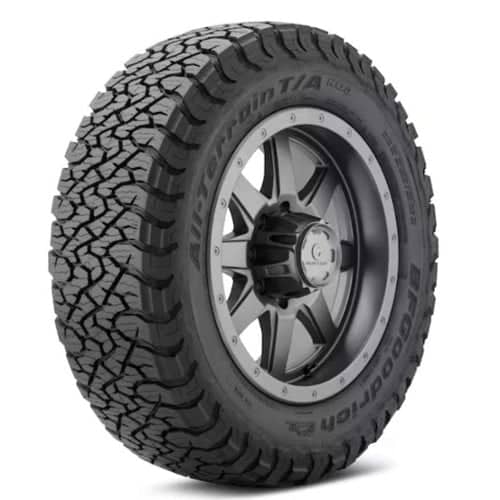
Here are common half-ton and SUV sizes with every construction each tire comes in. Prices are per tire at the time of writing; click through to check current pricing and your exact load and speed rating. You can also browse the full BFGoodrich All-Terrain T/A KO3 and Falken Wildpeak A/T4W size lists.
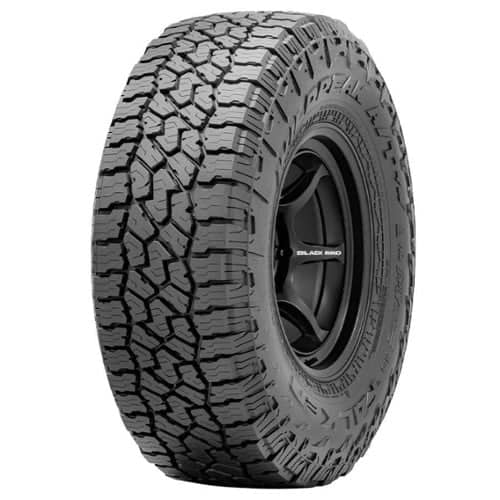
Size |
KO3 (LT Only) |
A/T4W Passenger |
A/T4W LT |
|---|---|---|---|
265/70R17 |
|||
275/65R18 |
|||
275/60R20 |
|||
275/55R20 |
|||
285/70R17 |
|||
265/75R16 |
|||
245/75R16 |
Two things jump out. In most of the sizes half-ton owners buy, the passenger A/T4W is the least expensive way into either tire. And in LT, the two land within about $20 of each other, so in that lane the choice really does come down to warranty, snow and sidewall, not price.
The wrong construction does not show up on the drive home. It shows up over the next 30,000 miles, and it gets more expensive as it goes:
The cheap fix is at the beginning: buy the construction your truck needs and set the pressure the tire maker's chart calls for.
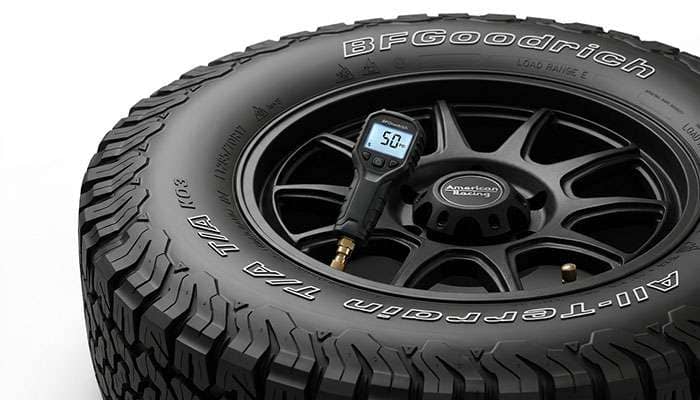
The KO3 against the Wildpeak A/T4W is not really a fight between two tread patterns. It is a question about your truck. BFGoodrich builds the KO3 in one construction, and it is a great tire when your truck needs an LT casing: heavy-duty pickups, plow rigs, hard trail rigs and anybody who wants white letters on 35s. Falken builds the A/T4W to match whatever your truck came with, and on half-tons and SUVs that came on passenger tires, that wins on ride, price and warranty.
Read the placard first. If it says LT, pick on snow, sidewall and warranty, and you will not go wrong with either. If it does not, the passenger A/T4W is the one I would put on my own truck. Shop the full lineups from BFGoodrich and Falken, or give us a call in Long Beach and we will check your placard with you.
For half-ton trucks and SUVs that came on passenger tires, usually yes, because the A/T4W comes in a matching passenger construction with a 65,000-mile warranty. For trucks that need LT tires, the two are close: the A/T4W has the longer warranty and the KO3 has the stronger snow results and sidewall.
No. Every BFGoodrich All-Terrain T/A KO3 size is an LT tire, including the sizes that fit crossovers. If your vehicle calls for a P-metric or Euro-metric size, a KO3 means switching to LT construction and setting pressure from BFGoodrich's load and inflation table.
By warranty, the A/T4W. Falken covers it for up to 65,000 miles on non-LT sizes and 60,000 miles on LT sizes. BFGoodrich covers the KO3 for 50,000 miles. Real tread life depends on load, pressure, alignment and rotation.
Only if your truck came on LT tires. If it came on passenger tires, the placard pressure was set for that construction. Size for size, an LT tire carries less weight at the same pressure, so it usually needs more air to carry the same load. Use the tire maker's load and inflation table.
For serious towing you want either one in LT Load Range E. Falken built the A/T4W's Heavy Duty sizes and Heat Diffuser technology with towing in mind and backs its LT sizes for 60,000 miles. The KO3 counters with CoreGard Max sidewall protection on every size. Match the load index to your truck's needs first.
Both carry the Three-Peak Mountain Snowflake symbol for severe snow. In testing, the KO3 has generally stopped shorter and accelerated better in snow, while the A/T4W has done slightly better on ice and dry pavement. Neither replaces a dedicated winter tire in deep, icy winters.