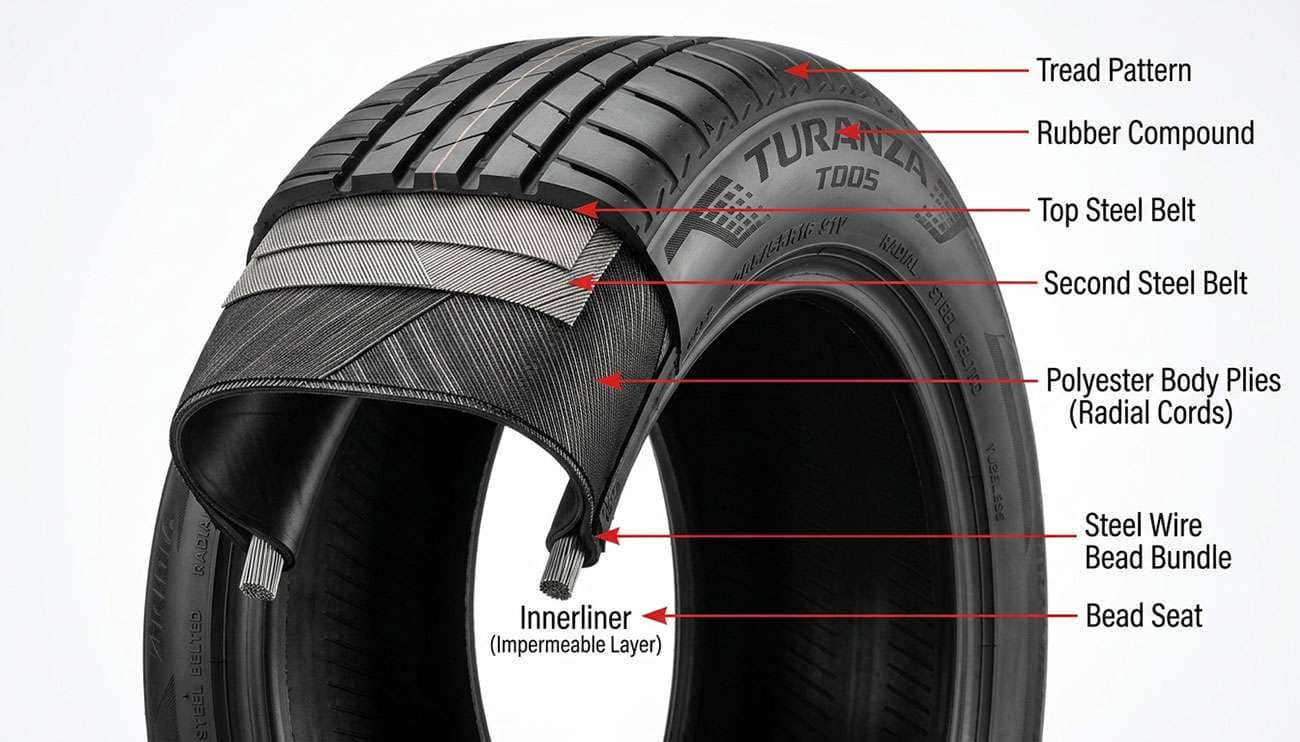
The key features of a tire are its tread, sidewall, steel belts, body plies, bead, and innerliner, plus the size, load index, speed rating, and build date molded into the sidewall. Here is the part nobody puts in front of you: almost every tire on the road shares those same parts. The features that decide whether a tire is right for your vehicle are the ones that change between two tires wearing the identical size. That means load capacity, construction, speed rating, and age.
You have probably been told the right tire "depends on your vehicle." It does. It depends on load capacity first. Across the tires sold in 265/70R17, a size that rides under a big share of half-ton pickups and full-size SUVs, the load index runs from 113 (2,535 lbs per tire) on a standard P-metric tire to 121 (3,197 lbs) on a Load Range E light truck tire. Same size on the sidewall. 662 more pounds per corner, and more than 2,600 pounds across a set of four. Here is which feature decides it for your vehicle.
Which tire feature matters most for your vehicle
Your Vehicle |
The Feature That Decides It |
Where to Find It |
What to Check |
|---|---|---|---|
Daily-driver sedan or small crossover |
Load type (SL or XL) and speed rating |
Load index and speed letter after the size; "XL" if reinforced |
Match or beat the load index and speed rating on your door placard |
Half-ton pickup or full-size SUV that tows |
Load capacity and P-metric vs. LT construction |
"P" or "LT" before the size; load index after it |
A P-metric tire on a truck loses about 9 percent of its rated load; confirm capacity covers your loaded axle weights |
3/4-ton or 1-ton truck |
Load range |
Load Range letter (E, F) and the max load at max psi line |
Stay at or above the original load range; never step down |
Sports or performance car |
Speed rating and traction grade |
Speed letter after the load index; UTQG traction grade near the bead |
Run the original speed rating or higher on all four corners |
Classic or collector car driven occasionally |
Age and construction |
Four-digit DOT date code; "Radial" or "Bias" on the sidewall |
Replace on age, not tread; know which construction the car was built around |
Utility, boat, or camper trailer |
ST construction and load range |
"ST" prefix and load range letter |
Use ST tires, not passenger tires, and check the speed symbol before highway runs |
I have been selling tires in Long Beach since 1971, and I can count on one hand the customers who asked about their innerliner. The questions that matter sound different. Will this tire carry my camper? Is it safe at 75 on the freeway? Why is my Impala's rubber cracking when it still has plenty of tread? Every one comes back to a feature that changes from one tire to the next.
Start with the parts, because everything that follows builds on them. Cut a modern passenger tire in half and you will find six layers working together.
Tread. The rubber that touches the road. Its grooves pump water out from under the tire, and its compound decides how it grips, wears, and handles cold. The tread is the only part of a tire you can watch wear out, which is exactly why people trust it too much.
Sidewall. The flexible wall between the tread and the wheel. It absorbs bumps, carries steering forces into the tread, and wears the tire's resume: size, load index, speed rating, maximum pressure, construction, and the DOT code. It is far thinner than the tread, which is why a cut there is a different problem than a nail in the tread.
Belts. Two or more layers of steel cord laid under the tread of a radial tire. They keep the tread flat on the road, resist punctures, and stop the tread from squirming as it rolls. Here is a detail most parts lists leave out: a true bias-ply tire has no belts at all. If your classic rides on bias-plies, that layer in the diagram does not exist in your tires.
Body ply, also called the casing. Layers of polyester, nylon, or rayon cord coated in rubber, running from one bead to the other. The casing is what holds air pressure, and air pressure is what actually carries your vehicle. A "10-ply rated" Load Range E truck tire usually has two or three body plies, not ten. The ply rating describes strength equal to an old cotton-cord tire with that many plies. It is not a head count.
Bead. A bundle of high-tensile steel wire wrapped in rubber at the inner edge of each sidewall. It locks the tire to the wheel's bead seat and seals the air in a tubeless tire. Every pound of cornering and braking force passes through it.
Innerliner. A layer of halobutyl rubber bonded to the inside of the casing. It replaced the inner tube when tubeless tires became standard on new American cars in the mid-1950s, and it is why a healthy tire loses only a little pressure each month.
For a labeled cutaway, our guide to the components of a tire with diagrams goes layer by layer. Here is the takeaway: those six parts tell you what a tire is. They do not tell you which tire you need. For that, you need the features that change.
No, and the gap is bigger than most people expect. Engineers describe four jobs every tire does: carry the vehicle's weight, transmit drive and braking force, steer and hold a line, and absorb shock from the road. Of those four, carrying the weight is the job with the widest spread between tires of the same size.
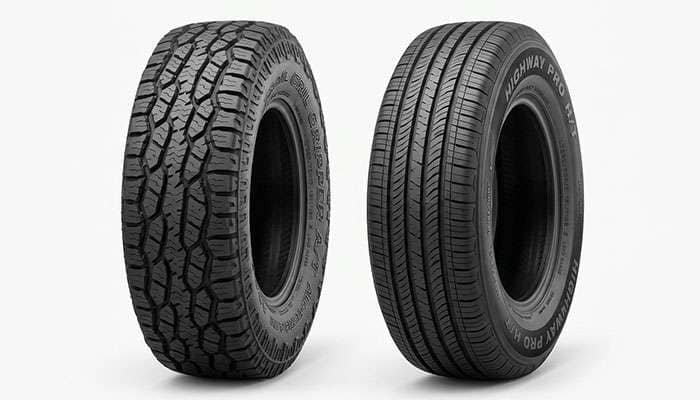
The load index is the two- or three-digit number right after the size, like the 113 in 265/70R17 113T. It points to a maximum load per tire at a reference pressure. Every step up the index adds roughly 2.5 to 3.5 percent more capacity. A 113 means 2,535 lbs. A 121 means 3,197 lbs.
Why can two tires with the same dimensions carry such different loads? Because the rubber does not carry the load. The air does. A tire's casing is a pressure vessel, and its load rating is really a statement about how much air pressure that casing can safely hold. A standard load (SL) passenger tire reaches its maximum rated load at 35 psi. An extra load (XL) tire uses a reinforced casing and reaches its rating at 41 psi. Light truck tires go further: Load Range C at 50 psi, D at 65, E at 80, and F at 95.
Here is what that looks like in five common sizes, using typical load ratings across the tires sold in each size. LT figures are at maximum rated pressure.
Tire Size |
Where You See It |
Standard Load |
Reinforced or LT |
Extra Capacity Per Tire |
|---|---|---|---|---|
215/55R17 |
Midsize sedans |
94 SL (1,477 lbs) |
98 XL (1,653 lbs) |
+176 lbs |
235/65R17 |
Midsize crossovers and SUVs |
104 SL (1,984 lbs) |
108 XL (2,205 lbs) |
+221 lbs |
235/75R15 |
Older half-ton pickups and classic trucks |
105 P-metric (2,039 lbs) |
116 LT Load Range E (2,756 lbs) |
+717 lbs |
265/70R17 |
Half-ton pickups and full-size SUVs |
113 P-metric (2,535 lbs) |
121 LT Load Range E (3,197 lbs) |
+662 lbs |
275/65R18 |
Half-ton pickups |
114 P-metric (2,601 lbs) |
123 LT Load Range E (3,417 lbs) |
+816 lbs |
Look closely at 235/75R15, because it hides a trap. LT Load Range C tires in that size often carry a load index of 104 (1,984 lbs), which is lower on paper than a P-metric tire at 105 (2,039 lbs). That looks backward until you know the rule the Tire and Rim Association writes into its load tables. When a P-metric tire goes on a light truck, an SUV, or a trailer, its rated capacity gets divided by 1.10. That 2,039-lb P-metric tire is really an 1,854-lb tire on a pickup, and the LT tire wins after all. Our breakdown of P-metric vs. LT tires walks through when that math changes your choice.
There is a catch going the other direction, too. An LT tire only carries its full rating at its full pressure. Run a Load Range E tire at 35 psi and it carries about what a P-metric tire carries, with a stiffer ride on top. If the letters and numbers start to blur together, our guide on load range vs. load index sorts out which one to read first.
The minimum load index for your vehicle is on the tire placard on the driver's door jamb, which FMVSS 110 requires on passenger cars and light trucks. That number is your floor. Never go below it.
Construction is the feature that changes how a tire behaves before you ever look at a number. There are three basic types, and if you own anything built before the mid-1970s, you need to know which one your car was designed around.
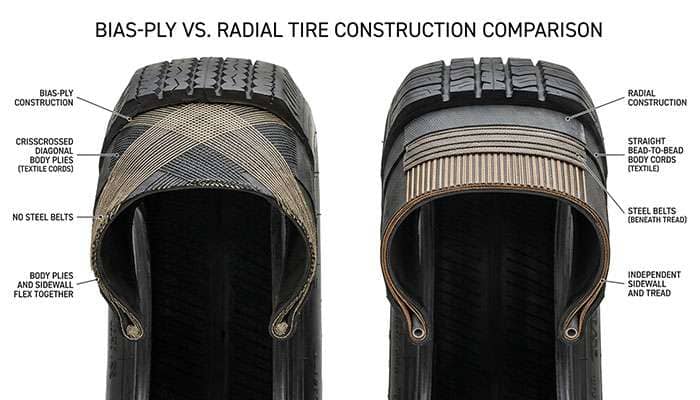
Radial. The body ply cords run straight across from bead to bead at 90 degrees to the direction of travel, and steel belts sit under the tread. Because the sidewall and the tread act as separate structures, the sidewall can flex over a bump while the tread stays flat on the road. You get a steadier contact patch, cooler running, longer tread life, and lower rolling resistance. Nearly every tire sold today is a radial.
Bias-ply. The body plies run diagonally, roughly 30 to 40 degrees off the centerline, with each layer crossing the one below it. There are no belts. The sidewall and tread work as one unit, so when the sidewall flexes, the tread squirms right along with it. That builds more heat, wears the tread faster, and produces the slightly loose, wandering feel anybody who drove a '60s car remembers. Bias-plies also take a set when they sit, which is the flat-spot thump that fades after the first few miles.
Bias-belted. The bridge between the two, popular in the late 1960s and early 1970s: bias body plies with fiberglass or polyester belts under the tread.
The two main constructions are certified under different federal standards. Radial tires for passenger vehicles and light trucks fall under FMVSS 139. Bias-ply passenger tires fall under FMVSS 109, the older standard written for the tires of their era. That is not a knock on bias-plies. It is a reminder that the two are built and tested to different requirements, so they will not behave the same way.
The mistake I see most is mixing. Somebody loses two bias-plies on a road trip, replaces them with radials, and keeps the other two. Radial and bias tires build cornering force differently, and mixed construction can make a car oversteer or pull without warning. Tire industry guidance is simple: never mix radial and bias-ply tires on the same axle, and ideally do not mix them at all.
If you love the look of a bias-ply but want radial manners on the freeway, bias-look radials split the difference with a radial casing under a period-correct tread and sidewall. Our full comparison of radial vs. bias-ply tires for classic cars lays out when each one makes sense. One more thing to know before you commit: many reproduction bias-ply tires carry no speed symbol at all.
The speed rating is the letter after the load index, like the T in 113T. It tells you the maximum speed the tire can sustain while carrying its rated load at the correct pressure, proven on a laboratory test drum. Think of it less as a top-speed number and more as a heat number. Speed builds heat, and a higher speed rating means a casing and compound built to get rid of it.
Speed Symbol |
Maximum Speed |
Where You Usually See It |
|---|---|---|
L |
75 mph |
Some trailer and off-road tires |
Q |
99 mph |
Winter tires and some mud-terrain tires |
R |
106 mph |
Heavy-duty light truck tires |
S |
112 mph |
Light truck all-terrain and some touring tires |
T |
118 mph |
Family sedans, minivans, and SUVs |
H |
130 mph |
Sport sedans and touring tires |
V |
149 mph |
Performance sedans and coupes |
W |
168 mph |
High-performance cars |
Y |
186 mph |
Exotic and ultra-high-performance cars |
Higher speed ratings usually come with stiffer sidewalls and quicker steering response, which is why carmakers spec V- and W-rated tires on sport sedans even though nobody is supposed to drive 149 mph. Lower ratings usually trade a little steering precision for ride comfort and tread life.
Two rules from the shop floor. First, match or beat the speed rating on your door placard on all four corners. Second, if you ever mix ratings, the lowest-rated tire sets the speed limit for the whole vehicle. The rating is not fixed, either. Underinflation, overloading, and some repairs knock it down, which is why our article on tire speed rating derating is worth reading before a long, loaded road trip.
This is the feature that rarely makes the parts list, and it matters most on a classic car or any vehicle that sits more than it drives: the build date.
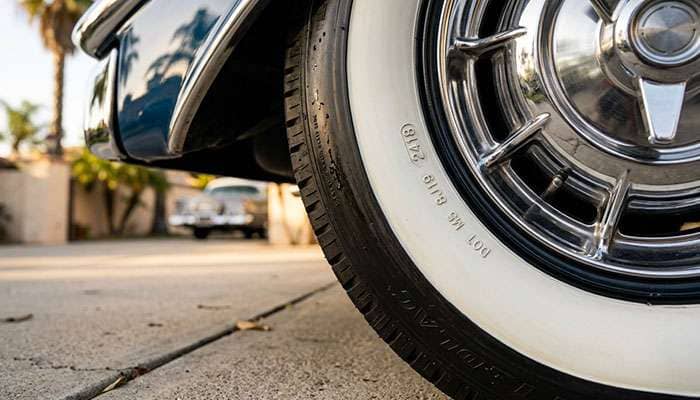
Every tire sold in the U.S. carries a DOT Tire Identification Number. The last four digits are the date code: week first, then year. A code ending in 2321 means the 23rd week of 2021. Tires built before 2000 used three digits, which leaves you guessing at the decade. If you find one of those on your car, the guess no longer matters. Replace it. Federal rules only require the full code on one sidewall, so if you do not see it, check the side facing the frame.
Why does age matter when the tread looks good? Rubber ages from the inside out. Oxygen works its way through the casing, the compounds that keep rubber flexible get used up, and the bond between the steel belts and the rubber around them weakens. The tread can show 9/32 of an inch left while the casing underneath is 15 years old and brittle. That is how a tread separation happens on a tire that "looked brand new."
NHTSA does not set a federal expiration date for tires. Many vehicle manufacturers recommend replacing tires six years from the date of manufacture regardless of tread, and tire manufacturers commonly set ten years as the outer limit. Heat, sunlight, and sitting all run the clock faster. That is why Southern California garage queens worry me more than daily drivers. A show car can roll on tires with 2,000 miles and 12 birthdays. Our guide on how to tell how old your car tires are shows exactly where the code hides.
Passenger tires sold in the U.S. carry Uniform Tire Quality Grading under NHTSA rules, molded near the bead as a number and two letters, like 600 A A.
Treadwear. A number compared to a control tire graded at 100, based on a 7,200-mile road course in Texas. A 600 should outlast a 300 from the same manufacturer. Across brands, the comparison is looser, because each company grades its own tires.
Traction. AA, A, B, or C, based on straight-line wet braking. It does not measure cornering grip, dry braking, or hydroplaning resistance.
Temperature. A, B, or C, based on how well the tire sheds heat at speed. C meets the federal minimum. A is the best.
Not every tire has to carry these grades. Light truck tires, deep-tread winter tires, temporary spares, and limited-production specialty tires are exempt. That is why most LT tires and nearly all bias-ply reproduction tires show no UTQG stamp at all. On those tires, load range and construction tell you far more than any grade would.
New tread depth swings more than people think, too. Across the tires sold in 265/70R17, it runs from about 10/32 of an inch on highway tires to more than 20/32 on mud-terrain tires. Tall tread blocks add off-road bite, but they squirm more on dry pavement and add road noise.
A tire with the wrong features rarely fails on day one. It fails in stages, and each stage costs more than the one before it. Here is the ladder, from the first sign to the last.
On a classic, the ladder starts with age instead of load: weather cracks, then rubber too hard to grip in the wet, then separation. Every rung costs more than the fix at the top, which is one set of tires with the right load index, construction, speed rating, and build date for the way you actually drive.
This takes about five minutes per vehicle, and you do not need anything but a flashlight.
Every tire has tread, a sidewall, a casing, beads, and an innerliner, and most have steel belts. Those parts will not tell you which tire belongs on your vehicle. The features that do are the ones that change between two tires stamped with the same size: how much weight it carries and at what pressure, whether it is radial or bias, how fast it can run, and how long ago it was built.
After more than fifty years of selling tires, here is my advice. Read the whole sidewall, not just the size. The size gets the tire onto your wheel. The rest of the numbers decide whether it gets you home.
A tire supports the vehicle's weight, transmits acceleration and braking force to the road, steers and holds the vehicle's direction, and absorbs shock from the road surface. Supporting the weight is the function that varies most between tires of the same size.
For most vehicles, it is load capacity, because it is the feature that changes most between tires of the same size and the one that causes failures when it is too low. On classic and stored vehicles, age ranks right alongside it. On performance cars, speed rating matters most.
Not automatically. A higher load index means more capacity, which you need if you tow or haul, but it often brings a stiffer casing and a firmer ride. Match or exceed the load index on your door placard, then choose more only if your loads call for it.
XL means extra load. The tire has a reinforced casing that reaches its maximum rated load at 41 psi instead of the 35 psi used for standard load tires. In a typical 235/65R17, that moves the load index from 104 (1,984 lbs) to 108 (2,205 lbs) per tire.
There is no federal expiration date, but rubber ages whether the tire rolls or not. Many vehicle manufacturers recommend replacement six years from the date of manufacture, and tire makers commonly treat ten years as the limit. Check the four-digit DOT date code on the sidewall.
Often you can, as long as the size fits and the load capacity at the pressure you run meets your vehicle's needs. Expect a firmer ride and higher pressures. Never go the other way and swap a truck's original LT tires for P-metric tires with less capacity.