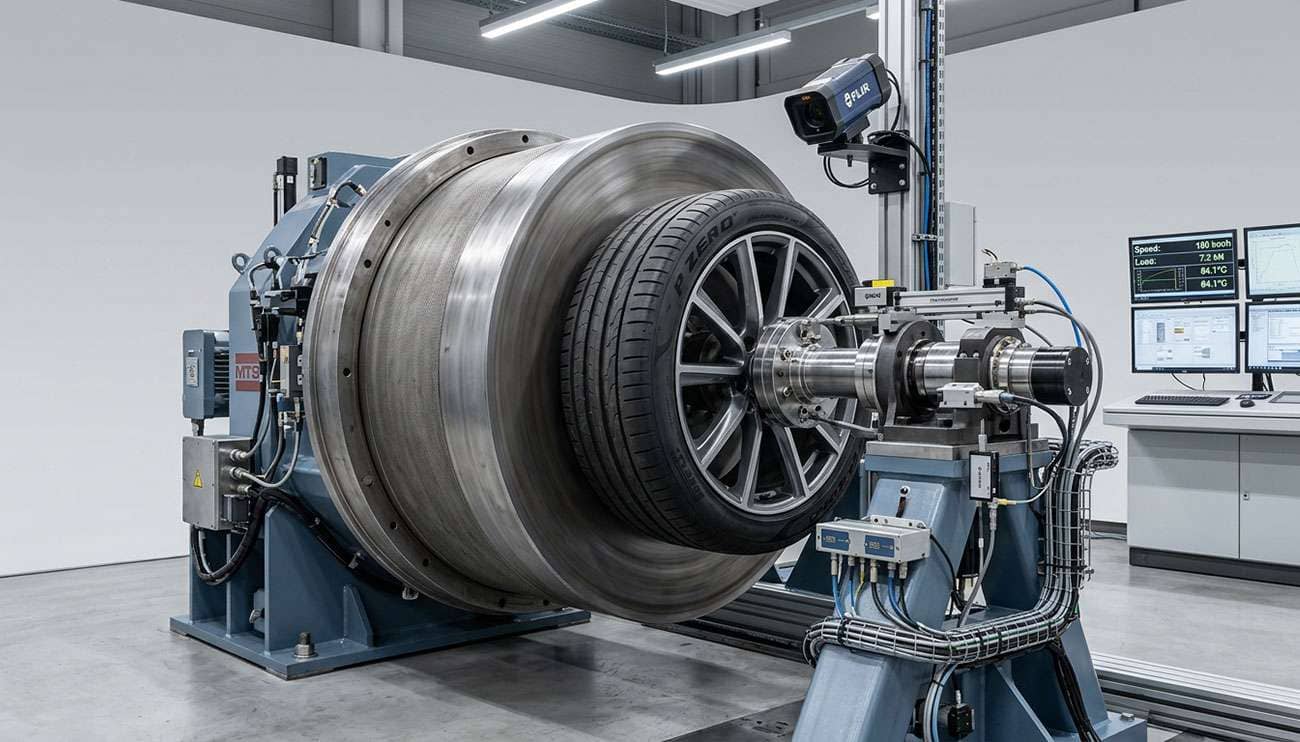
The letter on your tire's sidewall — H, V, W, Y — looks like a guarantee. H means 130 mph, V means 149 mph, W means 168 mph. Those numbers are real. They're also lab numbers, which means they describe a tire's behavior under conditions almost no driver will ever actually replicate on the road.
Once you load the car, drive it in 95°F summer heat, run a tire that's three years old at slightly low pressure, the speed rating you paid for starts shrinking — silently, with no warning on the dash. The sidewall still says V, but the real-world envelope is closer to T. This isn't a defect. It's a feature of how the rating system works. And if you understand the math, you can spec your tires correctly for the way you actually drive.
If you need a refresher on what the letters mean, our breakdown of the tire speed rating system covers the chart and our piece on the highest tire speed ratings covers the Y/Z range. This article is about what those numbers actually mean once the tire leaves the test machine.
Tire speed ratings come from a standardized test — most commonly ECE Regulation 30 in Europe and FMVSS 109 in the United States, with SAE J2562 used for high-speed performance ratings. The test is precise, repeatable, and lab-controlled. It's also nothing like your daily commute.
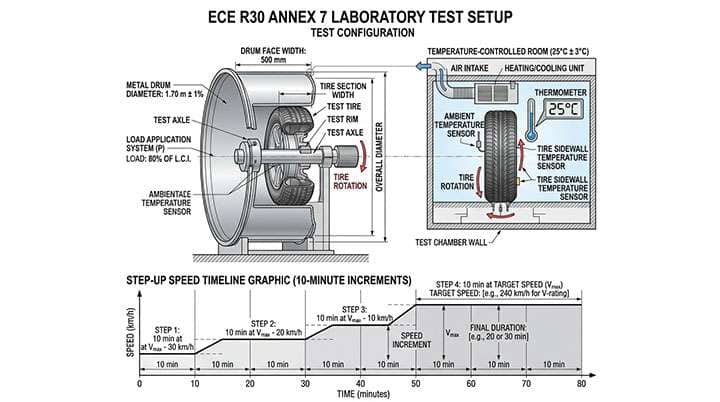
Here's how a tire actually earns its rating. The tire is mounted on a wheel, properly inflated to manufacturer spec, and pressed against a metal drum with a load that simulates a typical vehicle weight at 88% of the tire's full load index. The room is held at 25°C — exactly 77°F. Cool ambient. Controlled humidity.
The drum spins. Starting 40 km/h (about 25 mph) below the target rating, the speed steps up in 10 km/h (6.2 mph) increments, with each speed held for 10 minutes. Then 10 minutes at the target. If the tire is still intact at the end of that final 10-minute window — no tread separation, no belt failure, no visible damage — it passes.
That's it. That's the entire test.
Read that protocol carefully and you'll notice three things the rating doesn't promise. First, "intact" is not the same as "comfortable" or "safe to drive on indefinitely" — a tire that survives 10 minutes at 168 mph in a lab might not survive an hour at 130 mph on a hot interstate. Second, the test happens at 88% of full load — meaning above that load, the rating is no longer the rating. Third, the room is 77°F. Drive across Arizona in July at 110°F asphalt temperatures and you've already left the test conditions far behind.
This is the gap. The number on your sidewall is what the tire can survive once, briefly, under perfect conditions. Real-world driving stacks heat, load, age, and pressure variables on top of that ideal — and each one peels mph off the effective rating.
Four variables determine whether your sidewall rating still means what it says. Track each one and you can estimate, within reasonable accuracy, what your tire's effective speed capacity actually is on a given day.
This is the most-formalized de-rating factor in the industry. SAE J2562 and the load-speed compensation tables published by major manufacturers (Michelin, Continental, Bridgestone, BFGoodrich) all describe the same principle: as the load on a tire approaches and exceeds the test load, the maximum sustained speed must be reduced.
The test runs at 88% of the tire's full load index. Below that, you're inside the test envelope. From 88% up to 100%, manufacturer-specific tables typically prescribe a speed reduction — generally on the order of 5–15 mph depending on the rating and load delta. Above 100% load, the speed rating is functionally void; the tire is operating outside the conditions the test was designed to validate.
The practical implication: a fully loaded SUV with the family, gear, and a roof box pushing total tire load near the index limit cannot rely on the rated speed. The tire is engineered for it under controlled conditions, but the heat margin shrinks fast as load climbs. Our breakdown of load range vs. load index covers the load-side math in detail, and the guide to reading load range and ply ratings walks through the sidewall markings.
The lab test runs at exactly 25°C. Anything above that — and "above 77°F" describes a substantial portion of US summer driving — adds heat the test didn't account for. Tire compound chemistry is temperature-sensitive: rubber softens, structural rigidity decreases, and the rate of internal heat generation under flex increases. The tire is dissipating heat to the surrounding air, and when that air is hotter, dissipation is slower.
Industry guidance generally treats every 10°C (18°F) above lab conditions as cause for additional caution. There's no formal published de-rating curve like the load tables, but the principle is well-documented: a tire running at sustained 168 mph in a 100°F desert is operating well outside its certification envelope, even if the load is below 88%. This is why high-performance tire manufacturers publish hot-weather inflation guidelines and recommend hot-day pressure checks for any sustained high-speed driving.
Tire compounds are designed to behave a certain way at the moment they leave the factory. They don't stay that way. Rubber polymers cross-link further over time (oxidation, UV exposure, ozone exposure), the tire's elasticity decreases, and the internal cord adhesion can degrade. Most major manufacturers — Michelin, Continental, Bridgestone — recommend tire replacement at six years from the manufacture date regardless of tread depth, and treat any tire over ten years old as out of service.
For the speed rating, that aging curve has direct implications. A tire's certification reflects its as-manufactured properties. By year five or six, the rubber chemistry has shifted enough that the tire's actual high-speed heat tolerance is meaningfully reduced — even if the tread looks healthy and the sidewall shows no visible cracking. Pirelli's published consumer guidance puts it bluntly: an aged tire's speed rating is no longer relevant. Our piece on how long car tires actually last covers the full age curve, and the breakdown of tire dry rot covers the chemistry of rubber degradation specifically.
The lab test runs at the manufacturer's recommended inflation pressure. Underinflation — even by 5–10 PSI — increases the tire's deflection cycle under load, which generates heat. More flex per revolution, more heat, faster heat buildup. At sustained highway speeds, the difference between a properly inflated tire and one that's 8 PSI low can mean the difference between operating inside the rated envelope and operating well outside it.
This is why tire pressure monitoring systems are mandated: chronic underinflation is the single most common driver-controlled de-rating factor, and it's silent. The tire still drives, the car still feels normal, and the rating decay happens entirely in the rubber. Our guide on stopping tires from losing air covers the diagnosis side of this problem.
Stack these factors together and the de-rating compounds. Here's a worked example for a V-rated tire (149 mph nominal) under common driving scenarios:
Scenario |
Conditions |
Approximate Effective Rating |
|---|---|---|
Lab conditions |
New tire, 77°F, 88% load, full PSI |
149 mph (V) |
Mild summer day, fully loaded family SUV |
2-year tire, 85°F, 95% load, full PSI |
~135–140 mph |
Hot summer day, moderate load, slight underinflation |
3-year tire, 100°F, 88% load, 5 PSI low |
~125–130 mph (H territory) |
Aged tire, hot conditions, near-max load |
6-year tire, 100°F, 100% load, full PSI |
Below H — out of certification envelope |
These are approximate engineering estimates, not published manufacturer numbers — there's no universal de-rating formula because each tire model's compound and construction respond differently to each variable. But the directional point holds: a V-rated tire that's 6 years old, fully loaded, and on a 100°F road is not operating as a 149 mph tire. The lab number describes a tire that doesn't exist at that point.
This is also why insurance and warranty considerations get serious at high-speed events. Factory-spec speed ratings reflect the OEM's calculation of what the vehicle needs at peak performance with a margin. Driving a vehicle that calls for V-rated tires on H-rated rubber — or driving aged V-rated tires at sustained V-rated speeds — can have warranty and insurance implications if a failure occurs.
Tire failure at sustained high speed is rarely the cartoon version — sudden bang, immediate flat. The actual failure mode is thermal, and it's progressive. Here's the engineering reality.
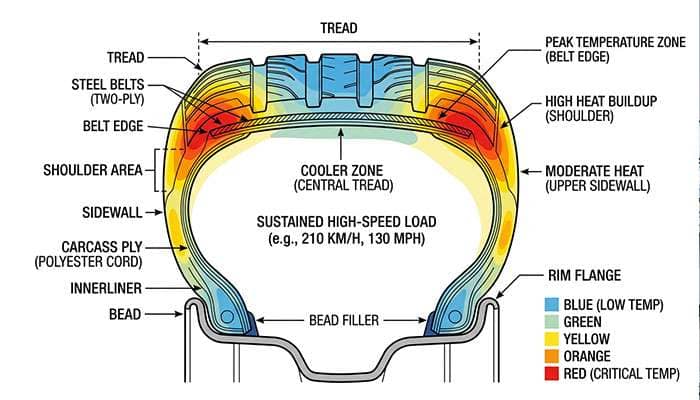
Under sustained load and rotation, every part of the tire flexes. Each flex generates heat through internal friction in the rubber compound. At low speeds and moderate temperatures, the tire dissipates that heat to the air faster than it builds up. As speed and load increase, heat generation rate climbs faster than dissipation rate, and core temperatures rise — particularly at the belt edge under the shoulder, which is the highest-strain region of the tire.
When core temperatures cross critical thresholds (industry research generally points to roughly 250–260°F at the belt edge as the danger zone), the rubber compound begins to lose its bond to the steel belt cords. This is called belt edge separation, and it's the most common high-speed failure mode. The tire continues to roll for some period — sometimes minutes, sometimes longer — while the separation grows internally. Then, when the structural integrity finally fails, you get a tread peel: the entire outer tread surface delaminates from the casing, often catastrophically.
This is why the speed rating exists in the first place. It's not a "top speed" number in the casual sense. It's a heat-resistance certification. The lab test specifically validates that the tire can survive 10 minutes at the rated speed without internal thermal failure. Real-world conditions that increase heat generation or decrease heat dissipation eat into the margin between operating temperature and failure temperature — and that margin is what the rating protects.
The practical takeaway from all this isn't that speed ratings are wrong — it's that they're a ceiling, not a floor, and treating them as a floor is what causes trouble. Here's how to spec tires that hold their rating in real conditions.
Match or exceed the OEM spec. Your owner's manual or the doorjamb sticker lists a recommended speed rating for your vehicle. The OEM picked that rating with the vehicle's intended use case in mind, including margin for hot weather, full loads, and aging. Match it as a minimum. Exceeding it (going from a recommended H to a V, for instance) gives you additional thermal margin under demanding conditions — useful if you tow, drive in hot climates, or drive at sustained highway speeds. Our comparison of H vs. V rated tires covers when the upgrade is worth the cost and when it isn't.
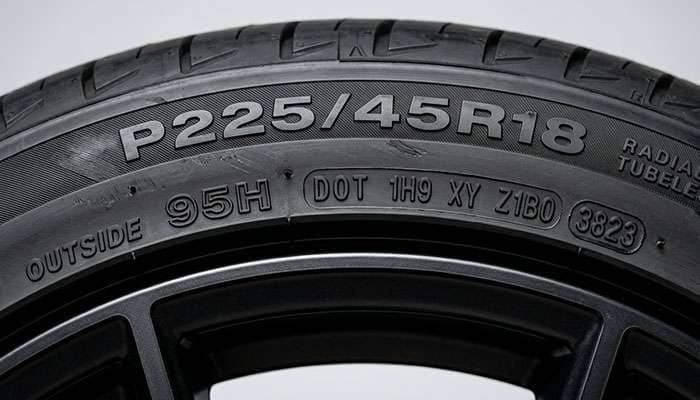
Buy fresh stock. The DOT date code on the sidewall tells you the manufacture week and year (last four digits — week then year). A tire stamped 2424 was built the 24th week of 2024. Reputable retailers move stock fast and most tires are within a year of production when sold, but it's worth checking. A tire that sat in a warehouse for 3 years before purchase has already eaten 3 years of its useful life. The full sidewall decoder is in our piece on reading tire sidewall numbers.
Maintain inflation religiously. Check pressure monthly, before long trips, and any time the temperature swings significantly (cold weather drops PSI). Tire pressure has more day-to-day impact on effective speed rating than almost any other variable, and it's the only one you control directly.
Replace at age, not just wear. A tire with 50% tread at year seven is still an aged tire. The compound has degraded whether you used it or not. For high-speed-rated tires especially, the age threshold is the binding constraint, not the tread.
Don't mix ratings across an axle. If you have one V-rated tire and three H-rated tires, your effective speed rating is the lowest one. Worse, the handling characteristics of mixed ratings — different sidewall stiffness, different compound — can create unpredictable behavior in transient maneuvers. The Tire Industry Association recommends matching ratings on all four corners. Browse our full tire inventory to spec a complete matched set.
Speed ratings are real engineering specifications — but they describe a moment in a tire's life under conditions almost no driver replicates on the road. Heat, load, age, and inflation each chip away at that lab number, and they compound. A V-rated tire on a 100°F day, fully loaded, three years old, and slightly underinflated isn't a V-rated tire anymore. It's a tire whose effective rating you have to estimate based on conditions.
The fix isn't to panic — it's to spec correctly. Match or exceed the OEM rating. Buy fresh stock. Maintain inflation. Replace at age. Match ratings across axles. Do those five things and the rating on your sidewall will hold across the conditions you'll actually face. Skip them, and you're driving on a smaller envelope than you think.
No — the math works in the other direction. An H-rated tire under the same hot, loaded, slightly-underinflated conditions de-rates from H to something below H. The de-rating doesn't depend on the starting rating; it depends on the conditions. Higher initial ratings give you more margin for the same conditions, not less. If your vehicle calls for V-rated tires, downgrading to H gives up that margin without saving you the de-rating.
The most reliable signals are tire surface temperature and inflation pressure changes. After sustained highway driving in hot weather, place your hand near (not on) the tire sidewall — if it's significantly hotter than ambient, the tire is shedding heat at a high rate. Hot-running tires also show abnormal pressure increases (PSI rises with temperature), so a tire that goes from cold-spec PSI to 8+ PSI above spec after a long drive is running hot. These are signs to check load, inflation, and driving conditions before continuing.
Not exactly. Higher-rated tires generally use stiffer construction and harder compounds to handle high-speed heat, which often produces shorter tread life — not longer. The benefit of overspeccing is thermal margin under the conditions you actually drive in, not extended wear life. For a daily-driver application in moderate climate, the OEM-recommended rating is usually optimal. Overspeccing makes most sense for hot climates, towing applications, sustained highway use, and performance driving.
The letter system and target speeds are harmonized — H means 130 mph (210 km/h) on both sides of the Atlantic, V means 149 mph (240 km/h), and so on. The certification protocols differ slightly: ECE Regulation 30 governs European tire approval, FMVSS 109 governs US passenger car tire compliance, and SAE J2562 covers the high-speed test methodology often used for performance ratings. Most major manufacturers test against multiple standards because they sell into both markets. The end result for a consumer is essentially the same — a V-rated tire is a V-rated tire — but the underlying compliance documentation comes from different regulatory bodies.