
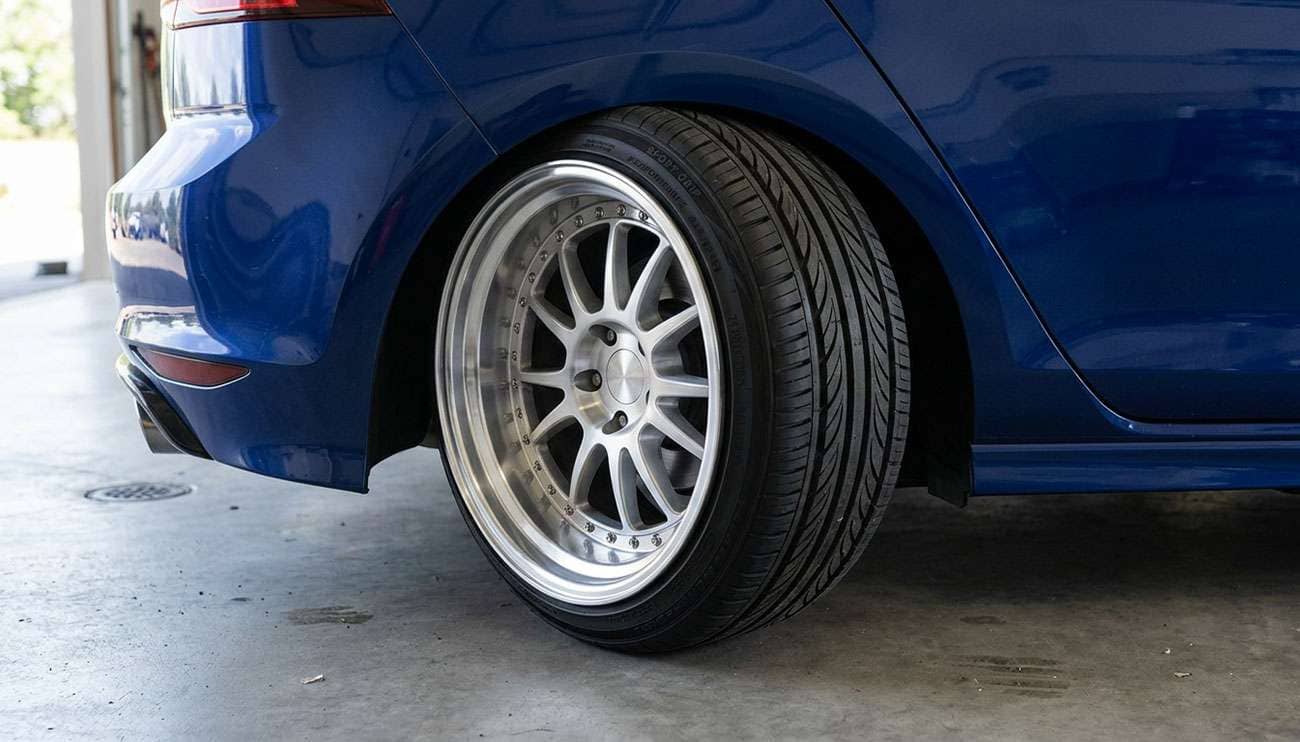
Stretching a tire is safe only as long as your wheel width stays inside that tire's approved rim width range. Past the top of that range, it isn't, and the risk climbs with every half inch. Every tire size has a range of wheel widths it was designed and tested on, published by the tire maker. Most answers on this subject say "a little stretch is fine, too much is dangerous" and never tell you where "too much" begins. It begins at a number, it's printed on the tire's spec sheet, and you can check it in two minutes.
I'm Hank Feldman. I've been mounting tires in Long Beach since 1971, and I've watched the stretched look come around more than once. I like a clean, tight sidewall as much as anybody. But I've also seen what a hard stretch looks like after a pothole. Here's how to tell where your setup lands.
Your Wheel vs. the Tire's Approved Range |
What's Happening at the Bead |
Verdict |
|---|---|---|
Inside the range |
Bead sits square on the seat, sidewall flexes as designed |
Safe. Every rating on the sidewall applies. |
At the top of the range |
Sidewall pulls straight, slight stretched look |
Safe. This is the in-spec way to get the look. |
Up to 0.5 in past the max |
Bead tilts on the seat, sidewall goes into tension |
Outside spec. Ratings are no longer backed by the maker. |
0.5 to 1 in past the max |
Bead held mostly by air pressure, rim lip fully exposed |
Risky. Not for daily driving or potholed roads. |
More than 1 in past the max |
Hard stretch, often won't seat without dangerous methods |
Unsafe on public roads. |
If your wheel is past the range, there's almost always a different tire size that gives you most of the look while staying inside it. That's where the second table comes in. These are typical approved ranges for common low-profile sizes across the market. Run the narrowest size whose range still reaches your wheel width, and the tire sits at the top of its spec.
Wheel Width |
In-Spec Size for a Tight Look |
Typical Approved Range |
|---|---|---|
17x8 |
205/40R17 or 215/45R17 |
7 to 8 in |
17x8.5 |
215/40R17 or 225/45R17 |
7 to 8.5 in |
18x9 |
225/40R18 |
7.5 to 9 in |
18x9.5 |
235/40R18 or 245/40R18 |
8 to 9.5 in |
18x10 |
255/35R18 |
8.5 to 10 in |
18x11 |
275/35R18 |
9 to 11 in |
Ranges vary a little by manufacturer and tire line, so always confirm against the spec sheet for the exact tire you're buying.
A stretched tire is a tire mounted on a wheel wider than it was designed for. The beads, the two stiff hoops that seal against the wheel, get pulled apart to reach the wider bead seats. That pulls the sidewalls out at an angle, so instead of bulging past the wheel lip, they slope inward toward the tread. The wheel lip ends up as the widest point of the assembly. That's the look: a skinny-looking tire tucked under a fender, with the whole rim showing.
The look grew out of the stance and lowered-car scene, where people wanted wide wheels to fit inside the fenders at aggressive camber angles. A narrow tire on a wide wheel clears the fender lip better than a properly matched tire would. That's a real reason, and I understand it. It just comes with a cost the tire was never designed to cover.
Every tire mounted on a wheel of a different width than its measuring rim is "stretched" or "pinched" a little. That's normal, and the approved range exists to tell you how much is fine. Our article on what putting the same tire on different rim widths does walks through how width changes the shape. The question isn't whether you're changing the tire's shape. It's whether you've gone past the line the tire was engineered for.
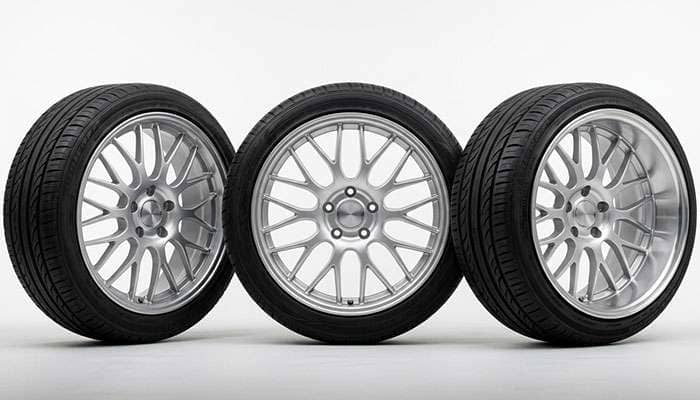
This is the number nobody puts in front of you, and it's the only one that answers the safety question. Here's where it comes from and how to use it.
In the United States, the Tire and Rim Association publishes standards that list, for each tire size, a measuring rim width and a range of approved rim widths. ETRTO publishes the European equivalent. Tire manufacturers build to those standards and print the approved range on each tire's spec sheet, usually listed as "approved rim width," "rim width range," or "permitted rims."
Across the market, most passenger and performance sizes carry an approved range about 1.5 to 2 inches wide. A 225/40R18, for example, is typically approved for 7.5 to 9 inch wheels. A 245/40R18 typically runs 8 to 9.5 inches. The measuring rim, the width the tire's published section width is measured on, sits near the middle of that range.
Wheel width is measured from bead seat to bead seat, inside the lips, not across the outside of the lips. The number is usually stamped on the wheel as part of a code like 18x9.5J. If it's not stamped, measure across the outside of the lips and subtract about an inch for the lip flanges. Our guide on matching tire size to wheel width goes into the measuring details.
Take your wheel width and subtract the top of the tire's approved range. If the answer is zero or negative, you're in spec. If it's positive, that's how far past the line you are. A 215/40R17 approved for 7 to 8.5 inch wheels, mounted on a 17x9.5, is 1 inch past its max. That's a hard stretch, no matter how good it looks.
As a rule of thumb, a tire's section width changes about 0.2 inches for every half inch of rim width change. The tire never really gets wider to match the wheel. The wheel just pulls it into a different shape, and the difference between our section width and tread width explainer shows why the tread barely moves while the sidewall takes the strain.
A tire is a pressure vessel with flexible walls. It's designed so the sidewalls bow out a certain amount, flex over bumps, and carry load in a specific shape. Change that shape far enough and every one of those jobs gets harder.
A tire bead has a shaped profile designed to sit flat on the wheel's bead seat and lock against the rim flange. On a wheel inside the approved range, it does. On a wheel past the range, the bead gets pulled outward and tilted. Instead of sitting flat, it rides more on its edge, with less rubber clamped against the seat. Our article on what a tire bead is covers the construction that's being asked to do this.
A normal sidewall carries load by flexing. A stretched sidewall is already pulled tight before the car's weight ever lands on it. It can't flex the way it was designed to, so bumps and cornering loads concentrate at the lower sidewall, right above the bead. That's where fatigue cracks start.
Pulling the beads apart tends to round the tread across its width. The center carries more of the load, and the shoulders carry less. You get less grip in hard cornering and braking, plus faster wear down the middle. On a car running a lot of negative camber, the inner edge takes even more of the load, which compounds the problem.
The load index and speed rating on your tire's sidewall were established on a rim inside its approved range. NHTSA's tire performance standard for passenger tires, FMVSS 139, tests tires mounted on rims listed for that size. Mount the tire outside its range, and the tire maker no longer stands behind those ratings. The tire might still carry the load. Nobody has tested that it does.
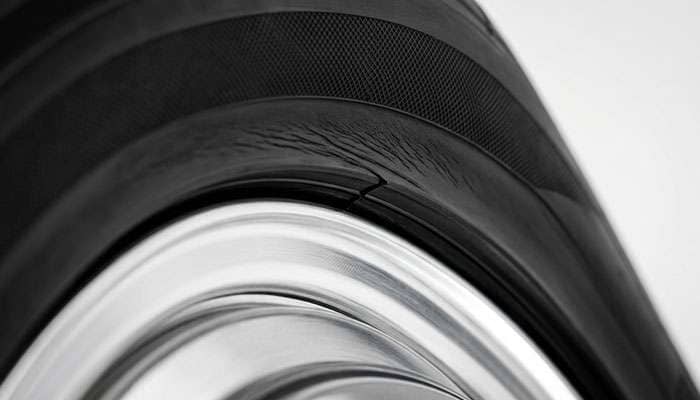
Yes. This is the failure that worries me most, because it happens fast and without warning.
On a properly matched wheel, the bead is locked in place by its shape, its fit on the bead seat, and the safety hump on the wheel. Air pressure helps, but it isn't doing all the work. On a hard stretch, the bead's grip on the seat is reduced, so air pressure is carrying much more of the load. Hit a pothole, drop a wheel off the edge of the pavement, or take a sharp corner with the pressure a few psi low, and the bead can roll off the seat. When that happens, the tire loses all its air at once.
Our article on the tire bead seat safety hump explains what normally keeps a deflating tire on the wheel. A stretched bead is already halfway past the point where that hump helps.
A tire that's badly stretched often won't seat with a normal air chuck, because the beads can't reach the bead seats on their own. Some people use a flammable spray and an open flame to force the bead out. I'm not going to describe how it's done, because it shouldn't be. It's a small explosion inside a tire, and it injures people every year. It can also damage the bead rubber in ways you can't see. If a tire needs fire to get on a wheel, that tire is telling you it doesn't belong on that wheel.
In most cases, yes. Most tire manufacturers' limited warranties exclude damage caused by improper mounting, use on a wheel the tire wasn't designed for, or misapplication. A tire mounted past its approved rim width range is a textbook example. If a stretched tire develops a sidewall crack or a bead leak, expect the warranty claim to be denied.
Many tire shops also won't mount a tire outside its approved range, for the same reason. If something goes wrong, they're the last ones who had their hands on it. The Tire Industry Association's technician training puts heavy emphasis on verifying tire and rim compatibility before mounting, and shops that follow it tend to say no to a hard stretch.
There's no federal rule in the US that names tire stretch specifically. Vehicle equipment rules are set mostly by the states, and they vary. Some state inspection programs look for tires that are unsafe or improperly sized for the wheel, and an officer or inspector can make a judgment call on an extreme stretch. If your state has safety inspections, ask your inspection station before you build the car.
The bigger legal exposure is after a crash. If a stretched tire fails and causes an accident, an insurer or the other party can point to a tire mounted outside its manufacturer's specifications. Whether that affects a claim depends on your policy and your state. It's not a fight you want to be in.
A stretched tire rarely fails the first week. It costs you a little at a time, and the bill grows.
With less bead rubber clamped to the seat, small imperfections in the wheel or bead let air seep out. You find yourself topping off the same tire every week. Running it low, even a few psi, makes every other stage below more likely.
A properly matched tire protects the wheel lip with a bit of sidewall. A stretched tire leaves the lip as the outermost point. One curb scrape takes the finish off. A harder hit bends the lip, and a bent lip on a stretched tire is a guaranteed leak.
The rounded tread profile wears down the center and gives you less grip when you need it most. In the wet, a smaller effective contact patch means less margin before the tires let go.
Repeated flexing of a sidewall that's already in tension fatigues the area just above the bead. Look for fine cracks or a ripple in the rubber near the rim. Once the cords underneath are damaged, the tire is finished. Our guide on whether tire sidewall damage is safe to drive on shows how to judge it.
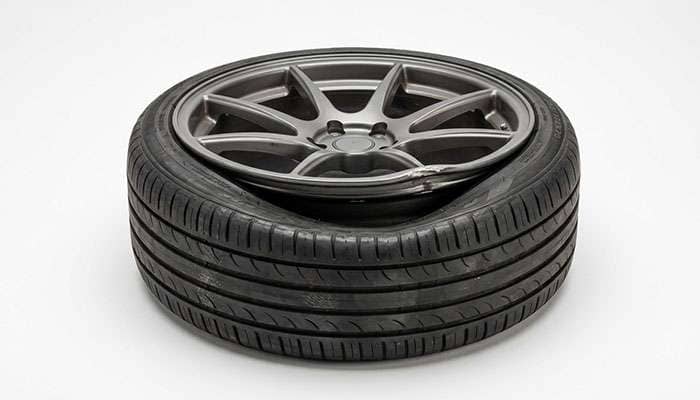
The last stage is sudden: a pothole or a hard corner rolls the bead off the seat, the tire empties in a second, and the car drops onto the wheel. At highway speed, that can mean a loss of control, a damaged wheel, and bodywork, plus a set of correctly sized tires you'll be buying anyway.
The correctly sized tire costs about the same as the stretched one. Buy it first and you skip the rest of the ladder.
You can get a tight, clean sidewall without leaving the spec. Here's the process I'd walk anyone through at the counter.
When you're ready to shop, our performance tires section lets you search by size, so you can find a tire whose approved range actually covers your wheel.
Is it safe to stretch a tire? Inside its approved rim width range, yes, and the top of that range already gives you a tight, clean look. Past the top of the range, the bead tilts, the sidewall goes into tension, the contact patch shrinks, and the ratings on the sidewall stop being backed by the people who made the tire. The farther past the line, the faster those problems stack up.
The good news is that the line isn't a mystery. It's a number on the tire's spec sheet. Measure your wheel, look up the range, do one subtraction, and you'll know exactly where you stand. If you're past it, there's almost always a size that gives you most of the look and all of the safety margin.
It's safe as long as the wheel width stays inside the tire's approved rim width range, which is listed on the tire maker's spec sheet. Past the top of that range, the bead sits on its edge, the sidewall is under tension, and the tire can unseat from the wheel. The farther past the range, the greater the risk.
You can safely mount a tire on any wheel width up to the top of its approved rim width range. A 225/40R18 approved for 7.5 to 9 inch wheels can go on a 9-inch wheel. Anything wider than the top of the range is outside the manufacturer's specification.
Yes. A stretched tire has less bead rubber clamped to the wheel's bead seat, so air pressure does more of the work holding it on. A pothole, curb strike, or hard corner, especially with low pressure, can roll the bead off the seat and cause a sudden, complete loss of air.
Usually. Most tire manufacturers' limited warranties exclude damage from improper mounting or use on a wheel the tire wasn't designed for. A tire mounted past its approved rim width range typically falls under that exclusion.
No federal rule in the US addresses tire stretch by name. Vehicle equipment and inspection rules vary by state, and an inspector or officer may flag an extreme stretch as unsafe. After a crash, a tire mounted outside its manufacturer's specifications can also become an issue with insurance.
Check the tire manufacturer's spec sheet for the approved rim width range, sometimes listed as rim width range or permitted rims. Then compare it to your wheel width, measured bead seat to bead seat or read from the stamp on the wheel, such as 18x9.5J.



