
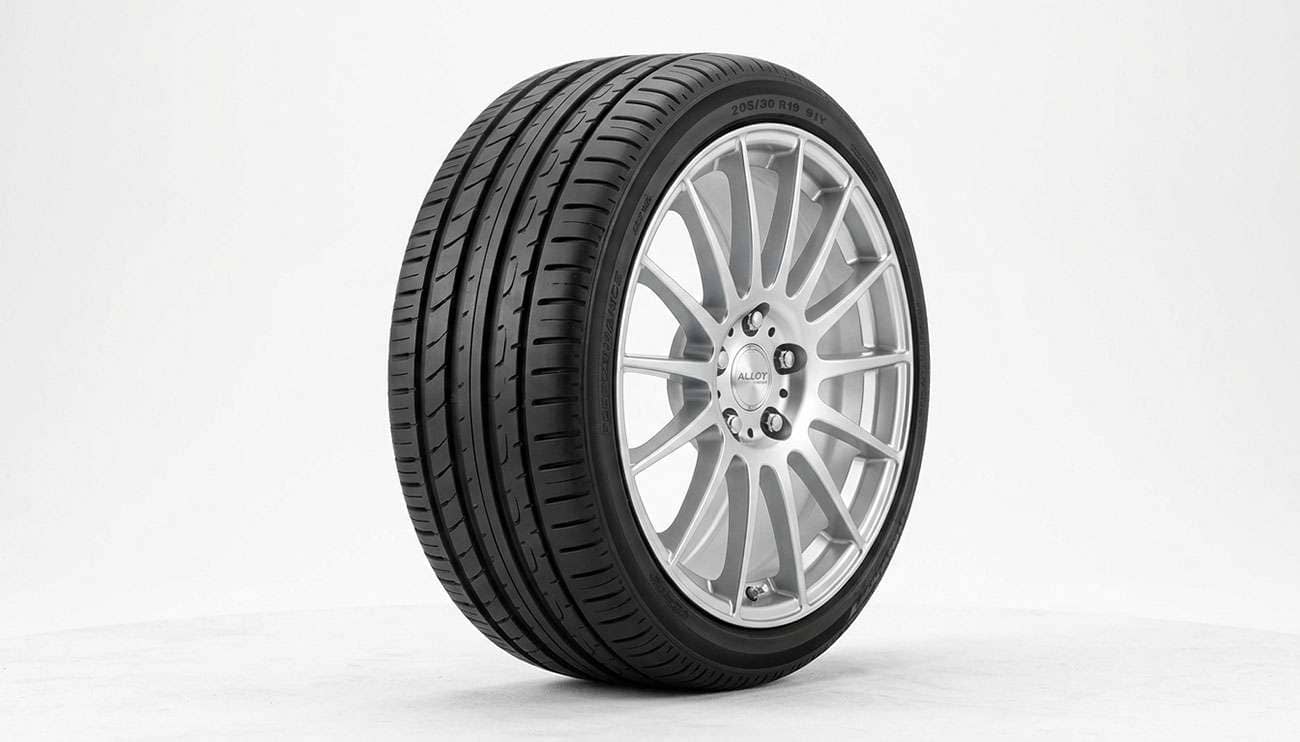
By the most widely used definition, aspect ratio 50 or lower, yes. By a stricter one that starts at 45, no. You will find both stated as fact, which should tell you something. The aspect ratio is a percentage, not a measurement, and a percentage of what changes everything. Your 205/50R17 carries 102.5 mm of sidewall. A 275/50R20 wears the same "50" and carries 137.5 mm. That is 35 mm of difference between two tires with identical labels, and it is the whole answer to the question you are actually asking.
I have had this conversation across the counter more times than I can count, usually with somebody holding a printout that says their tire is not low profile, standing next to a bent rim. The label did not bend that rim. Four inches of sidewall did.
Here is why you cannot get a straight answer anywhere. There is no standards body that defines "low profile." Not the Tire and Rim Association, not the Department of Transportation, not the SAE. It is a marketing term, and everybody draws the line where it suits them.
Walk around long enough and you will see the threshold set at 55 and below, at 50 and below, and at 45 and below. All three get written down as if they came off a stone tablet. A 205/50R17 lands on the wrong side of one, right on the line of another, and safely outside the third. Same tire, three verdicts.
So the honest answer to the question is that it depends entirely on who you ask, and that is useless to you. What is not useless is the sidewall height in millimeters, because that number does not move around. It is just arithmetic: section width times aspect ratio. For a 205/50R17 it is 205 times 0.50, which gives you 102.5 mm, or 4.04 inches of rubber between the rim flange and the pavement.
That number tells you how much cushion you have, how much the tire will flex in a corner, and how much protection your wheel has when you find a pothole in the dark. Nothing on the label does any of that work.
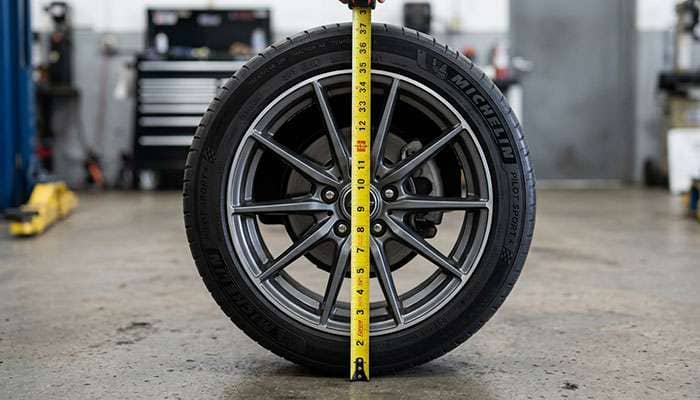
Run the numbers all the way out and here is what you have.
Measurement |
Metric |
Inches |
|---|---|---|
Section width |
205 mm |
8.07 in |
Sidewall height |
102.5 mm |
4.04 in |
Overall diameter |
636.8 mm |
25.07 in |
Revolutions per mile |
n/a |
About 804 |
Approved rim width |
140 to 190 mm |
5.5 to 7.5 in |
Two of those deserve a second look. The rim width window runs a full two inches, with 6.5 as the measuring rim, and where you sit inside that window changes the tire meaningfully. Mount a 205/50R17 on a 7.5-inch wheel and the tread pulls flatter and the sidewall stands more upright, which sharpens turn-in and takes away what little compliance you had. Put it on a 5.5 and the sidewall bows out, softening the ride and rounding the tread crown. Same tire, two different personalities. We get into that at length in our piece on running the same size tire on different rim widths.
The other one is the 25.07-inch overall diameter. That is a small tire by any modern standard, and it means every revolution counts more. At roughly 804 revolutions per mile, a 205/50R17 turns about 40 more times per mile than a 26-inch tire. More revolutions means more heat cycles, more flex cycles, and a tire that lives a slightly harder life than the number on the odometer suggests.
This is the part I wish somebody had put in front of me thirty years ago instead of arguing about definitions.
Line up a handful of tires that all say "50" on the sidewall and watch what happens to the actual measurement.
Tire Size |
Aspect Ratio |
Actual Sidewall Height |
Difference vs 205/50R17 |
|---|---|---|---|
195/50R16 |
50 |
97.5 mm (3.84 in) |
5 mm less |
205/50R17 |
50 |
102.5 mm (4.04 in) |
Baseline |
225/50R17 |
50 |
112.5 mm (4.43 in) |
10 mm more |
245/50R18 |
50 |
122.5 mm (4.82 in) |
20 mm more |
275/50R20 |
50 |
137.5 mm (5.41 in) |
35 mm more |
Every one of those is a 50-series tire. The spread from top to bottom is 40 mm, which is better than an inch and a half. When somebody tells you that 50-series is not really low profile, there is a fair chance they are thinking of a truck tire with a third more sidewall than the one on your car.
Now flip it around and compare your 205/50R17 to tires nobody would ever call low profile. A 205/55R16, which is the size a lot of these cars wore before somebody plus-sized them, carries 112.75 mm. A 215/60R16 carries 129 mm. Your tire has less sidewall than both of them, and less than the 225/50R17 that shares its exact aspect ratio.
Here is the one that surprises people. Going from a 205/55R16 up to a 205/50R17 barely changes the overall diameter, 24.88 inches to 25.07 inches, which is why the swap works so cleanly and why manufacturers do it. But you gave up 10.25 mm of sidewall in the trade, roughly nine percent of your cushion, and you will feel every bit of it on a bad road. That is the real cost of a plus-one, and it does not show up anywhere in the size comparison. Our plus sizing calculator guide walks through the rest of that math.
So: is 102.5 mm low profile? It is short enough that you should treat it like one. Drive it like one, inspect it like one, and shop for it like one. Whether a website is willing to hang the label on it does not change what happens when you hit a curb. For the broader trade-offs, our rundown of low profile tire pros and cons covers the ground, and tire aspect ratio decoded explains why the percentage misleads people so consistently.
This size shows up across roughly 400 model variants from about 75 manufacturers, which is a wide net for a size a lot of people assume is obscure. It concentrates in compact and sport-compact platforms.
You will find it on the BMW 1 Series and 2 Series, including the 128i, 135i, 228i, and 230i. On the Audi A3 and TT. On the Acura ILX and RSX. On the Volkswagen Golf and Jetta, the Mazda 3, the Ford Focus, the Hyundai Elantra, and a long tail of MINI variants. It also turns up as a factory winter fitment on cars that wear something wider in summer, which is a detail worth knowing if you are staring at a size on a wheel that does not match your door placard.
That last point trips people up regularly. If your placard says one thing and your wheels say 205/50R17, somebody before you either plus-sized the car or fitted a dedicated winter setup. Neither is wrong, but it does mean the placard pressure may not be the right number anymore, and it means you should figure out which wheel you are actually holding before you order four tires.
The load index runs 89 or 93 on nearly everything in this size, which works out to 1,279 or 1,433 pounds per tire. On a compact car that is plenty of margin. The rule still holds: match or exceed what your placard calls for, and never go down.
Everybody wants one number here, and there isn't one, because the answer scales with section width.
Five points of aspect ratio means five percent of the section width, doubled for both sides of the wheel. On your 205, that is 205 times 0.05 times two, which comes to 20.5 mm, or 0.81 inches of overall diameter. A 205/45R17 stands 24.26 inches tall against 25.07 inches for the 50-series, a 3.3 percent difference.
Run the same 50-to-45 step on a 275 and you get 27.5 mm, or 1.08 inches. Same five points on the label, a third more actual change. So if you read somewhere that dropping from a 50 to a 45 costs you about an inch, that is true for a wide tire and overstated for yours.
The practical side of that 0.81 inches on a 205/50R17:
A 3.3 percent diameter change sits right at the edge of the conventional three percent substitution window. That is close enough that I would not do it casually on a car with stability control calibrated to the original rolling circumference, and it is close enough that a good shop should ask you why before they order the tires.
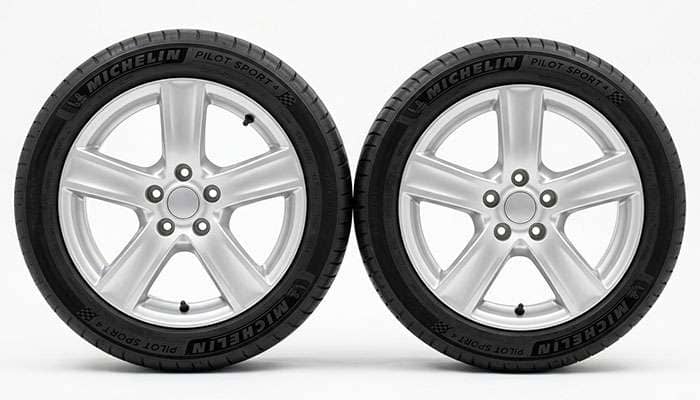
Usually yes, and this is one of the cleaner substitutions in the book.
A 215/50R17 stands 25.46 inches against 25.07 for the 205, a difference of 10 mm or 0.39 inches. That is 1.57 percent, comfortably inside tolerance. Your speedometer would read about 1.6 percent low, so an indicated 60 mph becomes an actual 60.9 mph. Nobody is getting a ticket over that.
Three things to check before you pull the trigger. First, rim width. A 215/50R17 typically wants 6.0 to 7.5 inches, so if your wheel is a 5.5 you are outside the window and the swap is off. Second, clearance. You are adding 10 mm of section width, five of which goes toward the strut, and on a tightly packaged compact with the wheel turned to the lock you can find contact you did not expect. Third, the placard. Going wider is a change from what the manufacturer signed off on, and on a car with a narrow track it can affect how the car behaves at the limit.
The upside is real, though. That 215 buys you 107.5 mm of sidewall instead of 102.5, which is five more millimeters of protection between your wheel and the next pothole, plus a wider contact patch. On a car that lives on rough city streets, that is a trade I would take. If you decide to go that direction, our roundup of the best 215/50R17 tires has the model-level picks.
One thing I would not do is mix. Four matching tires, or at minimum a matched pair across each axle. A 215 on one side and a 205 on the other puts different rolling circumferences on the same axle, and on anything with a limited-slip or an all-wheel-drive coupling, that is a repair bill waiting to happen.
People ask this constantly, usually after striking out at a big-box store, and the answer is no. This is a well-supplied size with a deep field of all-season options and a healthy performance summer selection, because it lives on cars that came from the factory with a sporting bias.
Where it does get thinner is winter. Dedicated snow tires exist in 205/50R17, but the choice is meaningfully narrower than the all-season field, and the good ones move early. If you run winters on this size, order them in September, not the week after the first storm. That is not a sales pitch, it is just how a low-volume winter fitment works every single year.
The other place to be careful is speed rating. Because this size lives on sport compacts, plenty of the stock is V, W, or Y rated. If your placard calls for H and you buy a Y-rated summer tire because it was on sale, you have bought a tire that gets hard and unhappy below about 45 degrees. Going up in speed rating is allowed, but a summer compound is a summer compound regardless of what the rating letter says.
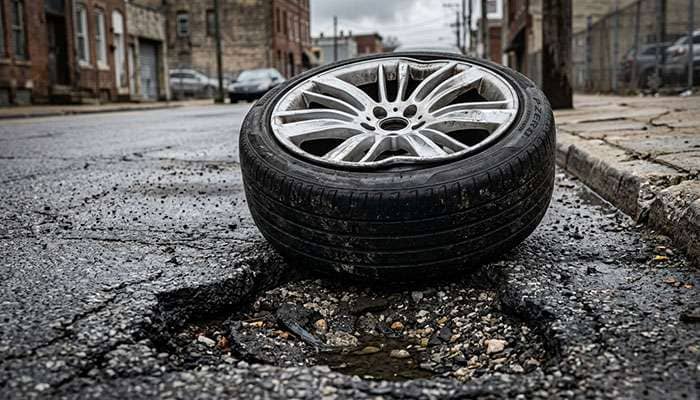
Here is the part that brings people into the shop, and it follows a pattern I could set my watch by.
It starts with a pothole you did not see. On a tire with 130 mm of sidewall, that impact gets absorbed and you drive on annoyed. On 102.5 mm, the sidewall runs out of travel before the energy does, and the rim flange pinches the tire against the edge of the hole. Sometimes the tire survives and the wheel takes it. Sometimes both.
The first stage is invisible. The impact leaves a small internal separation in the sidewall ply that you cannot see from the outside. The second stage is a bulge, a soft lump on the sidewall where the broken cords have stopped containing the air pressure. That bulge is not cosmetic and it does not heal. It is a tire on borrowed time, and it needs to come off the car. Our guide to tire sidewall damage and whether it is safe to drive is the one to read if you have found one.
The third stage is the wheel. A bent outer lip leaks slowly, which shows up as a tire that needs air every couple of weeks and a TPMS light that comes on cold mornings. People chase that for months blaming the valve stem. The fourth stage is a sidewall failure at speed, which on a short-sidewall tire tends to happen without much warning because there is very little rubber to give you a symptom first.
There is a quieter cost too. Short sidewalls transmit impact energy straight into the suspension instead of soaking it up, so bushings, strut mounts, and wheel bearings all work harder over the life of the car. A set of 205/50R17s will not destroy a front end, but it will shorten the interval before things start to knock.
None of this is an argument against the size. It is an argument for treating it with respect. If you have taken a hard hit, our checklist on what to check after hitting a pothole covers the inspection in order.
Go look at the tire. Run your hand around the inner and outer sidewall with the wheel turned to full lock so you can reach behind. You are feeling for a lump, a soft spot, or a scuff that has gone deep enough to expose cord. Anything you find on a sidewall is a replacement, not a repair. There is no legitimate sidewall patch on a passenger tire, and anyone who offers you one is doing you harm.
Then check the pressure cold, before the car has been driven more than a mile. Short sidewalls hide underinflation better than anything else on the road, because there is not enough rubber to visibly bulge. A 205/50R17 can be eight pounds down and look completely normal. That is precisely the condition that turns a pothole into a bent rim.
Then read the four-digit date code on the sidewall. On a size that often sits on a second set of wheels for half the year, tires age out long before they wear out. Six years is the point to start evaluating regardless of tread depth, and ten is the point to stop arguing about it.
Last, check the placard against what is actually on the car. If they do not match, somebody made a change, and you want to understand that change before you buy four more of the same thing by default.
Shop 205/50R17 tires at Performance Plus Tire and match the load index and speed rating on your placard.
Is a 205/50R17 a low profile tire? By the line most of the industry draws, yes, it sits right on it. By a stricter line, no. The argument has been running for years and it is never going to resolve, because nobody owns the definition.
What I would rather you walk away with is the number. You have 102.5 mm of sidewall, about four inches. That is less than a 225/50R17 with the same aspect ratio, less than the 205/55R16 a lot of these cars started life on, and 35 mm less than a 275/50R20 that carries the identical label. Whatever anyone wants to call it, four inches of sidewall behaves like four inches of sidewall.
Keep the pressure right, look at the sidewalls more often than you think you need to, and slow down for the bad stretch of road you already know about. Do that and this is a genuinely good size to drive, sharp and responsive on a light car. Ignore it and you will meet me at the counter holding a bent wheel, and we will both already know how it happened.
It depends on the definition used, and there is no official one. Under the common threshold of aspect ratio 50 or lower, yes. Under a stricter threshold of 45 or lower, no. The useful number is the sidewall height, which is 102.5 mm or 4.04 inches. That is shorter than a 225/50R17 with the same aspect ratio and shorter than a 205/55R16, so it behaves like a low profile tire regardless of the label.
Around 400 model variants across roughly 75 manufacturers, concentrated in compact and sport-compact cars. Common applications include the BMW 1 Series and 2 Series, Audi A3 and TT, Acura ILX and RSX, Volkswagen Golf and Jetta, Mazda 3, Ford Focus, Hyundai Elantra, and various MINI models. It also appears as a factory winter fitment on cars that run a wider size in summer.
Overall diameter is 25.07 inches, section width is 8.07 inches, and sidewall height is 4.04 inches. It turns about 804 revolutions per mile and mounts on rims from 5.5 to 7.5 inches wide, with 6.5 inches as the measuring rim.
It depends on the section width, because aspect ratio is a percentage. At 205 mm wide, a 50-series is 0.81 inches taller than a 45-series, which is 3.3 percent. At 275 mm wide, the same five-point step is worth 1.08 inches. There is no single answer that applies across all widths.
In most cases yes. A 215/50R17 is 25.46 inches against 25.07 for the 205, a 1.57 percent increase that is well inside tolerance and would make the speedometer read about 1.6 percent low. Confirm three things first: that your rim width falls in the 215's approved range, that you have strut and fender clearance at full lock, and that the load index meets your placard. Never mix widths across an axle.
No. All-season and performance summer selection in this size is deep, because it is a factory fitment on a lot of sport compacts. Dedicated winter tires are the exception, where the field is noticeably narrower and stock moves early in the season. If you run winters on this size, order well before the first storm.



