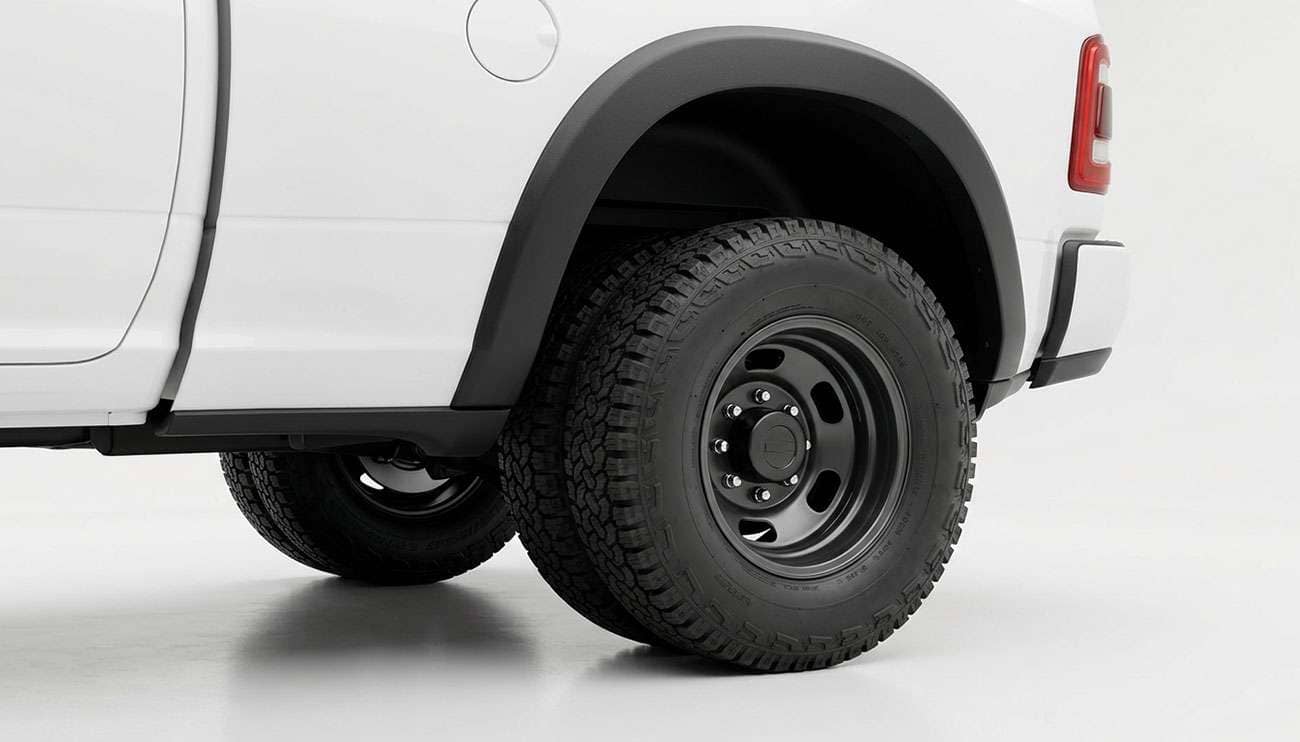
Yes, dually tires have to match, but the number that decides it is diameter, not the brand on the sidewall. The two tires bolted together on each side of a dual rear axle need to be within 1/4 inch of each other in overall diameter, or 3/4 inch in circumference, at the same cold pressure. For two tires of the same make, model, and size, that works out to no more than 4/32 inch of tread depth difference. Size and load range have to be identical every time. Most guides tell you duals "should match" and stop there. The tolerance is the part you actually need.
Find your situation in the table, then jump to the section that covers it.
Your Dual Pair |
Diameter Gap |
Verdict |
What to Do |
|---|---|---|---|
Same make, model, and size; tread within 4/32 inch |
1/4 inch or less |
Matched |
Run it. Recheck at every rotation. |
Same make and model; tread 5/32 to 8/32 inch apart |
About 5/16 to 1/2 inch |
Out of tolerance |
Swap in a closer tire or replace the pair. |
New tire next to a mate worn past half |
More than 1/2 inch |
Badly mismatched |
Replace the pair. Check the other side too. |
Same size, different brand or tread type |
Unknown until measured |
The label can't tell you |
Tape the circumference. Within 3/4 inch passes. |
Identical tires, pressures 5 psi or more apart |
Grows under load |
Mismatched by air |
Set both to the placard cold pressure. |
Different size, load range, or construction |
Not the issue |
Never acceptable |
Replace to the placard size and load range. |
The dually question I hear most isn't whether duals should match. It's whether the pair someone already has does. Here's how to find out.
Closer than you can judge by eye. The Tire and Rim Association caps the diameter difference between dual tires at 1/4 inch. The Tire Retread & Repair Information Bureau publishes that limit by size class, and every light truck tire on a one-ton pickup falls into its smallest class, 8.25R20 and under. Bigger commercial casings get a 1/2-inch allowance. Your dually doesn't.
The same tolerance can be measured four ways:
Measurement |
Maximum Difference |
When You Use It |
|---|---|---|
Overall diameter |
1/4 inch |
Tires standing side by side off the truck |
Radius |
1/8 inch |
Tires mounted, side jacked up, straightedge underneath |
Circumference |
3/4 inch |
Tape wrapped around the tread center |
Tread depth |
4/32 inch |
Only when both tires are the same make, model, and size |
Tread sits on both sides of a tire's diameter. Every 1/32 inch that wears off the top also wears off the bottom, so diameter shrinks twice as fast as tread depth. A 4/32-inch tread gap is an 8/32-inch diameter gap, and 8/32 is 1/4. That's why the shortcut works, and why it only works for identical tires. Two different models can show the same tread depth and still have started life at different diameters.
A typical LT235/80R17 stands about 31.8 inches tall, so a quarter inch looks like nothing. But the load problem below scales with how far a tire compresses under weight, and a 17-inch light truck tire compresses less than a semi tire. The same quarter inch takes a bigger slice of a pickup tire's capacity.
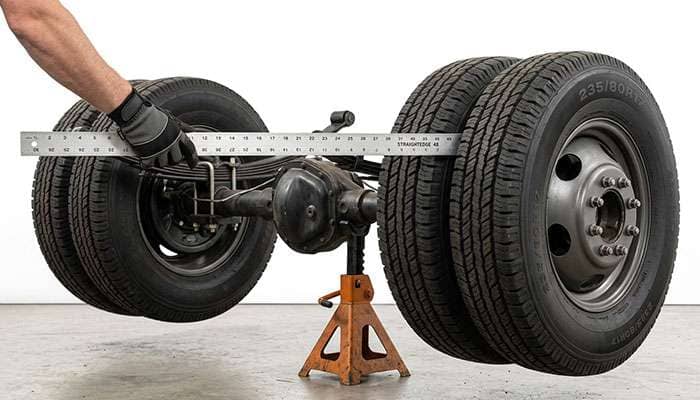
Because the two wheels on each side are clamped together and turn as one piece, at exactly the same rpm, whether their tires agree on size or not. That one fact creates two separate problems, and SAE engineers were already publishing on why dual tires drift out of match back in 1952.
Your axle sits at one height. Both tires on a side reach the pavement from the same hub, so the taller tire gets compressed harder, and a tire compressed harder is carrying more weight. On a heavy truck, commercial tire engineers put a 1/4-inch diameter difference at about 600 pounds more on the larger tire.
Scale that to a pickup. Assume an LT235/80R17 Load Range E compresses roughly an inch at its 2,833-pound dual rating, or about 2,800 pounds per inch. A 1/4-inch diameter gap is a 1/8-inch radius gap, so the two tires end up roughly 350 pounds apart in load. That's about 12 percent of the dual rating, moved by a difference you can't see. Treat it as a rough estimate, not a lab number. It's the same problem covered in what happens when rear axle tires are overloaded, concentrated onto one tire.
The smaller tire has a shorter circumference but has to cover the same ground every revolution, so it slides to keep up. Commercial tire engineers have calculated that a 5/16-inch mismatch drags the smaller tire about 13 feet every mile, roughly 246 miles of sliding per 100,000. Michelin's truck tire engineers estimate an uncorrected mismatch costs 5 to 20 percent of tread life, on both tires.
And you won't feel any of it. Fleet managers report that drivers generally can't detect mismatched duals from the seat. The first symptom is usually a tire that's already damaged.
Only if the worn tire isn't very worn. Ram's owner's manual says tires on dual assemblies should be matched for wear to prevent overloading one tire in a set. The question is how much wear separates the two, not whether one is new.
Across the LT235/80R17 Load Range E market, the typical highway tire starts near 14/32 inch of tread and the typical all-terrain near 16/32. To stay inside the 4/32 window with an identical new tire, the surviving mate needs roughly 11/32 or more. At 8/32, the mate is 7/16 to 1/2 inch smaller in diameter, well past the limit. If you're not sure where yours sit, our guide to the tread depth to replace tires covers the gauge readings.
You have four ways out:
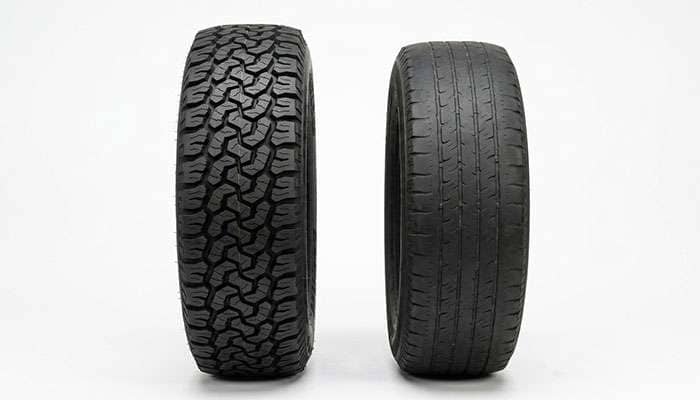
Across the truck, yes. Within a single dual pair, only if you measure. The general rules are in our guide to whether you can mix tire brands. Duals add a measurement step, because the size on the sidewall is a nominal size. It names a size class, not an exact diameter.
One industry comparison of five popular commercial drive tires sold in the same nominal sizes found new diameters spread from 40.5 to 41.1 inches. That's more than double the dual limit before a single mile of wear.
Light truck tires show the same spread in tread depth alone. In LT235/80R17 Load Range E, new tread runs from about 12/32 inch on a highway rib to 18/32 inch on a mud-terrain. Side by side, that 6/32 tread gap is already a 3/8-inch diameter gap, before any casing difference. And two brands with similar tread depth can still land on different diameters, so the tread shortcut doesn't carry across brands.
Radial tires deflect more under load than bias-ply tires, so the two will never split the load evenly, even at identical diameters. This comes up on vintage duallies. Many older one-tons ran bias-ply 16-inch tires, and if you're restoring one with that look, keep all four rears bias-ply.
Yes, with no exceptions. Every light truck tire built for dual service carries two load indexes, and the second is the one your rear axle lives on. On an LT235/80R17 Load Range E marked 120/117, the 120 is the single rating of 3,086 pounds and the 117 is the dual rating of 2,833 pounds, both at maximum pressure. The dual number is lower partly because it already assumes two tires won't split the load perfectly. A mismatch spends that margin. The full breakdown is in our explainer on load range vs. load index.
Truck |
OE Size |
Load Index (Single/Dual) |
Dual Capacity Per Tire |
|---|---|---|---|
Ram 3500 dual rear wheel (recent model years) |
LT235/80R17 E |
120/117 |
2,833 lb |
Chevrolet Silverado / GMC Sierra 3500HD dual rear wheel |
LT235/80R17 E |
120/117 |
2,833 lb |
Ford F-350 dual rear wheel (2017 and newer) |
LT245/75R17 E |
121/118 |
2,910 lb |
Older 16-inch duallies |
LT215/85R16 E or LT235/85R16 E |
115/112 or 120/116 |
2,469 lb or 2,756 lb |
Ford F-450 pickup |
225/70R19.5 G |
Read your sidewall |
Read your sidewall |
Always confirm against your door-jamb placard. Mixing load ranges inside a pair breaks the match two ways. A Load Range D tire maxes out at 65 psi against 80 psi for Load Range E, so it can't run the rear pressure a one-ton calls for. And the lighter-built tire squats more at any pressure, so it behaves like a smaller tire and pushes load onto its stiffer mate.
Directly. An underinflated tire compresses more under load, so its loaded radius shrinks and the axle sees a smaller tire. Its mate picks up the difference. On commercial truck tires, a 5-psi gap between two identical duals has been shown to leave the low tire about 10/32 inch smaller in circumference. Two perfectly matched tires can be mismatched by nothing but air.
The inner dual is the tire most likely to be low, because it's the hardest to reach. Ram uses distinct pressure sensors in the inner rear wheels, which is also why Ram says inner and outer wheels can't be switched. Check the inners first, cold, and set all four rears to the placard rear pressure before you measure anything else.
They have to match in size, not in brand or model. Current one-ton duallies run the same size at all six positions, and Ford's Super Duty owner's manuals recommend rotating dual rear wheel trucks side to side only, keeping each rear dual together as a pair. Ram's manual shows the same pattern. Fronts and rears can come from different purchases, as long as each dual pair is matched to itself.
On a 4x4 dually, the transfer case ties the axles together whenever four-wheel drive is engaged. If the fronts roll at a noticeably different diameter than the rears, the driveline winds up. Heavy-truck guidance for multi-axle drives keeps the average tire diameter of one axle within 1/4 inch of the other, a sensible target for a 4x4 dually too.
The left and right dual pairs can be different brands, but keep them close in diameter. A big gap makes the differential act as if the truck is always turning slightly, working the gears on every straight mile.
When two tires are within tolerance but not identical, mount the larger one on the outside. Goodyear's commercial guidance says that when a difference is unavoidable, the smaller tire goes inside. The outer dual generally wears faster than the inner, a point GM makes in its dual-wheel owner's manuals, so a slightly larger outer tire wears down toward its mate. Road crown also favors the smaller tire on the inside.
Matching also means mounting direction. Ram notes its 3500 dual rear tires may have only one approved direction of rotation because of asymmetric tread and outlined white lettering. Inner and outer wheels mount back to back, so a tire that's correct on an outer wheel can run backward on an inner one. Ram says a spare used in an outer position may need to be remounted on the rim so the wheel dishes inward. Check rotation arrows on both tires before the lug nuts go on.
The mechanics are the same, but the stakes change once your truck is a commercial motor vehicle. Under FMCSA's definition in 49 CFR 390.5, a vehicle with a gross vehicle weight rating of 10,001 pounds or more used in interstate commerce qualifies. One-ton duallies typically carry a GVWR well above that line, so check your door-jamb label. A dually hauling equipment for a business across state lines falls under FMCSA's Part 393 equipment rules.
FMCSA doesn't publish a dual-matching tolerance of its own. What 49 CFR 393.75 does set is at least 2/32 inch of tread on rear tires and 4/32 inch on fronts, no tire loaded beyond its sidewall maximum, and no tire run below the cold pressure required for its load. Mismatched duals threaten the last two.
Using the same rough math: say your rear axle scales at 9,400 pounds, or 2,350 per tire if all four shared evenly. Put a new 16/32 tire next to a mate at 4/32 and the diameter gap is 3/4 inch. At roughly 2,800 pounds per inch, the new tire picks up about 525 pounds over its share. That's about 2,875 pounds, past its 2,833-pound dual rating, on an axle weight that looks fine on paper.
Mismatched duals fail in a predictable order, and each step costs more than the one before it.
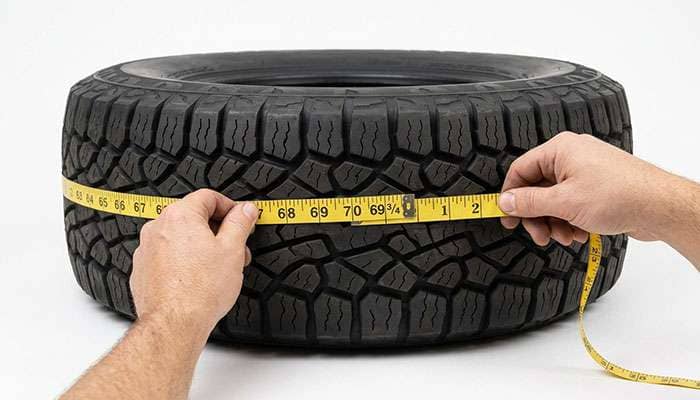
You need a tread depth gauge, a cloth tape measure, a straightedge such as a 4-foot level, a jack with stands, and an accurate pressure gauge. Start with the tires cold.
Tread Left on the Other Rear Tires |
Gap to a New Tire |
What to Buy |
Why |
|---|---|---|---|
11/32 inch or more |
4/32 inch or less |
1 tire, same make and model |
It lands inside the tolerance. |
8/32 to 10/32 inch |
5/32 to 7/32 inch |
2 tires, the full pair on that side |
One new tire would carry the pair's load. |
7/32 inch or less |
8/32 inch or more |
All 4 rear tires |
The set is past half. A pair now means another pair soon. |
Same make and model unavailable |
Unknown until measured |
At least 2, measured |
Different brands only match on a tape. |
The gaps assume a new tire starting near 15/32 inch, typical for Load Range E light truck tires. Check the new tread depth of the tire you're buying and adjust.
Dually tires have to match, and "match" has a number attached: within 1/4 inch of diameter, 3/4 inch of circumference, or 4/32 inch of tread for identical tires, with the same size, load range, and construction every time. Brand can differ, but only after a tape measure says so.
The reason is mechanical. Two wheels bolted together turn at one speed, so the taller tire takes the load and the shorter one gets dragged. You won't feel it, so the check has to be deliberate.
When the numbers say it's time, shop truck tires in your dually's exact size and load range, and buy the single, pair, or full set the tolerance calls for.
Here's what decides it.
Yes, if the new tire's partner is close enough. With the same make, model, and size, the surviving mate needs to be within 4/32 inch of the new tire's tread depth, usually 11/32 inch or more remaining. With a different brand, the two need to measure within 3/4 inch in circumference. Otherwise, replace the pair.
Yes. The inner and outer tire on each side must be the same size, load range, and construction, and within 1/4 inch in diameter at the same cold pressure. If they're within tolerance but not identical, mount the larger tire outside.
The industry guideline is 4/32 inch, which equals a 1/4-inch diameter difference because tread wears off both sides of the diameter. It only applies to the same make, model, and size. For different tires, keep circumference within 3/4 inch.
Yes across axles and side to side. Within a single dual pair, different brands work only if they're the same size, load range, construction, and tread category, and measure within 3/4 inch in circumference. The same size label doesn't guarantee the same diameter.
Not always. If the remaining rears have 11/32 inch or more, one matching tire can work. Between 8/32 and 10/32, replace the pair on that side. At 7/32 inch or less, replace all four rears.
Yes, but compare its diameter with the tire it will run next to first. Older Ram owner's manuals say that if there's a significant difference, the larger tire should go in a front position instead. A spare used in an outer dual position may also need to be remounted on its rim for rotation direction.