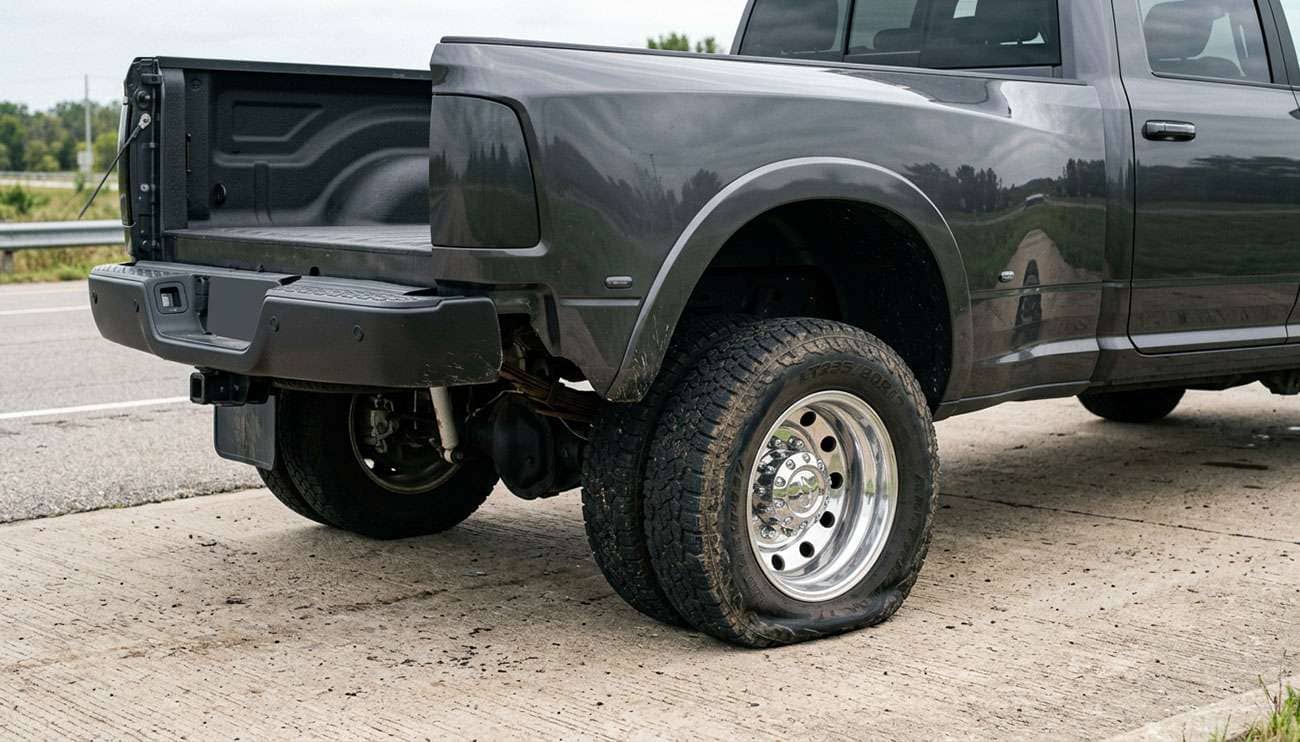
Yes, but only if the surviving tire on that side can carry the whole corner by itself, and on a loaded or towing dually it usually cannot. Most answers stop at "drive slowly" or "it depends on the load" without giving you the number. The number is your rear axle weight divided by two, compared with the partner tire's single load rating at the pressure it is actually running. On a Ram or GM dually at placard pressure, that line sits at about 5,360 lbs on the rear axle.
There is a second problem, and it has nothing to do with math: you may not know you have a flat at all. An inner dual can go to zero behind a fully inflated outer tire with no lean, no pull and, on many trucks, no warning light. By the time you find it, the partner tire has been carrying double duty for miles. Both problems have the same fix, which is knowing your numbers before the flat happens.
This table uses LT235/80R17 Load Range E, the factory size on Ram 3500 and Chevy and GMC 3500HD duallies. Ram's placard runs the rear duals at 65 psi, where the load and inflation table rates this tire at 2,680 lbs single. At its 80 psi sidewall maximum, it is rated at 3,085 lbs single.
Rear Axle Weight |
Load on the Surviving Tire |
Percent of Its Single Rating (65 psi / 80 psi) |
Can You Drive? |
|---|---|---|---|
Under 5,360 lbs |
Under 2,680 lbs |
Under 100% / under 87% |
Yes, slowly, to the nearest safe place to change it |
5,360 to 6,170 lbs |
2,680 to 3,085 lbs |
100% to 115% / 87% to 100% |
Only after airing the partner to 80 psi |
6,170 to 7,000 lbs |
3,085 to 3,500 lbs |
115% to 131% / 100% to 113% |
Off the travel lane only, at a crawl |
Over 7,000 lbs (loaded bed, fifth wheel, gooseneck) |
Over 3,500 lbs |
Over 131% / over 113% |
No. Change the tire where you are |
Any weight, flat tire shredding or rubbing its partner |
Not the limiting factor |
Not the limiting factor |
No. Stop and change it |
The table assumes the weight splits evenly side to side, which it rarely does exactly. Treat any row boundary as a caution zone, not a target. The size table further down gives the same break-even number for every common dually size.
Look at the sidewall of a dually tire and you will find two numbers in the service description, such as 120/117. The first is the single load index. The second is the dual load index, and it is always lower. On an LT235/80R17 E, 120 means 3,085 lbs and 117 means 2,835 lbs, both at 80 psi. If you want the background on how those indexes relate to load range, our guide on load range vs. load index covers it.
The dual rating is lower by design. Two tires bolted side by side run hotter than one tire with open air around it, and the industry builds in reserve so that when one dual fails, the other three can carry the axle temporarily at reduced speed. That reserve is the whole reason you can limp at all. It is also why the reserve runs out fast: the surviving tire jumps from its dual share to the full corner, and its single rating is the only number that still applies.
The federal standard for trucks over 10,000 lbs GVWR, FMVSS 120, requires the sum of the tires' maximum load ratings on an axle to be no less than that axle's gross axle weight rating. Your truck's certification label lists the rear GAWR with the tire size and a cold pressure marked for dual fitment. The truck was certified on four rear tires sharing that load. Take one away and you are outside the math the label was built on. The reason duals exist in the first place is covered in our piece on why dually wheels carry what they carry.
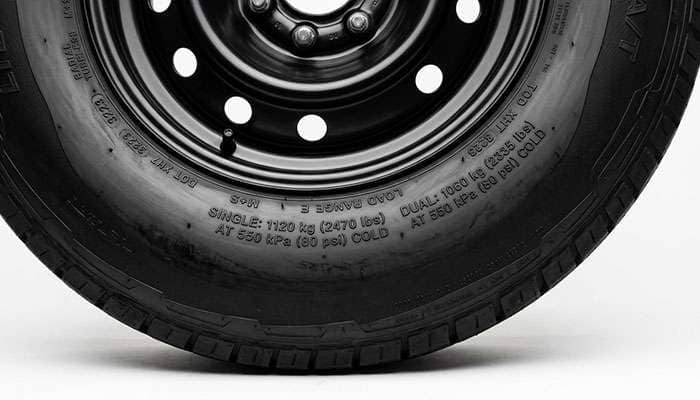
At its sidewall maximum pressure, one tire can carry its single rating and no more. Here is what that means for each common factory dually size. Loads are the sidewall maximums at each tire's maximum pressure; check the numbers stamped on your own tires.
Dually Tire Size |
Common Factory Fitment |
Per Side, Both Tires (2 x Dual) |
Per Side, One Tire (Single) |
Capacity Lost |
Max Rear Axle Weight to Limp |
|---|---|---|---|---|---|
LT215/85R16 E (115/112) |
Older Ford F-350 DRW |
4,940 lbs |
2,680 lbs |
46% |
5,360 lbs |
LT235/85R16 E (120/116) |
Older Ford F-350 DRW and other older one-tons |
5,556 lbs |
3,042 lbs |
45% |
6,084 lbs |
LT235/80R17 E (120/117) |
Ram 3500 DRW, Chevy Silverado and GMC Sierra 3500HD DRW |
5,670 lbs |
3,085 lbs |
46% |
6,170 lbs |
LT245/75R17 E (121/118) |
Current Ford F-350 DRW |
5,820 lbs |
3,195 lbs |
45% |
6,390 lbs |
225/70R19.5 G (128/126) |
Ford F-450 pickup |
7,500 lbs |
3,970 lbs |
47% |
7,940 lbs |
Two things jump out. First, losing one tire costs that side of the axle 45 to 47 percent of its capacity, not 50, because the survivor gets to use its higher single rating. That is the reserve the dual rating builds in. Second, the last column assumes the partner tire is at its sidewall maximum. Most duallies do not run there. Ram's placard, for example, calls for 65 psi in the rear duals, and at 65 psi an LT235/80R17 E is rated at 2,680 lbs single. That cuts the break-even rear axle weight from 6,170 lbs to 5,360 lbs. Pressure is part of the answer, and it is the part you can fix at the roadside if you carry a compressor.
The door sticker gives you the rear GAWR, which is the maximum the axle may carry, not what it is carrying right now. You need the actual number, and there are three ways to get it.
Here is how it plays out. Say your scale ticket shows 3,800 lbs on the rear axle empty. That puts 1,900 lbs on the surviving tire, 71 percent of its single rating even at 65 psi. Hook up a fifth wheel that adds 3,200 lbs to the rear axle and you are at 7,000 lbs, or 3,500 lbs on one tire. That is 131 percent of its rating at 65 psi and 113 percent at 80 psi. Same truck, same flat, opposite answers.
Even under the break-even weight, the answer is slow and short. The dual reserve exists to get you out of immediate danger, not to finish the trip. A tire carrying its full single rating on hot pavement with its flat neighbor flexing beside it is working at the top of its envelope.
Above the break-even weight, speed becomes the only variable left, and it shrinks fast. Tire engineers working from industry load tables put the allowable speed at roughly 40 mph for 7 percent overload, 30 mph at 13 percent, and 20 mph at about 21 percent. Past that, you are at walking pace or you are not moving. The partner tire also accumulates damage you cannot see, so distance matters as much as speed.
The practical rule: hazard lights on, get off the travel lane, and go to the nearest place where you can change the tire safely. That is usually the next wide shoulder or parking lot, not the tire shop across town. If you carry a compressor, air the partner to its sidewall maximum before moving at all.
Not beyond getting off the road. A fifth wheel or gooseneck puts most of its pin weight on the rear axle, and with any real trailer behind you, the math in the first table lands you in the bottom rows. A bumper-pull trailer adds less rear axle load directly, but the overloaded partner tire is still doing the braking and cornering work for that whole corner with a trailer pushing on it.
If you are hooked up, the safest sequence is to get the rig fully off the road, change the tire there, and only then continue. If you cannot change it yourself, call for road service rather than limping with the trailer attached. This is the scenario where the dually reserve gets used up fastest and where a second tire failure has the worst consequences.
An outer flat announces itself. An inner flat usually does not, for four reasons.
Fleet tire specialists make the same point: a low inner dual is very hard to see, and the fully inflated tire mated to it fatigues from the extra load. If your truck does have a pressure warning, take it seriously. Our guide on whether you can still drive with the TPMS light on explains what the light is and is not telling you.
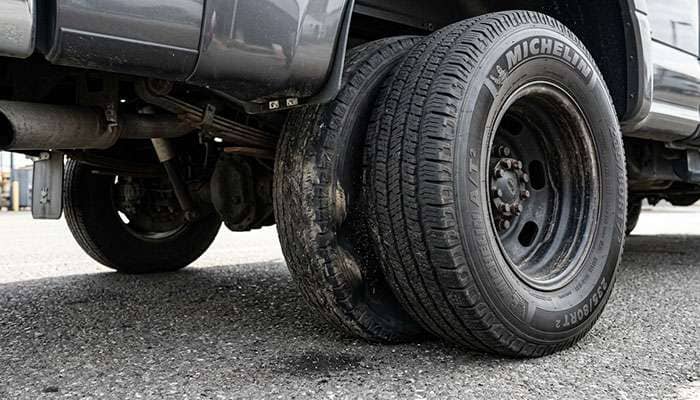
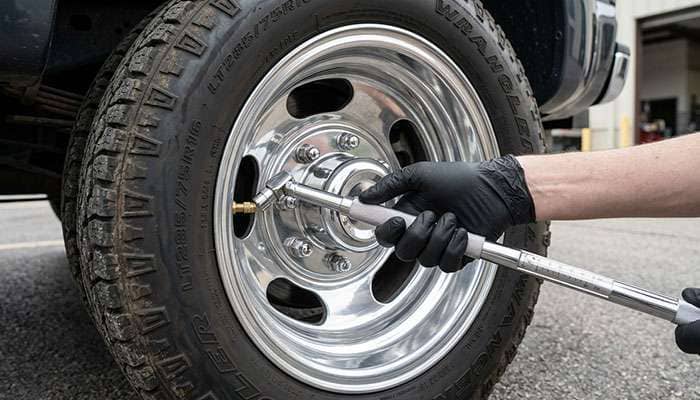
Checking all six tires should take five minutes. If it takes longer, fix the setup.
For personal use, no federal rule speaks directly to it, and the physics above is your guide. For business use, it can be a different story. A truck with a GVWR of 10,001 lbs or more used in interstate commerce is a commercial motor vehicle, and most one-ton duallies are rated well above that line.
For those trucks, FMCSA regulation 49 CFR 393.75 is blunt: no motor vehicle may be operated on a tire that is flat or has an audible leak, and there is no exception for duals. FMCSA's 49 CFR 396.7 allows a vehicle found in an unsafe condition to continue only to the nearest place where repairs can safely be made, and only if that is less hazardous to the public than leaving it on the highway. Roadside inspectors commonly treat a tire at half its sidewall maximum pressure or less as flat. On an 80 psi Load Range E tire, that is 40 psi.
A flat dual is not dead weight. It is still bolted to the hub and still rolling, and that is where the costs start.
Every rung adds tires to the bill. Stopping at the first one is the cheapest outcome available.
Sometimes. The rule is matching. Industry guidance for dual assemblies keeps paired tires within 1/4 inch in diameter, or 3/4 inch in circumference, at working pressure. Fleet shops often use a 4/32 inch tread depth difference as a quick proxy when the size, brand and tread design are the same. In commercial truck tires, a 1/4 inch diameter difference can put roughly 600 lbs more on the taller tire. A brand-new tire next to a half-worn partner is a mismatch, and the new tire ends up carrying more than its share.
What you replace depends on what the partner went through:
What Happened |
Partner Tire |
What to Replace |
|---|---|---|
Caught it parked, never rolled flat |
Never carried the corner alone |
Repair the flat if the puncture qualifies, or replace it with a tire matched to the partner |
Limped a short distance, empty, under break-even |
Worked within its single rating |
Replace the flat with a matched tire; have the partner demounted and inspected |
Drove loaded, towing, or above break-even |
Overloaded |
Both tires on that side, as a matched pair |
Inner flat ran unnoticed for miles |
Overloaded for an unknown distance |
Both tires on that side; inspect the wheels and check the other side |
Rear tires already half worn or more |
Any condition |
All four rears, so every dual pair matches |
When you buy, match the size, the load range and both load index numbers on your current tires. Not every LT tire in common dually sizes is stamped with a dual rating, and a tire with only one number has no marked dual capacity, so confirm the second number before it goes on a dual position. Going down in load index on a dually is a bad trade for the reasons in our piece on whether a lower load index tire is safe. You can shop LT replacements in dual-rated sizes in our truck tires lineup.
A dually can carry you to safety on one rear tire per side, but only inside a weight limit most drivers have never calculated. Divide your rear axle weight by two and compare it with the partner tire's single rating at the pressure it is running. Under that number, move slowly and briefly. Over it, change the tire where you are.
The inner dual is the flat that hurts most because it hides. Put a gauge on all six tires regularly, fix any setup that makes the inner valves hard to reach, and treat any partner that carried the corner alone as a suspect tire until it has been inspected.
Only a short distance at low speed, and only if half your rear axle weight is less than the surviving tire's single load rating at its current pressure. On an LT235/80R17 E at 65 psi, that means a rear axle weight under about 5,360 lbs. Loaded or towing, you are usually over that limit and should change the tire where you are.
Only to the nearest place where you can safely change the tire. The dual load reserve is designed for temporary operation at reduced speed. Every mile on an overloaded partner tire adds internal damage, so the shorter the distance, the better.
Put a gauge on it. The outer tire keeps the truck level, so an inner flat rarely shows from a walk-around. From behind the truck, look for an inner sidewall bulging toward its partner or rubber dust between the tires, and check both duals to the same cold pressure.
Some do and some do not. The federal TPMS standard, FMVSS 138, excludes vehicles with dual wheels on an axle. Ram 3500 duallies use dedicated inner-dual sensors, while other duallies have shipped without factory TPMS or without coverage on every position. An aftermarket six-sensor system fills the gap.
Yes, if the new tire matches its partner within 1/4 inch in diameter and has the same size, load range and dual rating. If the partner carried the corner alone under load, or the rears are already significantly worn, replace the pair or all four rears instead.
Only far enough to get off the road. A fifth wheel or gooseneck puts most of its pin weight on the rear axle, which usually pushes the surviving tire well past its single load rating. Change the tire before continuing.