
Wider tires sell because they look the part. Bigger contact patch, more rubber on the ground, the visual stance every car magazine has trained us to want since the eighties. The performance pitch isn't wrong either — for pure dry traction, wider almost always wins.
But here's what the marketing copy skips: the contact patch only does work in one direction. Every other parameter — wet grip, fuel burn, noise, steering effort, suspension life, cost, and snow performance — moves the wrong way when you go wider. Most drivers find out the hard way after the upgrade is already in the budget.
I'll walk through all seven trade-offs, with the engineering behind each, so you know exactly what you're trading when you size up. I'll also tell you the cases where the trade is genuinely worth it.
This is the disadvantage that gets buried the most often, and it's the one that matters most for safety. The wider your tire, the more water sits between the contact patch and the road surface — and the harder it is for the tread grooves to evacuate that water before the tire lifts off the pavement and starts skimming.
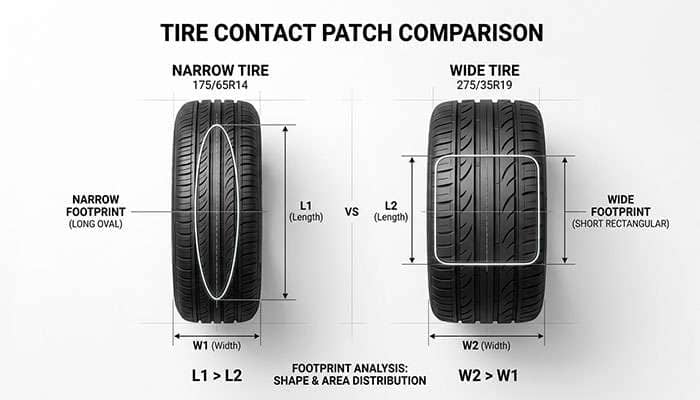
The mechanics are simple. A narrow tire creates a long, slim contact patch — picture a knife edge cutting through standing water. A wider tire creates a shorter, broader patch that has to push more water out sideways before the rubber can grip the pavement. At highway speeds in heavy rain, that's the difference between staying planted and floating.
Real numbers from independent testing: hydroplaning onset can shift by as much as 5-10 mph between a narrower OE tire and a significantly wider aftermarket setup at the same tread depth. That's the gap between maintaining control and losing it on a flooded interstate. We've covered the full mechanics of this in our piece on what hydroplaning is and how to prevent it, and the math works against wider rubber every time.
Tire engineers compensate with aggressive directional tread patterns and deeper circumferential grooves on performance tires designed for wider fitments — but that compensation only goes so far. A 275-section tire with a great wet-weather tread will still hydroplane sooner than a 235-section version of the same compound and pattern.
Wider tires cost you fuel for three independent reasons, and they stack.
First, weight. A 275/40R20 tire and wheel assembly typically weighs 8-12 pounds more per corner than the 235/45R18 it replaces. That's 32-48 pounds of unsprung rotating mass added to the vehicle, and rotating mass costs roughly twice the energy to accelerate as static weight does because the engine has to spin it as well as move it forward.
Second, aerodynamic drag. Increasing tread width by just 30mm can increase frontal area drag by around 6%, which translates to measurable fuel penalty at highway speeds where aero accounts for most of the power demand.
Third, rolling resistance — though this one has a nuance worth flagging. In a controlled lab test at identical inflation pressure, a wider tire actually has slightly lower rolling resistance than a narrow one because its contact patch is shorter and deforms less per revolution. But in the real world, wider tires usually run lower pressures than narrow ones (often 32-35 psi versus 38-42 psi), which more than wipes out that lab advantage. Add the heavier construction and stiffer sidewalls, and the practical fuel penalty is real.
The combined effect typically lands somewhere between 1-3 mpg lost on a passenger car after a meaningful upsize, and worse on trucks. Tire pressure plays a separate role — see our breakdown of how tire pressure affects gas mileage for the inflation side of the equation.
The relationship between tire width and noise is direct: more rubber making contact with the road means more surface area generating vibration that radiates through the wheel, into the suspension, and finally into the cabin as audible hum.
Three factors compound the effect:
Contact patch area. A wider contact patch produces more pavement-induced vibration at any given speed. Doubling the contact patch doesn't double the noise (sound scales logarithmically), but you'll feel and hear the difference clearly above 50 mph.
Tread block size and pattern. Performance-oriented wider tires often use larger, stiffer tread blocks for cornering grip. Larger blocks slap the road harder and ring louder than the small, flexible blocks on a comfort-tuned narrow tire.
Sidewall stiffness. Wider tires almost always come with shorter, stiffer sidewalls (lower aspect ratio), which transmit more impact harshness through to the wheel and suspension instead of absorbing it. That feeds directly into the cabin as vibration through the steering wheel and seat.
If you've narrowed down a wider tire and want to keep noise manageable, the tread compound and pattern matter as much as the width. Our guide to what causes tire noise walks through which design elements drive cabin sound and which to look for in a quieter performance tire.
Bigger contact patch, more friction with the pavement when the wheels turn. That friction has to be overcome by either your arms or the power steering pump every time you maneuver.
On modern cars with electric power steering, the system compensates well enough that most drivers don't notice the difference at highway speeds. But at parking-lot speeds — backing into a tight space, three-point turns, low-speed cornering — the extra effort is real and noticeable. Older vehicles with hydraulic power steering feel it more, and unassisted steering (vintage cars, kit cars, some racing applications) can become genuinely difficult with significantly wider rubber.
There's also a precision side effect: wider tires increase the scrub radius — the distance between the steering axis and the center of the contact patch. Larger scrub radius amplifies bump steer, makes the steering wheel kick harder over potholes, and increases torque steer in front-wheel-drive cars under acceleration. None of this destroys handling, but the steering will feel busier and less calm than the OE setup the suspension was tuned for.
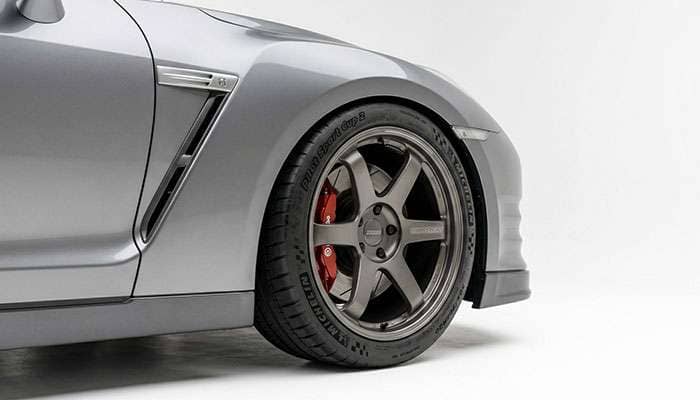
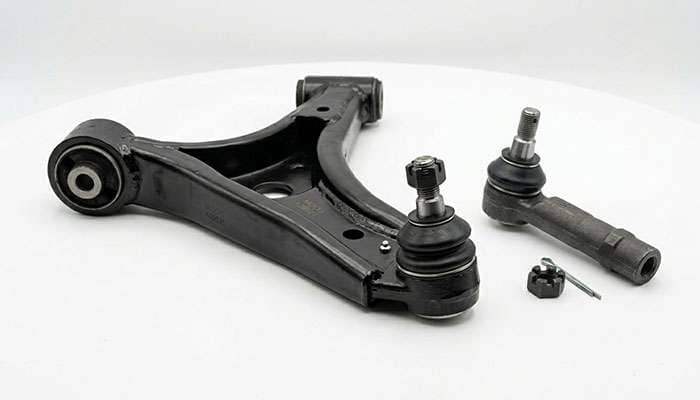
This is the trade-off that shows up six months to two years after the upgrade, when components start needing replacement that wouldn't have failed for another 50,000 miles on the OE setup.
The mechanism is unsprung weight and rotational mass. A heavier wheel-and-tire assembly puts more load on every component that supports or moves it: wheel bearings spin harder, ball joints carry more weight at every steering input, control arm bushings absorb more impact energy, tie rod ends fight more friction every time you turn the wheel, and strut shafts cycle under heavier loads at every bump.
The wear isn't catastrophic — it's accelerated. Manufacturer engineers spec OE tire and wheel weight as a known input to component fatigue life calculations. When you exceed that input by 30-40% per corner, you're not breaking anything immediately; you're moving the failure curve earlier. Wheel bearings that would have lasted 100,000 miles might call it quits at 70,000. Ball joints that would have made 80,000 miles might start clunking at 55,000.
The effect is most pronounced on vehicles that weren't designed with significant aftermarket sizing headroom — economy cars, older sedans, base-trim crossovers. Performance trims and trucks generally have beefier suspension hardware that absorbs the extra load with less impact. An alignment after any tire size change is mandatory regardless — see our piece on whether you need an alignment with new tires for the full picture.
The price tag on the tire itself is just the start. A meaningful upsize usually drags four other costs with it.
Wider wheels. A wider tire needs a correspondingly wider wheel to seat properly. A 275-section tire wants an 8.5-9.5" wheel; a 235-section is happy on a 7.5-8" wheel. Aftermarket wheels run $200-600 each, multiplied by four corners.
The tires themselves. Wider sizes consistently cost more per tire than narrower equivalents from the same line. A 235/45R18 in a premium performance tire might run $220; the 275/40R18 version of the same tire commonly runs $280-310 — and that gap widens as you climb into 20" and 22" diameters.
To put real numbers on it from current PPT inventory: in a premium summer tire like the Michelin Pilot Sport 4 S, the 235-section sizes typically come in around $230-260 per tire, while 275-section equivalents run $310-380. In a more aggressive performance category like the Continental ExtremeContact Sport, the gap is similar — narrower fitments are roughly $200-240 and wider fitments push $280-340 each.
TPMS and labor. If your new wheels need different TPMS sensors or relocation, that's $30-80 per sensor plus mount and balance labor of $25-40 per tire.
Alignment after install. Mandatory whenever tire dimensions change meaningfully. $80-150 at most shops.
A typical upsize from OE 235/45R18 to a 275/35R19 setup, including wheels, tires, sensors, mount/balance, and alignment, lands somewhere between $2,400 and $4,500 depending on brand and shop. None of that is wasted money if you actually use the performance — but it's worth knowing the real number before you commit.
The same property that helps wider tires on dry pavement — distributing vehicle weight over a larger area — works against them in snow and on ice.
In snow, you want pressure concentrated on a small contact patch so the tire can cut down through the snow layer to grip the pavement underneath. A narrow tire acts like a knife edge; a wide tire acts more like a snowshoe and tends to "float" on top of the snow instead of biting through it. The same principle applies on packed snow and slush — narrower is better.
On ice, the gap is smaller because contact pressure isn't the dominant variable (the rubber compound and siping density matter more), but wider tires still don't help. The added weight that comes with most wider setups slightly extends braking distances on slick surfaces.
This is why most all-wheel-drive vehicles delivered to snow-belt customers come with narrower OE tire specs than their dry-state counterparts of the same model — the manufacturers know what works in winter, and it's not extra width. If you live somewhere with regular winter weather, the case for wider summer tires gets stronger as a dedicated seasonal setup, not a year-round one.
I'm not anti-wider tire — there are absolutely scenarios where the trade-off math tips the right way. Here are the four where I'd recommend going wider without hesitation.
Track and autocross use. When you're driving at the limit on dry pavement, the dry-grip advantage is everything and the wet-weather, fuel, and noise penalties don't matter. Wider is genuinely faster.
High-power performance cars in dry climates. 500+ horsepower needs a contact patch to put it down. A 275-section tire on the rear of a Hellcat, GT500, or Z06 isn't a vanity choice — it's a hookup necessity. Pair it with a quality performance tire like the Michelin Pilot Sport 4 S or Continental ExtremeContact Sport, and the noise/wear trade is part of the deal you signed up for. We've ranked the best options in our roundup of the best high-performance tires for sports cars.
Show cars and dedicated weekend drivers. If the car sees light mileage, mostly in good weather, the fuel and wear penalties become rounding errors. The aesthetics win, fair enough.
Trucks doing real work in dry conditions. Wider tires distribute load better, give more stability under heavy payloads, and improve traction in dry dirt and gravel. Just don't expect them to help you in deep snow.
Outside of these cases — daily drivers, family vehicles, anything used in mixed weather — the OE width is almost always the right call. Manufacturers don't choose tire size by accident; they spec the dimensions that balance the same seven trade-offs we just walked through. If you do go wider, our guide to plus-sizing tires covers how to do it within the 3% diameter rule, and for extreme fitments, you might be looking at tubbing the car for wider tires. Also worth reading our low-profile tire pros and cons piece, because most upsizes drop aspect ratio at the same time.
Here's how the two configurations stack up across the dimensions that matter for daily driving.
Performance Dimension |
OE Width Tire |
Wider Aftermarket Setup |
|---|---|---|
Dry traction |
Adequate for design loads |
Noticeably better |
Wet weather grip |
Better water evacuation |
Higher hydroplaning risk |
Fuel economy |
Baseline factory spec |
1-3 mpg worse on average |
Cabin noise |
Tuned for comfort |
Increased hum and vibration |
Steering effort |
Calibrated to OE weight |
Heavier at low speeds |
Suspension wear rate |
Designed component life |
Accelerated by 20-30% |
Snow and ice traction |
Better grip and float resistance |
Reduced bite, more float |
Total upgrade cost |
Replacement cost only |
$2,400-4,500 typical |
Wider tires aren't bad — they're a trade-off, and the trade only makes sense when the dry-grip and aesthetic gains are worth the costs in wet weather, fuel, noise, steering, suspension life, money, and winter performance. For track cars, high-output performance vehicles, and dedicated weekend drivers, the math works. For daily drivers in mixed climates, OE width almost always wins on the balance sheet.
If you've decided wider tires fit your use case, the right tire makes a measurable difference in how much of the downside you actually feel. A premium performance tire like the Michelin Pilot Sport 4 S or Continental ExtremeContact Sport compensates for some of the wet-weather and noise penalties through tread design and compound choice. A budget-tier wide tire amplifies all seven disadvantages without delivering the dry-grip upside that justified the upgrade in the first place. If you want a more accessible price point with strong performance, the General G-MAX RS punches above its tier on dry handling. Browse the full range of performance tires to find the right fit for your application.
The main disadvantages of wider tires are increased hydroplaning risk in wet weather, reduced fuel economy of 1-3 mpg, more cabin noise and vibration, heavier steering at low speeds, accelerated wear on suspension and steering components, higher total cost (typically $2,400-4,500 for a full upgrade), and worse snow and ice performance.
Yes. Wider tires typically reduce fuel economy by 1-3 mpg through three independent factors: increased rotating mass (8-12 pounds more per corner), greater aerodynamic drag (around 6% per 30mm of added width), and lower operating pressures that increase real-world rolling resistance compared to narrower OE tires.
Wider tires have a higher hydroplaning risk than narrower tires of the same compound and tread pattern. The larger contact patch creates a shorter, broader footprint that has to push more water sideways before the rubber grips pavement. Hydroplaning onset can shift 5-10 mph earlier on a significantly wider setup, which matters at highway speeds in heavy rain.
Wider tires don't cause immediate suspension damage, but they accelerate wear on wheel bearings, ball joints, control arm bushings, tie rods, and strut shafts by 20-30%. OE suspension components are specified for the factory wheel and tire weight; exceeding that by 30-40% per corner moves the failure curve earlier on every component that supports or moves the wheel.
Yes. Wider tires perform worse in snow because they distribute vehicle weight over a larger contact patch, causing them to float on top of the snow layer instead of cutting through to grip the pavement underneath. Narrower tires concentrate weight on a smaller patch and bite through snow more effectively. This is why most AWD vehicles delivered to snow-belt regions ship with narrower OE tire specs.
Wider tires are worth the trade-offs for track and autocross use, high-horsepower performance cars in dry climates, show cars and weekend drivers with light mileage, and trucks doing real work in dry conditions. For daily drivers in mixed weather, the OE width almost always offers the better balance of grip, efficiency, comfort, and cost.
A typical upsize costs between $2,400 and $4,500 once you account for wider aftermarket wheels ($800-2,400 for a set), the wider tires themselves ($800-1,500), TPMS sensors if needed ($120-320), mounting and balancing ($100-160), and the mandatory post-install alignment ($80-150). Premium brands and larger diameters push toward the high end of the range.



