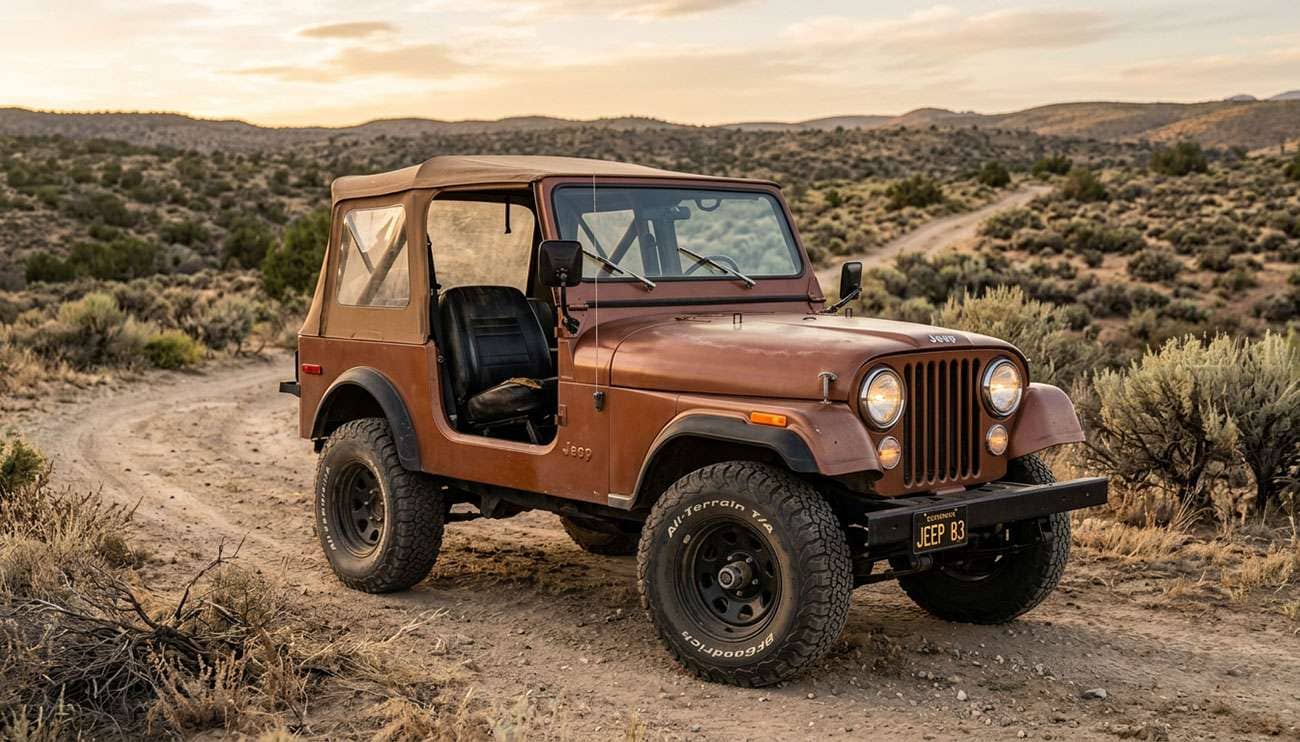
A stock CJ-7 will fit a 31x10.50R15 tire on the right wheel, and a 30x9.50R15 or 235/75R15 fits with room to spare. You'll hear "31s fit, it depends" from just about everybody. What it depends on comes down to two things most guides never put in front of you: which axle track your Jeep has, and how much your 40-year-old leaf springs have settled. The axle track decides how wide you can go and what backspacing you need. The springs decide how tall you can go before the rear wheel well catches the tire.
I've been mounting tires on CJs since they were new on the showroom floor. Most of the CJ-7s that roll into our shop in Long Beach today are wearing a mismatch: the wrong backspacing for their axle, or 31s stuffed under springs that gave up years ago. Let's sort out yours.
Find your Jeep in the left column. The year tells you the axle track. The spring check is something you can do in your driveway in five minutes, and I'll show you how further down.
Feature |
Fits Clean |
Biggest on Stock Suspension |
Wheel to Run |
|---|---|---|---|
1976-1981 narrow-track, healthy springs |
235/75R15 or 30x9.50R15 |
31x10.50R15, only with shallow backspacing |
15x8, about 3.5 in backspacing |
1982-1986 wide-track, healthy springs |
30x9.50R15 or 31x10.50R15 |
31x10.50R15; 32s need rear trimming |
15x8, about 3.75 in backspacing |
Any year, sagged springs |
225/75R15 or 235/75R15 |
30x9.50R15 until the springs are replaced |
Factory 15x7 or a 15x8 |
Any year, concours or period-correct restoration |
H78-15 bias-ply or 225/75R15 radial |
Stay with the factory size |
Factory steel or styled wheel |
The second table sorts by how you use the Jeep. That's the question that tells you which tire to put on the order sheet once the size is settled.
Feature |
Best Size |
Why |
|---|---|---|
Weekend cruiser, mostly pavement |
235/75R15 |
Light, quiet, keeps factory gearing close, widest choice of all-season tread |
Mixed street and dirt road |
30x9.50R15 |
Fills the wheel well, clears everything on stock springs, minimal gearing hit |
Real trail use |
31x10.50R15 |
The classic CJ size; deepest selection of all-terrain and mud-terrain tread |
Restoration or show |
H78-15 bias-ply or 225/75R15 |
Matches what the Jeep wore when it left Toledo |
The CJ-7 ran from 1976 through 1986, and the factory tire changed with the times. Early Jeeps rolled out on bias-ply and bias-belted letter sizes like H78-15, roughly 27.5 inches tall. As radials took over, the standard fitment moved to metric sizes from 205/75R15 up through 235/75R15, depending on year and trim. Renegade and Laredo packages generally wore the bigger 235/75R15 on styled wheels, while base Jeeps often made do with something narrower on plain steel.
Every CJ-7 used a 15-inch wheel on a 5x5.5 bolt pattern. That bolt pattern is your friend, because it is shared with a long list of trucks and Jeeps, and wheel selection in 15-inch 5x5.5 is still deep today. If you're shopping wheels, our 5x5.5 wheel guide covers what else shares that pattern.
Feature |
Overall Diameter |
Tread Width |
Where It Fits |
|---|---|---|---|
H78-15 (bias) |
about 27.5 in |
about 8 in |
Factory; restoration |
205/75R15 |
27.1 in |
8.1 in |
Factory base |
215/75R15 |
27.7 in |
8.5 in |
Factory base |
225/75R15 |
28.3 in |
8.9 in |
Factory; fits every CJ-7 |
235/75R15 |
28.9 in |
9.3 in |
Factory Renegade and Laredo; fits every CJ-7 |
30x9.50R15 |
about 29.9 in |
9.5 in |
Stock suspension, any year |
31x10.50R15 |
about 30.8 in |
10.5 in |
Stock suspension with healthy springs and the right backspacing |
33x12.50R15 |
about 32.8 in |
12.5 in |
Needs a lift |
The 235/75R15 is the easiest upgrade on a CJ-7 and is still one of the most widely stocked 15-inch light truck sizes on the market. It's about 28.9 inches tall. You can see how it measures against the others in our 235/75R15 in inches breakdown.
Yes, with conditions. The 31x10.50R15 is the size every CJ owner asks about, and on a healthy Jeep with the right wheel, it fits without a lift. It is also the deepest flotation size in the 15-inch market, so you will have more tread choices here than in any other CJ size, from highway all-terrains to full mud-terrains.
Here are the conditions. The springs need to be holding factory ride height. The wheel has to put the tire where it clears the front leaf spring at full lock. And you have to accept that hard articulation off-road may still kiss the rear wheel well opening. On a Jeep that only sees pavement and graded roads, that last point may never come up.
The flotation sizing tells you the tire's real numbers right on the sidewall: 31 inches tall, 10.50 inches wide, 15-inch wheel. Measured, most 31s come in closer to 30.5 to 30.8 inches mounted. If you're cross-shopping metric sizes against it, our 31x10.50R15 equivalent chart lines them up.
On load, you don't need to overbuy. A CJ-7 is a light machine. Nearly every 31x10.50R15 is built as a Load Range C light truck tire rated at 109, or 2,271 pounds per tire at 50 psi. Four of them carry more than twice what a fully loaded CJ-7 weighs. Going to a heavier ply rating only makes a short-wheelbase Jeep ride harder.
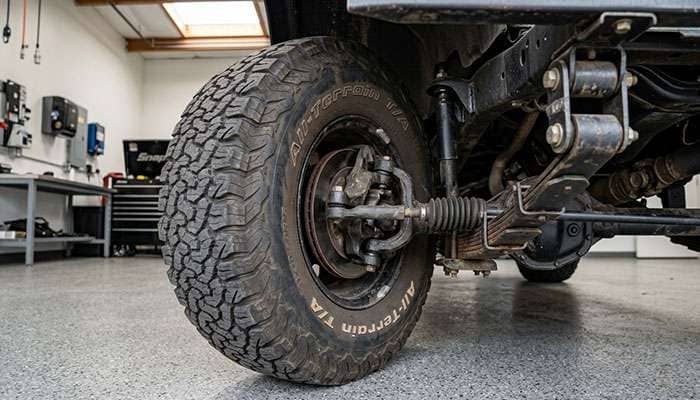
They do, and this is the part almost nobody mentions. In 1982, AMC widened the CJ-7's axles. The narrow-track axles used from 1976 through 1981 measure about 53 inches from wheel mounting surface to wheel mounting surface. The wide-track axles that arrived for 1982 measure about 56 inches up front. That puts each front wheel roughly 1.5 inches farther out on a 1982-1986 Jeep.
The frame and leaf springs didn't move. So on a narrow-track Jeep, the same wheel and tire sits 1.5 inches closer to the front spring and the frame. Bolt a wheel with deep backspacing on a 1979 CJ-7 and the inside sidewall of a 31x10.50 rubs the spring when you crank the wheel. Put that same wheel on a 1984 and it clears.
That's why two CJ-7 owners can run the exact same 31s and tell you completely different stories. One has a wide-track Jeep and never rubs. The other has a narrow-track and chewed up a sidewall in the first parking lot.
Start with the model year on the title, then confirm it at the axle. If someone swapped axles over the years, the year won't tell you the truth. Measure from the face of one front hub to the face of the other. Around 53 inches means narrow-track. Around 56 inches means wide-track. While you're under there, look at the rear cover: a round 12-bolt cover is the AMC 20 that most CJ-7s used, and an odd-shaped 10-bolt cover usually means a Dana.
On a narrow-track Jeep, the inside clearance is your limit. Use a shallower backspacing wheel to push the tire outward, away from the spring. On a wide-track Jeep, the outside clearance becomes the limit, so watch how far the tread sticks past the fender or flare. Many Renegade and Laredo models wore factory plastic flares, which buys a little room on the outside.
The youngest CJ-7 on the road is about 40 years old. Leaf springs that age have almost always settled. Every inch of sag is an inch less room between the top of the tire and the wheel well when the suspension compresses.
Owners who've been at this a while will tell you the rear wheel well is where a stock CJ-7 runs out of room for diameter. The rear opening is the tightest, and the rear springs carry the most weight, so they settle first. A Jeep that fit 31s comfortably in 1985 may only clear 30s today without a hint of rubbing.
Park on level ground with a normal load: fuel in the tank, spare tire mounted. Measure from the center of each hub straight up to the edge of the wheel opening. Do all four corners and write the numbers down.
Then look for these signs: one corner sitting noticeably lower than its opposite, rear leaves that look flat or reverse-arched instead of curved, and shiny or crushed bump stops. If the rear sits more than about an inch lower than the front, or one side sits low, plan on springs before you plan on 31s.
New stock-height springs are one of the best things you can do for an old CJ anyway. They bring back the ride height, the handling, and the room in the wheel well. If you want to know how far a factory-height truck can go in general, our biggest tire without a lift guide covers the same logic across other trucks.
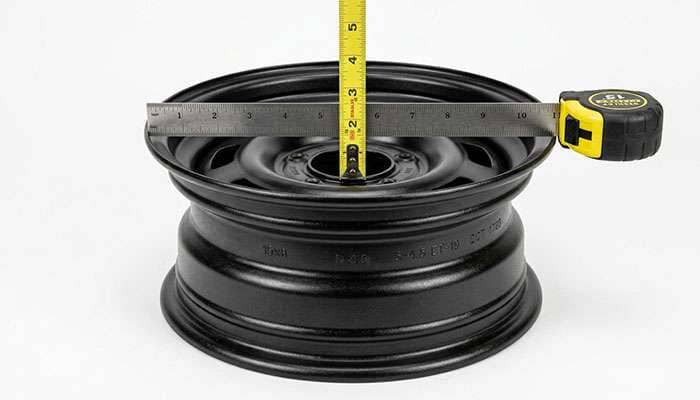
The factory wheel on most CJ-7s was a 15x7. That works fine for 225/75R15, 235/75R15, and 30x9.50R15. For a 31x10.50R15, step up to a 15x8. A 10.50-wide tire is designed around a rim in the 7 to 9-inch range, and the 8-inch wheel holds the sidewall in its intended shape, gives the bead good support, and sets the tread flat on the ground.
Backspacing is the measurement from the wheel's mounting face to its inner edge. Less backspacing pushes the tire outward. More backspacing pulls it inward toward the spring.
Feature |
Wheel |
Backspacing Starting Point |
What You're Clearing |
|---|---|---|---|
Narrow-track, 31x10.50R15 |
15x8 |
About 3.5 in |
Front leaf spring and frame at full lock |
Wide-track, 31x10.50R15 |
15x8 |
About 3.75 in |
Balance between spring inside and flare outside |
Any track, 30x9.50R15 or 235/75R15 |
15x7 or 15x8 |
Factory or close to it |
Narrower tire clears without changes |
Treat those as starting points, not gospel. Forty years of bent spring hangers, swapped steering boxes, and aftermarket shackles mean every CJ is a little different. Mount one tire, turn lock to lock, and look at the gap to the spring before you mount the other three. If 15x8 is a new measurement to you, our 15x8 wheel explainer walks through width, diameter, and offset.
One more thing on wheels. Don't go wider just to look tough. A 15x10 wheel on stock suspension pushes a 31 way out past the body, throws mud and rocks down the side of the Jeep, and loads up the wheel bearings and ball joints on a Dana 30 that wasn't built for it.
Not without changes. A 32x11.50R15 on a wide-track CJ-7 with fresh springs is the absolute edge, and most owners who try it end up trimming the rear wheel opening. Selection in 32x11.50R15 is also thin compared to 31s, so you give up tread choices for an inch you'll rub on.
A 33x12.50R15 needs a lift, period. Most CJ owners running 33s are on about 4 inches of spring lift, and with the right backspacing and some fender work, a 2.5-inch lift can get there too. That's also the point where the gearing math stops being optional, which we'll get to next.
If you're planning a lift anyway, pick the tire first and build the lift around it. It is a lot cheaper than buying a lift, finding out the tire still rubs, and buying a second lift.
CJ-7s left the factory with a range of axle ratios. The common ones are 2.73, 3.31, and 3.54, depending on engine and year. A lot of six-cylinder and V8 Jeeps got the tall 2.73s for highway mileage, and those Jeeps feel bigger tires the most.
When you put on a taller tire, the effective gear ratio drops. Here's how a factory 225/75R15 at 28.3 inches compares once you move up:
Feature |
30x9.50R15 |
31x10.50R15 |
33x12.50R15 |
|---|---|---|---|
2.73 factory ratio |
Feels like 2.58 |
Feels like 2.51 |
Feels like 2.35 |
3.31 factory ratio |
Feels like 3.13 |
Feels like 3.04 |
Feels like 2.85 |
3.54 factory ratio |
Feels like 3.35 |
Feels like 3.25 |
Feels like 3.05 |
A 3.54 Jeep handles 31s just fine. A 3.31 Jeep feels it on hills but lives with it. A 2.73 Jeep on 31s is a dog off the line, lugs in top gear, and gives back any mileage you hoped to save. To find your ratio, lift both rear tires, put the transfer case in neutral, mark the driveshaft, and turn both tires one full turn together in the same direction. The number of driveshaft turns is your ratio. When it's time to fix it, our regear after bigger tires guide covers what to change and when.
Your speedometer reads low with bigger tires, too. CJ-7s use a mechanical speedometer driven by a gear in the transfer case. Going from a 28.3-inch factory tire to a 31 makes the speedometer read about 8 percent low: 55 on the dash is about 60 on the road. The fix is a different driven gear in the transfer case, an inexpensive part and a short job.
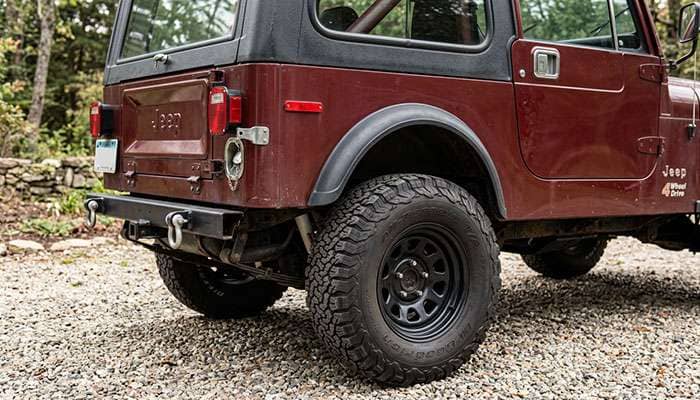
Getting the size wrong on a CJ doesn't fail all at once. It nickels and dimes you, and every step costs more than the last.
It starts with a scuff at full lock in the grocery store parking lot, or a thump from the rear on a driveway dip. That's tire against spring, frame, or wheel well. Most owners ignore it.
A sidewall that rubs the same spot on every turn wears through its outer rubber, then starts exposing cords. Sidewall damage can't be patched. That tire is done, no matter how much tread is left.
Rubbing the rear wheel opening cracks old fiberglass or plastic flares and chews up sheet metal that's hard to replace on a 40-year-old Jeep. Up front, extra tire weight and too little backspacing load the steering box, tie rod ends, and Dana 30 ball joints harder than they were designed for.
Tall tires on 2.73 gears mean slipping clutches, overheating in traffic, and a transmission working too hard. Eventually you're paying for a regear you never budgeted.
Add it up and it all ends the same way: a set of tires that didn't fit, sold cheap or tossed, and a second set in the size you should have bought the first time. Spending ten minutes with a tape measure is the cheapest part of this whole job.
Here's the order I'd walk a customer through at the counter.
Check the year, then measure hub face to hub face up front. About 53 inches is narrow-track; about 56 is wide-track.
Measure hub center to wheel opening at all four corners on level ground. Low or uneven corners mean springs come before bigger tires.
Count driveshaft turns or read the tag on the axle. 2.73 Jeeps should think hard before going past 30s.
235/75R15 for pavement, 30x9.50R15 for mixed use, 31x10.50R15 for trail work on a healthy Jeep. Restorations stay with the factory size, and bias-ply is available for show Jeeps. If you're weighing bias against radial, our radial vs. bias-ply comparison lays out the trade-offs.
15x7 for the smaller sizes, 15x8 for 31s, with backspacing set for your axle track.
Mount one tire, turn lock to lock, and bounce the corner if you can. Then mount the rest.
The honest answer to "what fits a stock CJ-7" is a 31x10.50R15 on a 15x8 wheel, with two big conditions: your Jeep needs springs holding factory height, and your wheel needs backspacing that matches your axle track. Narrow-track Jeeps from 1976 through 1981 need the tire pushed outward, away from the front spring. Wide-track Jeeps from 1982 through 1986 have that extra 1.5 inches per side and are more forgiving.
If your springs are tired, run a 30x9.50R15 or 235/75R15 until they're replaced. If your Jeep is a show piece, stay with the factory size. And if you're dreaming about 33s, buy the lift and the gears before you buy the tires.
When you know your size, take a look at our classic tire collection. We've been putting rubber on CJs since they were new, and we're happy to help you sort out the rest.
Here's what to remember before you order tires for a CJ-7.
A stock CJ-7 fits up to a 31x10.50R15 on a 15x8 wheel, as long as the leaf springs are holding factory height and the wheel backspacing suits the axle track. A 30x9.50R15 or 235/75R15 fits any CJ-7 with room to spare.
No. A 33x12.50R15 needs a suspension lift on a CJ-7, typically around 4 inches of spring lift, or a smaller lift combined with fender trimming. A 32-inch tire is the edge on stock suspension and usually needs rear wheel well trimming.
Early CJ-7s wore bias-ply sizes like H78-15. Later Jeeps came on radials from 205/75R15 up to 235/75R15 depending on year and trim, with Renegade and Laredo models usually getting the 235/75R15.
Every CJ-7 uses a 5x5.5 bolt pattern, also written as 5x139.7mm, on 15-inch wheels. Factory wheels were most often 15x7.
On a 15x8 wheel, start around 3.5 inches for a 1976-1981 narrow-track Jeep and around 3.75 inches for a 1982-1986 wide-track Jeep. Always test fit one tire at full lock to check spring clearance.
Not if it has 3.54 gears. A 3.31 Jeep is livable on 31s. A 2.73 Jeep becomes sluggish because 31s make it act like a 2.51, so a regear is worth considering if you plan to keep the bigger tires.