
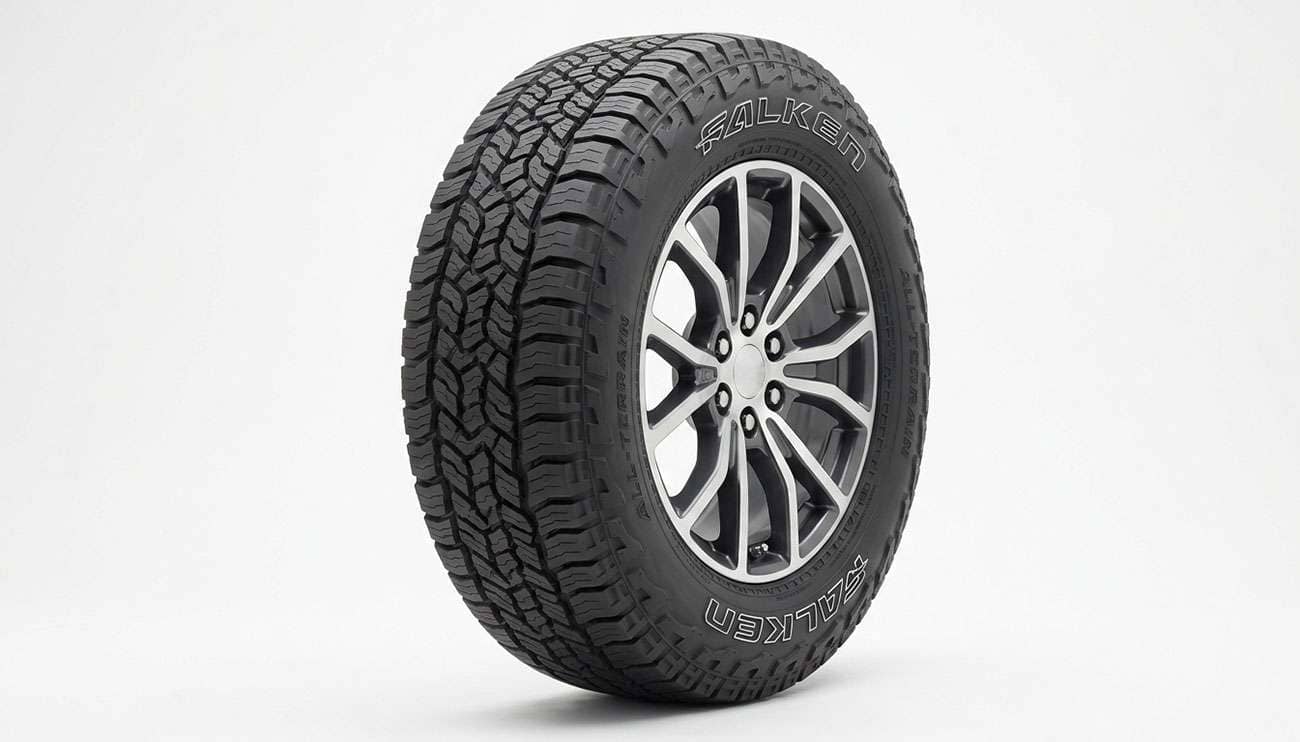
Every list you will find ranks all-terrain tires by road noise. Noise matters, but it is not what makes a daily driver miserable. The spec that does is printed right on the sidewall and almost nobody mentions it: LT or Standard Load. The same tire, same tread pattern, same name, comes in both. One rides like a truck should. The other rides like a wheelbarrow, costs you more money, and stops longer - and most people driving an empty half-ton to work bought the wrong one.
I have been putting tires on trucks since the seventies, and I can tell you exactly how this conversation usually goes. Fella comes in, says he wants the best all-terrain tire. I ask him what he hauls. He says nothing, really - it is his daily driver, he takes the boat out twice a summer, maybe a load of mulch in the spring.
Then he tells me he wants the ten-ply.
He wants it because somebody at work told him ten-ply is tougher, and tougher sounds better. And he is not wrong that it is tougher. He is wrong that tougher is what he needs. That man is about to pay an extra sixty bucks a corner to make his own truck ride worse for the next fifty thousand miles.
So before anybody talks about which brand is best, answer this: do you actually carry weight? Not could you. Do you. Because that single question splits the entire all-terrain market in half, and every review you have read skipped right over it to talk about decibels. If you are still deciding whether an all-terrain belongs on a truck you commute in at all, we took that up separately in daily driving on off-road tires.
Look at a tire size on a truck. You will see something like 265/70R17, or you will see LT265/70R17. That LT prefix means Light Truck construction. No prefix, or a P prefix, means it is built as a passenger-metric tire in Standard Load or Extra Load.
Same tread. Same name on the sidewall. Completely different carcass underneath.
The LT version has more plies in the sidewall and a heavier belt package. It runs a much higher inflation pressure - often 50 to 80 psi versus 35 to 44 on the Standard Load version. It weighs somewhere around eight to twelve pounds more per tire, and that weight is unsprung, which is the worst place on a vehicle to add it. And it carries a dual load index, like 121/118, instead of a single one like 115.
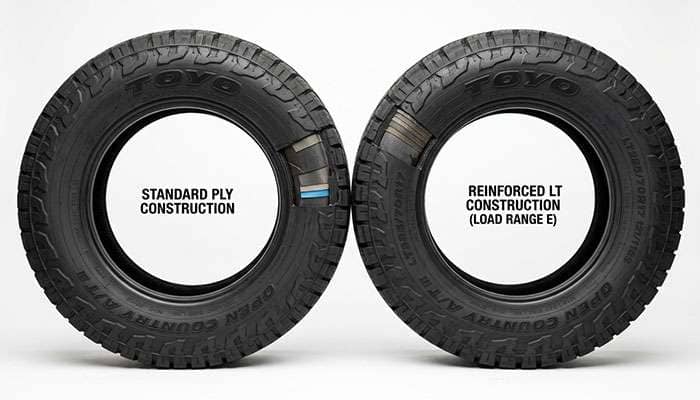
Here is what that does to you on a Tuesday morning commute. The stiffer sidewall at 65 psi cannot deform over expansion joints, so every seam in the road comes straight through the seat. The extra unsprung mass means the suspension has more work to do controlling the wheel, so it never settles. And because you are running pressure sized for a load you are not carrying, the tire crowns - it bulges slightly in the center and wears the middle of the tread out first.
What You Actually Do With the Truck |
What to Buy |
Why |
|---|---|---|
Commute empty, occasional weekend load |
Standard Load or XL, no LT prefix |
Softer ride, less unsprung weight, lower price, better fuel economy, wears flat instead of crowning |
Tow a trailer more than a few times a year |
LT, Load Range D or E |
Sidewall stiffness controls trailer sway; the load index has to cover tongue weight on the rear axle |
Carry payload most days - tools, gear, materials |
LT, Load Range E |
You are running near the placard number regularly and need the reserve capacity |
Three-quarter ton or one ton truck |
LT, no exceptions |
The vehicle came with it and the placard requires it; Standard Load will not meet the rating |
Real trail use over rocks and sharp rubble |
LT, Load Range C or higher |
Sidewall punctures are the failure mode off-road, and plies are what resist them |
Read your door placard before you decide. It gives you the size and load requirement the vehicle was engineered around, and it beats whatever the last guy put on it. If you want the full breakdown of what those load range letters actually mean, we walk through it in tire E load rating explained.
Now here is the part that gets people. The LT version is not just harsher. It costs more. Same model, same size, same store - you pay a premium for the privilege of a rougher ride you did not need:
Model in 265/70R17 |
Standard Load |
LT 10-Ply |
Extra Cost Per Set of 4 |
|---|---|---|---|
Hercules Terra Trac AT II |
$150.61 |
$185.99 |
$141.52 |
Hankook Dynapro AT2 RF11 |
$204.41 |
$250.00 |
$182.36 |
Falken Wildpeak A/T4W |
$237.00 |
$301.00 |
$256.00 |
General Grabber A/TX |
$248.99 |
$295.99 |
$188.00 |
Toyo Open Country A/T III |
$262.01 |
$323.89 |
$247.52 |
Between one hundred forty and two hundred fifty-six dollars a set, to make an empty truck ride harder. That is the whole argument in one table.
One more thing worth knowing: the speed rating usually drops when you go LT. That Standard Load Hankook is a T rating. The LT version is an S. Not a problem at legal speeds, but it tells you something about what the tire was built to do.
These are the ones I put on trucks that live on pavement. Prices are what we are selling them for in 265/70R17, and the cost-per-mile column is what actually matters over the life of the tire - not the sticker. If you are shopping for an SUV rather than a pickup, the sizing and priorities shift a little and we ranked those separately in the 7 best all-terrain tires for SUVs.
Tire |
Price Each (SL) |
Treadwear Warranty |
Cost Per 1,000 Miles (Set of 4) |
Best For |
|---|---|---|---|---|
Hercules Terra Trac AT II |
$150.61 |
60,000 miles |
About $10.04 |
The value play nobody talks about |
Hankook Dynapro AT2 RF11 |
$204.41 |
60,000 miles |
About $13.63 |
Quietest of the bunch on pavement |
Falken Wildpeak A/T4W |
$237.00 |
55,000 miles |
About $17.24 |
Best all-around daily driver |
General Grabber A/TX |
$248.99 |
60,000 miles |
About $16.60 |
Snow country without a second set |
Toyo Open Country A/T III |
$262.01 |
65,000 miles |
About $16.12 |
Longest wear, deepest size range |
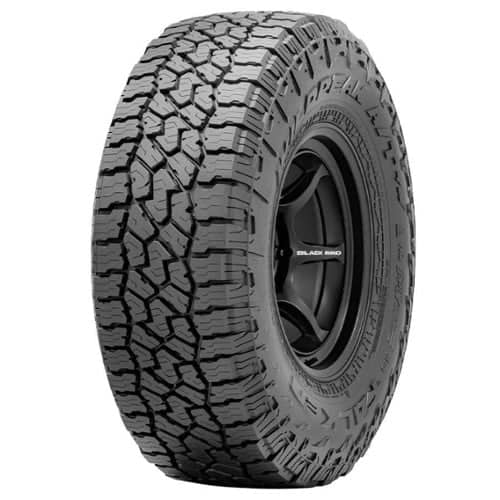
If somebody walks in with a half-ton and no strong opinion, this is where I point them. The A/T4W is the newer generation and Falken did the work on the on-road side without giving up the trail manners the line was known for. It carries the Three-Peak Mountain Snowflake rating, which matters more than people think in this state once you get above the snow line. At $237 in Standard Load it is not the cheapest, but it is the one I get the fewest complaints about.
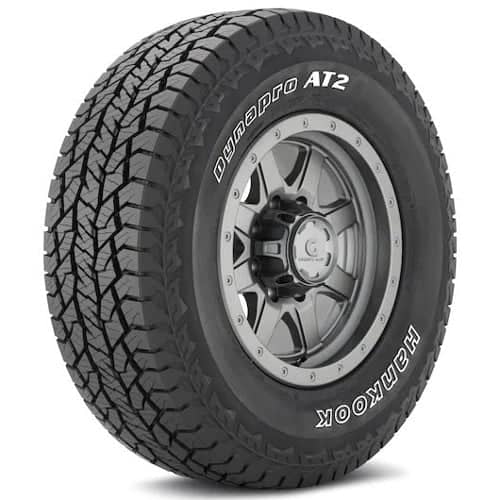
If road noise is genuinely your top complaint, this is the pick. Hankook built the tread with a quieter pitch sequence and it shows on the highway. At $204.41 it undercuts the premium names by a comfortable margin, and the 60,000-mile warranty puts it in good company on cost per mile.
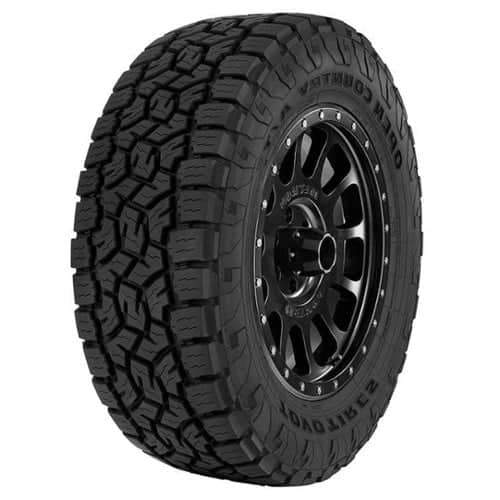
Toyo backs this one with 65,000 miles and it is the deepest size range we stock in the category, which means if you have an oddball fitment this is often the tire that exists in it. Higher sticker at $262.01, but the warranty stretches it out and the wear is famously even.
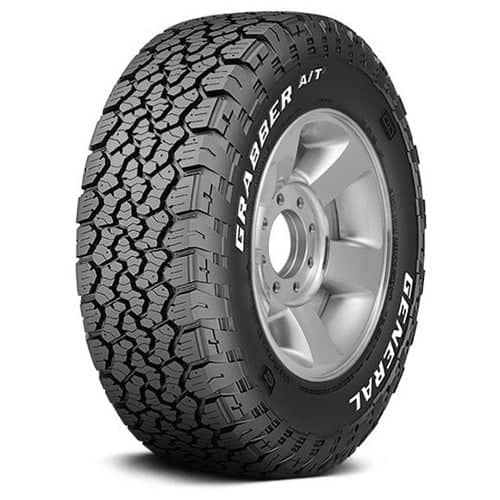
The Grabber A/TX is the one I put on trucks that see actual snow and whose owners do not want to mess with a second set of wheels. Severe snow rated, and General has been doing this a long time.
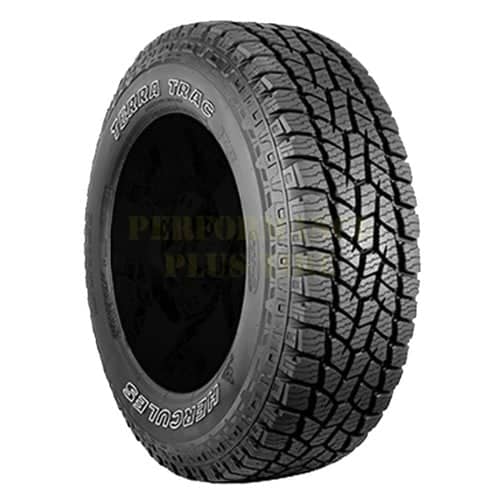
Nobody writes about Hercules and I do not entirely understand why. Sixty thousand mile warranty, $150.61 a corner, and it comes in at about ten dollars per thousand miles - the best number on this whole page by a wide margin. Is it a Toyo? No. Is it two thirds the price with the same warranty? Yes.
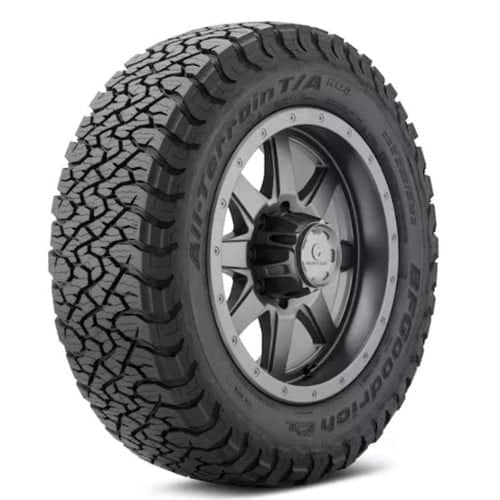
The KO3 is a good tire and it is quieter than the KO2 it replaced. But note that in 265/70R17 it only comes as an LT at $298.99 - there is no Standard Load option in that size. So if you are an empty-truck commuter, the KO3 is making the LT decision for you whether you wanted it or not. Also worth knowing: BFGoodrich is retiring the KO2 size by size as KO3 production ramps, which changes the math on buying the outgoing tire. We covered that in detail in whether BFGoodrich KO2 tires are still worth buying.
A lot of the big retailer roundups put a house brand in the value slot. If a tire on somebody's best-of list is a name you have never heard anywhere else, check whether that retailer happens to own the brand. It might still be a fine tire. But you can only buy it from them, and that is worth knowing before you decide it won a fair fight.
Noise is real and I am not dismissing it. I am saying it is the second question, not the first.
Here is what actually produces the drone. Tread blocks slap the pavement in sequence, and if the blocks are evenly spaced they slap at a single frequency, which your ear hears as a tone. Manufacturers vary the block spacing - a pitch sequence - to spread that energy across frequencies so it reads as broadband hiss instead of a hum. That is most of the engineering behind a quiet all-terrain.
The rest is void ratio. More open space between blocks means better mud clearing and more noise. There is no way around that tradeoff; it is geometry.
But notice what else makes noise: a tire that is crowning because it is overinflated for its load, or cupping because the wheel is out of balance. Plenty of trucks I see with a noise complaint do not have a noisy tire. They have a correctly chosen tire being run wrong. If quiet is your whole priority across every tire type, we ranked those separately in the quietest and smoothest tires we road tested.
You will see two markings on all-terrain sidewalls. M+S means mud and snow, and it is essentially a tread geometry designation - a manufacturer can self-apply it. The Three-Peak Mountain Snowflake, the little mountain symbol with a snowflake in it, means the tire passed an actual traction test in medium-packed snow against a reference standard.
Those are not the same thing, and the gap between them is wide. An M+S-only all-terrain can be genuinely poor in snow.
If you live where it snows, or you drive up into it on weekends, get the Three-Peak. On this list the Falken A/T4W and the General Grabber A/TX both carry it. If you are in Southern California and never leave the basin, it is not worth paying for.
Worth saying plainly: a severe-snow-rated all-terrain is still not a winter tire. It is a compromise that gets you through, not a dedicated snow tire. If you are trying to sort out where all-terrains sit against the alternatives, all-terrain versus all-season tires lays out the tradeoff.
Picking the wrong construction does not blow a tire out on day one. It just charges you slowly, in four or five different ways at once.
You paid the premium up front. Between $141 and $256 extra for the set, per that table above. That money is gone before you leave the lot.
You lose fuel economy every single mile. Eight to twelve extra pounds per corner of rotating, unsprung mass takes energy to accelerate and to stop. Call it half a mile per gallon on a half-ton. Over 50,000 miles at twenty miles per gallon, that is roughly sixty gallons of fuel you burned carrying plies you never loaded.
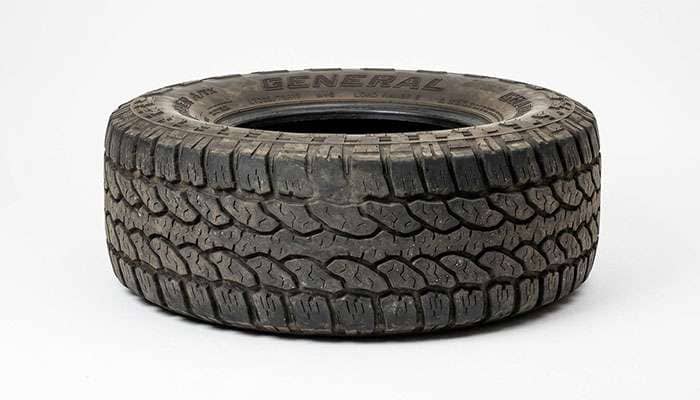
You wear out the middle of the tread first. Running an E-rated tire at the pressure the sidewall allows, on a truck that never carries the load, crowns the contact patch. The center wears, the shoulders do not, and a tire warrantied for 60,000 miles goes in the trash at 40,000. There went the warranty advantage you paid for.
You stop longer. More unsprung mass and a stiffer carcass with a smaller effective contact patch on an unloaded truck means longer braking distances, particularly in the wet. That is the one that actually matters.
And you beat up the truck. Every impact the sidewall does not absorb goes into the shock, the bushing, the ball joint, and the wheel bearing. Suspension components on a truck that rides hard for 50,000 miles do not last as long as ones that do not. You will not notice it as a line item. You will notice it as a front end that feels loose sooner than it should.
None of that shows up in a noise ranking. All of it shows up in your wallet.
And while you are down there looking at the tread, look at the sidewalls too. If you are seeing scuffs, gouges, or bulges from curbs and trail rock, read tire sidewall damage and whether it is safe to drive before you put more miles on them. Sidewall damage does not heal.
Step 1. Open the driver's door and read the placard. Write down the size and the load requirement. That is your baseline, not what is on the truck now.
Step 2. Answer the payload question honestly. Empty commuter with occasional weekend duty means Standard Load or XL. Regular towing or hauling means LT. Three-quarter ton or heavier means LT, period.
Step 3. Decide on snow. If you see it, insist on the Three-Peak Mountain Snowflake symbol. If you do not, skip it and put the money elsewhere.
Step 4. Compare on cost per thousand miles, not sticker price. Divide the set price by the warranty mileage. The cheap tire with a short warranty is often the expensive one.
Step 5. Set your pressure to the placard, not the sidewall. The number on the sidewall is the maximum the tire can hold, not what your truck wants. This is the single most common mistake I see and it undoes a good tire choice.
Step 6. Rotate every 5,000 to 7,000 miles. All-terrains wear unevenly if you let them, and the treadwear warranty generally requires documented rotation anyway.
If you want to see everything we stock in the category with your size filtered in, start with our best all-terrain tires selection, or call the shop and we will pull the placard spec for your year and trim.
The best all-terrain tire for daily driving is the one built for the weight you actually carry, which for most people reading this is not much. Buy the Standard Load version of a good tire, set the pressure to the door placard, get the snowflake if you need it, and you will have a truck that rides well and a set of tires that wears flat and goes the distance.
Buy the ten-ply because it sounds tougher and you will spend more money to ride harder, stop longer, burn more fuel, and replace the tires early. I have watched people do it for fifty years. It is the most expensive way there is to feel like you bought the good ones.
If you only take one thing from this: the answer is on your door jamb, not in a noise ranking.
For most daily drivers the best choice is a Standard Load version of a quality all-terrain rather than the LT ten-ply version of the same tire. The Falken Wildpeak A/T4W is the strongest all-around pick for a half-ton commuter, the Hankook Dynapro AT2 RF11 is the quietest, and the Hercules Terra Trac AT II offers the best cost per mile. Which is right for you depends on whether you actually carry weight regularly.
Almost certainly not, unless you tow regularly, carry payload most days, or drive a three-quarter ton or heavier truck. Ten-ply LT tires cost more, weigh more, ride harsher, hurt fuel economy, and wear out the center of the tread early when run unloaded at high pressure. On an empty half-ton used as a commuter, a Standard Load tire is the better tire in every measurable way.
No. Modern all-terrain tires are perfectly livable as daily drivers, and the good ones give up very little to a highway tire in ride and noise. The compromises are modest: slightly more road noise, roughly one mile per gallon of fuel economy, and somewhat shorter tread life than a dedicated highway tire. What makes an all-terrain unpleasant daily is usually the wrong construction or the wrong inflation pressure, not the category itself.
Among the tires we stock, the Hankook Dynapro AT2 RF11 is the quietest on pavement, thanks to a varied tread pitch sequence that spreads noise energy across frequencies rather than concentrating it into a single tone. Keep in mind that a tire crowning from overinflation or cupping from imbalance produces noise that has nothing to do with the tread design, so rule those out before blaming the tire.
Most quality all-terrain tires carry treadwear warranties between 55,000 and 65,000 miles, and reaching that depends on rotation every 5,000 to 7,000 miles and correct inflation pressure. Running an LT tire at high pressure on an unloaded truck is the fastest way to fall short, because it wears the center of the tread out well before the shoulders. Treadwear warranties are prorated, so falling short does not mean a free replacement.
M+S is a tread geometry designation that a manufacturer can apply to its own tire without independent testing. The Three-Peak Mountain Snowflake symbol means the tire passed a standardized traction test in medium-packed snow against a reference tire. If you drive in real snow, look for the snowflake symbol specifically. Note that even a severe-snow-rated all-terrain is a compromise rather than a replacement for a dedicated winter tire.



