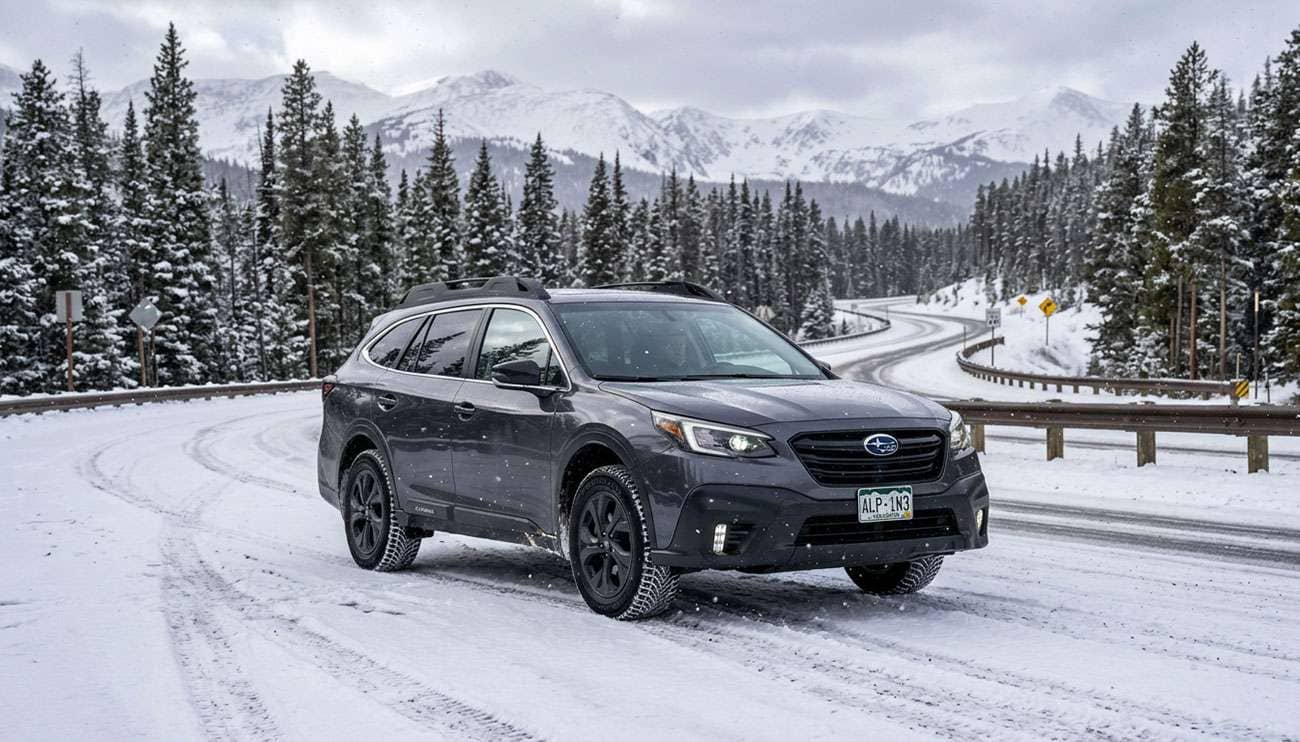
Only some of them. An all-season tire meets Colorado's traction law if the sidewall carries an M+S, M/S, or M&S mark or a mountain-snowflake, and if it still has at least 3/16 inch of tread. The words "all-season" are not the test. Since August 12, 2026, AWD and 4WD do not change the answer either. The same tire rule covers every passenger vehicle.
I have sold tires in Long Beach since 1971, so most of my customers meet snow on a trip, not on the commute. They call before ski week and ask if their all-seasons are legal on I-70. Most answers stop at the sidewall marking. The part that catches people is the tread. A tire can be nowhere near worn out, pass the quarter test, and still come up short of Colorado's number.
Walk out to the car, read the sidewall, and measure the tread. Those two things decide it.
Sidewall Marking |
3/16 Inch of Tread or More |
Under 3/16 Inch |
|---|---|---|
M+S, M/S, or M&S |
Complies |
Needs chains or an approved device |
Mountain-snowflake |
Complies |
Needs chains or an approved device |
Rated all-weather by the manufacturer |
Complies |
Needs chains or an approved device |
"All Season" with no M+S |
Not on the statute's list, so do not count on it |
Needs chains or an approved device |
No snow marking (summer tire) |
Does not comply |
Needs chains or an approved device |
Here is the same answer by the kind of tire you are shopping for. The stopping figures are CDOT's, from 60 mph on snow.
Tire Type |
Usual Marking |
Traction Law |
How It Does in Snow |
|---|---|---|---|
Summer |
None |
No |
Worst. More than 800 feet to stop |
All-season, no M+S |
None, or "All Season" |
No |
About 669 feet to stop |
All-season with M+S |
M+S |
Yes, at 3/16 inch |
CDOT calls it acceptable in light snow |
All-weather |
Mountain-snowflake, usually with M+S |
Yes, at 3/16 inch |
CDOT calls it safe in winter conditions |
All-terrain |
M+S, and a snowflake on some |
Yes, at 3/16 inch |
Varies a lot by tire |
Winter |
Mountain-snowflake and M+S |
Yes, at 3/16 inch |
Best. About 310 feet to stop |
It means the tire qualifies on paper, and that is all it means. The statute, C.R.S. 42-4-106, asks for tires "imprinted by a manufacturer" with a mountain-snowflake, M&S, M+S, or M/S symbol, or tires the manufacturer rates as all-weather. Those are the only marks on the list. I am a tire man and not a lawyer, but I can read a sidewall, and "All Season" by itself is not on that list.
You will see some published lists add "All Season" as an acceptable marking. Most all-season tires do carry M+S, so the difference rarely bites. But not every one does, and a tire with "All Season" alone is the one you do not want to argue about on the shoulder at Silverthorne.
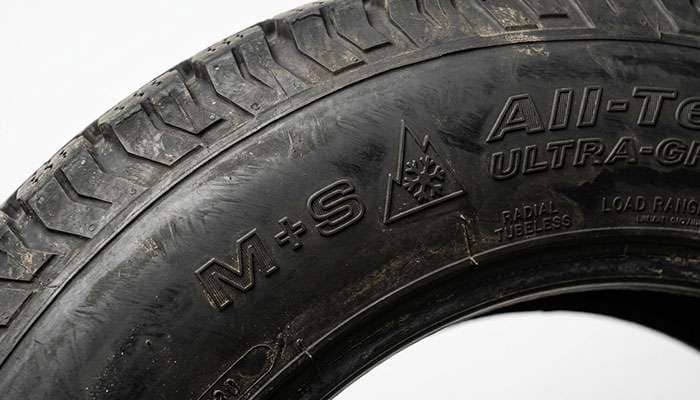
M+S describes tread geometry. The U.S. Tire Manufacturers Association standard asks for slots or pockets at the tread edge and at least 25 percent open space in the tread. Nobody has to prove that tire stops or climbs in snow. The mountain-snowflake is different. To earn it, a tire has to score at least 110 percent of a reference tire in a medium-packed snow test under ASTM F1805. If you want the longer version, read what the snowflake tire symbol means and our comparison of M+S vs. winter tires.
CDOT has also said plainly that all-weather tires are not the same as all-season tires. An all-weather tire is a year-round tire that earned its snow rating, and we break that down in all-season vs. all-weather vs. winter tires.
Colorado requires 3/16 inch, which is 6/32. The state raised that number from 1/8 inch when it rewrote the rules in 2019. The wear bars molded into your tire sit at 2/32, so Colorado wants three times what most people think of as the legal limit.
This is the one that gets people. Everybody knows the quarter test: put Washington's head in the groove, and if his head is covered, you are fine. But the top of his head sits about 4/32 from the edge of the coin. A tire can cover it and still be 2/32 short of Colorado's minimum. That test is fine for deciding when to shop. It does not tell you what you need to know for I-70.
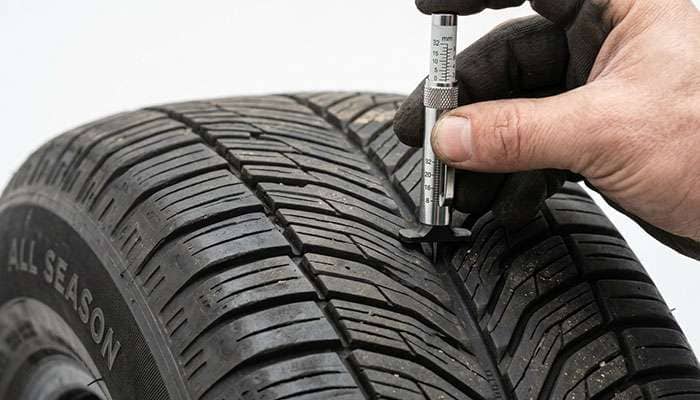
Buy a tread gauge. They cost next to nothing, and every parts store has one. Measure the inside, center, and outside grooves on all four tires, then go by the lowest number. Our guide to tread depth to replace tires shows how to read one.
Most passenger all-season tires start at 10/32 or 11/32. Do the math on that and you will see the problem. You lose Colorado compliance long before you reach the wear bars.
New Tread |
Usable Tread to 2/32 |
Tread Worn at 6/32 |
Tread Life Used |
|---|---|---|---|
9/32 |
7/32 |
3/32 |
43 percent |
10/32 |
8/32 |
4/32 |
50 percent |
11/32 |
9/32 |
5/32 |
56 percent |
12/32 |
10/32 |
6/32 |
60 percent |
A 60,000-mile all-season that starts at 10/32 and wears evenly drops under 6/32 at about 30,000 miles. That tire is perfectly good in Long Beach and short of the law at the Eisenhower Tunnel. If you drive a front-wheel-drive car, check the fronts first, because they usually wear fastest.
No. This is the biggest change, and plenty of drivers have not caught up to it. For years an AWD or 4WD vehicle only needed 3/16 inch of tread. The tire's rating did not matter. In August 2025 the state started requiring marked tires on those vehicles, and in 2026 the drivetrain language came out of the statute entirely.
So an AWD crossover on summer tires does not comply. A 4WD truck on worn-out all-terrains does not comply. The drivetrain gets you moving, but it does not satisfy the law. Only the tires or the traction device do. CDOT still recommends AWD or 4WD in the mountains, and I agree with them. It just is not your legal answer anymore.
Yes, as of August 12, 2026, if the tires are marked and have 3/16 inch of tread. That answer changed twice in two years, so here is how it went.
Because this moved so fast, you will still find pages online that show last season's 2WD rule. If you drive a 2WD car, carry an approved traction device anyway. It settles any argument, and you need one for the chain law regardless.
There are two ways it can apply to you.
It covers all motorists who are not driving a commercial vehicle, and that includes out-of-state plates. Commercial trucks have their own chain rules. The statute says "equipped" means you use or carry the gear, so a device in the trunk counts until the law is active. Once the signs are on, it has to be on two or more drive tires.
Troopers do write these. Local reporting counted 586 traction and chain law citations from September 2025 through May 2026, with 522 of them on the I-70 corridor. CDOT's FAQ has said the State Patrol will not proactively check tread depth because it lacks the manpower. So do not expect a roadside inspection to warn you. The tires usually get looked at after you have spun out and stopped traffic, and by then you have bigger problems than a gauge reading.
They count if the mark is on the sidewall, and the 3/16-inch rule is the same. Most all-terrain and mud-terrain tires carry M+S, and many newer all-terrains carry the mountain-snowflake too, which tells you they passed the snow test.
Truck owners get a break on the math because these tires start deep. Most all-terrains start at 13/32 or deeper, so a 15/32 tire stays above 6/32 for about two-thirds of its usable tread. But remember what M+S means. Big open lugs make a tire qualify, and they do not make it stop on packed snow. Studded winter tires are legal year-round in Colorado within limits, and they follow the same tread rule.
Plan on it. The statute says "tires" and carves out no exception for the axle that is not driving, and CDOT words it the same way. I see this all the time with two new tires on one axle and two old ones on the other. If your rears are at 5/32, you have a problem on paper and a bigger one on a downhill curve, because the rear is the end that comes around on you.
Mixed sets fail the same way. M+S tires up front and summer tires out back do not get you through. If you drive a performance car that came with summer tires from the factory, assume you need a device or a different set before you go up the hill.
Your all-seasons can only get you through the first one. People use these names interchangeably, and they are two different steps.
Restriction |
What It Takes |
Do M+S All-Seasons Work? |
|---|---|---|
Passenger Vehicle Traction Law (Code 15) |
Marked tires with 3/16 inch of tread, or chains or an approved device |
Yes |
Passenger Vehicle Chain Law (Code 16) |
Chains or an approved device on every vehicle |
No. Tires do not count here, including winter tires |
Highway closed |
Nothing gets you through |
No |
CDOT calls the chain law the final step before closing the highway, and says activating it is exceedingly rare. It was last used in March 2019. Coming from California, do not assume the rules match. Our guide to chains with 4WD or AWD in California covers the R levels, and they work differently.
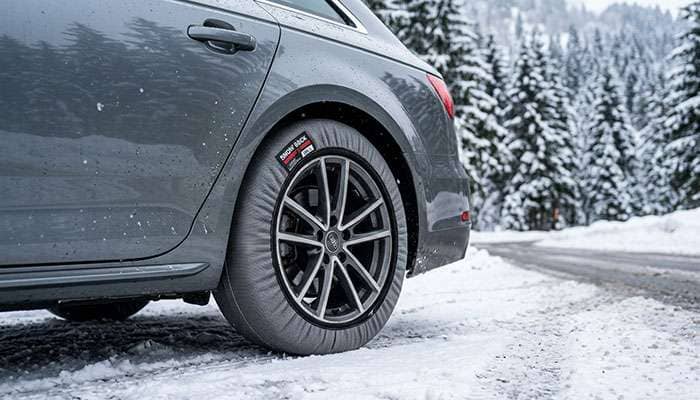
Colorado's approved list is short and specific. It is CDOT's Approved Products List, and it includes certain textile covers and cable products. A device has to be on that list to count, so check the exact model before you buy one, and practice fitting it in your driveway. A snowbank in the dark is a bad place to read the directions.
Yes, and that surprises a lot of people flying into Denver. Your California plates do not matter, and neither does the name on the rental agreement. The state senator behind the 2025 law said a lot of the drivers cited or causing delays on I-70 are in rental cars.
Since August 2025, from September 1 through May 31, rental companies have to tell you at the time of rental what the law requires, what the penalty is, and whether your vehicle complies. That notice can be spoken, in the app, or on a sign. They do not have to give you chains. So read the notice, look at the sidewall before you leave the lot, and pack a tread gauge in your ski bag. It weighs less than your gloves.
Legal and ready are two different things. CDOT's own numbers show it: from 60 mph on snow, a winter tire stops in about 310 feet, and an all-season without M+S needs about 669 feet. That is more than twice the distance, and an M+S mark does not close the gap. CDOT calls M+S tires acceptable in light snow and says they are less capable than winter tires.
Cold matters as much as snow. All-season rubber stiffens as the temperature drops, even on dry pavement. See what temperature is too cold for all-season tires. Here is how I tell customers to think about it:
You have three ways out, and the right one depends on how often you go up.
Whichever you pick, do not leave it for the morning you leave. Mountain shops get busy the first big storm of the year, and new tires deserve a few hundred easy miles before you ask them to work on a grade.
The ticket is the cheap part. Each step on this ladder costs more than the one before it.
All of that costs more than buying the right tires in October.
An all-season tire passes Colorado's traction law when it has the right mark and 6/32 of tread. Drivetrain does not change that, and neither does a passing quarter test. Measure before you pack. If your tires come up short, or you want more than the legal minimum, browse our winter tires and look for the snowflake on the sidewall.
Yes for everyday driving. Under the traction law, an all-season tire needs an M+S, M/S, or M&S mark, a mountain-snowflake, or a manufacturer all-weather rating, plus at least 3/16 inch of tread. Without those, you need chains or an approved traction device when the law is active.
Yes, as long as they have at least 3/16 inch of tread. M+S tires satisfy the traction law on any passenger vehicle, but they do not satisfy the passenger vehicle chain law, which requires chains or an approved device.
The minimum is 3/16 inch, or 6/32. That is deeper than the 2/32 wear bars and deeper than the roughly 4/32 a quarter shows. Use a tread gauge and go by the lowest groove.
Not by itself. Since August 12, 2026, the statute no longer mentions four-wheel drive or all-wheel drive. Your vehicle needs marked tires with 3/16 inch of tread, or chains or an approved traction device.
Not during a traction law, if your tires are marked and have 3/16 inch of tread. You do need chains or an approved device during a passenger vehicle chain law, which applies to every vehicle. CDOT says that step is rare.
CDOT's published figures differ. Some of its pages list a $50 fine plus a $17 surcharge, and its traction law page lists $100 plus $33. If your vehicle closes a travel lane, CDOT lists up to $500 plus a $157 surcharge.