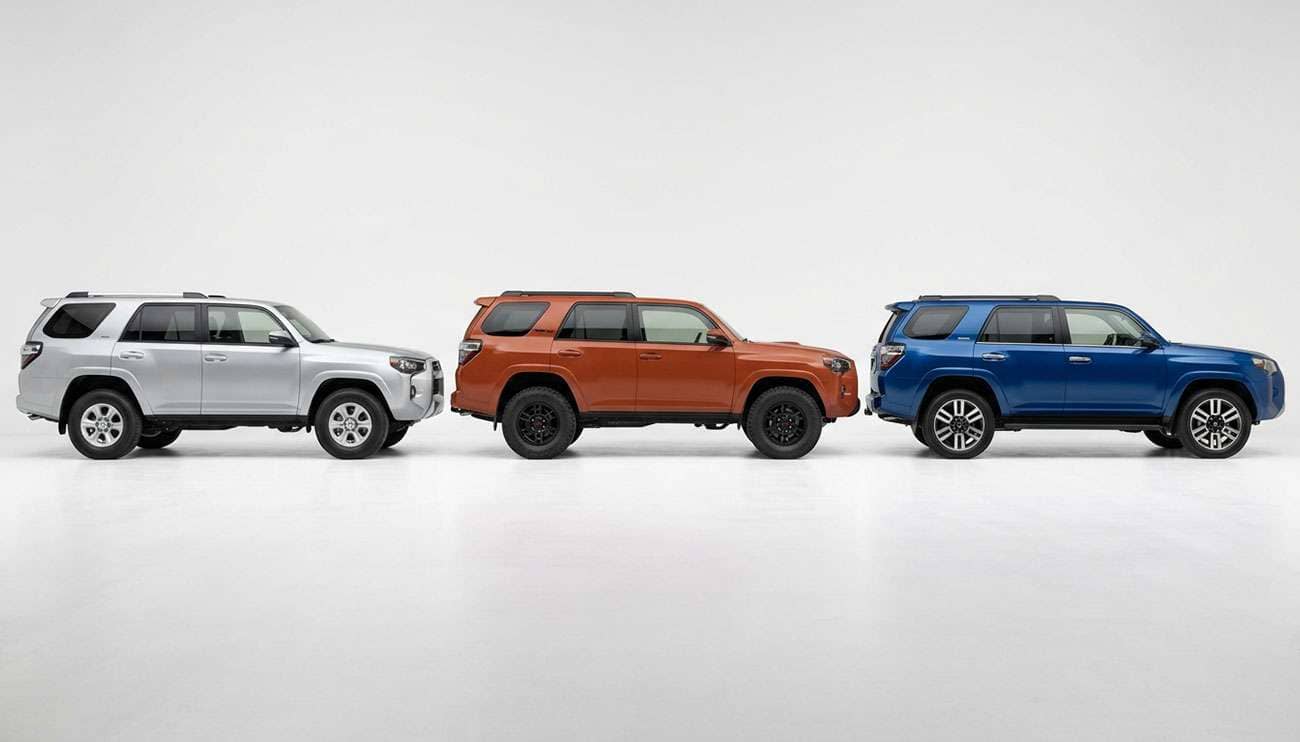
I pulled every factory tire Toyota has put on a 4Runner since 2010 and worked out the height of each one. On the fifth generation, every single one lands at 31.6 inches. The SR5, the Limited on 20s, the TRD Pro: same height, within a tenth of an inch. On the sixth generation, the same question has three different answers, and the trim decides which one you get.
That's the detail a trim chart doesn't show you, and it changes how you shop.
The short answer: A 2025 or newer 4Runner runs 245/70R17 on the SR5, 265/55R20 on the TRD Sport, Limited and Platinum, and 265/70R18 on the TRD Off-Road, TRD Pro and Trailhunter. A 2010 to 2024 4Runner runs P265/70R17 on every trim except the 20-inch ones, which run P245/60R20. Most charts stop there. The part nobody puts in front of you: on a sixth gen, the TRD Pro and the TRD Off-Road wear the same tire size, and the sixth gen's factory tires carry a higher load index than the P-metric version of each size.
Here's every factory size from 2010 on, with the load index on the factory tire, the height I worked out from the size, and the cold pressure on the door placard.
Years and Trim |
Wheel |
Factory Tire |
Load Index |
Height |
Door Placard |
|---|---|---|---|---|---|
2025-26 SR5 |
17 x 7 in |
245/70R17 |
110 |
30.5 in |
33 psi |
2025-26 TRD Sport, Limited, Platinum |
20 x 8 in |
265/55R20 XL |
113 |
31.5 in |
33 psi |
2025-26 TRD Off-Road, TRD Off-Road Premium |
18 x 7.5 in, +55 mm |
265/70R18 |
116 |
32.6 in |
33 psi |
2025-26 TRD Pro, Trailhunter |
18 in, about +20 mm |
265/70R18 |
116 |
32.6 in |
33 psi |
2010-24 SR5, Trail, TRD Off-Road, and their Premium versions |
17 x 7 in, about +15 mm |
P265/70R17 |
113 |
31.6 in |
32 psi |
2015-24 TRD Pro |
17 x 7 in, about +4 mm |
P265/70R17 |
113 |
31.6 in |
32 psi |
2010-24 Limited, Nightshade, TRD Sport |
20 in |
P245/60R20 |
107 |
31.6 in |
32 psi |
Sizes and pressures come from Toyota's published specifications and the tire makers' factory fitment listings. Fifth-gen offsets are owner-measured, not Toyota figures. Your door jamb placard is the final word for your truck.
Read the height column and the pattern jumps out. Two fifth-gen sizes, two wheel diameters, one height. On the sixth gen, there are three heights: 30.5 inches on the SR5, 31.5 on the 20-inch trims and 32.6 on every 18-inch trim. A two-inch spread from the bottom of the lineup to the top.
If it's a 2010 through 2024, it's a fifth gen. If it's a 2025 or newer, it's a sixth gen, built on Toyota's TNGA-F truck platform alongside the current Tacoma. The two generations don't share a single factory tire size, so this is the first question to answer.
They don't share wheels, either. Both use the 6x139.7 (6x5.5) bolt pattern, which is where the confusion starts. The fifth gen uses a 106.1 mm center bore and M12 x 1.5 studs. The sixth gen uses a 95.1 mm bore and M14 x 1.5 studs. A sixth-gen wheel won't slide over a fifth-gen hub, and a fifth-gen wheel only goes on a sixth-gen hub with hub rings and M14 lug nuts, which is a compromise, not a fitment. Our guide to whether Tacoma wheels fit a 4Runner has the full generation-by-generation breakdown.
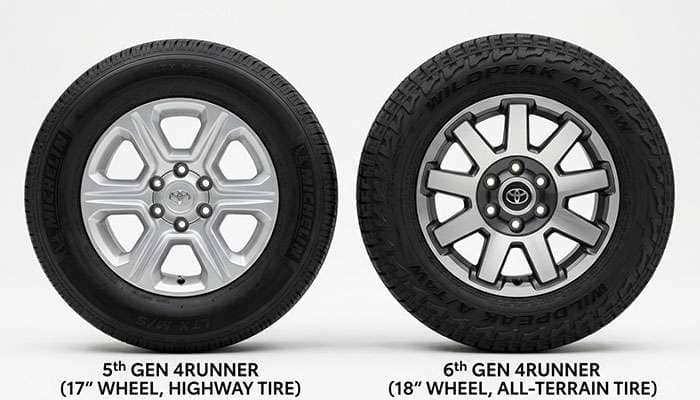
Here's why the generation matters for tire size. On the fifth gen, Toyota sized every factory tire to the same 31.6-inch height and let trim change only the wheel diameter. Move a fifth-gen Limited's 20-inch wheel and tire package onto an SR5 and the speedometer doesn't move: P265/70R17 and P245/60R20 differ by less than a tenth of an inch. On the sixth gen, trim sets the height, and moving between trims moves the speedometer.
Fourth-gen trucks ran P265/70R16 and P265/65R17 tires, both about 30.6 inches tall. They share the fifth gen's 106.1 mm bore and M12 studs but ran smaller front brakes, so 16-inch wheels that fit a fourth gen won't clear a fifth gen. Read the placard before you order.
On a 2025 or newer TRD Pro or Trailhunter, the factory tire is a 265/70R18 with a 116 load index, a Toyo Open Country A/T III from the factory, on an 18-inch wheel at about +20 mm offset. Toyota markets it as a 33. Run the numbers and a 265/70R18 is 32.6 inches tall. Both trims come only with the i-FORCE MAX hybrid powertrain.
Here's the variable nobody names. The TRD Pro and Trailhunter don't run a bigger tire than a sixth-gen TRD Off-Road. Same 265/70R18, same 116 load index, same 32.6 inches. What changes is the wheel. The TRD Off-Road's 18 x 7.5-inch wheel sits at +55 mm. The TRD Pro and Trailhunter wheels sit at about +20 mm, which puts each tire 35 mm, about 1.4 inches, farther out. That's the wider stance you see, and it's why a TRD Pro clears a 285/70R18 at stock height. Toyota's spec sheet puts the TRD Pro and Trailhunter at 10.1 inches of ground clearance against 9.1 for the TRD Off-Road, and that difference comes from the suspension, not the tire.
If you're shopping for a size up from there, our guide on whether 33s fit a stock 4Runner covers what clears on each generation and trim.
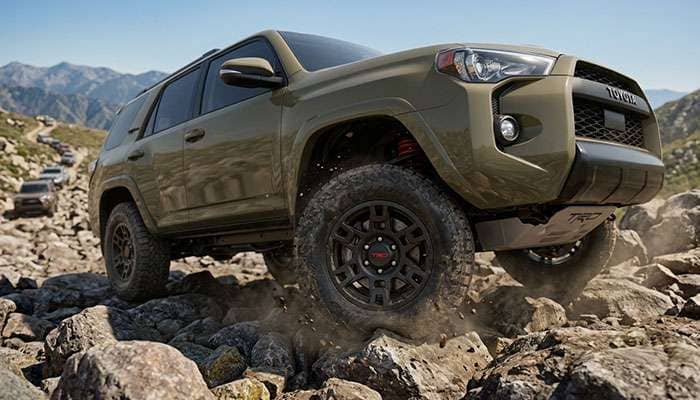
The fifth-gen TRD Pro rode on the same P265/70R17 113S as the SR5, 31.6 inches tall. Toyota gave it its own wheel at about +4 mm, 11 mm farther out than the SR5's roughly +15 mm wheel, plus its own shocks and skid plate. It never got a taller factory tire. If you own one and want a 33, that's a fitment job, not a factory size.
On a 2025 or newer TRD Off-Road or TRD Off-Road Premium, it's a 265/70R18 with a 116 load index on an 18 x 7.5-inch wheel at +55 mm, 32.6 inches tall. That holds for the gas engine and the i-FORCE MAX hybrid. Gas and hybrid trucks have shipped on different brands of all-terrain, but in the same size.
That's worth calling out, because it's not how the Tacoma works. On a 2024 and newer Tacoma, the gas TRD Off-Road runs a 17-inch tire and the hybrid runs an 18. Our Toyota Tacoma tire size by trim guide covers that split. On the 4Runner, every sixth-gen TRD Off-Road gets the 18.
Our 265/70R18 tire size guide has the full dimensions and the rim width range for that size.
Yes, and it's one of the cleaner swaps on the sixth gen. Same bolt pattern, same 95.1 mm bore, same M14 studs and the same 265/70R18 tire. The TRD Pro wheel moves the tire about 1.4 inches outboard, which widens the stance and puts more of the tread outside the fender. Toyota also sells an optional TRD 18-inch wheel for the TRD Off-Road at 18 x 8 inches and about +45 mm, a middle ground between the two. Whichever you pick, the tire size on the placard doesn't change, so the pressure and load index don't either.
On a 2017 to 2024 TRD Off-Road, and the 2010 to 2016 Trail it replaced, it's a P265/70R17 113S on a 17-inch wheel, 31.6 inches tall. Here's what size a 265/70R17 is in inches if you want the width and circumference too.
On a 2025 or newer SR5, it's a 245/70R17 with a 110 load index on a 17 x 7-inch wheel, 30.5 inches tall. That's the smallest tire in either generation, and Toyota's spec sheet lists the SR5 at 8.1 inches of ground clearance, a full inch under the TRD Off-Road.
One wrinkle. Toyota's launch product sheet listed the SR5 on an 18-inch wheel with a 245/70R18, and Toyota's wheel data carries that size at 110H on an 18 x 7.5-inch wheel. The tire makers' fitment listings for the SR5 show the 17. If your SR5 has 18s, the size is 245/70R18, about 31.5 inches tall. Check the sidewall.
On a 2010 to 2024 SR5 or SR5 Premium, it's a P265/70R17 113S on 17-inch wheels, 31.6 inches tall. Here's the comparison that catches people: the fifth-gen SR5 sits on a tire 1.1 inches taller than the sixth-gen SR5 that replaced it. If you're cross-shopping generations and you notice the new one looks a little lower in the wheel well, that's why.
On a 2025 or newer TRD Sport, TRD Sport Premium, Limited or Platinum, it's a 265/55R20 on a 20 x 8-inch wheel, 31.5 inches tall. The factory tire is an extra load (XL) tire with a 113 load index and a V speed rating. Toyota's spec sheet puts these trims at 8.8 inches of ground clearance.
On a 2010 to 2024 Limited, the 2019 to 2021 Nightshade or the 2022 to 2024 TRD Sport, it's a P245/60R20 107H on 20-inch wheels. That's 31.6 inches tall, the same as the fifth gen's 17-inch tire.
The sixth-gen 20-inch tire is the only factory 4Runner size that's extra load, and it's V-rated, good to 149 mph. A lot of all-terrain tires in 265/55R20 are XL but only H-rated. The rule tire makers teach installers is to match or beat the factory load index and speed rating. If you're putting an all-terrain on a sixth-gen Limited, read both numbers on the sidewall before you read the tread pattern.
At least the number on your factory tire: 113 on a fifth gen on 17s, 107 on a fifth gen on 20s, and 110, 113 or 116 on a sixth gen. The two generations handle this differently, and that's the part a size chart won't tell you. Fifth-gen factory tires are P-metric. Sixth-gen factory tires have no P in front of the size, and on the SR5 and the 18-inch trims they're rated 2 load index points higher than a P-metric tire in the same size.
Factory Tire |
Trims |
Factory Rating |
Same Size in P-Metric |
Passenger Tires Below Factory Index |
Share That Are LT |
|---|---|---|---|---|---|
P265/70R17 113 |
2010-24 SR5, Trail, TRD Off-Road, TRD Pro |
2,535 lbs |
Already P-metric |
Almost none; most are rated 115 |
About half |
P245/60R20 107 |
2010-24 Limited, Nightshade, TRD Sport |
2,149 lbs |
Already P-metric |
Almost none |
Almost none |
245/70R17 110 |
2025-26 SR5 |
2,337 lbs |
108 (2,205 lbs) |
About 1 in 6 |
About half |
265/70R18 116 |
2025-26 TRD Off-Road, TRD Pro, Trailhunter |
2,756 lbs |
114 (2,601 lbs) |
About 1 in 5 |
About half |
The P-metric load indexes come from the Tire and Rim Association's passenger table, and the market shares come from what's actually sold in each size. The sixth gen's 265/55R20 XL is left off because so few replacement tires are sold in that size that a share would be misleading.
Buy a P-metric replacement in your exact sixth-gen size and it reads 2 points under what came off the truck: 108 instead of 110 on an SR5, 114 instead of 116 on a TRD Off-Road, TRD Pro or Trailhunter. About 1 in 6 passenger tires sold in 245/70R17 and about 1 in 5 in 265/70R18 rate below the factory number. The Tire and Rim Association also has installers divide a passenger tire's rated load by 1.10 when it goes on a truck or SUV, factory tire included. Toyota sized for that. A replacement that starts 2 points lower starts behind.
The fifth gen is the easier truck to shop for on this point. Its factory tires were P-metric to begin with, and almost every passenger tire sold in P265/70R17 and P245/60R20 meets or beats the factory index. Most 265/70R17 passenger tires on the market are rated 115, two points better than factory.
About half of the 265/70R17s, 245/70R17s and 265/70R18s sold are LT tires, and about 9 in 10 of those LT tires are load range E. It's a popular upgrade, and here's the math nobody does at the counter.
A fifth gen's door placard says 32 psi. On the Tire and Rim Association's passenger table, a P265/70R17 at 32 psi is rated for 2,425 pounds. Divide by 1.10 for SUV use and you get 2,205 pounds per tire. Now the LT tire. On the light truck table, an LT265/70R17 is rated for 1,890 pounds at 35 psi, 2,075 at 40 and 2,255 at 45. So a fifth-gen 4Runner on LT265/70R17s needs about 45 psi to carry what the factory tire carried at 32. That's 13 psi over the door sticker.
Run the same math on a sixth gen and it lands in the same place. An LT245/70R17 on an SR5 needs about 45 psi. An LT265/70R18 on a TRD Off-Road, TRD Pro or Trailhunter needs about 45 to 50 psi, against a 33 psi placard. A load range E carcass at 45 psi rides firmer than the factory tire at 33, and most owners notice it on the first drive home. Our guide to P-metric vs. LT tires walks through the procedure and the ride tradeoff.
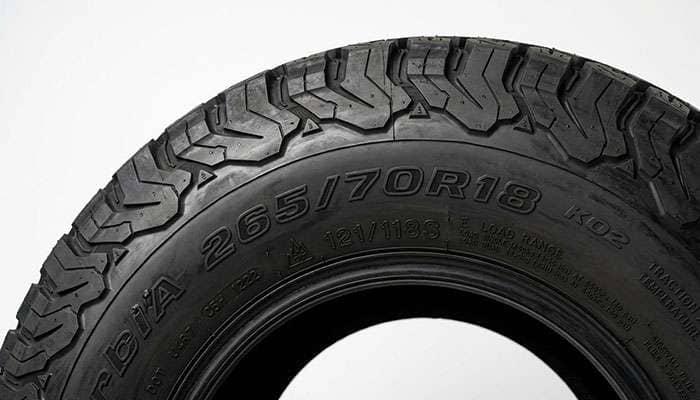
A wrong 4Runner tire doesn't always announce itself at the counter. Some mistakes ride along with you for 40,000 miles.
If you want the sizes and load indexes matched to your exact truck, start with our Toyota 4Runner tire and wheel search and pick your trim.
On a 2010 to 2024 4Runner, trim picks the wheel and nothing else that matters much. Every factory tire is 31.6 inches tall, the TRD Pro included. On a 2025 or newer 4Runner, trim picks the height: 30.5 inches on the SR5, 31.5 on the 20-inch trims and 32.6 on every 18-inch TRD trim. The TRD Pro and Trailhunter share that 265/70R18 with the TRD Off-Road and set themselves apart with a wheel that sits 35 mm farther out.
Once you have the size, get the load index and pressure right. The sixth gen's factory tires are rated above their P-metric twins, and an LT tire on either generation needs about 45 psi to do the factory tire's job. Those two numbers are where most 4Runner owners leave capacity on the table.
A 2025 or newer TRD Pro runs 265/70R18 tires with a 116 load index on 18-inch wheels at about +20 mm offset. Toyota markets them as 33s; they measure about 32.6 inches. A 2015 to 2024 TRD Pro runs P265/70R17 113S, the same size as the SR5, about 31.6 inches tall.
Yes. Both run 265/70R18 tires with a 116 load index on 18-inch wheels at about +20 mm offset, and both come from the factory on Toyo Open Country A/T III tires. The wheel finishes differ, but the tire size and load index are the same.
A 2025 or newer SR5 runs 245/70R17 tires with a 110 load index on 17 x 7-inch wheels, about 30.5 inches tall. A 2010 to 2024 SR5 runs P265/70R17 113S on 17-inch wheels, about 31.6 inches tall.
A 2025 or newer TRD Off-Road runs 265/70R18 tires with a 116 load index on 18 x 7.5-inch wheels, the same tire size as the TRD Pro, for both the gas and hybrid models. A 2017 to 2024 TRD Off-Road runs P265/70R17 113S on 17-inch wheels.
Not the wheels. The 2025 and newer 4Runner uses a 95.1 mm center bore and M14 studs, and the 2010 to 2024 trucks use a 106.1 mm bore and M12 studs, so the wheels don't swap. The tire sizes are different too. Match the size on your own door placard.
At least the index on your factory tire: 113 for a P265/70R17 and 107 for a P245/60R20 on a 2010 to 2024 truck, and 110 for a 245/70R17, 113 XL for a 265/55R20 and 116 for a 265/70R18 on a 2025 or newer truck. P-metric tires in the sixth-gen sizes read 2 points lower, so check the sidewall before you buy.