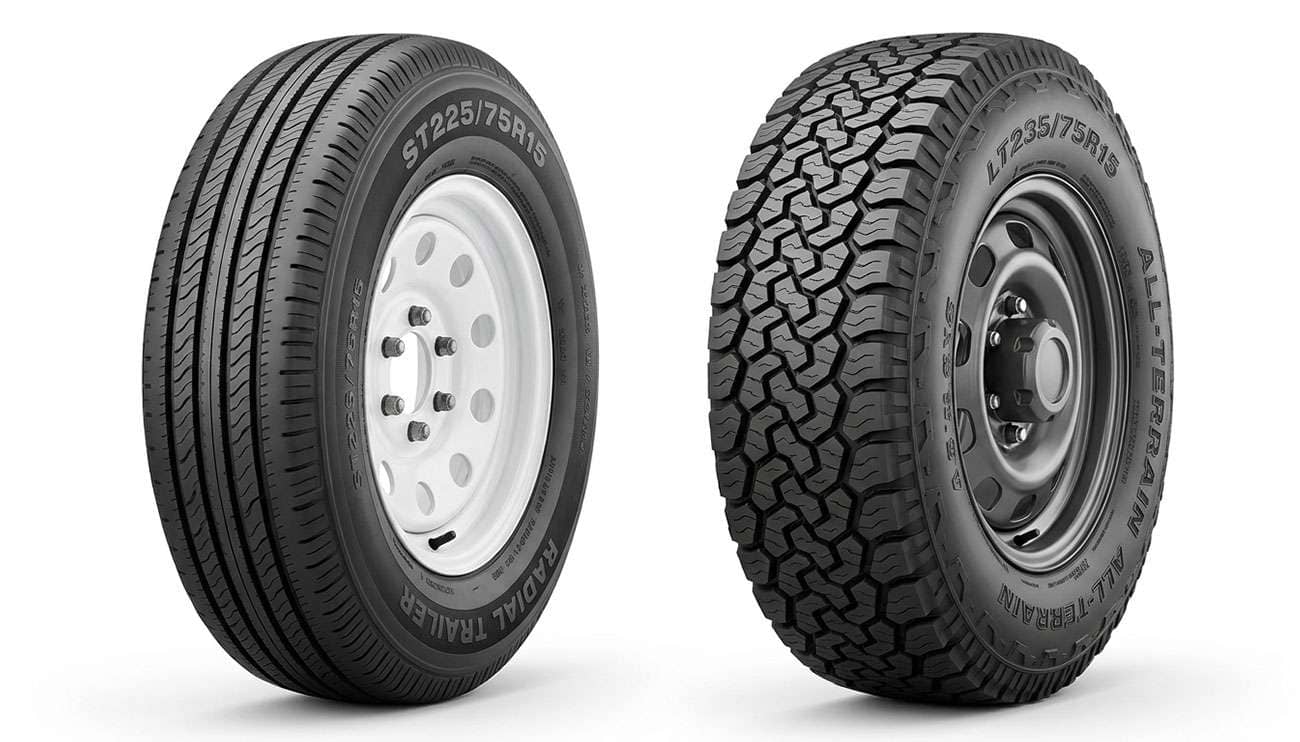
The short answer: on a truck, SUV, or van, yes. A 235/75R15 is 2.1% taller and almost always carries more weight than the 225/75R15 it replaces. On a trailer, usually no. The variable that decides it is the letters in front of the size. The 225/75R15 is one of the most common trailer sizes on the road, sold as an ST tire in Load Range D or E. The 235/75R15 is almost never sold in ST construction. Swap a tandem trailer from ST225/75R15 Load Range E to a passenger 235/75R15 and you can lose more than 3,000 lb of legal tire capacity while going "bigger."
Most answers to this question treat it as geometry: diameter, width, the 3% rule. Those numbers are correct, and I'll give you all of them. But size is the smaller half of a tire's job. Load capacity is the bigger half, and for these two sizes it depends almost entirely on what the tire is built for. Start with the table below and find your row.
What You Have Now |
Can You Switch to 235/75R15? |
What to Watch |
|---|---|---|
P225/75R15 or 225/75R15 on a truck, SUV, or van |
Yes, in most cases |
Fender and frame clearance at full lock; 2.1% speedometer change |
ST225/75R15 Load Range D or E on a trailer |
Usually no |
Passenger and most LT 235/75R15 tires carry less than the ST tire you are removing |
P225/75R15 on a trailer |
Possible, but ST225/75R15 is the better fix |
Passenger tires are derated 10% in trailer service under FMVSS 120 |
Mixed sizes on one axle or a tandem pair |
Only if all tires on that axle set change |
The taller tire carries more than its share of the load |
It matters more than anything else in this article. Look at the sidewall of the tire you're replacing and read the characters directly in front of the 225.
Across the market, a large share of everything sold in 225/75R15 is ST construction. That's the trap. The 235/75R15 market looks completely different. It's dominated by Extra Load passenger tires and LT light truck tires for pickups and SUVs. ST235/75R15 exists, but it's close to unobtainable compared to its ST225 counterpart.
So when a trailer owner searches "can I use 235/75R15 instead of 225/75R15" and reads that the size difference is within tolerance, they walk away believing a bigger tire is a stronger tire. On a trailer, it usually isn't. If you need a refresher on reading trailer sidewalls, our guide to the ST225/75R15 tire code breaks down every character.
Here is the full dimensional comparison, calculated from the size codes. Measured dimensions vary slightly by brand and tread pattern, and LT and ST tires often run a few tenths of an inch different from passenger tires of the same nominal size.
Feature |
225/75R15 |
235/75R15 |
Difference |
|---|---|---|---|
Overall diameter |
28.29 in |
28.88 in |
+0.59 in (+2.1%) |
Section width |
8.86 in |
9.25 in |
+0.39 in (+4.4%) |
Sidewall height |
6.64 in |
6.94 in |
+0.30 in |
Revolutions per mile |
713 |
698 |
-2.1% |
Approximate air volume |
About 4,000 cu in |
About 4,425 cu in |
About +10.6% |
Because both sizes share the same 75 aspect ratio, the extra 10 mm of width also adds sidewall height. That's why the 235 grows in both directions. For the exact inch conversions, see our 235/75R15 in inches breakdown.
The air volume row is the one I want you to focus on. Load capacity is set by how much air the casing holds at a given pressure. The 235 holds about 10.6% more air than the 225. In matching construction, that shows up directly in the load index: a P225/75R15 is rated 102 (1,874 lb) and a P235/75R15 is rated 105 (2,039 lb), an 8.8% increase. Same construction, bigger air chamber, more capacity. That relationship only holds when you compare like to like. Change the construction, and it falls apart.
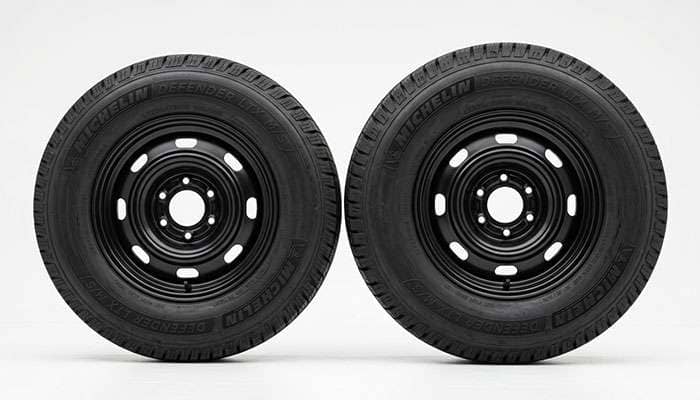
This is the table that answers the question. Every figure is the maximum load per tire at the tire's maximum rated pressure, from the standard load index chart. LT figures are single-wheel ratings.
Feature |
225/75R15 |
235/75R15 |
|---|---|---|
P-metric, standard load |
102 = 1,874 lb |
105 = 2,039 lb |
Extra Load (XL) passenger |
Uncommon |
109 = 2,271 lb (the most common 235/75R15 on the market) |
LT Load Range C |
Rarely sold |
104 = 1,984 lb at 50 psi |
LT Load Range D |
Rarely sold |
110 = 2,337 lb at 65 psi |
LT Load Range E |
Rarely sold |
116 = 2,756 lb at 80 psi |
ST Load Range D |
113 = 2,535 lb at 65 psi |
Effectively unavailable |
ST Load Range E |
117 = 2,833 lb at 80 psi |
Effectively unavailable |
Read across the bottom rows. The strongest common 225/75R15 is an ST Load Range E at 2,833 lb. The most common 235/75R15 is a passenger XL at 2,271 lb. On paper, the "smaller" tire carries 562 lb more per tire. In trailer service it's worse than that, for reasons covered in the next section.
On a truck or SUV, the picture flips. The tire you're replacing is almost always a P225/75R15 at 1,874 lb. Every common 235/75R15 version, from P-metric up through LT Load Range E, matches or beats that. That's why the switch is usually a straightforward upgrade on a vehicle. The difference between P-metric and LT construction goes deeper than load numbers, and we cover it in P-metric vs LT tires.
Load Range D on an ST tire and Load Range D on an LT tire are not the same rating. Both use 65 psi as the maximum pressure, but an ST225/75R15 Load Range D is rated for 2,535 lb and an LT235/75R15 Load Range D is rated for 2,337 lb. ST tires are rated higher for their size because trailer axles don't steer or drive, and the Tire and Rim Association load tables for ST tires assume that lower-stress duty cycle along with a lower maximum speed.
Only if the replacement carries at least as much as the ST tire it replaces after any required derate, and in practice very few 235/75R15 tires do. Here's the math.
Federal Motor Vehicle Safety Standard 120 governs tire selection on trucks, buses, and trailers. Two parts of it matter here. First, the sum of the load ratings of the tires on an axle must equal or exceed that axle's Gross Axle Weight Rating (GAWR), which is printed on the trailer's certification label. Second, section S5.1.2 says that when a passenger car tire is installed on a truck, multipurpose vehicle, bus, or trailer, its load rating must be divided by 1.10 before you add it up.
That 10% cut applies to passenger tires. It does not apply to ST or LT tires. So here's what each option looks like per tire in trailer service:
Feature |
Rated Load Per Tire |
Trailer-Service Capacity Per Tire |
Tandem Trailer, Four Tires |
|---|---|---|---|
ST225/75R15 Load Range E |
2,833 lb |
2,833 lb |
11,332 lb |
ST225/75R15 Load Range D |
2,535 lb |
2,535 lb |
10,140 lb |
LT235/75R15 Load Range E |
2,756 lb |
2,756 lb |
11,024 lb |
235/75R15 XL passenger |
2,271 lb |
About 2,065 lb |
About 8,260 lb |
LT235/75R15 Load Range C |
1,984 lb |
1,984 lb |
7,936 lb |
P235/75R15 standard load |
2,039 lb |
About 1,854 lb |
About 7,416 lb |
Swap a tandem trailer from ST225/75R15 Load Range E to the most common 235/75R15 on the market, a passenger XL, and you lose about 3,072 lb of tire capacity. Swap to a P235/75R15 and you lose almost 3,900 lb. Even an LT235/75R15 Load Range E, the strongest 235 you can realistically buy, comes up about 77 lb short per tire and costs more than the ST tire it replaces.
Say your trailer's certification label lists a GAWR of 5,200 lb per axle. Two tires on that axle need to total at least 5,200 lb, so each tire needs at least 2,600 lb. An ST225/75R15 Load Range E (2,833 lb) clears it. A Load Range D (2,535 lb) doesn't. A derated 235/75R15 XL (about 2,065 lb) misses by more than 500 lb per tire. Your axle numbers will differ. The method doesn't.
There are two more trailer-specific limits. Check the maximum load stamped on your trailer wheels. Many light-duty 15-inch trailer wheels are rated below what a Load Range E tire carries, and the lower number always wins. And check the speed rating: older ST tires with no speed symbol are limited to 65 mph, while many current ST tires carry an L (75 mph), M (81 mph), or N (87 mph) rating.
If your trailer is chewing through tires, a size change won't fix it. The causes are almost always load, pressure, heat, or age, and we walk through each one in why trailer tires keep blowing out. For a full construction comparison, read trailer tires vs car tires.
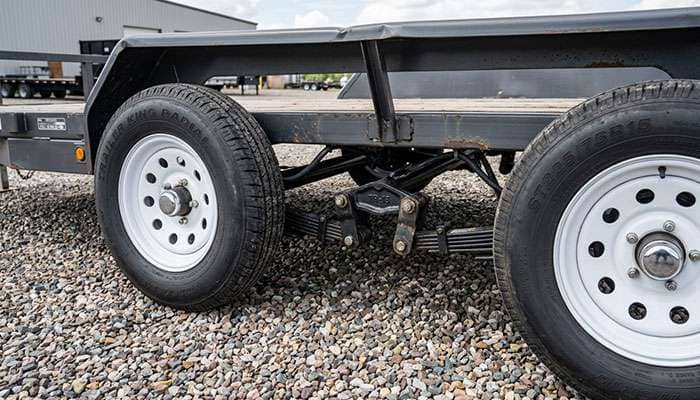
Usually, yes. Both sizes mount on a 15-inch wheel, and the approved rim width ranges overlap heavily. Most 15x6, 15x6.5, and 15x7 wheels fall inside both ranges. Narrower 15x5 or 15x5.5 trailer wheels are where you run into trouble: the 235 may fall outside its manufacturer's approved range on those, which pinches the bead and rounds the tread.
Always check the specific tire maker's approved rim width list for the exact tire you're buying. Ranges vary by manufacturer and by construction, and LT and ST tires are often more restrictive than passenger tires. Then confirm the wheel's own load rating, which matters more on trailers than on vehicles.
On most vehicles that came on 225/75R15, no, but check before you buy. You're adding 0.30 in of radius and about 0.20 in of width per side. The places that run out of room first are predictable:
As a working rule, if you have at least 0.5 in of clearance at every one of those points with the current tire, the 235 will fit. If you're under that anywhere, measure again with the vehicle loaded the way you actually drive it. We used the same method in our 235/65R17 instead of 225/65R17 fitment guide, and it carries over directly.
If a tire does rub, it rarely fails all at once. It scuffs the outer sidewall a little at a time until the cords show. If you've already found scuffing or a cut, read tire sidewall damage: is it safe to drive before your next trip.
By 2.1%. The 235 covers more ground per revolution, so if your speedometer was calibrated for 225/75R15, it will read low. At an indicated 60 mph, you're doing about 61.3 mph. At an indicated 70, about 71.5. Your odometer undercounts by the same 2.1%.
That's inside the roughly 3% diameter change most engineers consider acceptable without recalibration. ABS and stability control will adapt as long as all four tires match. On a trailer, speedometer error doesn't apply, but the 0.30 in increase in loaded radius does raise the trailer slightly. That's not enough to change hitch geometry in any meaningful way.
The gearing effect is equivalent to a 2.1% taller final drive. On a four-cylinder compact pickup that already works hard on grades, you may notice a little more downshifting with a load. Most drivers won't feel it.
Not on the same axle, and not across a tandem pair. Here's the mechanism.
On a tandem trailer, both axles share the load through the suspension equalizer. A tire that's 0.59 in taller sits higher and picks up more of the load, while the shorter tire next to it carries less. The taller tire then runs hotter and closer to its limit than its rating assumes. That's the same reason trailer makers specify matched tires and why replacing one tire on a tandem with a different size is a bad idea even if the load index looks fine.
On a four-wheel-drive or all-wheel-drive vehicle, a 2.1% diameter difference between axles forces the transfer case or center differential to make up the speed difference constantly. Over time that wears clutches and chains and can trigger drivetrain warnings. Change all four, or none.
Spare tires are the one gray area. A 225 spare on a vehicle running 235s is fine for short trips at reduced speed. On a trailer, carry a spare that matches the tires you run.
When the 235/75R15 is the wrong construction for the job, the damage builds in stages. Here's how it typically progresses, from cheapest to most expensive.
Every step on that list starts the same way: a tire that carries less than the axle needs. The size difference between 225/75R15 and 235/75R15 never causes it. The construction difference does.
Once you have your numbers, browse our trailer tires by size and load range, or call us and we'll run the capacity math with you.
On a truck, SUV, or van that came on P225/75R15, a 235/75R15 is a reasonable switch. It's 2.1% taller, it fits most stock wheels, and nearly every version carries more weight than the tire you're removing. Check clearance and replace all four.
On a trailer, the answer reverses. The 225/75R15 is a trailer workhorse in ST Load Range D and E, and the 235/75R15 is not. Most 235s carry less in trailer service, especially after the FMVSS 120 passenger tire derate. If your trailer needs more capacity, the fix is a higher load range in ST225/75R15, not a wider passenger tire.
Only if the 235 carries at least as much load as the tire it replaces after any required derate. Most trailers on 225/75R15 run ST tires in Load Range D (2,535 lb) or E (2,833 lb). A passenger 235/75R15 XL is rated 2,271 lb and drops to about 2,065 lb in trailer service under FMVSS 120, so it is a downgrade. ST225/75R15 in a higher load range is usually the better choice.
The 235/75R15 is about 28.88 in tall versus 28.29 in, 9.25 in wide versus 8.86 in, and has a 6.94 in sidewall versus 6.64 in. In matching construction it carries more load, such as 2,039 lb for a P235/75R15 versus 1,874 lb for a P225/75R15.
In most cases, yes. Both mount on 15-inch wheels and most 15x6 to 15x7 wheels fall within both approved rim width ranges. Very narrow trailer wheels may fall outside the 235's approved range, so check the tire maker's specifications for the exact tire.
Your speedometer will read about 2.1% low. At an indicated 60 mph you will actually be traveling about 61.3 mph. That is within the roughly 3% range generally considered acceptable.
No. On a tandem trailer the taller tire carries more than its share of the load and runs hotter. Replace all tires on the axle set with the same size, construction, and load range.
Usually, yes. Most trucks and SUVs that came on 225/75R15 used a P-metric tire rated 1,874 lb, and every common 235/75R15 version carries as much or more. Confirm clearance at full steering lock and full suspension compression, and replace all four tires.