
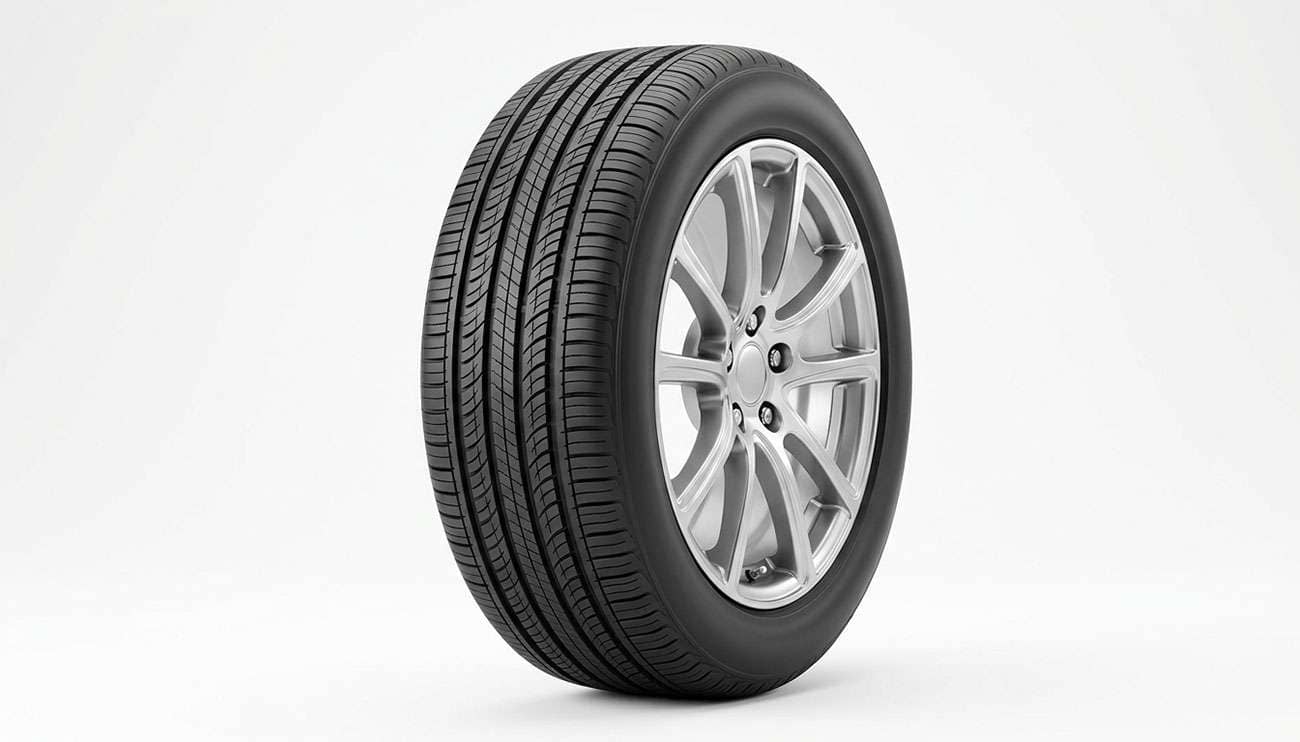
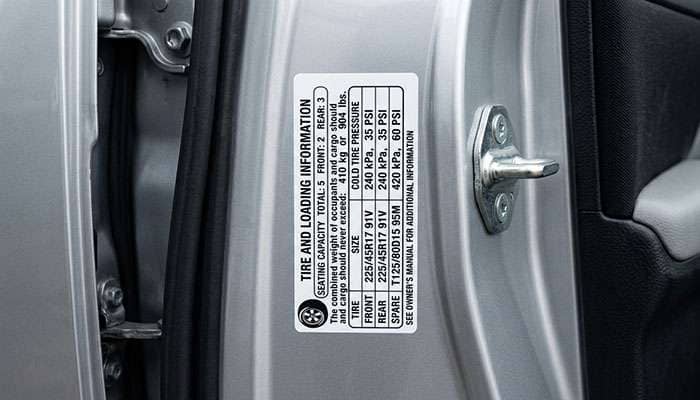
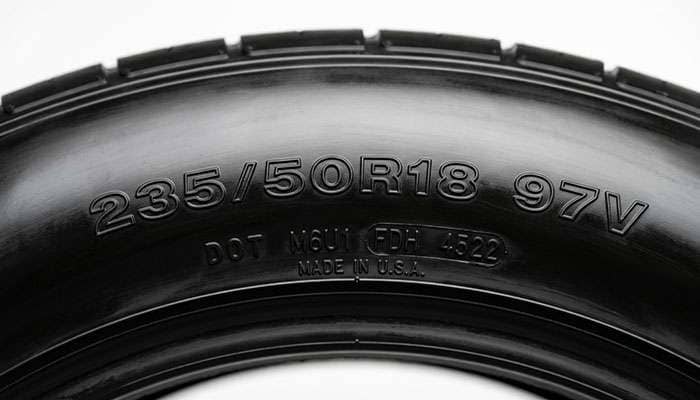
There is no single best 235/50R18 tire, because 235/50R18 is not one fitment. It is two. Roughly two thirds of the vehicles that wear this size are specified at load index 97. Roughly a quarter need 101 XL. Those two groups do not shop from the same shelf. Before you look at a single grip score, read the two characters printed right after the size on your driver door placard. That pair decides which half of this size you are actually allowed to buy from.
Most guides for 235/50R18 open with a ranked table of dry grip and comfort percentages and never separate the two load ratings. That is the part nobody puts in front of you. A 97-rated tire and a 101 XL tire wearing the identical 235/50R18 stamp are built on different casings, carry different maximum loads, and reach those loads at different inflation pressures. Ranking them in one column produces a list where the top pick is the wrong tire for one reader in four.
So start here, with the code, not with the brand.
Placard Code After the Size |
What It Means |
Typical Vehicle |
What You Can Fit |
|---|---|---|---|
97H |
1,609 lbs per tire, sustained to 130 mph |
Touring-trim mid-size sedan |
97H or higher. V, W and Y all exceed the requirement |
97V |
1,609 lbs per tire, sustained to 149 mph |
The most common 235/50R18 fitment by a wide margin |
97V, 97W, 97Y, or any 101 XL tire |
97W or 97Y |
1,609 lbs per tire, sustained to 168 or 186 mph |
Sport-trim sedan or coupe on a performance suspension |
Match the letter or go up. Do not drop to V or H |
101V, 101W or 101Y with XL |
1,819 lbs per tire, Extra Load casing |
Compact and mid-size crossover, heavier sedan trim |
101 XL only. A 97 tire is 210 lbs per corner short |
95, 96, 98 or 99 |
Less common OE variants inside this size |
Specific model years and export-market trims |
That number or higher. Never lower |
Find your row, then read the section below that matches it. If you want to understand the arithmetic behind those numbers before you commit, our breakdown of load range vs load index explains where the pound figures come from and why they are not interchangeable with ply ratings.
235/50R18 is one of the broadest crossover-and-sedan sizes in the modern market. Fitment databases list this size across roughly 67 manufacturers and nearly 200 distinct models, which is why the size shows up on showroom floors that have almost nothing else in common.
On the passenger car side you will find it on the Acura TLX, Buick LaCrosse, Regal and Regal TourX, Chrysler and Dodge full-size sedans, Audi A8, BMW 7 Series, Lincoln and Mercury sedans, and a long list of Ford and Chevrolet mid-size and full-size cars. On the crossover side it appears on the Audi Q3 and RS Q3, BMW X3, Alfa Romeo Tonale, Mazda crossovers, Volvo compact utilities, Jeep, and a large group of Hyundai, Kia and Volkswagen utility models.
That spread is exactly the problem. A 3,400-pound sedan and a 4,300-pound crossover both leave the factory on 235/50R18, and the tire that is correct for one is under-rated for the other. The size is identical. The casing requirement is not.
There is a second split hiding in the same size. Speed ratings across 235/50R18 fitments run from S all the way to Y, with V accounting for a little more than half of the applications, H around one in six, and W another one in six. If your placard reads 97V and you install a 97H tire because the price was better, you have quietly dropped 19 mph of rated sustained speed capability and changed the casing stiffness the chassis was tuned around. Our comparison of H vs V rated tires covers what that swap actually changes in ride and steering feel.
This is the larger group. If your placard reads 97 followed by H, V, W or Y, you are on the standard load side of the size and you have the deepest selection available. The picks below are grouped by what you actually want the tire to do, not by an overall score, because a tire that wins on dry grip and loses on tread life is the right answer for one driver and the wrong answer for the next.
What You Want Most |
Tire |
Load and Speed |
Price Each |
|---|---|---|---|
One set year-round, including light snow |
Michelin CrossClimate2 |
97V |
$256.99 |
Wet grip and sharp steering |
Continental ExtremeContact DWS06 Plus |
97W |
$205.99 |
Maximum tread life |
Continental TrueContact Tour 54 |
97V |
$208.99 |
Quiet highway miles |
Bridgestone Turanza QuietTrack |
97V |
$277.55 |
Long mileage on a budget |
Goodyear Assurance MaxLife 2 |
97W |
$226.99 |
Lowest cost per mile |
General AltiMax RT45 |
97H |
$186.99 |
Two notes on that table before you pick.
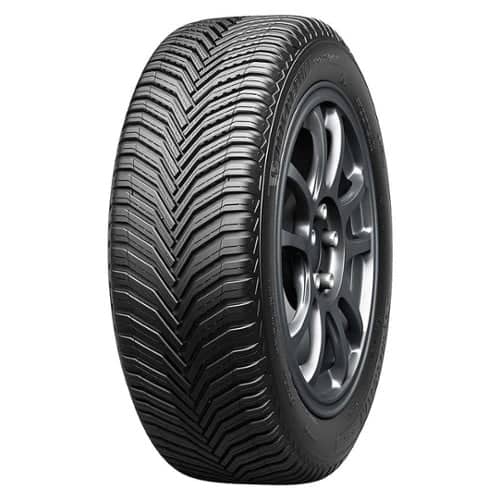
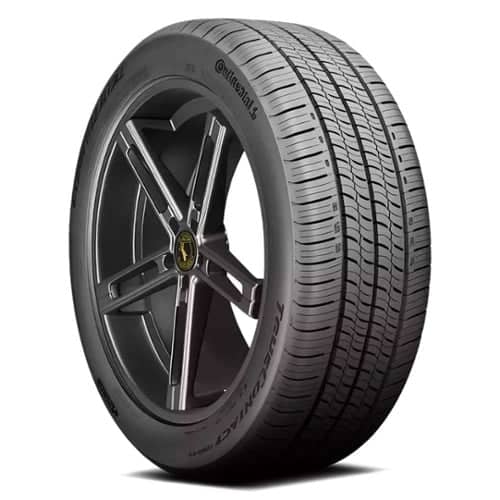
The CrossClimate2 is the one tire here that carries the three-peak mountain snowflake symbol, which means it has passed a standardized snow traction test rather than simply carrying an M+S marking. It runs a 640 treadwear grade with a 60,000-mile limited treadwear warranty. If you live somewhere that gets a handful of genuinely bad mornings each winter and you do not want to own two sets of wheels, this is the tire that removes the decision.
The AltiMax RT45 is the only H-rated tire in the group. If your placard reads 97V, it is not a legal-spec replacement even though it carries the correct load index and the correct size. Read the letter, not just the number. This is the single most common mistake made in this size, and it costs nothing to avoid.
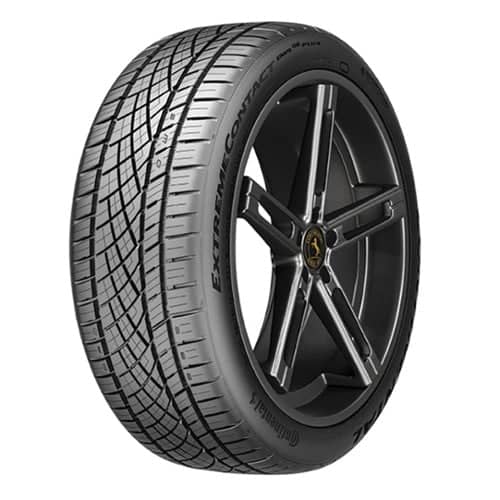
The ExtremeContact DWS06 Plus deserves a specific call-out for wet performance. Its tread carries visible DWS indicators that wear away in sequence, so you can read remaining dry, wet and snow capability off the tread face without a depth gauge. On a 3,600-pound sedan doing freeway miles in rain, that is a tire that gives you feedback instead of asking you to guess.
If your placard reads 101 with an XL designation, your vehicle needs 1,819 pounds of capacity per corner. A standard load 97 tire tops out at 1,609 pounds. The gap is 210 pounds per tire and 840 pounds across the vehicle, and there is no inflation pressure that closes it. The casing is not rated to carry it, so adding air adds stress, not capacity.
What You Want Most |
Tire |
Load and Speed |
Price Each |
|---|---|---|---|
All-season grip with performance handling |
Michelin Pilot Sport A/S 4 |
101Y XL |
$229.99 |
Premium all-season balance |
Pirelli P Zero All Season Plus 3 |
101W XL |
$229.61 |
All-weather capability with a snowflake rating |
Toyo Celsius II |
101V XL |
$207.69 |
Performance per dollar |
Falken Azenis FK460 A/S |
101Y XL |
$192.00 |
Maximum dry and wet grip, warm climates |
Michelin Pilot Sport 5 |
101Y XL |
$300.99 |
Dedicated winter set |
Michelin X-Ice Snow |
101H XL |
$304.65 |
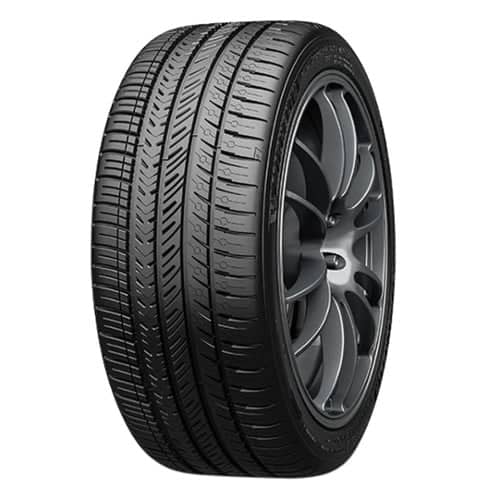
The Pilot Sport A/S 4 is the default answer for a crossover owner who wants the chassis to feel the way it did on the OE tire. It carries a Y speed rating, which is well above what any 101 XL placard requires, and the extra casing stiffness that comes with the rating is a benefit rather than a compromise on a taller vehicle that transfers weight in corners.
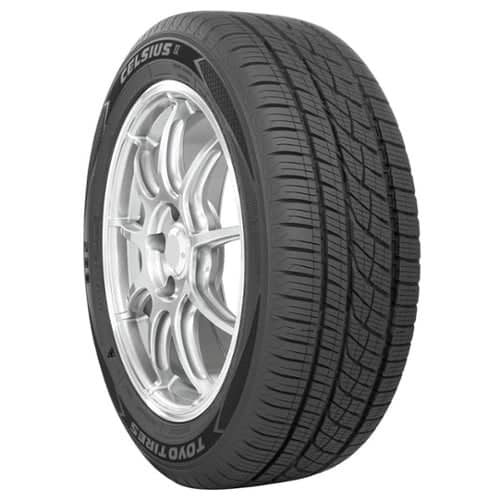
The Celsius II is the pick if your winters are real but not severe. All-weather tires like this one hold the three-peak snowflake certification while remaining usable in July, which is a meaningfully different product from a standard all-season. You give up some dry steering precision compared to the Pilot Sport A/S 4 and you gain genuine cold-weather compound behavior below 45 degrees Fahrenheit.
If you genuinely need a dedicated winter set, the X-Ice Snow is the studless option that makes sense in this size. It is a 101H XL, so it satisfies crossover load requirements without dropping capacity the way some winter tires in adjacent sizes do. Budget for a second set of wheels. Mounting and dismounting the same rims twice a year is how bead seats get damaged.
The two sizes are 10 millimeters apart in section width and about four tenths of an inch apart in overall diameter. Here is what that actually means on the vehicle.
Specification |
235/50R18 |
245/50R18 |
|---|---|---|
Section width |
235 mm, about 9.25 inches |
245 mm, about 9.65 inches |
Sidewall height |
117.5 mm, about 4.63 inches |
122.5 mm, about 4.82 inches |
Overall diameter |
About 27.25 inches |
About 27.65 inches |
Revolutions per mile |
Higher |
About 1.4 percent lower |
Speedometer effect |
Reference |
Reads about 0.9 mph slow at an indicated 60 |
Approved rim width range |
6.5 to 8.5 inches |
7.0 to 8.5 inches |
The 1.4 percent diameter change is inside the tolerance most engineers use for a substitution, so the swap is usually mechanically viable on a wheel that is at least 7.0 inches wide. That is not the same as saying it is a good idea. Widening the section by 10 millimeters moves the tire closer to strut housings and inner fender liners, changes the scrub radius slightly, and adds rolling resistance. On a vehicle with active safety systems calibrated to a specific rolling circumference, the electronics see a wheel speed that is 1.4 percent off from what the factory expected on every corner.
The one time this swap is worth doing is when the 245 gives you access to a compound or model that simply is not offered in 235/50R18. Otherwise, stay in your size. We go deeper on the trade-off in our piece on 235 vs 245 tires, including what the width change does to wet braking and steering effort.
Across the current market, 235/50R18 runs from roughly $67 to roughly $490 per tire. The midpoint sits near $197, and the middle half of the market falls between about $150 and $232. Here is how the tiers break down and what you are actually buying at each level.
Price Tier |
Share of the Market |
What You Get |
Who It Suits |
|---|---|---|---|
Under $100 |
About 6 percent |
Entry-tier construction, shorter or no mileage warranty |
Low-mileage second vehicles, short-term ownership |
$100 to $200 |
About 48 percent |
Mainstream all-season and touring lines with real warranties |
Most daily-driven sedans and crossovers |
$200 to $300 |
About 39 percent |
Premium touring, all-weather and ultra high performance lines |
Drivers who want OE-level behavior back |
Over $300 |
About 7 percent |
Flagship performance, dedicated winter, run-flat construction |
Specific requirements rather than general use |
Two structural facts drive price inside this size. First, XL construction costs more to build than standard load, so the 101 side of the size sits higher on average than the 97 side for otherwise comparable tires. Second, speed rating tracks price closely, because a Y-rated casing uses more reinforcement and a more thermally stable compound than an H-rated one. When you compare two tires that look identical on paper and one is $40 cheaper, check the letter first. That is usually where the difference lives.
Budget for a full set. Replacing two tires on an all-wheel-drive crossover puts mismatched rolling circumferences on the same axle set, and the driveline pays for it. On a front-wheel-drive sedan you have more latitude, but you are still trading away balanced handling.
Reliability is not a brand property. It is a model property, and the same manufacturer will sell you a 640-treadwear touring tire and a 300-treadwear summer tire in this exact size. Asking which brand lasts longest is asking the wrong question, because the answer changes line by line inside every catalog on the shelf.
What you can actually evaluate is three things, all of which are printed or published for every tire you are considering.
The UTQG treadwear grade. It is molded into the sidewall. It is a comparative index established under a federally specified test procedure, and it is only valid for comparisons within a manufacturer, not across them. A 640 from one brand and a 640 from another were not necessarily run against the same reference expectations. Inside a single brand, though, it tells you a great deal. Our guide to UTQG tire ratings covers how to read the traction and temperature grades alongside it.
The mileage warranty. This is the number the manufacturer is willing to put money behind, which makes it more honest than any marketing claim. The Michelin CrossClimate2 in this size carries a 60,000-mile limited treadwear warranty against a 640 treadwear grade. Long-wear touring lines in this size reach considerably higher. Ultra high performance all-season lines land lower, and dedicated summer tires typically carry no mileage warranty at all. None of that makes one better than another. It tells you what the compound was optimized for.
Whether the model is current. A tire that has been superseded in the manufacturer lineup is not a worse tire, but it does mean the sizes will thin out and the compound is a generation behind. Check that the specific model you are looking at is still in the maker's current catalog before you commit to a set you will own for five years.
Applied to 235/50R18, that framework produces a straightforward answer. For longevity, the long-wear touring lines from Continental, Goodyear and General deliver the most miles per dollar. For balanced all-around performance with real cold-weather capability, Michelin and Toyo lead in this size. For grip per dollar, Falken and Kumho consistently undercut the premium tier without giving up the load and speed ratings you need.
There is no recommended pressure for a tire size. There is a recommended pressure for your vehicle, and it is printed on the placard inside your driver door jamb. Federal Motor Vehicle Safety Standard No. 110 requires that placard to be there specifically so you do not have to guess.
What the fitment data shows about this size is instructive anyway. Across 235/50R18 applications, 32 psi cold is the most common factory specification at roughly 46 percent of fitments, 35 psi accounts for about 32 percent, and 44 psi appears on roughly 10 percent. Values of 29, 38 and 41 psi fill in the rest. That is a 15 psi spread inside one tire size. Anyone who gives you a single number for 235/50R18 is answering a question about a size that only has an answer at the vehicle level.
The high end of that spread is not random. The 44 psi placards cluster on XL fitments, because an Extra Load casing reaches its rated capacity at a higher reference pressure than a standard load casing does. That is the mechanism behind the whole 97 versus 101 distinction, and it is why you cannot substitute one for the other by adjusting the compressor.
Three rules that hold regardless of which number your placard shows:
Set pressure cold, meaning the vehicle has been parked at least three hours or driven less than a mile. A tire that has been on the freeway reads four to six psi high, and if you bleed it down to placard pressure warm, you are running under-inflated the next morning.
Never inflate to the number on the sidewall. That figure is the maximum pressure the casing is rated to hold, not a target. Running it turns the contact patch crowned, wears out the center rib, and costs you wet traction at exactly the moment you need it.
Check monthly and before long trips. A healthy tire loses roughly one psi per month through the casing, and another one psi for every ten degrees Fahrenheit the ambient temperature drops. A set that was correct in October is measurably low by January without anything being wrong.
Fitting a 97 tire to a vehicle whose placard reads 101 XL does not fail immediately. That is what makes it dangerous. The tire holds air, the car drives, and the consequences accumulate on a schedule you cannot see from the driver seat. Here is the sequence.
Day one. The casing deflects further under the same load than the engineer intended, because it has less reinforcement doing the same job. Steering feel softens. Turn-in goes vague. Most drivers register this as the new tires being more comfortable than the old ones.
First few thousand miles. The contact patch distorts under cornering load in a way the tread pattern was not designed to accommodate. Shoulder blocks and outer ribs wear faster than the center. If you rotate on schedule you will see it as a wear pattern that does not match the tire's design intent.
First season. Sustained over-deflection raises the operating temperature of the casing. Heat is the variable that governs the durability of the bond between rubber and the steel belt package. Federal Motor Vehicle Safety Standard No. 139 exists in large part because heat and endurance behavior under load is what separates a tire that survives a summer at highway speed from one that does not.
Eventually. The failure mode is belt-edge separation. It presents first as a vibration you feel through the seat or the steering wheel that does not respond to balancing, and it presents second as a tread loss event. The National Highway Traffic Safety Administration has documented the relationship between load, heat and separation failures for decades, and the Tire Industry Association trains technicians to treat unexplained vibration in a load-stressed tire as a removal condition rather than a balance problem.
There is a paperwork dimension too. If a claim adjuster reads your placard and then reads your sidewall and the numbers do not agree, you have handed them an argument. That is not a hypothetical in a serious collision.
The same logic applies to any structural compromise in the casing. If you are inspecting tires and find bulges, cuts or scuffing on the sidewall, our guide to tire sidewall damage walks through which observations are cosmetic and which mean the tire comes off the vehicle today.
Five steps, in order. Do not skip the first one.
Step one: photograph your placard. Open the driver door and shoot the sticker on the jamb or the B-pillar. It lists the front and rear tire size, the load index and speed rating, and the cold inflation pressure for each axle. Every decision below comes from that photograph.
Step two: confirm what is currently on the vehicle. Read the sidewall of one front tire and one rear tire. If they do not match the placard, someone before you made a substitution, and you need to decide whether to correct it rather than perpetuate it. This is more common on used vehicles than most buyers expect.
Step three: filter by load index first, speed rating second. The load index is a hard requirement. The speed rating is a hard requirement in the downward direction only. You can go up on both and you can never go down on either.
Step four: pick your season strategy. One set of all-seasons, one set of all-weather tires with the three-peak snowflake, or two sets with a dedicated winter package. Southern California drivers can usually stop at all-season. Anywhere that sees sustained temperatures below 45 degrees Fahrenheit, the compound matters more than the tread pattern, and an all-weather tire is the better single-set answer.
Step five: buy four. Mixed tread depths across an axle set change effective rolling circumference, and on all-wheel drive that becomes a differential problem rather than a handling preference. If budget forces two, put the new pair on the rear regardless of which axle drives the car, because the rear losing grip first is how a recoverable understeer situation becomes an unrecoverable one.
If you want to see how this size compares to the neighbors before you commit, we have run the same analysis on 235/55R17 and on 235/60R18, both of which share the 235 section width and carry their own load index splits.
The best 235/50R18 tire is the one that matches the code on your placard and then matches how you actually drive. That order is not negotiable. This size carries two distinct casing requirements under one set of numbers, and the ranked lists that ignore the split will eventually hand somebody a tire that is 210 pounds per corner short of what their vehicle needs.
Read the placard. Filter by load index, then by speed rating. Then, and only then, argue about wet grip and tread life, because at that point every option in front of you is one your vehicle can legally and safely carry. If you are ready to compare what is available in your specific rating, browse the full 235/50R18 tire selection and filter to your load and speed code.
No. A 97 tire is rated for 1,609 pounds per corner and a 101 XL is rated for 1,819 pounds, a shortfall of 210 pounds per tire and 840 pounds across the vehicle. The Extra Load casing reaches its rating at a higher reference pressure than a standard load casing, so there is no inflation setting that recovers the missing capacity. You can always go up in load index. You can never go down.
It depends on your load rating. On the 97 standard load side, the Michelin CrossClimate2 is the strongest single-set choice because it carries a three-peak mountain snowflake rating alongside a 640 treadwear grade. On the 101 XL side, the Michelin Pilot Sport A/S 4 gives crossover owners OE-level steering response, while the Toyo Celsius II is the better answer if you see real winter weather.
It depends entirely on which line you buy. Long-wear touring models in this size carry mileage warranties well past 60,000 miles, mainstream all-seasons typically land between 45,000 and 65,000, and ultra high performance and summer models run considerably shorter or carry no mileage warranty at all. Alignment, inflation discipline and rotation intervals move real-world results by tens of thousands of miles in either direction.
Very. Fitment databases list it across roughly 67 manufacturers and nearly 200 vehicle models, spanning mid-size and full-size sedans as well as compact and mid-size crossovers. That breadth is why the size carries such a wide range of load indexes and speed ratings, and why matching your specific placard code matters more here than it does in a size with a single dominant fitment.
Usually yes, mechanically, on a wheel at least 7.0 inches wide. The 245 is about four tenths of an inch larger in overall diameter, a 1.4 percent change that is inside common substitution tolerance, and it adds 10 millimeters of section width. It will read your speedometer about 0.9 mph slow at an indicated 60. It is worth doing only when the 245 gives you access to a tire model that is not offered in your size.
Yes. If the factory placard specifies an XL fitment, the vehicle's gross axle weight ratings were calculated against that casing capacity. Suspension tuning, stability control calibration and braking distances were all validated on it. Dropping to standard load changes the deflection behavior the chassis was developed around, and the load shortfall is real regardless of how lightly you load the vehicle day to day.



