
Yes — reputable wheel and tire packages ship pre-mounted and pre-balanced. But "balanced" covers a wide range of standards, and what gets done at a high-volume warehouse isn't always what a top-tier specialty shop would do for the same set of wheels. The difference between "balanced" and "balanced correctly" is what determines whether your steering wheel sits still at 75 mph or hums like a tuning fork.
The industry tolerance for a balanced wheel is 0.25 ounces of residual imbalance — roughly the weight of a US quarter. The road force limit most shops target is under 25 pounds. A factory-fresh package from a serious retailer should arrive inside both windows. The question is whether yours actually does, and how to confirm it before you put miles on something that's vibrating at 65.
The short answer: yes, packages from established retailers like Performance Plus, Discount Tire, Tire Rack, and similar arrive pre-balanced. The wheels and tires get mounted, balanced on a calibrated machine, and shipped with the wheel weights already attached. You bolt them on, drive away, and most of the time everything is fine.
The longer answer: balancing quality varies. Some warehouses run standard spin balance at production speed. Others run road force balance, which catches problems standard spin balance misses. Some match-mount the tire to the wheel for the lowest possible runout. The procedure each retailer uses determines how smooth your ride is on day one. Two packages at the same headline price can ship with substantially different balance quality, and the difference shows up the first time you hit highway speed. Our breakdown of what's actually included in a wheel and tire package covers the inclusion side. This article focuses on the balance procedure side.
A balanced wheel and tire assembly has its mass distributed evenly around the rotational axis. Real-world manufacturing tolerances make perfect balance impossible — every tire and every wheel has small mass variations. A balancer detects those variations and tells you where to add counterweights to offset them.
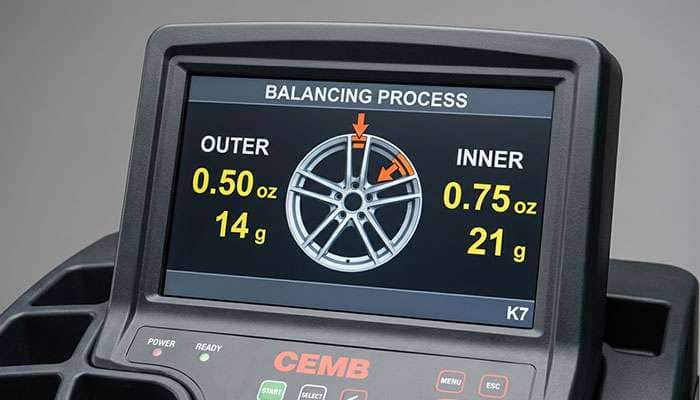
There are two types of imbalance the equipment measures. Static imbalance is when a heavy spot exists somewhere on the assembly that makes the wheel want to rotate to a low point if you spin it freely — same as a wheel that always settles with a specific spot at the bottom. Dynamic imbalance is when the heavy spot is offset from the centerline, which causes the wheel to wobble side-to-side at speed even when static balance is fine. A modern balancer measures both and specifies counterweights for the inner and outer plane to correct each one independently.
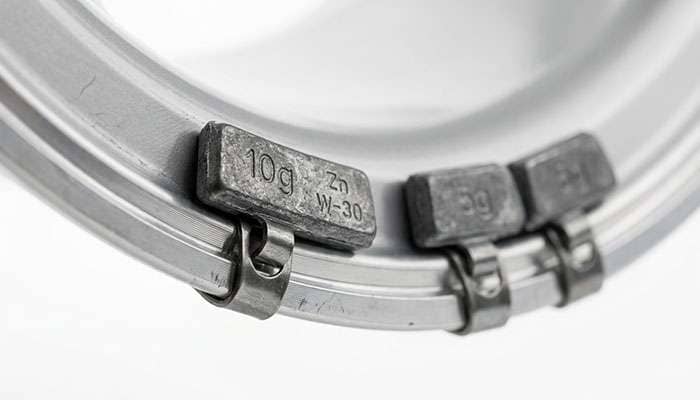
The industry tolerance for residual imbalance after correction is 0.25 ounces. That's the spec a calibrated machine targets. Better operators run tighter — many premium shops won't release a wheel above 0.10 ounces. Worse operators accept whatever the machine spits out. Counterweights come as adhesive strips inside the rim or clip-on weights at the rim flange, in 0.25 oz increments typically. For more on what the weights themselves look like, see our complete guide to wheel weights.
Production-volume mounting and balancing at a warehouse follows a standardized sequence. The tire gets mounted to the wheel using a tire machine — typically with the wheel mounted hub-down, the bead lubricated, and the tire seated to a specified pressure (usually 35 to 45 PSI for the bead seat, then adjusted to vehicle spec). The valve stem gets installed if not already present, and TPMS sensors are installed and verified if the package includes them.
Once mounted, the assembly goes onto a balancer. The technician selects the wheel type (steel vs. alloy, conventional vs. low-profile), enters the wheel diameter and width, and spins the assembly at production speed (typically 200 to 250 RPM, simulating roughly 50 mph). The machine reads imbalance and displays the recommended counterweight placement and amount. The technician applies the weights, re-spins to verify the assembly is now within spec, and the package moves to the shipping line.
That's the standard procedure. The variables that affect quality are: which type of balancer was used (basic spin vs. road force), how strict the tolerance setting is (0.25 oz vs. 0.10 oz), whether the technician verified after applying weights, and whether the wheels were match-mounted to the tires for runout. Each of those steps changes the final result. Costs at a retail shop run $15 to $30 per wheel for standard balance and $40 to $80 per wheel for road force — see our breakdown of mounting and balancing costs for the details.
Three procedures get used in the industry. Each catches different problems, and the difference matters more on larger diameters and stiffer-sidewall tires.
Standard spin balance measures mass distribution. The machine spins the assembly at production speed and identifies where the heavy spots are. It corrects for static and dynamic imbalance by specifying counterweights. It does not measure tire stiffness variation — only mass. A wheel that's mass-balanced can still vibrate if the tire has uneven sidewall stiffness or radial runout, because those create force variation the spin balancer doesn't see.
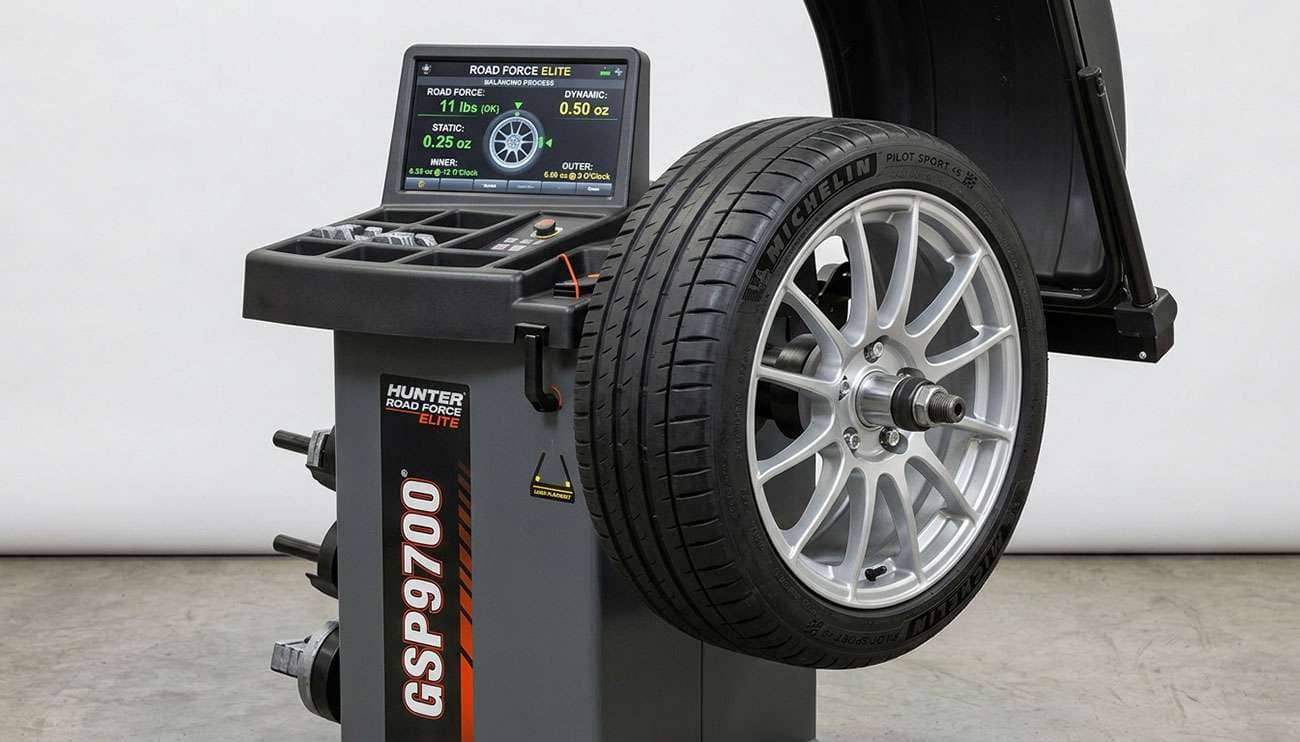
Road force balance uses a Hunter GSP9700 or similar machine that loads the assembly against a roller while spinning it, simulating actual road conditions. The machine measures both mass imbalance (same as spin balance) and force variation — the variation in the tire's resistance to compression as it rotates. Force variation under 25 pounds is industry-standard for an acceptable assembly. Premium shops target under 18 pounds. A road-force balancer can also indicate which way to rotate the tire on the wheel to minimize force variation, which is what match-mounting refers to.
Match-mounting uses the road force data to physically rotate the tire on the wheel so that the tire's high spot aligns with the wheel's low spot. This nets the two variations against each other and reduces total runout. Match-mounting is typically reserved for premium packages, larger diameter wheels (20" and up), and customers who paid for road force service. It adds 15 to 20 minutes per wheel but produces the smoothest possible result. Our essential balancing guide walks through the technique in more detail.
Here's how the three approaches compare:
Procedure |
Standard Spin Balance |
Road Force Balance |
Match-Mounting |
|---|---|---|---|
What it measures |
Mass distribution only |
Mass + force variation under load |
Road force, then physically rotates tire to minimize |
Catches mass imbalance |
Yes |
Yes |
Yes |
Catches sidewall stiffness variation |
No |
Yes |
Yes, and corrects it |
Catches radial runout |
No |
Yes |
Yes, and corrects it |
Typical tolerance |
0.25 oz residual |
0.25 oz + under 25 lbs road force |
0.10 oz + under 18 lbs road force |
Time per wheel |
5–8 minutes |
10–15 minutes |
20–30 minutes |
Retail cost (per wheel) |
$15–$30 |
$40–$60 |
$60–$80 |
When it's used on packages |
Default for most packages under 19" |
Larger wheels, premium tier, on request |
Premium, large diameter, performance applications |
When the package arrives, do a visual inspection before bolting anything on. Check four things on every wheel.
Confirm wheel weights are present. Look at both the inside and outside of the rim flange. You should see either clip-on weights at the rim edge or adhesive strips on the inner barrel. Some balanced assemblies will have weights only on the inner side (modern alloy wheels often hide them inboard for aesthetics), but they should not have zero weights on a freshly balanced assembly. A perfectly balanced fresh assembly with no weights at all is statistically improbable — more likely the balance step got skipped.
Check that weights are firmly attached. Adhesive weights should be flush against the rim with no peeling edges. Clip-on weights should be tight against the flange. A loose weight will shift or come off during the first drive, and your now-balanced assembly will be out of spec by the second mile.
Verify the tire pressure. Packages typically ship at 35 to 40 PSI for transport stability. Adjust to your vehicle's door placard spec before driving. Wrong pressure changes the tire's effective mass distribution and can mask or create vibration the balancer didn't see.
Inspect for shipping damage. Look for curb-style scuffs, gouges in the rim, sidewall punctures, or signs the assembly took an impact. Damage that occurred after balancing will show up as vibration even though the original balance was correct. Reputable retailers will replace damaged assemblies — but only if you catch it before installation.
Even a properly balanced package can drift out of spec during shipping. Three things cause this in practice. Long-haul vibration during transit can loosen adhesive weights or shift them slightly off their original position. Temperature swings during transport — a package leaves a warehouse in California at 80 degrees and arrives in Minnesota at 20 degrees — affect adhesive bond strength on stick-on weights. Pressure changes during altitude transitions can create temporary bead seat shifts that resolve with the first 50 miles of driving.
The result is that a package balanced to 0.10 oz at the warehouse might measure 0.30 oz when you put it on the vehicle. Most of the time it's fine — small enough that you won't feel it. Sometimes it's not. If you feel any vibration in the steering wheel or seat at highway speeds (typically 55 to 75 mph) within the first 100 miles, the assembly needs to be re-balanced. Don't drive on it for thousands of miles hoping it goes away. Vibration causes uneven tire wear that becomes permanent and can't be corrected by later balancing.
This is one of the reasons our breakdown on why pre-mounted packages save money notes that the labor savings include the warehouse balance, but a rebalance after install is sometimes still appropriate for premium applications.
After installation, two checks should happen at the 50 to 100 mile mark. The first is a lug nut re-torque. New aluminum wheels and new lug nuts can settle slightly during the first heat cycles, which can lower torque by 10 to 15 ft-lbs from the original spec. Re-torquing to the manufacturer's spec (typically 80 to 140 ft-lbs depending on the vehicle) prevents wheel loosening and shaft fatigue.
The second check is a balance verification — but only if you're feeling vibration. If the ride is smooth at all speeds, the warehouse balance is holding and no rebalance is needed. If you feel vibration, get the assembly road-force balanced (not just spin balanced) at a shop with the right equipment. Road force will catch what standard spin balance missed and identify whether the issue is mass imbalance or force variation. For a deeper look at how balancing fits with other maintenance, see tire alignment vs. rotation vs. balancing.
Some signs warrant an immediate rebalance, not waiting for the 50-mile check. Vibration at a specific speed range (typically 55 to 65 mph) that disappears above and below indicates a balance issue. A steering wheel oscillation or "shimmy" that increases with speed is almost always front-axle imbalance. Visible weights that came off (you can see the adhesive residue but no weight) need replacement immediately. Any side-pull or steering drift that wasn't there before the new wheels could be a balance issue or could be alignment — get it checked either way before extended driving.
For a deeper look at what balancing actually accomplishes mechanically, see our breakdown of what tire balancing does and why ignoring imbalance creates compounding problems.
Wheel and tire packages from established retailers ship balanced. The procedure is real, the equipment is calibrated, and the tolerances are within industry spec. What varies is the balance procedure used (spin vs. road force vs. match-mounting), how strictly the tolerance is set, and whether shipping conditions disturbed the result before the package reached you. Verify on arrival, recheck at 50 to 100 miles, and rebalance immediately if you feel vibration. Done right, a packaged set should drive as smoothly as anything you'd get installed at a top-tier shop.
Yes — packages from established retailers ship pre-mounted and pre-balanced using calibrated equipment. Wheel weights are applied during the balance procedure, and the assembly is verified within industry tolerance (0.25 oz residual imbalance) before packaging. The balance is real, not a marketing claim, but the procedure quality varies by retailer and equipment.
Only if you feel vibration. A properly balanced package that arrived intact and was installed correctly should drive smoothly without immediate rebalancing. If you feel any steering wheel oscillation or seat vibration at highway speeds in the first 100 miles, get the assembly road-force balanced. For larger wheels (20+ inches) or performance applications, some buyers proactively road-force balance after install for the smoothest possible result.
Standard spin balance measures mass distribution only. Road force balance also measures force variation — how the tire's stiffness varies as it rotates under load. Spin balance can leave a wheel that's mass-balanced but still vibrates because the tire has uneven sidewall stiffness or radial runout. Road force catches both. Most packages under 19 inches use spin balance; larger diameters and premium tiers often use road force.
Look for wheel weights on each rim — clip-on weights at the rim flange or adhesive weights on the inner barrel. A freshly balanced assembly typically needs at least some weight to correct for natural manufacturing variation. A wheel with zero weights anywhere is suspicious — either the assembly was perfectly balanced from the factory (statistically rare) or the balance step got skipped.
First check that lug nuts are torqued correctly to your vehicle spec, that tire pressure matches the door placard, and that no weights came off during shipping (look for adhesive residue with no weight). If those are good and vibration persists, take the assembly to a shop with road-force balancing equipment. Standard spin rebalance may not fix the issue if the cause is force variation rather than mass imbalance.
Yes — TPMS sensors are part of the rotating mass and must be installed before balancing. A reputable warehouse installs sensors first, then balances the complete assembly with sensors in place. If you add sensors later, the balance is no longer accurate and the assembly should be re-balanced. Always confirm with the retailer whether sensors are pre-installed and balanced into the package.



